#FAIR alignment: #PIDs matter 🔗

60% of @helmholtz data professionals regularly assign persistent identifiers (PIDs) to data – making it citable!

Let's make data findable!

📊 Dashboard: https://2024.dashboard.survey.helmholtz-metadaten.de
📔 Report: https://doi.org/10.3289/HMC_publ_08

#HMCsurvey #HMCrocks #FAIR

@HelmholtzOpenScienceOffice @HelmholtzImaging @hzbde

Nach der LMU München startet nun auch die TU Dortmund in die Implementierungsphase der Praxisorientierten Leitlinien für Lieferanten von DataCite DOI-#Metadaten

Ziel ist es, den Metadatenaustausch zwischen den dSPACE-Repositorien der TU und DataCite nachhaltig zu verbessern.

Die Pilotierung zeigt exemplarisch, wie sich Leitlinienempfehlungen mit der Weiterentwicklung zentraler #OpenSource Infrastruktur verbinden lassen

#PIDs #OpenScience @dspacetweets @datacite

📣 The PIDfest 2026 call for proposals is open!

PIDfest brings together the global persistent identifier (PIDs) community to exchange ideas, share experiences, and explore how PIDs strengthen research infrastructure and support connected, open research.

🗓 Submission deadline: 22 March 2026
📅 Conference dates: 27–29 October 2026
📍 Leiden, Netherlands

More information and proposal submission: https://www.pidfest.org/pidfest-2026/call-for-proposals-2026

#PIDs #PersistentIdentifier #PIDNetwork #PIDfest #OpenScience

How do we preserve access when the average URL breaks in just 100 days?

Join us for next week's #DPClinic on 17 March to explore ARK persistent identifiers with @jakkbl John Kunze (Drexel University) and discover a more flexible and inclusive approach to persistent linking.

More info: https://www.dpconline.org/events/eventdetail/680/-/dpclinic-march-ark-persistent-identifiers

Open to all 😊
#DigitalPreservation #Coalition #DPC #clinic #sharingknowledge #digipres #ARK #PIDs #GLAM

Missed the Love Data Week deep dive with DataCite and ORCID? Learn how both organizations help auto-update your record, connect your research outputs, and boost visibility.
Watch the recording and explore the slides: https://doi.org/10.5438/z5vn-gm49

#LoveDataWeek #OpenResearch #OpenScience #OpenInfrastructure #PersistentIdentifier #PIDs @ORCID_Org @pmarrai

Les identifiants persistants dans le schéma de métadonnées Datacite : recommandations du
consortium français

https://hal.science/hal-05533028v2

#datacite
#pids

Persistent identifiers in the Datacite metadata schema: recommendations from the French consortium

This document was produced by a working group of the French DataCite consortium led by INIST-CNRS. It complements those produced by the consortium's other working groups (Metadata, Scope, Economic Model, Media, Awareness and Training, and Communication). The aim is to provide some guidelines on the choice of persistent identifiers that can be declared when creating DOIs in DataCite and associated metadata. It is intended for publication managers, particularly repository managers. These recommendations are only indicative, as the landscape of persistent identifiers for research is constantly evolving. They are aligned with those of the MESRE (Ministry of Higher Education, Research, and Space) regarding persistent identifiers.

No shortcuts to research information citizenship, by Simon Porter at Digital Science

> Over the past decade, the research community has become increasingly comfortable using the language of openness. We talk about open science, open infrastructure, open metadata and open knowledge graphs. But openness, like citizenship, is not something that can be claimed by declaration alone. It is something that must be earned, maintained, and continually renewed.

https://www.digital-science.com/blog/2026/02/no-shortcuts-to-research-information-citizenship/

#pids
#openalex

No shortcuts to research information citizenship - Digital Science

Being open isn't enough - true "research information citizenship" requires a robust, genuinely open research infrastructure.

Digital Science

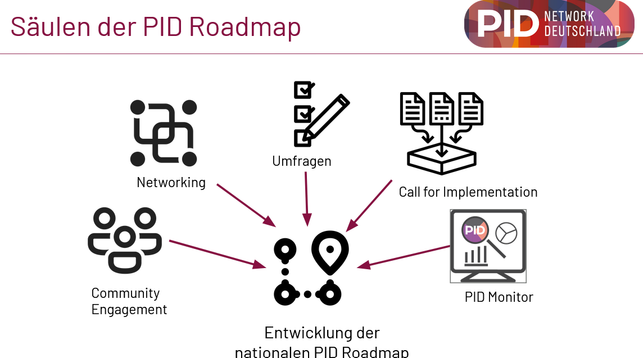
Gestern haben wir an der #RDA DE Konferenz teilgenommen, um die zentrale Rolle von #PIDs bei der Schaffung einer FAIREN Forschungslandschaft zu diskutieren. Der Austausch macht deutlich: Eine robuste PID-Infrastruktur ist das Rückgrat von #FDM & #OpenScience.

👉 Zum Projekt: pid-network.de
👉 Zum Poster: https://doi.org/10.5281/zenodo.16636358

@datacite @tibhannover @HelmholtzOpenScienceOffice @unibielefeld @DNB_Aktuelles

Yesterday, we joined the #RDADE26 conference to discuss the vital role of #PIDs in creating a seamless research landscape.

The exchange with the RDA community once again highlighted that a robust PID infrastructure is the backbone of #OpenScience.

👉 https://pid.services.base4nfdi.de/

Really looking forward to our #CopimConference to kick off later this week!

On Day 2, I'll be chairing a session on

Metadata, dissemination challenges & open community solutions for open access books

and will be welcoming panelists @EmmaE_B , Edgar Garcia Valencia, and Harrison W. Inefuku.

Emma, Edgar, and Harrison will be sharing perspectives of a library, an infrastructure researcher, and a library publisher, on the varied issues related to book #metadata and #dissemination - perspectives that will touch upon questions such as “What is a book?”, and discuss issues of ingest pipelines and adoption of #PIDs and controlled vocabularies in the books space.

Panellists will also seek to touch upon the benefits of, and potential barriers to, establishing practical, community-led solutions that make #OAbooks findable and re-usable within as well as outside of library systems.

Intrigued? Find out more here https://copim.pub/join-us-for-the-copim-conference-2026-exploring-the-future-of-community-led-open-access-books/