https://wp.me/p2yJaA-2Iy
#London #LondonEngland #England #UK #UnitedKingdom
#museum #BritishMuseum #History #AinSakhriLovers #archaeology #Natufian
#travel #travelling #traveling #travelphotography #tourism
#JBinnacle
A #Natufian figurine, 12,000 years old, of a woman with a goose perched on her back, both red-ochred.
But some rather stupid statements in this on 'early settled communities were already engaging in symbolic expression long before such traditions became common in the Neolithic'. Does the author not know Palaeolithic communities all over the world were?!
No way this whole #Neolithic research stuff will ever get boring. Just look at this fantastic little clay #figurine from Nahal Ein Gev II (modern Israel), conveying a 12,000 years old #natufian story …
https://phys.org/news/2025-11-woman-goose-year-glimpse-prehistoric.html via @physorg
A 12,000-year-old clay figurine unearthed in northern Israel, depicting a woman and a goose, is the earliest known human-animal interaction figurine. Found at the Late Natufian site of Nahal Ein Gev II, the piece predates the Neolithic and signals a turning point in artistic and spiritual expression. Combining naturalism, light manipulation, and symbolic imagination, it reveals how early communities used art to explore the relationship between humans and the natural world.
Advanced Stone Age architecture in the Near East: new study rewrites archaeological history
Traditional theories about the origins of building in the Near East have been overturned by a landmark study, which shows that advanced building techniques and diverse architectural forms emerged much earlier than previously thought—dating back to the Natufian period (15,000–8,500 years ago)...
More info: https://archaeologymag.com/2024/12/advanced-stone-age-architecture-in-near-east/
Follow @archaeology
And round and round it goes ...
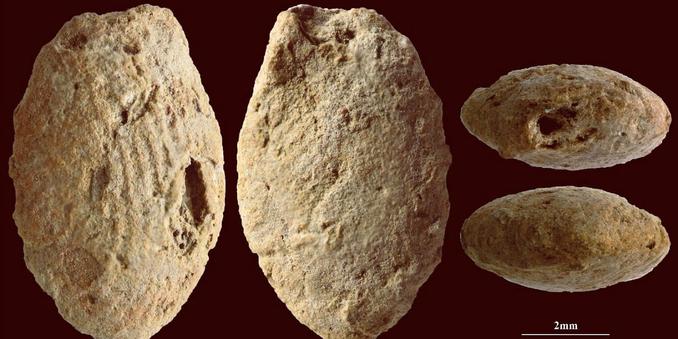
Stones with holes or spindle whorls? - Do these perforated pebbles from 12,000 y/o #Natufian Nahal Ein-Gev II (Israel) anticipate wheeled rotational technologies right there in the #Neolithization of the Southern Levant?
https://journals.plos.org/plosone/article?id=10.1371/journal.pone.0312007 by Talia Yashuv & Leore Grosman in PLoS ONE 19(11), 2024. 🔓
‘The wheel and axle’ revolutionized human technological history by transforming linear to rotary motion and causing parts of devices to move. While its ancient origins are commonly associated with the appearance of carts during the Bronze Age, we focus on much earlier wheel-shaped find–an exceptional assemblage of over a hundred perforated pebbles from the 12,000-year-old Natufian village of Nahal Ein-Gev II, Israel. We analyze the assemblage using 3D methodologies, incorporating novel study applications to both the pebbles and their perforations and explore the functional implications. We conclude that these items could have served as spindle whorls to spin fibres. In a cumulative evolutionary trend, they manifest early phases of the development of rotational technologies by laying the mechanical principle of the wheel and axle. All in all, it reflects on the technological innovations that played an important part in the Neolithization processes of the Southern Levant.
Nice marketing idea, #TurkishAirlines - but I guess, the #Natufian hunters from #Shubayqa would like to have a word. 😆😂