The ignominious end of HMS Caledonia: the thread about how the Navy’s longest ship ended up as scrap metal on the Forth seabed
This thread was originally written and published in August 2023.
Q. What was the largest ship in the Royal Navy at the outbreak of WW2?
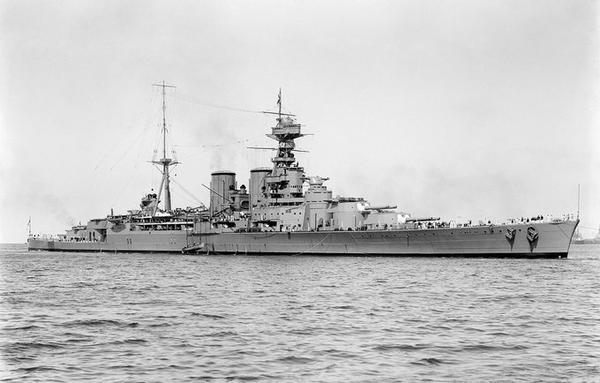
A. As any respectable naval anorak knows, it was the 47,000t, 860ft long battleship HMS Hood, the “Mighty Hood“, pride of the fleet and largest warship afloat. Right? Or… was it the Bismarck?
HMS Hood, 1924, Allan C. Green photo
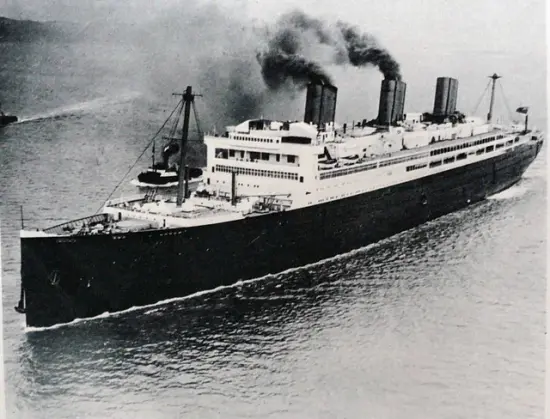
No, the largest ship in the Royal Navy at the outbreak of WW2 was the 56,500t, 956-ft long training ship HMS Caledonia; until 1936 the Cunard-White Star liner RMS Majestic, which until 1922 had been the Hamburg-Amerika liner SS Bismarck. Until 1935, the largest ship in the world
HMS Caledonia, 1937, en route from Southampton to Rosyth
The Bismarck was the 3rd and largest of three Hamburg-Amerika liners built immediately prior to WW1; the others were the Vaterland and Imperator. They were ordered to reclaim dominance and German national pride in the Transatlantic liner stakes from the British Cunard and White Star liners. They were to do this by being both the largest and grandest liners afloat. Bismarck was the last of the trio but before she was laid down, the Hamburg-Amerika line found out that the new Cunard liner Aquitania was to be longer than her, so they hastily rejigged the design to add an extra 6 feet on. They needn’t had bothered, they had made been misinformed and Aquitania actually ended up being 50ft shorter than Bismarck.
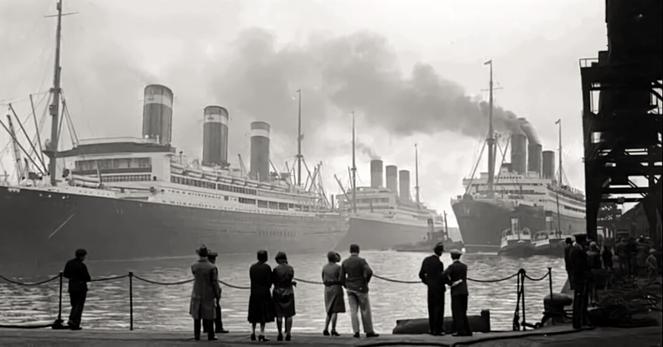
Majestic (ex-Bismarck, background) with her sisters the Cunard line’s Berengaria on the right (ex-Imperator) and United States Line’s Leviathan (ex-Vaterland) in the foreground
It was too late to change the design however and it was too late for her sister Imperator, which had been given the most embarrassingly awful nose job to lengthen her by the vainglorious addition of a massive bronze eagle figurehead which was meant to make her 1ft longer than Aquitania. Fortunately for her appearance this partially fell off during Atlantic storms within a year, and was removed.
The bronze figurehead on Imperator
Bismarck was launched in June 1914 by a granddaughter of the Iron Chancellor, but this ceremony was jinxed when she fluffed the swinging of the champagne bottle and it only broke on the second attempt: none other than Kaiser Wilhelm II stepped in to give it his best swing. The outbreak of war found her without a purpose, and construction ground to a halt beyond maintenance work. During the war she was stripped of valuable components, wiring and piping and all her brass and copper. The incomplete hulk was ceded to Britain under the Treaty of Versailles as reparations for the loss of the White Star liner Britannic (sister of Titanic), which had struck a German mine and sunk in 1916 while serving as a hospital ship. This was the largest ship lost in the war, but although she sank in just 55 minutes, all but 30 souls on board were saved. Her sister Imperator went to Cunard as a replacement for the Lusitania, the ill-fated liner whose sinking had outraged America and helped drag that nation into the war against Germany.
Hospital ship HMHS Britannic during World War I
White Star sent representatives and shipyard engineers from Harland & Wolff in Belfast to Hamburg to supervise completion of their new possession. The whole ship needed re-wiring, and a mysterious fire that damaged her during completion and which the British put down to sabotage by the German workers was probably an electrical fault: this would be a recurrent theme. She completed in March 1922 and White Star officers were sent to supervise her trials by officers and men of Hamburg-Amerika line. This was marred by briefly running aground, but after a week she was accepted and handed over. Her German name was painted out and replaced with Majestic.
Majestic at New York shortly after her acquisition by White Star Line
A White Star crew arrived and sailed her to Southampton, during which time they repainted her funnels into company colours. She arrived exactly 10 years to the day that the Titanic had departed on her ill-fated maiden voyage. Not only the largest in the world, she was arguably the most opulent, designed by the French architect Charles Mewès. Her German builders had trunked the boiler uptakes around the ships sides (rather than through the centre), to allow for huge, uninterrupted interior spaces, and spared no expense on the specification
First class entrance foyer on the Majestic
Despite being a foreigner in a time when ocean liners were a symbol of national prestige, she was made White Star flagship and was the pride of the fleet. Her first official duties were to be inspected by King George V and Queen Mary, before heading for New York. She settled down to a glamorous 1920s career on the Atlantic, but one that was always marred by the occasional spontaneous fire in her electrical system, and growing cracks in her decks (which grew to 100ft long) as a result of the lengthening job.
White Star service poster for Majestic; “The World’s Largest Ship”
The Depression hit the Transatlantic liners hard, already struggling from a downturn in migrating passengers, and in White Star’s case, poor corporate management. The Majestic frequently found herself on “booze cruises” from a very dry and thirsty Prohibition-era USA to help pay her huge running costs. But the cracks grew bigger, the electrical fires got more frequent and the finances grew ever worse. Cunard and White Star line merged in 1934 in a government-sponsored deal. The new company had too many liners and the older ones began to be disposed of; Majestic survived the initial chop, but her card was marked.
With the new company flagship Queen Mary under construction, Cunard-White Star made to dispose of the sister ship Berengaria, which was older and more prone to fires, but the larger Majestic had higher running costs so in 1936 was taken out of service instead.
RMS Queen Mary under construction at John Brown’s yard at Clydebank, c. 1934
She quietly sailed her last voyage in February that year and disappeared from the schedules without any announcement on her future. In May she was bought by Thomas Ward of Inverkeithing for £115k (c. £6.6m in 2023), the scrapyard where many a liner and battleship ended its days.
Announcement of the last sailing of the Majestic, Birmingham Gazette, 14th February 1936
Majestic was taken into dock at Southampton to have her funnels and masts lowered to allow her to sneak beneath the Forth Bridge, but there was a snag – the minor matter of fine legal print of the Treaty of Versailles. Bismarck had been handed over as a prize of war as compensation to White Star, but the terms did not allow the new owner to sell her. Instead, the Royal Navy stepped in and took possession, and “gave” Wards 24 old destroyers of equivalent scrap value in return. Everyone was happy. The lawyers were happy. Cunard-White Star got paid by Wards, Wards got the scrap they had paid for and the Royal Navy got what had been – until 6 months previous – the largest ship in the world, for the price of only a few old rusty relics.
Majestic in the King George V Dry Dock in Southampton having had her funnels and masts shortened
The great liner was now taken in for conversion to an enormous training ship, with capacity for 1500 trainee boys and 500 officer apprentices. Her luxurious fittings – apart from the swimming pool – were stripped out, and the vast interior converted to spartan classrooms. Where once her passengers slept in the most luxurious cabins afloat, the new occupants would sling hammocks from the roof beams in time-honoured Royal Navy tradition. In April 1937 she made her last sea voyage, to Rosyth on the Firth of Forth.
The Majestic passing under the Forth Bridge in April 1937 en route to commissioning as into the Royal Navy
On arrival, she commissioned as HMS Caledonia, named after the Victorian training ship that had once served on the Forth under that name. Her job was to train the boys and young men who would fill the ranks of the expanding Royal Navy in the run up to the inevitable war. By the end of the year there were 1,000 trainees aboard.
The training ship HMS Caledonia on the Forth in 1898, an old battleship built in 1810 as HMS Impregnable.
The new Caledonia only had an expected lifespan of 4 years, she was to plug the gaps until permanent shore facilities could take over; but she didn’t even make this. On the outbreak of war there was a panic that the Luftwaffe would target her for a revenge sinking. This was not without reason and the first air raids over the United Kingdom during the war soon followed over the Forth with the Royal Navy and Rosyth being the target. And so the trainee boys onboard were packed off to safety in the Isle of Man, the officer apprentices were sent ashore at Rosyth, and the great ship was floated out into the Forth and pumped full of water so she would settle on the sea bed at low tide (therefore couldn’t be “sunk”), to await her fate, or another use.
However the proud old ship had other ideas. Just 26 days after war was declared and a full 17 days before the Luftwaffe arrived over the Forth, she set herself on fire and burnt out, settling on to the bed of the Firth. Her shonky electrical system had the last laugh. With the country now at war with Germany, the niceties of previous treaties could be overlooked, and she was sold to Wards of Inverkeithing – again, for mining as a strategic reserve of scrap iron. She was demolished in situ from 1940-43.
In July 1943, what remained of the hull was patched up and floated around the corner to Inverkeithing, for beaching and final break-up by Wards. This was completed in 1944, her name transferred to a shore station at Oban.
The remains of Majestic being scrapped at Inverkeithing in 1943-44. IWM A 25218
After the war, the name was relocated back to Rosyth, where it was a shore training establishment until 1985. It was rehabilitated again at Rosyth in 1996, where it remains to this day, the Navy’s HQ in Scotland and Northern Ireland. The HMS Caledonia which was once the liner RMS Majestic remains the longest ship to have ever commissioned into the Royal Navy, a full 24ft longer than the modern Queen Elizabeth aircraft carriers. With her loss in 1939, the battleship HMS Hood would regain her crown as the largest ship in the Navy. In a sardonic twist of fate, Hood would be sunk in May 1941 by a German ship named Bismarck – with great loss of life.
German naval photo of the sinking of HMS Hood. Bundesarchiv, Bild 146-1998-035-05 / Lagemann / CC-BY-SA 3.0
If you have found this useful, informative or amusing, perhaps you would like to help contribute towards the running costs of this site – including keeping it ad-free and my book-buying budget to find further stories to bring you – by supporting me on ko-fi. Or please do just share this post on social media or amongst friends.
Explore Threadinburgh by map:
Travelers' Map is loading...
If you see this after your page is loaded completely, leafletJS files are missing.
These threads © 2017-2026, Andy Arthur.
NO AI TRAINING: Any use of the contents of this website to “train” generative artificial intelligence (AI) technologies to generate text is expressly prohibited. The author reserves all rights to license uses of this work for generative AI training and development of machine learning language models.
#Lochend #Logan #Restalrig #StMargaret Jon PENNYCOOK
 DrImplausible
 Björn Müller
 Andy Arthur - Threadinburgh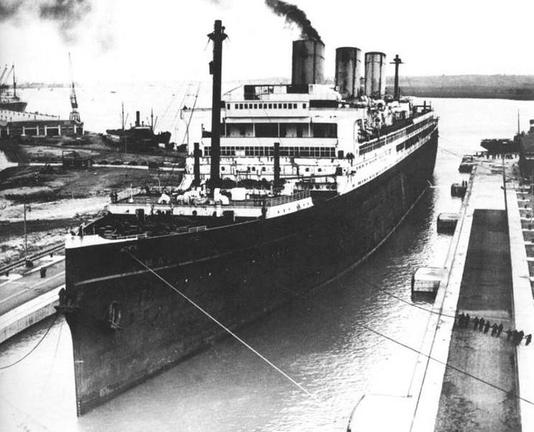
 karibu
 JohnM
JohnM
 Billwill
 The Times Of India
 Home ━ The European Conservative