Akanthomyces aculeatus

https://www.mushroomexpert.com/Akanthomyces_aculeatus.html

Ecology: Parasitic on adult moths; summer and fall, or over winter in warm climates; apparently fairly rare; distribution uncertain, but in North America fairly widely distributed east of the Rocky Mountains. The illustrated and described collections are from Maryland and Minnesota.

Fruiting Body: At first a mat of dull yellow material, covering the body of a moth (often binding it to the substrate below it), with a bald surface; bumpy projections emerging and extending into cylindric or club-shaped, individual extensions (synnema) that then extend further, becoming spear-shaped and measuring 8-15 mm x 0.5-1 mm; surface dull, pale yellow, bald at first but becoming dusted with powder with maturity.

Microscopic Features: Conidia 2.5-3 x 2 m; broadly ellipsoid before germination; smooth; hyaline in KOH. Tramal hyphae 1.5-3 m wide, smooth, moderately thick-walled (walls to 0.5 m); hyaline to golden yellow in KOH. Phialides arising in a palisade, perpendicular to tramal hyphae; up to about 15 x 5 m; septate; cylindric to clavate or subfusiform; 1-sterigmate; smooth; hyaline in KOH.

#mushrooms #fungi #mycology #shrooms #mushtodon #sporespondence #floraspondence

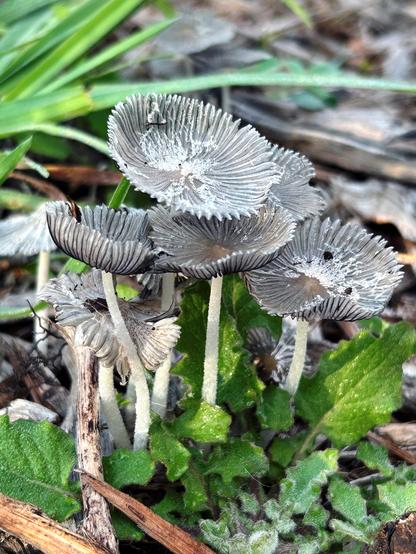
A cluster of hare's foot inkcaps (𝘊𝘰𝘱𝘳𝘪𝘯𝘰𝘱𝘴𝘪𝘴 𝘭𝘢𝘨𝘰𝘱𝘶𝘴) from last September:

#MushroomMonday #Mushtodon #mushrooms #fungi #inkcaps

Russula ochroleucoides

https://www.mushroomexpert.com/Russula_ochroleucoides.html

Ecology: Mycorrhizal with white oak and with beech; growing alone, scattered, or gregariously; summer and fall; widely distributed in eastern North America. The illustrated and described collections were made in Illinois.

Cap: 4-10 cm; convex, becoming broadly convex to flat, or shallowly depressed; firm and hard, at least when young and fresh; dry; bald or very finely velvety; with maturity often developing a network of cracks and fissures, especially over the center; when young and very fresh bright yellow marginally and pinkish orange centrally--but usually bright yellow to pale or very pale yellow when collected, with pink hints sometimes persisting over the cracked center; the margin not lined; the skin quite adnate and not peeling away easily.

Gills: Broadly attached to the stem; close or nearly crowded; often forked near the stem; short-gills infrequent; white, becoming creamy with age; usually bruising yellowish, then slowly brown to reddish brown; usually developing brownish spots and discolorations with age.

Stem: 2-6 cm long; 1-2 cm thick; more or less equal; bald; whitish; bruising and discoloring yellowish, then slowly brown.

Flesh: White; unchanging when sliced; quite firm when fresh.

Odor and Taste: Odor not distinctive, or faintly fragrant; taste usually oily and somewhat bitter or acrid, but occasionally not distinctive in older specimens.

Dried Specimens: The gills dry brownish yellow, as in Russula flavisiccans.

Chemical Reactions: KOH on cap surface negative to orangish. Iron salts slowly pink (wait 10-15 minutes) on stem surface.

Spore Print: White or creamy.

Microscopic Features: Spores 6-8 x 5-7 ; subglobose or broadly ellipsoid; with amyloid warts that project less than 0.5 , and connectors forming partially reticulate areas. Pleurocystidia 60-90 x 7-10 ; subfusiform. Pileipellis a cutis underneath a turf-like layer of erect elements, hyaline in KOH, with rounded to subacute apices; some elements with thick walls; pileocystidia up to about <NOBR>140 x 8 ,</NOBR> clavate to cylindric, positive in sulphovanillin and with refractive-ochraceous contents in KOH.

#mushrooms #fungi #mycology #shrooms #mushtodon #sporespondence #floraspondence

Lycoperdon umbrinum

https://www.mushroomexpert.com/Lycoperdon_umbrinum.html

Ecology: Saprobic; growing alone, scattered, or gregariously; in woods under conifers; summer and fall, or over winter and in spring in warmer climates; widely distributed in North America. The illustrated and described collections are from Illinois and Colorado.

Fruiting Body: 3-7 cm high; 3-8 cm wide; usually pear-shaped; covered, especially on the top, with small (up to 1 mm) spines that protrude individually or aggregate at their tips; surface underneath spines usually visible, smooth and shiny or very slightly pitted where spines have fallen off; sometimes pale at first but usually darkening to brown or dark brown from the top downward; skin thin and papery; interior at first white, then turning into brown spore dust, with whitish to brownish flesh in a well-developed sterile base; base attached to white rhizomorphs.

Microscopic Features: Spores 3.5-5 ; globose; smooth or very finely spiny (hard to see with light microscopy); olive yellow in KOH. Capillitial threads olive yellow in KOH; 3-5 m wide; walls under 0.5 microns thick.

#mushrooms #fungi #mycology #shrooms #mushtodon #sporespondence #floraspondence

Hymenopellis furfuracea

https://www.mushroomexpert.com/Hymenopellis_furfuracea.html

Ecology: Saprobic on the deadwood of hardwoods; occasionally growing directly from very well decayed logs and stumps, but more commonly attached to buried deadwood near stumps, appearing terrestrial; late spring through fall; apparently widely distributed east of the Rocky Mountains. The illustrated and described collections are from Illinois, Kentucky, and Tennessee.

Cap: 1.5-12 cm; bell-shaped or occasionally convex when young, becoming broadly convex to broadly bell-shaped or nearly flat in age; bald; smooth or, more often, moderately to prominently radially wrinkled and puckered (over the center when young and later nearly overall); sticky to greasy when fresh; dark brown to grayish brown or yellow-brown, but not infrequently fading to brownish or buff; the margin incurved when young, sometimes uplifted in maturity, not lined.

Gills: Broadly attached to the stem, or notched at the point of attachment, with a tiny tooth that runs down the stem; close or almost distant; white to creamy; thick; short-gills frequent.

Stem: 4-16 cm long above ground; 0.5-2 cm thick; typically club-shaped when young and, later, tapering a little to apex; white and nearly bald near the apex (or, rarely, overall); brownish gray to brownish or brown and fibrillose to hairy below, with the brown areas often stretched into snakeskin or chevron patterns by maturity; with a long, tapered tap root extending up to 10 cm underground; the tap root sometimes bruising rusty brown.

Flesh: Whitish; unchanging when sliced.

Odor and Taste: Not distinctive.

Chemical Reactions: KOH on cap surface negative.

Dried Specimens: Gills of dried specimens become dingy yellowish to brownish or very pale orangish after several years in storage.

Spore Print: White.

Microscopic Features: Spores 12-18 x 9-12.5 ; ellipsoid to broadly ovoid; smooth; hyaline in KOH; inamyloid. Pleurocystidia widely cylindric; hyaline; to about 125 x 40 . Elements on lamellar edges often collapsed and gelatinized, but when differentiated, cheilocystidia narrowly to widely fusiform, or sometimes subcylindric; up to 100 x 13 . Pileipellis hymeniform and somewhat gelatinized; elements subglobose-irregular to pyriform; pileocystidia frequent, thin-walled, hyaline, up to 150 x 13 .

#mushrooms #fungi #mycology #shrooms #mushtodon #sporespondence #floraspondence

Xerocomus ferrugineus

https://www.mushroomexpert.com/Xerocomus_ferrugineus.html

Ecology: Mycorrhizal with spruces and other conifers--but also occasionally reported under hardwoods (especially those occurring in mixed conifer-hardwood forests) and shrubs; growing alone, scattered, or gregariously; summer and fall; widely distributed in northern and montane North America; widely distributed in Europe. The illustrated and described collections are from Colorado and Finland.

Cap: 4-9 cm; convex, becoming broadly convex; dry; finely velvety; usually olive brown to reddish brown or yellowish brown, but occasionally entirely olive or nearly green.

Pore Surface: Yellow, becoming olive yellow with maturity; not bruising, or bruising slowly bluish; pores xerocomoid, 1-2 mm wide; tubes to 10 mm deep.

Stem: 3-7 cm long; 1-2 cm thick; equal to slightly club-shaped, with a pinched off base; dry; solid and tough; widely and coarsely ribbed, over the apex or overall; whitish to yellowish or yellow; basal mycelium yellow.

Flesh: Whitish to pale yellowish; not staining when sliced, or turning pinkish in the cap.

Odor and Taste: Not distinctive.

Chemical Reactions: Ammonia flashing blue-green on cap, then resolving to reddish brown; negative on flesh. KOH dark red to black on cap; orangish on flesh. Iron salts negative to gray on cap; negative on flesh.

Spore Print: Olive to olive brown.

Microscopic Features: Spores 10-13 x 3-4.5 m; fusiform; smooth; yellowish in KOH. Hymenial cystidia 35-50 x 5-7.5 m; lageniform; thin-walled; smooth; hyaline in KOH; inconspicuous. Pileipellis a collapsing trichoderm; yellow in KOH; elements 5-7.5 m wide, smooth; terminal cells cylindric with rounded apices.

#mushrooms #fungi #mycology #shrooms #mushtodon #sporespondence #floraspondence

Entoloma serrulatum

https://www.mushroomexpert.com/Entoloma_serrulatum.html

Ecology: Saprobic; growing alone, scattered, or gregariously in woods, often in damp areas; occasionally fruiting from moss-covered wood; late summer and fall (or over winter on the West Coast); apparently widely distributed in North America. The illustrated and described collection is from a tanoak forest in California.

Cap: 1-3 cm; convex, becoming broadly convex or slightly depressed; radially fibrillose-silky or finely scaly, especially over the center; black to bluish black, fading to gray; the margin finely lined in age.

Gills: Attached to the stem; close; whitish or pale bluish gray at first, becoming pinkish; with black or bluish black edges; jagged; with frequent short-gills.

Stem: 2-4 cm long; 2-3 mm thick; equal; silky at the apex and bald below; hollow; colored like the cap; with white mycelium at the base.

Flesh: Thin; fragile; pale or grayish.

Odor and Taste: Mealy.

Spore Print: Pink.

Microscopic Features: Spores 9-13 x 6.5-8 ; 5- or 6-sided. Pleurocystidia absent. Cheilocystidia 40-65 x 10-13 ; cylindric with subclavate, clavate, or subcapitate apices. Lamellar edge sterile. Pileipellis a cutis with areas of uplifted or ascending, clavate terminal elements; dark brown to blackish in 10% ammonia; pigment intracellular. Clamp connections absent.

#mushrooms #fungi #mycology #shrooms #mushtodon #sporespondence #floraspondence

Tulostoma lloydii

https://www.mushroomexpert.com/Tulostoma_lloydii.html

Ecology: Presumably saprobic; growing alone, scattered, or gregariously in woods, or in waste places with woody debris and plant debris; summer and fall; east of the Great Plains.

Spore Case: 6-10 mm across; more or less round, with a flattened bottom when mature; outer skin dark, quickly sloughing away to reveal the paler, paper-like inner skin; underside socket-like and flattened, usually displaying the darker remains of the outer skin; developing a more or less apical, finely hairy opening that is initially surrounded by a somewhat raised area.

Spore Mass: Yellowish, becoming cinnamon brown and powdery with maturity.

Stem: 5-8 cm long and 2-4 mm thick; tough; dark brown to reddish brown; the surface breaking up into patches and zones as the stem grows; more or less equal above a bulbous base.

Microscopic Features: Spores 3.5-5 x 3.5-4 ; subglobose to broadly elliptical or sublacrymoid; smooth; ochraceous in KOH; often with a prominent apiculus. Capillitial threads hyaline to ochraceous in KOH; 3.5-11 wide; walls often thickened; often encrusted.

#mushrooms #fungi #mycology #shrooms #mushtodon #sporespondence #floraspondence

Gymnopus androsaceus

https://www.mushroomexpert.com/Gymnopus_androsaceus.html

Ecology: Saprobic; growing gregariously on the litter of conifers or, more rarely, hardwoods; summer and fall, or over winter in warm climates; originally described from Sweden; widespread in Europe and western Asia; in North America widely distributed but more common in montane and northern regions; also reported from South Africa. The illustrated and described collection is from Michigan.

Cap: 4-11 mm; convex, becoming broadly convex; dry; bald; pinkish brown to orangish brown or reddish brown, often fading so that the center is darker; broadly and shallowly grooved.

Gills: Broadly attached to the stem; distant; with a few short-gills; pinkish.

Stem: 2-7 cm long; up to 1 mm thick; equal; dry; wiry; dark reddish brown to black; with abundant black rhizomorphs attached to the base.

Flesh: Insubstantial; pale brownish; unchanging when sliced.

Odor and Taste: Not distinctive.

Spore Print: White.

Microscopic Features: Spores: 5-8 x 3.5-4.5 m; subellipsoid to elongated-lacrymoid; smooth; hyaline in KOH; inamyloid. Basidia 20-30 x 4-7 m; clavate; 4-sterigmate; basidioles fusiform to widely fusiform. Cheilocystidia as broom cells 10-20 x 6-8 m; clavate to subclavate or somewhat irregular; with numerous rodlike or coralloid projections 1-3 m long; thin-walled; hyaline in KOH. Pleurocystidia not found. Pileipellis of more or less cylindric elements mixed with coralloid, broom cell projections; elements smooth or encrusted in KOH; clamp connections present.

#mushrooms #fungi #mycology #shrooms #mushtodon #sporespondence #floraspondence