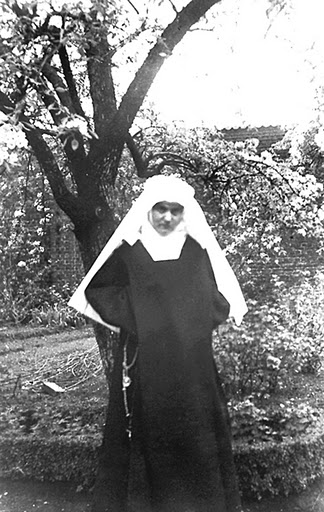
Quote of the Day, 17 January: St. Edith Stein

For a long while now I have hardly been able to do any work.

From the beginning of September until the middle of December, I took care of our good, eldest lay sister, Sr. Clara (cancer of the liver, as far as the doctors can tell). Then I got the office of turn-sister [portress], which means being a contact between the cloister and the outside world.

You can imagine that for this one needs a serviceable walking apparatus. I hope to be allowed to make my perpetual profession on April 21. Soon thereafter follows the Veiling Ceremony. That is, again, a big public celebration that the beloved baptismal sponsor [Hedwig Conrad-Martius] should not miss. Hopefully, the League of Academics will again cover the cost of travel.

We celebrated the 300th Jubilee Year of the Cologne Carmel for four days at the end of September/beginning of October. Our dear Mother wrote a beautiful commemorative booklet for the occasion. I believe you will receive it as a gift when you next visit us.

Do you know that Husserl’s health is very poor? This summer he suffered a severe recurrence of pleurisy and is not recovering well from it. Would you write to him sometime perhaps? They now live in Freiburg-Herdern, at Schöneck 6.

Saint Edith Stein

Letter 257 to Hedwig Conrad-Martius
17 January 1938

Note: In December 1937, Saint Edith Stein was appointed under obedience to the demanding office of Turn Sister (portress) at the Cologne Carmel—a role previously held by the sub-prioress. Responsible for daily provisions, communications at the grille, and the reception of guests, the office required tact, prudence, and discretion, virtues she exercised with notable charity and steadiness, in fidelity to the Constitutions of Saint Teresa of Avila.

Stein, E 1993, Self-Portrait in Letters, 1916-1942, Koeppel, J (trans.), ICS Publications, Washington DC.

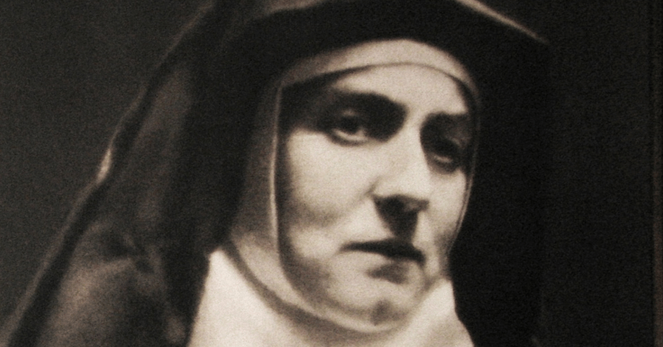
Featured image: Detailed image of Saint Edith Stein’s 1938 passport photo prepared for her travel to the Carmel of Echt in the Netherlands. Image credit: Discalced Carmelite (By permission).

#EdmundHusserl #jubileeYear #monasticLife #perpetualProfession #StEdithStein

🌱 Today’s #DailySutta:

SN 45.35 Paṭhamasāmaññasutta: The Ascetic Life (1st)

“Mendicants, I will teach you the ascetic life and the fruits of the ascetic life. …”

Read the sutta
📖 https://daily.readingfaithfully.org/sn-45-35-pathamasamannasutta-the-ascetic-life-1st-2/?=MDS

Get these by email
https://daily.readingfaithfully.org?=MSUDS

#MonasticLife #NobleEightfoldPath #StreamEntry #SamyuttaNikaya #Theravada #PaliCanon #RealBuddhaQuotes #Suttas #Dhamma #Buddhism #Buddha

Byzantine Monastic Complex Discovered in Upper Egypt Reveals Monks’ Way of Life.

Excavations in Sohag, Egypt, Uncover a Byzantine Residential Complex for Monks, Featuring a Church, Cells, Artifacts, and Coptic Inscriptions, Expanding Knowledge of Monastic Life in the Byzantine Period.

Read more: https://omniletters.com/byzantine-monastic-complex-discovered-upper-egypt-monks-life/

#ByzantineArchaeology #MonasticLife #UpperEgypt #Sohag #ByzantinePeriod #EarlyChristianity #CopticHeritage #ArchaeologicalDiscovery #AncientEgypt #archaeology

Byzantine Monastic Complex Discovered in Upper Egypt Reveals Monks’ Way of Life

Excavations in Sohag, Egypt, Uncover a Byzantine Residential Complex for Monks, Featuring a Church, Cells, Artifacts, and Coptic Inscriptions, Expanding Knowledge of Monastic Life in the Byzantine Period.

Omni Letters
Medieval monks endured brutal winters with no heat, except for one fire-lit room: the calefactory. Seen as spiritually valuable, cold shaped their lives, devotion — and architecture.
#MonasticLife #MedievalHistory #ColdSurvival #HistoryFacts #Storytelling #DidYouKnow #HistoryFacts #DocumentaryShort #WeirdHistory
Read more:https://www.ancient-origins.net/news-history-archaeology/medieval-monks-winter-00102435

Silence wasn’t just respected in medieval monasteries — it was enforced. 🤫

Communication ran on gesture, ritual, and discipline.

A whole society built around quiet order and spiritual focus.

#MedievalHistory #MonasticLife #SilentRule #Brewminate

https://brewminate.com/silence-gesture-and-discipline-regulated-speech-in-medieval-monastic-life/

Silence in Medieval Monastic Life

How medieval monks used regulated silence, gesture, and disciplined speech to shape communal life, spiritual focus, and the rhythms of monastic devotion.

Brewminate: A Bold Blend of News and Ideas

Quote of the day, 9 October: St. Elizabeth of the Trinity

We’re having a holiday in Carmel, for our elections took place yesterday [9 October].

Oh! if you knew how, in taking away our good Mother whom I loved so much, God has given me two others who are so good, so good! You see, it is delightful, and that makes me love still more this good Master who spoils His little one so much.

Our dear Mother Sub-Prioress was elected Prioress, and my good Angel, Sub-Prioress; this good news is really going to delight my dear little Mama, and I’ve been anxious to announce it to you.

Because of the elections, we’re having a free day, that is, we can have little visits with each other during the day. But, you see, the life of a Carmelite is silence, so she loves that above all!

Saint Elizabeth of the Trinity

Letter 97 to her sister Guite (excerpt)

Note: According to the Book of Elections of the Dijon Carmel, it was indeed “yesterday,” on October 9, 1901, that Mother Germaine of Jesus (who also held the office of Mistress of Novices) was elected Prioress and Sister Marie of the Trinity (who remained Elizabeth’s “Angel” during these first days), Sub-Prioress. The two religious, aged 31 and 26 respectively, bore the title “Mother” by virtue of their office. The prioress who was “taken away” from the community in Dijon was Mother Marie of Jesus, who became the founding prioress of the Carmel of Paray-le-Monial.

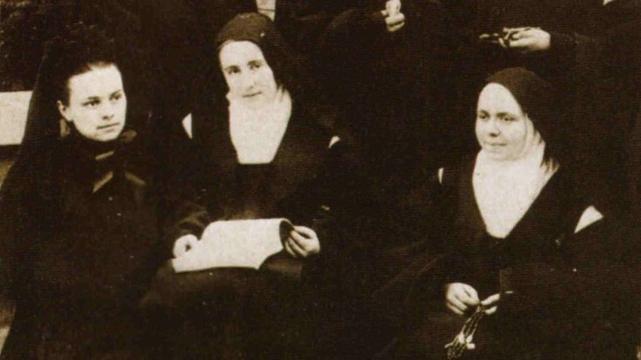
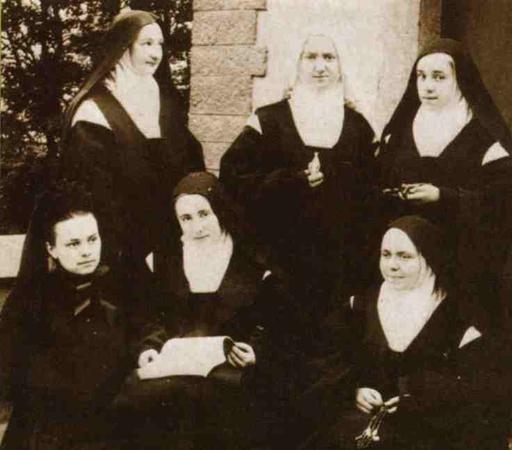
Mother Germaine (seated, center) holds an early copy of Story of a Soul. Photo taken on the terrace leading to the infirmary, 5 August 1901, three days after Elizabeth entered the Carmel of Dijon.
Front row, L-R: Postulant Elizabeth, Mother Germaine, Sister Geneviève of the Trinity
Back row, L-R: Sister Marie of the Trinity, Sister Hélène of Jesus, Sister Agnès of Jesus-Maria
Image credit: Discalced Carmelites (By permission)

Elizabeth of the Trinity, S 2003, The Complete Works of Elizabeth of the Trinity volume 2: Letters from Carmel, translated from the French by Nash, A, ICS Publications, Washington DC.

#elections #monasticLife #MotherGermaine #silence #StElizabethOfTheTrinity

Quote of the day, 29 September: St. Edith Stein

 Since September 29 we’ve had a new Mother who would like me to write something again.

Saint Edith Stein
Echt, 5 November 1940

Just now I am gathering material for a new work since our Reverend Mother wishes me to do some scholarly work again, as far as this will be possible in our living situation and under the present circumstances. I am very grateful to be allowed once more to do something before my brain rusts completely.

Echt, 17 November 1940


I am going about my new task like a little child making its first attempts at walking.

Echt, 16 May 1941


Please, will Your Reverence also pray a little to the Holy Spirit and to our Holy Father John for what I am now planning to write. It is to be something for our Holy Father’s 400th birthday (24 June 1942)

Echt, 8 October 1941


Because of the work I am doing I live almost constantly immersed in thoughts about our Holy Father John. That is a great grace. May I ask Your Reverence once more for prayers that I can produce something appropriate for his Jubilee?

Echt, 18 November 1941


Dear Mother,

… I am satisfied with everything. scientia crucis [science of the cross] can be gained only when one comes to feel the Cross radically. I have been convinced of that from the first moment and have said, from my heart: Ave, Crux, spes unica!

Echt, December 1941


Dear Sister Maria,

… while working on this task it often happened when I was greatly exhausted that I had the feeling I could not penetrate to what I wished to say and to grasp. I already thought that it would always remain so. But now I feel I have renewed vigor for creative effort. Holy Father John gave me renewed impetus for some remarks concerning symbols. When I finish this manuscript I would like to send a German copy to Father Heribert [Discalced Carmelite provincial in Germany] to have it duplicated for the monasteries.

The only reason I write so little is that I need all the time for Father John.

Echt, 9 April 1942


My dear ones,

A [Red Cross] nurse from [Amsterdam] intends to speak today with the Consul. Here, every petition [on behalf] of fully Jewish Catholics has been forbidden since yesterday. Outside [the camp] an attempt can still be made, but with extremely little prospect. According to plans, a transport will leave on Friday. Could you possibly write to Mère Claire in Venlo, Kaldenkerkeweg 185 [the Ursuline Convent] to ask for [my] manuscript if they have not already sent it. We count on your prayers. There are so many persons here who need some consolation and they expect it from the Sisters.

In Corde Jesu, your grateful

B.

Westerbork transit camp, 5 August 1942


Mother Antonia Ambrosia Engelmann, O.C.D. was elected prioress of the Carmel of Echt on 29 September 1940.  It is to her that we owe a debt of gratitude for Saint Edith Stein’s ultimate volume, The Science of the Cross. Gelber and Leuven (1993) note that although it was her final work, the manuscript was published as Vol. I in Edith Steins Werke. When Edith and Rosa were arrested in August of 1942, the completed portions of her manuscript had already been sent to a typist. Unaware of the fate that awaited her, Edith asks to retrieve that manuscript as if to continue working on it while in prison.


Stein E 1954, Kreuzeswissenschaft, E. Nauwelaerts, Louvain. | Wikimedia Commons

Stein, E. 1993, Self-Portrait in Letters, 1916-1942, Sister Teresa Benedicta of the Cross, Discalced Carmelite, translated from the German by Koeppel, J, ICS Publications, Washington DC.

Featured image: Vintage Remington Portable typewriter with German text. Original Flickr source no longer available.

#monasticLife #obedience #StEdithStein #StJohnOfTheCross #TheScienceOfTheCross

Quote of the day, 26 September: St. Elizabeth of the Trinity

My darling little sister,

There is so much happiness in my soul that I needed to come tell you about it while asking for your prayers as well.

Our Reverend Mother is allowing me to begin retreat, and tonight I am leaving for my great journey: ten days of complete silence, absolute solitude, with my veil lowered and several additional hours of prayer; it’s a very enticing schedule, I’m taking you and your angel with me; please tell our dear Mama to pray for the hermit who, for her part, will not forget her.

Please recommend me to your brother-in-law, the Abbé, and to Marie-Louise [Hallo].

A Dieu, little sister, I leave you, and I’m going to lose myself in Him, to let all this happiness I can no longer contain overflow. Union.

Your Sabeth r.c.i. [unworthy Carmelite religious]

Saint Elizabeth of the Trinity

Letter 211 to her sister Guite

Note: Saint Elizabeth’s private ten-day retreat began on 26 September 1904. She indicated to her Rolland aunts in a New Year’s letter at the end of 1904 that it was the first retreat since her religious profession—”a very great grace” (Cf. Letter 216). After briefly explaining to her aunts what a private retreat is like for a Carmelite nun, she told them “that these ten days of prayer and silence have been a foretaste of our Homeland.”

Let’s pause to consider St. Elizabeth’s comment about her retreat being spent “with my veil lowered and several additional hours of prayer.” In her community—as in all Carmels today—private retreat days are devoted to prayer, spiritual reading, rest, and quiet work in the solitude of one’s cell. Each Carmel maintains its autonomy, so practices vary from monastery to monastery.

During retreat, the nun is typically excused from the two hours of community recreation, creating perfect opportunities for solitary prayer in the choir near the Blessed Sacrament or in an upper-floor prayer space overlooking the tabernacle and altar. For Mass and the Liturgy of the Hours, St. Elizabeth would have worn her grand voile lowered while with the community—the large veil covering the nuns’ faces in the photo above. She would also have worn this lowered veil during silent meals in the refectory. The veil became her guardian of solitude throughout the retreat.

For Elizabeth, who loved to be “alone with the Alone” (Cf. Letter 297), we can understand why she called this ten-day retreat “a very enticing schedule.”

Elizabeth of the Trinity, S 2003, The Complete Works of Elizabeth of the Trinity volume 2: Letters from Carmel, translated from the French by Nash, A, ICS Publications, Washington DC.

Featured image: Discalced Carmelites receive a new aspirant at the monastery of the Incarnation in Avila. Image credit: Discalced Carmelite (By permission)

#monasticLife #retreat #solitude #StElizabethOfTheTrinity #veil

Pindapat complete including a philosophical discussion in the park regarding dependant origination with a stranger. The conclusion was that there should be more public philosophy #livingthedream #monasticlife #rightlivelihood

🕯️ A monk gently tends to his injured brother in faith ♥

New film project:
💞 Brotherhood and Love within Monastic Walls in the 12th Century 🕍

Image: Dreaminia 3.0, SDXL inpainted

#MonasticLife #BrotherInFaith #SacredCare #QueerHistory #HealingRitual #MaleIntimacy #gayart #LGBT #LoveIsLove