California singing #fish's midbrain may serve as a model for how mammals control vocal expressions
https://phys.org/news/2024-01-california-fish-midbrain-mammals-vocal.html

#Midbrain node for context-specific vocalisation in fish https://www.nature.com/articles/s41467-023-43794-y

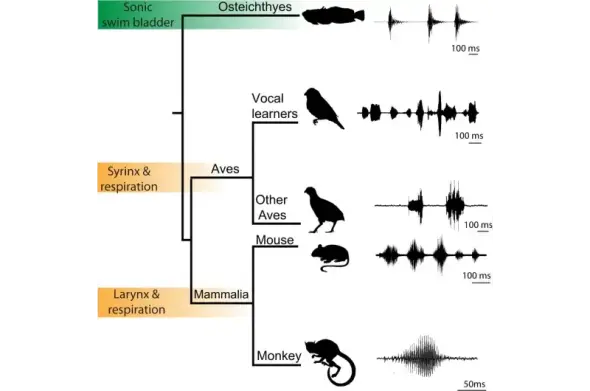
"#MidshipmanFish phrasing takes the form of grunts, growls and hums whenever the males seek mates or fend off foes... At low tides, people sitting along the shore report the steady, conversational hum of a male midshipman fish chorus."
California singing fish's midbrain may serve as a model for how mammals control vocal expressions

For talkative midshipman fish—sometimes called the "California singing fish"—the midbrain plays a robust role in initiating and patterning trains of sounds used in vocal communication.

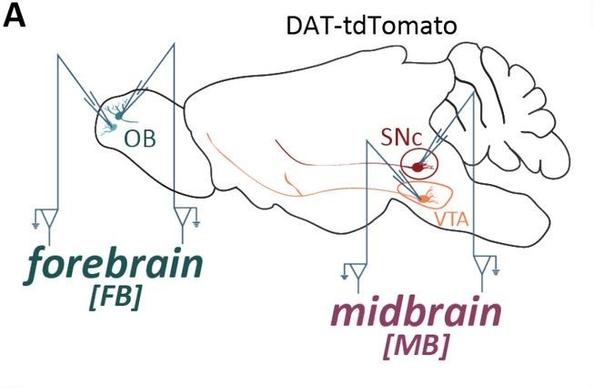
Did you see the preLight from Emily Winson-Bushby, Haoming You & Ana Dorrego-Rivas (#GrubbLab)?

They cover a preprint from Elisa Galliano & team that reveals clear functional differences between dopaminergic neurons in the midbrain and forebrain 🧠

#preLight 👉https://prelights.biologists.com/highlights/characterization-of-identified-dopaminergic-neurons-in-the-mouse-forebrain-and-midbrain/

#neuroscience #brain #forebrain #midbrain #dopamine #electrophysiology

Characterization of Identified Dopaminergic Neurons in the Mouse Forebrain and Midbrain - preLights

Are all dopaminergic neurons the same? Lau and colleagues played a round of Spot the Difference with dopaminergic neurons in different brain regions and found two functionally defined groups.

preLights
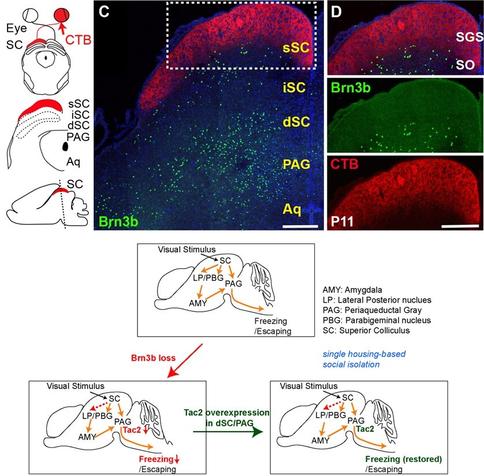
#Fear responses are essential for survival. Previous work has focused on forebrain & limbic system, but this study of the #midbrain visual circuitry reveals molecular mechanisms underlying its organization & fear-related behavioral function #PLOSBiology https://plos.io/47lGzZ6
Brn3b regulates the formation of fear-related midbrain circuits and defensive responses to visual threat

Fear responses to threat represent an essential survival instinct. While previous work has focused primarily on the forebrain and limbic system, this study examines the midbrain visual circuitry, identifying specific molecular mechanisms underlying its organization and fear-related behavioral function.

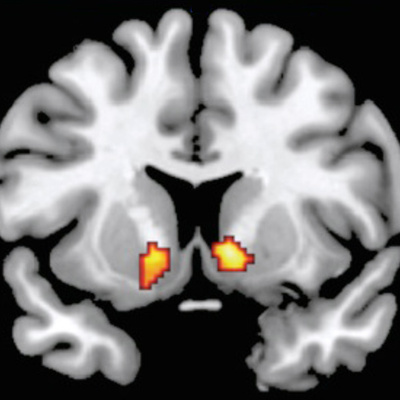
Reminded of @PhilCorlett1 's recent review during his visit, which highlights cross-domain #FMRI correlates of #PredictionErrors in the #VentralStriatum, #AnteriorInsula, and #Midbrain:
https://www.nature.com/articles/s41386-021-01264-3
Meta-analysis of human prediction error for incentives, perception, cognition, and action - Neuropsychopharmacology

Prediction errors (PEs) are a keystone for computational neuroscience. Their association with midbrain neural firing has been confirmed across species and has inspired the construction of artificial intelligence that can outperform humans. However, there is still much to learn. Here, we leverage the wealth of human PE data acquired in the functional neuroimaging setting in service of a deeper understanding, using an MKDA (multi-level kernel-based density) meta-analysis. Studies were identified with Google Scholar, and we included studies with healthy adult participants that reported activation coordinates corresponding to PEs published between 1999–2018. Across 264 PE studies that have focused on reward, punishment, action, cognition, and perception, consistent with domain-general theoretical models of prediction error we found midbrain PE signals during cognitive and reward learning tasks, and an insula PE signal for perceptual, social, cognitive, and reward prediction errors. There was evidence for domain-specific error signals––in the visual hierarchy during visual perception, and the dorsomedial prefrontal cortex during social inference. We assessed bias following prior neuroimaging meta-analyses and used family-wise error correction for multiple comparisons. This organization of computation by region will be invaluable in building and testing mechanistic models of cognitive function and dysfunction in machines, humans, and other animals. Limitations include small sample sizes and ROI masking in some included studies, which we addressed by weighting each study by sample size, and directly comparing whole brain vs. ROI-based results.

Nature