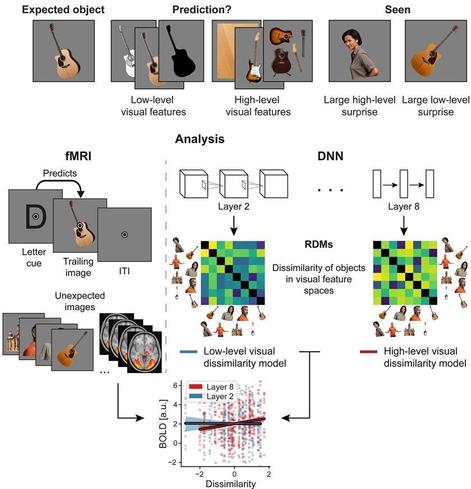
Surprising sensory input triggers stronger neural activity than expected input, but at which level of the cortical hierarchy are these predictions made? This study shows that prediction errors are computed at higher cortical levels and the resulting surprise signal is broadcast to earlier areas.
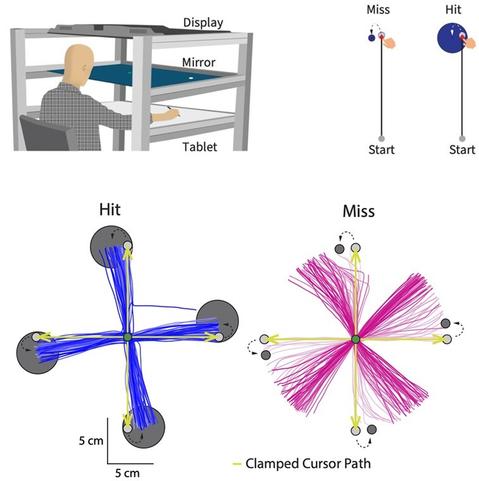
Humans learn from errors in their movements. This study shows that learning mechanisms triggered by limb-related sensory prediction errors and task-related performance errors are dissociable. While prediction errors drive implicit updates to motor plans, performance errors trigger deliberative selection of error-reducing actions.
...
Hashtags (chronologically mentioned, cont'd):
#inference #ActiveInference #sensory #prediction #PredictionErrors #expectation #interpretation #illusion #perception #ColorPerception #TheDress #PerceptualPrediction #neurodiversity #PerceptionCensus #ChatGPT #anthropomorphism #VegetativeState #AnimalWelfare #AnimalRights #suffering
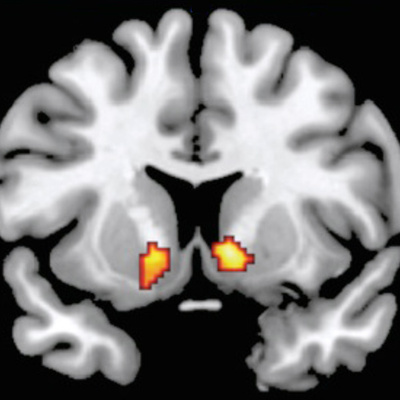
Prediction errors (PEs) are a keystone for computational neuroscience. Their association with midbrain neural firing has been confirmed across species and has inspired the construction of artificial intelligence that can outperform humans. However, there is still much to learn. Here, we leverage the wealth of human PE data acquired in the functional neuroimaging setting in service of a deeper understanding, using an MKDA (multi-level kernel-based density) meta-analysis. Studies were identified with Google Scholar, and we included studies with healthy adult participants that reported activation coordinates corresponding to PEs published between 1999–2018. Across 264 PE studies that have focused on reward, punishment, action, cognition, and perception, consistent with domain-general theoretical models of prediction error we found midbrain PE signals during cognitive and reward learning tasks, and an insula PE signal for perceptual, social, cognitive, and reward prediction errors. There was evidence for domain-specific error signals––in the visual hierarchy during visual perception, and the dorsomedial prefrontal cortex during social inference. We assessed bias following prior neuroimaging meta-analyses and used family-wise error correction for multiple comparisons. This organization of computation by region will be invaluable in building and testing mechanistic models of cognitive function and dysfunction in machines, humans, and other animals. Limitations include small sample sizes and ROI masking in some included studies, which we addressed by weighting each study by sample size, and directly comparing whole brain vs. ROI-based results.
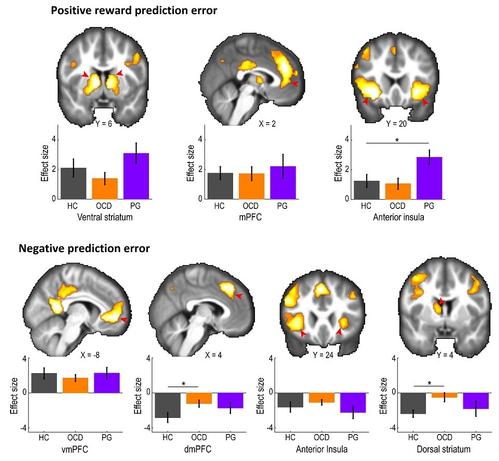
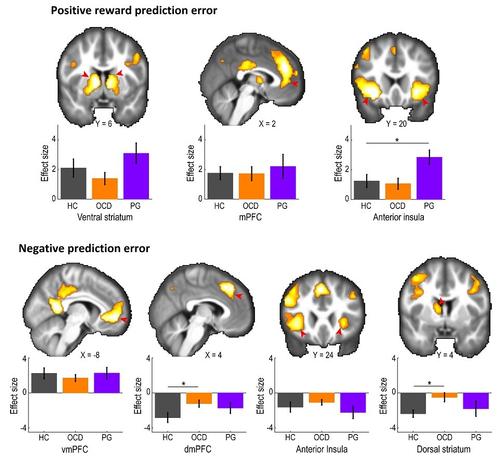
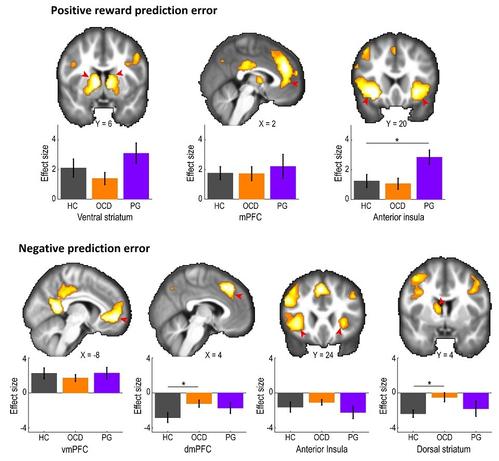
A brain imaging study reveals that obsessive-compulsive disorder and problem gambling are associated with distinct patterns of learning from positive and negative reward prediction errors, providing a neurocomputational account of abnormal inflexible behaviors in those disorders.