 Journal of Plant Ecology
The invasion of #SpartinaAlterniflora into coastal #Wetlands → SOC & TN⬇, the unstable part of DOM⬆, sulfate concentration⬇, SWC⬆ → #Methane production activity⬆, methane oxidation⬇ → methane production⬆.
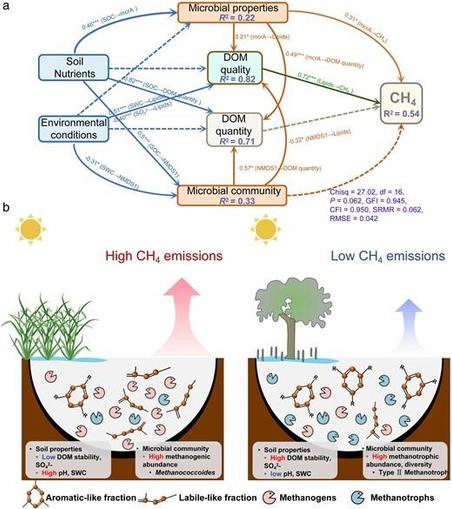
The invasion of #SpartinaAlterniflora into coastal #Wetlands → SOC & TN⬇, the unstable part of DOM⬆, sulfate concentration⬇, SWC⬆ → #Methane production activity⬆, methane oxidation⬇ → methane production⬆.
"#Agricultural runoff provides perfect nutrients for #methanogen growth.
#Fertilizer and animal waste washing into ocean systems creates nutrient-rich zones where these methanogens thrive like never before. #Nitrogen and #phosphorus pollution from farmland creates ideal conditions for explosive #microbial growth in #coastal waters and #DeepOcean areas. These agricultural inputs essentially act as fertilizer for #methane-producing microbes, creating a connection between #IndustrialFarming and atmospheric #GreenhouseGas levels that scientists never fully appreciated.
"Coastal regions near major agricultural areas show the highest concentrations of these supercharged methanogens, with some areas recording methane production levels ten times higher than baseline measurements. The problem compounds itself because areas with intensive farming also tend to have the strongest ocean currents, meaning these fertilized methanogen populations get distributed globally. Every season’s #AgriculturalRunoff creates new opportunities for these microbes to establish thriving colonies in previously stable ocean environments."
#DeepSeaLife #AgriculturalRunoff #BigAg #OceansAreLife #OceanCurrents #OceanMethane
"Marine scientists drilling into abyssal ocean floor sediments discovered thriving colonies of this new #methanogen species at depths previously thought to be biologically inactive. These extreme environments, characterized by crushing pressure and complete darkness, harbor #microbial communities that have evolved unique metabolic pathways. According to research published in #NatureGeoscience, these #DeepSea methanogens can survive in conditions that would kill most known life forms.
"The discovery challenges everything scientists thought they knew about where life can exist in Earth’s oceans. These microbes don’t just survive in the deep ocean trenches, they’re actually flourishing and producing methane at industrial scales. Their metabolic processes operate entirely differently from surface-dwelling organisms, using chemical energy sources that most life forms can’t even process."
Learn more:
https://www.msn.com/en-us/weather/topstories/earth-s-dangerous-warming-traced-to-a-hidden-culprit-says-new-data/ss-AA1VuuPp?ocid=winp2fptaskbarhover&cvid=0a3d1a553ba44c8893415037fea29306&ei=7#image=2
#DeepSeaLife #AgriculturalRunoff #BigAg #OceansAreLife #OceanCurrents #OceanMethane
【🎉Latest accepted article】
#SpartinaAlterniflora invasion stimulates #Methane emissions in coastal #Wetlands by increasing labile organic matter and shifting microbial communities
How #microbes extract important #metals from their environment
https://phys.org/news/2023-10-ancient-microbes-important-metals-environment.html
#Methanogens acquire and bioaccumulate #nickel during reductive dissolution of nickelian #pyrite: Rachel Spietz et al. https://journals.asm.org/doi/10.1128/aem.00991-23
"These findings help differentiate between two competing hypotheses about the reduction in atmospheric #methane billions of years ago that was likely caused by a reduction in the #methanogen population."
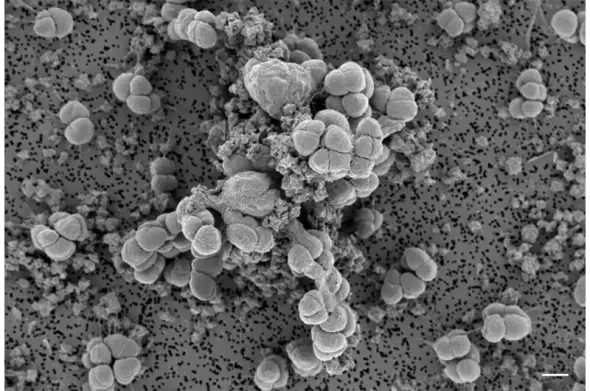

A new publication from a Montana State University scientist deepens existing knowledge of an ancient life-form and how it continues unique ecological processes today. The paper, titled "Methanogens acquire and bioaccumulate nickel during reductive dissolution of nickelian pyrite," was published Oct. 13 in Applied and Environmental Microbiology.
Capturing #CO2 with electricity: A microbial enzyme inspires electrochemistry!
Scientists from our Microbial Metabolism Group & the Univ. of Radboud and Geneva isolated a microbial enzyme & branched it on an electrode to efficiently and unidirectionally convert CO2 to formate.
Out now @ "Angewandte Chemie Int. Ed."
Read more here:
https://mpi-bremen.de/en/Capturing-CO2-with-electricity-A-microbial-enzyme-inspires-electrochemistry.html
Original publication here:
https://onlinelibrary.wiley.com/doi/10.1002/anie.202311981
#climatechange #microbiology #enzyme #methanogen #formate #carboncapture #coolscience

Capturing #CO2 with electricity: A microbial enzyme inspires electrochemistry
Scientists @MarineMicrobio isolate a #microbial #enzyme and branch it on an electrode to efficiently and unidirectionally convert CO2 to #formate
#methanogen #climatechange

Capturing #CO2 with electricity: A microbial enzyme inspires electrochemistry
Scientists @MarineMicrobio isolate a #microbial #enzyme and branch it on an electrode to efficiently and unidirectionally convert CO2 to #formate
#methanogen #climatechange

How a #microbe creates its own #sulfate reduction machinery.
#methanogen #Methanothermococcus #evolution
https://phys.org/news/2023-06-microbe-sulfate-reduction-machinery.html

Scientists at the Max Planck Institute for Marine Microbiology in Bremen, Germany, have uncovered the molecular secrets of a methane-generating microbe that can transform sulfate into sulfide—a ready-to-use cellular building block. This discovery opens up exciting opportunities in biofuel production.
The Genetics Of Temperature Adaptation: How Does Life Thrive In Extreme Conditions? https://astrobiology.com/2023/03/the-genetics-of-temperature-adaptation-how-does-life-thrive-in-extreme-conditions.html
The #methanogen core & #pangenome: conservation and variability across biology’s growth temperature extremes https://academic.oup.com/dnaresearch/article/30/1/dsac048/6862058
"#Methanogens can thrive across a range of temperature extremes, from -2.5 to 122 °C, making them ideal candidates to study temperature adaptation... Thermotolerant organisms had smaller genomes and a higher fraction of core genome."

 DoomsdaysCW
 Lukas VFN 🇪🇺
 MPI for Marine Microbiology
 Science News
 idw
idw CellBioNews