#CitationsNeeded pod's Nima Shirazi and Adam Johnson have a live convo @ Brooklyn's Word is Change bookstore about Adam's new book, "#HowToSellAGenocide: The #Media's Complicity in the Destruction of #Gaza," all royalties from which go to Middle East Children's Alliance.

https://citationsneeded.libsyn.com/live-show-how-to-sell-a-genocide-book-talk-at-the-word-is-change-bookstore-in-brooklyn-ny

#GazaCoverage #Palestine #Israel #PalestineCoverage #USmedia #WesternMedia #mediaCriticism #mediaRacism #MSM #liberalHypocrisy #mediaShitlibs #shitlibbingForGenocide #books @bookstodon

Citations Needed: Live Show: 'How to Sell a Genocide' Book Talk at The Word Is Change Bookstore in Brooklyn, NY

This is a live recording between Nima and Adam at the Word is Change Bookstore May 7, 2026. In this conversation, we discuss key findings that can be found in Adam's new book, How to Sell a Genocide: The Media's Complicity in the Destruction of Gaza.

Kevin Gosztola welcomes #mediaStudies professor #RobinAndersen to discuss her book #TheComplicitLens: #USMedia Coverage of #Israel's #GenocideInGaza

"Andersen discusses the coverage of #Gaza within the context of recent developments with the war in #Iran and #Lebanon."

https://www.youtube.com/watch?v=AP0LYDC5mWE
#Palestine #PalestineCoverage #media #GazaCoverage #MSM #mediaCriticism #books @bookstodon

From Gaza To Lebanon: The Role Of US Media In War Crimes (w/ Robin Andersen)

YouTube

Hey, Dumbass — You’re Supposed to Be Paying Attention

By Cliff Potts, CSO, and Editor-in-Chief of WPS News
Baybay City, Leyte, Philippines — June 6, 2026, 07:00 PHST

This Is Not Subtle, and It Isn’t New

Let’s dispense with politeness. What’s happening right now is not complicated, mysterious, or “algorithmic fate.” It is willful inattention trained into people over years.

For more than two years, WPS News has published sustained, sourced, historically grounded analysis on authoritarian drift, economic precarity, geopolitics, and institutional failure. The work is not fringe. It is not speculative. It is not vibes. And yet it is routinely ignored—across the United States, the EU, and even here in the Philippines.

That isn’t an accident. It’s learned behavior.

The Internet Trained You to Stop Thinking

The modern internet does not exist to inform you. It exists to manage you.

Platforms reward:

  • emotional reflex instead of judgment
  • speed instead of accuracy
  • tribal signaling instead of synthesis
  • repetition instead of memory

Anything that requires sustained attention, historical context, or second-order thinking is quietly pushed aside. Not banned. Not censored. Just ignored.

That’s worse.

Silence Is Not Neutral — It’s Cowardice with a UX

When peers, professionals, or “informed” readers say nothing, it’s tempting to assume disagreement. Most of the time, it’s simpler than that: they don’t want the responsibility that comes with understanding.

Engaging seriously with analysis means:

  • admitting prior assumptions were wrong
  • acknowledging complicity
  • accepting that problems are structural, not personal
  • recognizing that fixes are costly and uncomfortable

So people scroll. Silence becomes a lifestyle choice.

Younger Generations Aren’t Stupid — They’re Drowned

This is not a generational insult. It’s an observation.

Many younger readers are trapped in survival mode: debt, insecure work, housing stress, constant alerts, infinite feeds. When life feels unstable, long-range analysis feels abstract—even when it directly explains why life is unstable.

That doesn’t make the analysis wrong. It means the system is hostile to understanding.

The Death of Judgment as a Social Skill

Once upon a time, judgment was learned—through mentorship, institutions, and consequence. That pipeline is gone.

The internet flattened authority but replaced it with volatility. Experience is treated as irrelevance. Memory is framed as nostalgia. Long-view thinking is labeled elitism.

The result is a culture that reacts constantly and understands nothing.

This Isn’t an American Problem. It’s a Human One.

The same disengagement appears everywhere: the U.S., Europe, Southeast Asia, the Philippines. Different politics, same pattern.

If information doesn’t flatter, reassure, or entertain, it is filtered out—not by governments alone, but by habits cultivated over years of platform design.

People will later claim they “never saw this coming.” The archive will prove otherwise.

Being Ignored Does Not Mean Being Wrong

History is unkind to the argument that relevance equals immediacy.

Work that documents corruption, names power honestly, and refuses spectacle is often ignored until events force recognition. Archives exist for that reason.

WPS News is not built for dopamine. It is built for record.

Read or Don’t — But Stop Pretending This Is Invisible

The information is there. The connections are there. The patterns are obvious to anyone willing to look longer than a scroll.

If you choose not to pay attention, that’s your right. But stop pretending ignorance is imposed on you.

You were warned. Repeatedly.

For more social commentary, please see Occupy 2.5 at https://Occupy25.com

This article will be archived as part of the ongoing WPS News Monthly Brief Series available through Amazon.

References

Carr, N. (2020). The Shallows: What the Internet Is Doing to Our Brains. W. W. Norton & Company.
Zuboff, S. (2019). The Age of Surveillance Capitalism. PublicAffairs.
Postman, N. (1985). Amusing Ourselves to Death. Viking Penguin.

#attentionEconomy #Authoritarianism #digitalPlatforms #historicalMemory #internetCulture #journalism #mediaCriticism

Critique of Media Coverage and Climate Tipping Point Risks in a Warming World

📰 Original title: Media Myopia As We Hurtle Towards Climate Oblivion

🤖 IA: It's not clickbait ✅
👥 Users: It's not clickbait ✅

View full AI summary https://en.killbait.com/critique-of-media-coverage-and-climate-tipping-point-risks-in-a-warming-world.html?utm_source=mastodon_world&utm_medium=social&utm_campaign=killbait.mastodon_world

#climatechange #climatecrisis #mediacriticism #tippingpoints

Critique of Media Coverage and Climate Tipping Point Risks in a Warming World

The article argues that mainstream media is failing to adequately report the escalating climate crisis, allowing political and economic systems driven by corporate interests to continue largely unchallenged. It highlights how urgent scientific warnings about climate change are often underrepresented in news coverage, while political drama and short-term events dominate public discourse. A central example is the 100th birthday celebration of naturalist David Attenborough, where climate change—despite being a major focus of his recent work—was largely absent from the public narrative of the event. The article uses this to illustrate how even widely respected environmental voices are often depoliticized or sanitized in mainstream media contexts. The piece reviews recent scientific findings warning that Earth may be approaching critical climate tipping points. These include potential collapse of major systems such as the Atlantic Meridional Overturning Circulation (AMOC), accelerated melting of polar ice sheets, and dieback of the Amazon rainforest. Some studies suggest a significant risk—possibly as high as 50%—of AMOC destabilization by 2100, which could severely disrupt global weather patterns and agriculture, particularly in Europe and the Northern Hemisphere. It also discusses projections that current warming trends, already exceeding 1.3°C above pre-industrial levels, could lead to 2–3°C or higher warming under current policies, with worst-case scenarios reaching much higher temperatures if feedback loops are triggered. Such outcomes could result in widespread ecological collapse, food insecurity, and severe societal disruption. Ultimately, the article criticizes what it sees as a systemic failure of journalism to prioritize sustained, in-depth climate reporting, arguing that this lack of attention contributes to a dangerous disconnect between scientific warnings and public awareness.

KillBait

Critique of Media Coverage and Climate Tipping Point Risks in a Warming World

📰 Original title: Media Myopia As We Hurtle Towards Climate Oblivion

🤖 IA: It's not clickbait ✅
👥 Users: It's not clickbait ✅

View full AI summary https://en.killbait.com/critique-of-media-coverage-and-climate-tipping-point-risks-in-a-warming-world.html?utm_source=mastodon_social&utm_medium=social&utm_campaign=killbait.mastodon_social

#climatechange #climatecrisis #mediacriticism #tippingpoints

Critique of Media Coverage and Climate Tipping Point Risks in a Warming World

The article argues that mainstream media is failing to adequately report the escalating climate crisis, allowing political and economic systems driven by corporate interests to continue largely unchallenged. It highlights how urgent scientific warnings about climate change are often underrepresented in news coverage, while political drama and short-term events dominate public discourse. A central example is the 100th birthday celebration of naturalist David Attenborough, where climate change—despite being a major focus of his recent work—was largely absent from the public narrative of the event. The article uses this to illustrate how even widely respected environmental voices are often depoliticized or sanitized in mainstream media contexts. The piece reviews recent scientific findings warning that Earth may be approaching critical climate tipping points. These include potential collapse of major systems such as the Atlantic Meridional Overturning Circulation (AMOC), accelerated melting of polar ice sheets, and dieback of the Amazon rainforest. Some studies suggest a significant risk—possibly as high as 50%—of AMOC destabilization by 2100, which could severely disrupt global weather patterns and agriculture, particularly in Europe and the Northern Hemisphere. It also discusses projections that current warming trends, already exceeding 1.3°C above pre-industrial levels, could lead to 2–3°C or higher warming under current policies, with worst-case scenarios reaching much higher temperatures if feedback loops are triggered. Such outcomes could result in widespread ecological collapse, food insecurity, and severe societal disruption. Ultimately, the article criticizes what it sees as a systemic failure of journalism to prioritize sustained, in-depth climate reporting, arguing that this lack of attention contributes to a dangerous disconnect between scientific warnings and public awareness.

KillBait

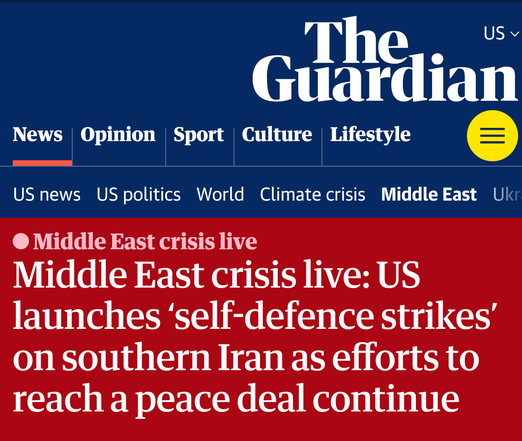
Terrible headline, but perhaps unintentionally captures the times.

#MediaCriticism #IranWar

Good morning, everyone! ☕️

The coffee’s brewing, and Germany is once again suffering from its annual Eurovision hangover. Sarah Engels came in 23rd place and received a dismal 0 points from the public.

And before anyone starts chanting the old mantra, “All of Europe hates us!”: No, that’s not the reason. It’s because #SWR manages pop culture like a PowerPoint presentation. A watered-down, completely risk-free radio pop song, approved by committees, simply fails miserably at the #ESC. The ESC demands risk, courage, artistry, and polarization—the exact opposite of German formulaic radio.
As long as we send the lowest common denominator to Europe, we’ll remain insignificant. 🤷‍♂️

Did you watch yesterday? Who was your true winner?

#ESC2026 #Eurovision #GoodMorning #MediaCriticism #ARD #PopCulture

Dear Kentuckians, MAGA dimwits are twisting the facts to falsely implicate Thomas Massie—a real thorn to the Trump regime—in a national scandal. Remember, Massie has consistently stuck to Trump's pledge of "no new wars", unlike the president himself. Do *not* let warmongering ass Ed Gallrein take his seat!

https://reason.com/2026/05/15/thomas-massies-enemies-are-attacking-him-with-an-unfair-accusation/

#Kentucky #elections #endlessWars #GOP #MAGA #mediaCriticism #ThomasMassie #USCongress #war

Thomas Massie's enemies are attacking him with an unfair accusation

Partisan political actors have seized on a vague and unsupported "hush money" allegation.

Reason.com

The Job Board Illusion

How Monster Normalized Failure—and LinkedIn Professionalized It

By Cliff Potts, CSO & Editor-in-Chief, WPS News

This Is Not a U.S.-Only Problem

Let’s clear away the most comforting myth at the outset: this is not an American problem. Professionals in the European Union, across Africa, throughout South and Southeast Asia, and in advanced economies like Japan are all operating inside the same hiring machinery. The platforms are global. The incentives are global. And the damage is global—often worse where worker protections are weakest.

What changes by region is not the design of the system, but how brutally it expresses itself.

The Original Sin of Modern Hiring

Before “networking,” before “personal brands,” before dashboards and engagement metrics, there was Monster.

Monster replaced the local newspaper help-wanted section—imperfect but human-scaled—with a national résumé dumping ground. It promised reach and efficiency. What it delivered was volume without judgment. Employers were flooded with applications they could not review. Applicants were trained to submit endlessly into silence. Feedback vanished. Closure disappeared.

Finding a real job through Monster was possible—but rare enough to feel like an accident rather than an outcome. That mattered. Monster didn’t just fail to fix hiring; it taught the market to tolerate failure. Silence became normal. Inefficiency became expected.

Monster normalized the problem.

Employers as Customers, Workers as Inventory

Across nearly every major platform—Monster, Indeed, CareerBuilder, and later LinkedIn—the same economic truth governs outcomes: employers pay; workers do not.

Employers get leverage and filters. Workers get forms and silence. Platforms profit whether a hire is made or not. Activity is rewarded; outcomes are not measured. The risk of matching is pushed downward onto individuals told to optimize résumés, keywords, and timing—often for roles already decided.

From Monster to LinkedIn: The Upgrade

Monster trained workers to expect inefficiency. LinkedIn professionalized it.

Where Monster’s failure was crude—apply and disappear—LinkedIn’s is sophisticated. It wraps the same broken pipeline in identity and metrics. Placement is replaced by visibility. Silence is reframed as a personal deficit: your brand, your network, your engagement.

LinkedIn did not correct the résumé black hole. It rebranded it. Workers now participate emotionally in a system that still does not owe them outcomes.

Europe: Compliance Theater

In the European Union, stronger labor law exists on paper, but platforms often function as compliance theater. Jobs are posted to demonstrate procedure, not to discover candidates. Internal selections are common before postings go live. The process looks fair; the outcome is predetermined.

The platform documents that rules were followed. It does not meaningfully expand access.

Africa: Global Competition Without Protection

Across Africa, platforms import Western hiring assumptions into markets with different realities. Professionals are encouraged to compete globally without the protections enjoyed elsewhere. Oversupply intensifies, wages are pressured downward, and credentials inflate without opportunity.

Platforms promise access to the world and deliver exposure to global competition without safeguards. Hope is extracted; talent is not placed.

Asia-Pacific: Labor Arbitrage at Scale

In South and Southeast Asia, massive professional oversupply collides with platform-mediated markets. Availability beats expertise. Price beats sustainability. Careers become continuous auditions.

Platforms do not merely reflect these conditions; they normalize them, exporting precarity as efficiency and resetting expectations downward across borders.

Japan: Corporate Hierarchy Without Accountability

Japan merits specific attention, not exemption. Despite its reputation for efficiency, corporate hierarchy often substitutes deference for accountability. Questioning leadership is discouraged; mobility is stigmatized; responsibility flows downward while authority remains fixed at the top.

Platforms interacting with this system do not introduce balance. They reward endurance, reinforce silence, and encourage compliance over negotiation. These are governance failures sustained by tradition and reputation—not harmless quirks. Respect for culture does not require silence about harm.

The United States: Plantation Logic in a Suit

In the United States, the dynamic wears a different costume but ends the same way. Management assumes control; workers assume risk. Obedience is framed as professionalism. Platforms promote hustle over leverage, branding over bargaining, and individual optimization over collective power.

Workers are told they are free to leave at any time. They are rarely given security to stay.

The Pattern That Connects It All

Across regions and cultures, one assumption governs modern hiring: labor must adapt to power, not the other way around. Job platforms did not invent this assumption. They monetize it.

Monster made dysfunction acceptable. LinkedIn made it personal. Later platforms multiplied it at scale.

Why This Matters

This is not a failure of effort. It is a failure of design.

Until hiring platforms are evaluated on placement quality, timing, and worker outcomes—not activity, visibility, or engagement—the professional class will continue to be managed rather than matched. The illusion of opportunity will persist. The anxiety will remain individualized. And the system will keep working exactly as designed.

For more social commentary, please see Occupy 2.5 at https://Occupy25.com

References (APA)

Autor, D. (2019). Work of the past, work of the future. AEA Papers and Proceedings, 109, 1–32. https://doi.org/10.1257/pandp.20191110

Graeber, D. (2018). Bullshit jobs: A theory. Simon & Schuster.

Kalleberg, A. L. (2018). Precarious lives: Job insecurity and well-being in rich democracies. Polity Press.

Mazzucato, M. (2018). The value of everything: Making and taking in the global economy. PublicAffairs.

Standing, G. (2011). The precariat: The new dangerous class. Bloomsbury Academic.

Weber, M. (1946). From Max Weber: Essays in sociology (H. H. Gerth & C. W. Mills, Eds.). Oxford University Press.

#corporatePower #employmentSystems #globalLaborMarkets #hiringPlatforms #Indeed #jobBoards #LinkedIn #mediaCriticism #Monster #precariousWork #professionalClass

Media/Wars Ep4

YouTube