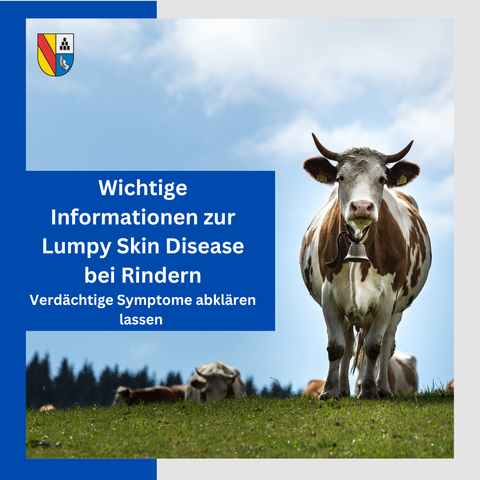
Seit dem Wiederauftreten der Lumpy Skin Disease (LSD) in Europa Ende Juni 2025 sind die Fallzahlen in den betroffenen Gebieten in Italien und Frankreich stetig angestiegen. Aufgrund der momentanen Ausbreitung der Krankheit ist es sehr wichtig, verdächtige Symptome bei Rindern abklären zu lassen.

Klinisch erkrankte Tiere haben Fieber und zeigen typische knötchenartige Hautveränderungen v. a. am Kopf, Hals, Perineum, und Euter, die häufig zusammen mit Läsionen an den Schleimhäuten auftreten. Außerdem kann die Erkrankung mit Milchrückgang, Ödemen sowie vergrößerten Lymphknoten einhergehen. Tragende Tiere können abortieren. Auch subklinische Verläufe sind möglich.

Die Übertragung des LSD-Virus erfolgt vor allem durch blutsaugende Insekten (Stechmücken, Fliegen, Zecken). Im Verdachtsfall muss unverzüglich das zuständige Veterinäramt verständigt und Proben für Abklärungsuntersuchungen entnommen werden.

Auf der Internetseite des Diagnostikzentrums Aulendorf ( www.stua-aulendorf.de) sind auf einem Merkblatt weitere Informationen zu der Tierseuche zu finden.

#landratsamtemmendingen #landkreisemmendingen #LumpySkinDisease

"Sequencing and Analysis of Lumpy Skin Disease Virus Whole Genomes Reveals a New Viral Subgroup in West and Central Africa"
Haga et al, 2024
https://www.mdpi.com/1999-4915/16/4/557
#LSDV #genomics #evolution #lumpyskindisease
Sequencing and Analysis of Lumpy Skin Disease Virus Whole Genomes Reveals a New Viral Subgroup in West and Central Africa

Lumpy skin disease virus (LSDV) is a member of the capripoxvirus (CPPV) genus of the Poxviridae family. LSDV is a rapidly emerging, high-consequence pathogen of cattle, recently spreading from Africa and the Middle East into Europe and Asia. We have sequenced the whole genome of historical LSDV isolates from the Pirbright Institute virus archive, and field isolates from recent disease outbreaks in Sri Lanka, Mongolia, Nigeria and Ethiopia. These genome sequences were compared to published genomes and classified into different subgroups. Two subgroups contained vaccine or vaccine-like samples (“Neethling-like” clade 1.1 and “Kenya-like” subgroup, clade 1.2.2). One subgroup was associated with outbreaks of LSD in the Middle East/Europe (clade 1.2.1) and a previously unreported subgroup originated from cases of LSD in west and central Africa (clade 1.2.3). Isolates were also identified that contained a mix of genes from both wildtype and vaccine samples (vaccine-like recombinants, grouped in clade 2). Whole genome sequencing and analysis of LSDV strains isolated from different regions of Africa, Europe and Asia have provided new knowledge of the drivers of LSDV emergence, and will inform future disease control strategies.

MDPI

With 29 confirmed cases of #lumpyskindisease in cattle, #SouthKorea is accelerating its efforts to vaccinate livestock. The goal is to complete vaccinations by early November while investigations into the disease's origin are ongoing.

https://www.koreatimes.co.kr/www/nation/2023/10/371_361818.html

Korea to complete LSD vaccinations by early Nov.: ministry

Confirmed cases of lumpy skin disease in cattle rose to 29 in Korea, officials said Wednesday, with health authorities speeding up efforts to administer vaccines to livestock nationwide.

The Korea Times

लम्पी स्किन रोग नियन्त्रण गर्न सरकारको ध्यानाकर्षण
https://www.breaknlinks.com/nepali/news/35216799

#BLNEWS #BLMEDIA #BREAKNLINKS
#LUMPYSKINDISEASE
#NEPAL #ANIMALS

लम्पी स्किन रोग नियन्त्रण गर्न सरकारको ध्यानाकर्षण

सांसद सूर्यबहादुर थापा क्षेत्रीले मदन भण्डारी राजमार्ग निर्माणको काम ढिलो गतिमा भइरहेको विषय उठाए। सांसद सोविता गौतमले आन्तरिक रोजगार बढाउने र अनौपचारिक अर्थतन्त्रलाई औपचारिक बनाउनुपर्ने विषय संसद्मा राखे। 

Breaknlinks
Lumpy Skin disease in cattle. Sensible to continue covid safety protocol. #lumpyskindisease