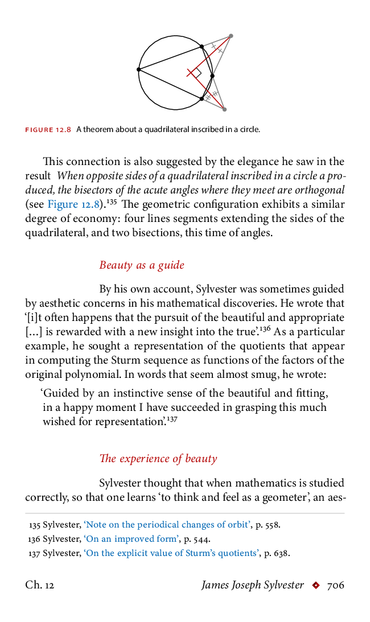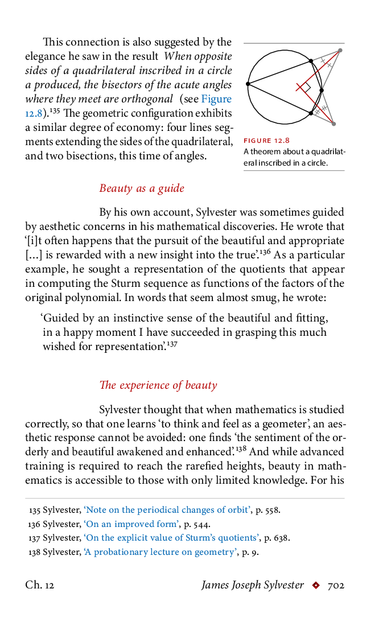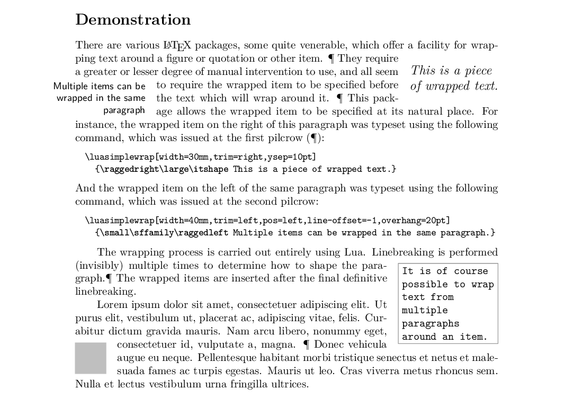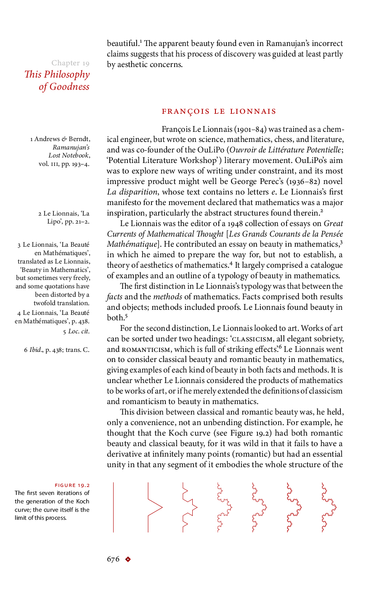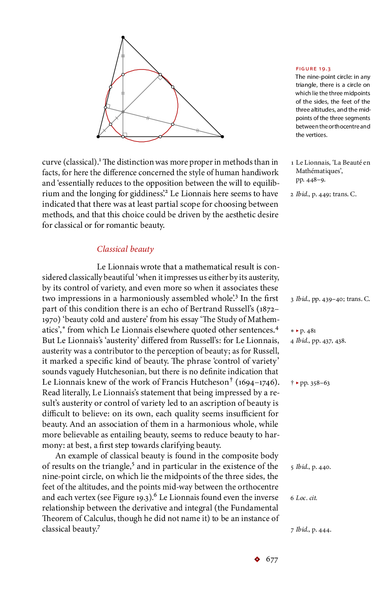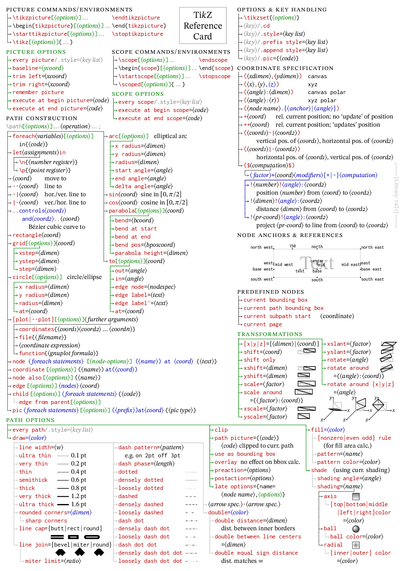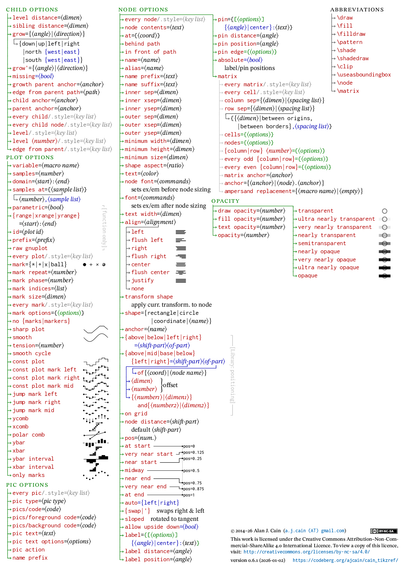
Various minor improvements to my #TikZ reference card. (Images attached.)

Download PDF or #LuaLaTeX source .zip/.tar.gz: https://codeberg.org/ajcain/cain_tikzref/releases

Git repository: https://codeberg.org/ajcain/cain_tikzref

The card is information-dense, merely reminder of syntax, not an explanation of meaning. The PDF is A4+color but the source can be compiled for letter paper and/or greyscale (see the README).

#TeXLaTeX #typography #Cheatsheet

My former student lent me their printed and bound copy of ‘Nine Chapters on the Semigroup Art’, my lecture notes for a tour through semigroup theory, in which they had marked various typos and minor errors, and points where they thought more explanation was required, so that I could make some improvements.

This was actually the first time I had ever seen it printed in full (photos attached). I had only printed individual chapters while working on it.

I think it looks pretty good, although I have improved the typography in the years since this copy was printed. In particular, I tightened the letter spacing used for theorem headers.

I released the #LuaLaTeX style "minos" I first developed for these notes (much revised and extended since) a few weeks ago: https://codeberg.org/ajcain/minos (Git repository) https://codeberg.org/ajcain/minos/releases (Documentation and source .zip/.tar.gz)

‘Nine Chapters’ itself is (and has always been) #OpenAccess: https://archive.org/details/cain_semigroups_a4_screen

#mathematics #typography #TeXLaTeX #semigroups

I figured out how to make these previews work. The problem did turn out to be that lualatex doesn't produce .dvi files. The aptly named dvilualatex binary needs to be used for this. The solution was to set the latex-compiler property of the org-preview-latex-process-alist members accordingly:

"dvilualatex -interaction nonstopmode -output-directory %o %f"

To quote the Emacs enthusiast interview, you can probably do this in a smarter way (and I'm all ears/eyes for suggestions).

For now, though, it works! As with most problems, this one just needed a fresh set of eyes and putting the right words in the search engine.

#emacs #orgmode #lualatex

Had I printed the #sydbox manual pages as a #pdf and sell it on a print-on-demand service, would you buy it to contribute to the project? It's pretty basic at the moment but looks roughly reasonable. Pipeline is #scdoc -> #man -> #pandoc -> #markdown -> #pandoc -> #latex -> #lualatex -> #pdf. I regenerate it every release, it's about 300 pages: https://gitlab.exherbo.org/sydbox/sydbox/-/blob/main/doc/manual/syd-manual.pdf #exherbo #linux #security
Yes
0%
No
25%
Who reads manual pages? Write a real book!
50%
You need a better retirement plan.
25%
Poll ended at .
doc/manual/syd-manual.pdf · main · Sydbox / sydbox · GitLab

rock-solid application kernel

GitLab
(1/3)
These are the new features the LaTeX #multilingual support (with #babel) has brought us this 2025. Remember that, unlike some AI chats mistakenly claim, babel provides comprehensive support for #LuaLaTeX and #XeLaTeX, as well as for #Unicode and #OpenType (with fontspec).

Small update to my (unofficial) #LuaLaTeX package "minos". Mostly small changes for consistency, with one substantial fix to typesetting the table of contents (The problem only arose when neither hyperref nor tagging-compatible code were being used.)

Git repository: https://codeberg.org/ajcain/minos

Download documentation or source .zip/.tar.gz: https://codeberg.org/ajcain/minos/releases

To see what "minos" can do, look at ‘Form & Number: A History of Mathematical Beauty’ [https://archive.org/details/cain_formandnumber_ebook_large], ‘An Annotated Mathematician's Apology’ [https://archive.org/details/hardy_annotated], or ‘Nine Chapters on the Semigroup Art’ [https://archive.org/details/cain_semigroups_a4_screen]. (All freely available under #CreativeCommons licences.)

#TeXLaTeX #typography

I have been perusing some beautifully typeset notes for three lectures on logic that @consequently shared recently: https://consequently.org/handouts/whl-l.pdf (sample pages attached)

The document has a very elegant combination of fonts (all freely available under the Open Font Licence):

• Alegraya ht for the body text [https://huertatipografica.com/en/fonts/alegreya-ht-pro];

• Alegraya Sans ht for the sidenotes and headings [https://huertatipografica.com/en/fonts/alegreya-sans-ht];

• AMS Euler for mathematics [exists in various versions, e.g. https://ctan.org/pkg/euler-math].

The layout is compact without being overly dense and the sidenotes are cleanly separated from the main text by colour and font.

I *think* the "ebproof" package [https://ctan.org/pkg/ebproof] was used for the proof trees. (Please correct me if I am wrong, @consequently)

I understand that my own package "marginalia" [https://ctan.org/pkg/marginalia] was used to create the sidenotes — and seeing it contribute in a small way to beautiful results like this is part of what makes package creation worthwhile. :-)

#typography #TeXLaTeX #LuaLaTeX #logic #OFL

A few days ago I released publicly the #LuaLaTeX style "minos", which I developed and used for my books, including ‘Form & Number: A History of Mathematical Beauty’ [https://archive.org/details/cain_formandnumber_ebook_large] and ‘An Annotated Mathematician's Apology’ [https://archive.org/details/hardy_annotated].

As a result of various emails from some of the people who originally asked me to make it available, I have made some improvements to the code and documentation. (I still doubt it will ever be improved enough for me to submit it to CTAN as an ‘official’ package, although it is possible that I might separate parts of it into packages for CTAN.)

Git repository: https://codeberg.org/ajcain/minos

Download documentation or source .zip/.tar.gz: https://codeberg.org/ajcain/minos/releases

Some of the typographical techniques are discussed in an #OpenAccess article in TUGboat: https://tug.org/TUGboat/tb46-1/tb142cain-setting-form.html

#TeXLaTeX #typography

I have made available the #LuaLaTeX style used in my books, including ‘Form & Number: A History of Mathematical Beauty’ [https://archive.org/details/cain_formandnumber_ebook_large], after several people emailed me to express an interest. The style (called "minos") is available here: https://codeberg.org/ajcain/minos

The style was written for my own use, and so the documentation is basic and the functionality follows precisely my own needs. I am not going to submit it to CTAN. It is probably more useful as a source of ideas and experimentation than as a style for anyone else.

1/2

#TeXLaTeX #typography

A new version of my #LuaLaTeX package ‘marginalia’ is now available on CTAN. [https://ctan.org/pkg/marginalia]

A new feature allows adding an arrow or other symbol next to the line relevant to the marginal note. (Example attached.) Even if the position of the marginal note is automatically adjusted (to avoid overlaps etc.), the arrow remains in place.

New vertical alignment options are available: centrally positioned (probably better for placing pictures in the margin) or midway between top/bottom lines (probably better for text-only margin notes).

The documentation has been improved with more explanation and examples.

General info: ‘marginalia’ allows the placement of marginal notes (or other marginal content) anywhere, without \marginpar’s limits, and automatically adjusts positions to prevent either overlaps or content being pushed off the page, and uses key–value settings that allow fine-grained customization.

There is an #OpenAccess introduction to ‘marginalia’ in ‘TUGboat: Communications of the TeX Users Group’: https://www.tug.org/TUGboat/tb46-1/tb142cain-marginalia.pdf

#TeXLaTeX #typography #marginalia