
One Source, Multiple Versions, Many Perspectives: Teaching Key Documents in U.S. History – Teaching with the Library

Teaching with the Library Primary Sources & Ideas for Educators

ISSN 2691-6916

Share & Subscribe to this blog

  • One Source, Multiple Versions, Many Perspectives: Teaching Key Documents in U.S. History
  • In Congress, July 4, 1776. The unanimous declaration of the thirteen United States of America.

    One Source, Multiple Versions, Many Perspectives: Teaching Key Documents in U.S. History

    Posted by: Colleen Smith, January 27, 2026

    This blog post is by Lee Ann Potter, director of Professional Learning and Outreach Initiatives at the Library of Congress. 

    At the recent annual meeting of the American Historical Association (AHA) in Chicago, I presented a K-16 teacher workshop titled “Revolutionary History Teaching.”  As the title suggested, I engaged participants with primary sources and teaching strategies related to the American Revolution.

    To introduce an activity focused on the Declaration of Independence, I asked the participating teachers if they invited their students to read the founding document.  They all said yes, doing so was part of their regular approach in both history and civics classes.

    “Which version?” I asked, to which I received few responses and many quizzical looks.

    I proceeded to divide the teachers into smaller groups and provided each with a facsimile of a different version of the Declaration. The versions I shared included:

    I encouraged the teachers to read their versions, to consider their students’ capabilities and background knowledge, as well as their course objectives, and to discuss within their small groups the associated pros and cons of inviting students to read their version rather than simply the document’s text.

    Then we engaged in a larger group discussion about each version.  The group with The Pennsylvania Evening Post was particularly interested in the advertisements that also ran in the edition and discussed how news was shared and spread in the 1770s; the group with the Dunlap Broadside also discussed the sharing of information and noted that the names of most of the delegates to the Second Continental Congress were missing, but they were present on the Goddard Broadside; the Goddard Broadside also prompted curiosity about Mary Katharine Goddard; those reading the rough draft commented on the value of sharing rough drafts with students and suggested that the section related to slavery, that was not included in the final document, would be of particular interest to their students; and the Journal was described as providing an interesting play-by-play of the document and other events and issues from the perspective of Congress.

    Our conclusion after a rich discussion: Sharing multiple versions of the Declaration with students may encourage knowledge of its contents to transform into curiosity about its context.

    Have you tried a similar approach with other seminal documents?  If so, what have the results been? Please share your experience in the comments!

    Do you enjoy these posts? Subscribe! You’ll receive free teaching ideas and primary sources from the Library of Congress.

    Categories

    Continue/Read Original Article Here: One Source, Multiple Versions, Many Perspectives: Teaching Key Documents in U.S. History | Teaching with the Library

    #AmericanHistory #classrooms #democracy #IdeasForEducators #LibraryOfCongress #LibraryOfCongressBlog #ManyPerspectives #MultiplesVersions #OneSource #PrimarySources #Teaching #TeachingWithTheLibrary

    Hallelujah for Handel’s “Messiah” – Library of Congress – Blog – Timeless

    Timeless Stories from the Library of Congress

    ISSN 2836-9459

    Share & Subscribe to this blog

    The title page for Handel’s “Messiah,” score, showing the composer elaborately dressed. Photo: Shawn Miller.

    Hallelujah for Handel’s “Messiah”, December 18, 2025

    Posted by: Mark Hartsell

    The Christmas season is filled with cherished traditions, and one of them is George Frideric Handel.

    Few works in Western classical music achieved the enduring popularity of Handel’s 18th-century oratorio “Messiah” — the thrilling power of its “Hallelujah” chorus has given audiences goosebumps for 283 years and counting.

     And unlike many works or composers, “Messiah” never went out of fashion, never needed to be “rediscovered.”

    Handel’s masterwork, which chronicles the prophecy, birth, crucifixion and resurrection of Jesus, originally was most associated with Easter. Over time, especially in the U.S., it became a Christmas tradition, performed in big city concert halls, college auditoriums and small-town churches just down the road. The “Messiah” singalong is a ’tis-the-season programming staple for major performing arts centers and community chorales alike.

    The red leather cover of an early edition of Handel’s “Messiah.” Photo: Shawn Miller. Music Division.

    The Music Division collections hold testaments to that tradition’s roots: a variety of 18th-century printings of selections from the work as well as complete scores.

    Handel debuted “Messiah” in Dublin in April 1742. The first complete score, however, wasn’t published until 25 years later — eight years after Handel’s death. The Music Division’s earliest complete orchestral score is bound in sumptuous red leather, brilliantly gilded. The letters “IHS” — a Christogram for the Latin Iesus Hominum Salvator, or Jesus, Savior of Mankind — lie within a circle of angels and stars.

    A close-up of the famous “Hallelujah” chorus. Photo: Shawn Miller. Music Division.

    The frontispiece presents an elaborate portrait of the regally dressed composer, followed two pages later by a list of subscribers who would be buying this, his latest work — starting with King George III and Queen Charlotte and the Dukes of York, Gloucester and Cumberland. Also on the list: Charles Jennens, the wealthy arts patron who compiled the “Messiah” libretto (he got three copies).

    Inside, from the first words of “Comfort Ye” to the final “Amen,” Handel delivers high drama, memorable arias and stirring choruses that peak over and over again and bring back audiences again and again — as they have now for nearly three centuries.

    Continue/Read Original Article Here: Hallelujah for Handel’s “Messiah” | Timeless

    #283Years #ChristmasMusic #Easter #Hallelujah #Handel #History #LibraryOfCongress #LibraryOfCongressBlog #Messiah #Music #MusicDivision #SeasonalMusic #Timeless

    “A Marvel of Ingenuity” – The Library’s Main Reading Room – Timeless

    Timeless Stories from the Library of Congress, ISSN 2836-9459

  • Home
  • “A Marvel of Ingenuity” — The Library’s Main Reading Room
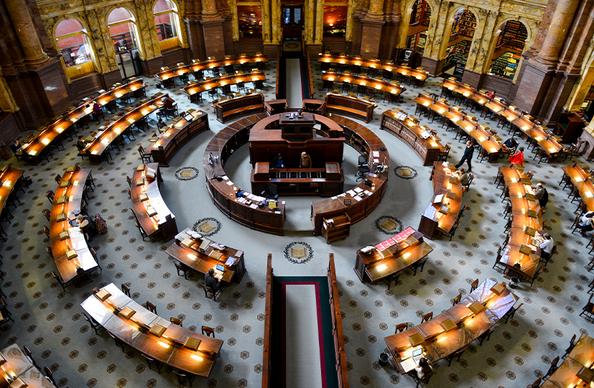
  • The Library’s Main Reading Room, anchored by its iconic desk. Photo: Shawn Miller.

    “A Marvel of Ingenuity” — The Library’s Main Reading Room

    December 4, 2025, Posted by: Neely Tucker

    —This is a guest post by Jane A. Hudiburg, an analyst in the Congressional Research Service. It also appears in the September/October issue of the Library of Congress Magazine.

    In 1888, Ainsworth Rand Spofford, the sixth Librarian of Congress, detailed his vision for the public reading room in the new Congressional Library — now known as the Thomas Jefferson Building. The space should follow the example set by the British Museum Library and be “circular or octagonal in form, so that all parts of it may be commanded” from the center.

    To realize this panopticon concept, Spofford provided specifications for a “massive circular desk” that would give librarians and the Main Reading Room superintendent a view of every researcher, the card catalog and each alcove representing a major realm of knowledge.

    Meanwhile, from the eye of the room’s domed ceiling, the figures in the aptly named painting “Human Understanding” could monitor the books springing forth from conveyor systems that connected the control room under the central desk to the stacks, the Capitol and eventually the John Adams Building and beyond. In her memoir “Thirty Years in Washington” (1901), Mary Cunningham Logan, the widow of Sen. John A. Logan, called the entire process — identifying, requesting and delivering books — a “marvel of ingenuity.”

    The Library’s Main Reading Room as seen from high above. Photo: Shawn Miller.

    Since that observation, the ingenious process has changed. The computer catalog replaced the card catalog; Electronic Book Paging phased out the call slips sent by pneumatic tubes; the book carrier pulled by continuously moving chains ceased operation, as did its replacement — a specialized elevator that lifted books from the control room into the reading room.

    The tunnel to the Capitol, which once allowed the quick transport of materials to members of Congress, closed prior to the construction of the Capitol Visitor Center. And, the Library began providing content online, allowing researchers all over the world to access its digitized collections. Still, the mahogany central desk remains a powerful symbol — a direct connection between knowledge and its seekers and the never-ending quest to deepen and expand all human understanding.

    Continue/Read Original Article Here: “A Marvel of Ingenuity” — The Library’s Main Reading Room | Timeless

    #Blog #LibraryOfCongress #LibraryOfCongressBlog #MainReadingRoom #Timeless #TimelessStoriesFromTheLibraryOfCongress

    Fuel for the Festivities – The Thanksgiving Breakfasts of Yesteryear – Inside Adams

    Inside Adams Science, Technology & Business, ISSN 2691-3690

  • Home
  • Fuel for the Festivities: The Thanksgiving Breakfasts of Yesteryear
  • An illustrated heading from the 1903 “Woman’s Favorite Cookbook.”

    Fuel for the Festivities: The Thanksgiving Breakfasts of Yesteryear

    November 21, 2025, Posted by: Jennifer Harbster

    The quintessentially American holiday, Thanksgiving evokes images of vast dinner spreads, centered on turkey, and as we cook and bake, prepare and labor on these elaborate feasts, who has time to think about breakfast? Well, some cookbook authors in the 1900s didn’t forget breakfast when they shared their Thanksgiving Day menus!

    Front cover of the 1903 “Landmarks Club Cook Book.”

    A hearty Thanksgiving breakfast menu of chicken pot pie, a common breakfast dish served at Thanksgiving of the time; baked potatoes; baked sweet apples; and coffee comes from the Landmarks Club of California. In 1903, to help raise money to preserve California’s Spanish missions, club founder Charles Fletcher Lummis and the members published “The Landmarks Club Cook Book” (Los Angeles,1903).  Lummis, the first city editor of the “Los Angeles Times” and head librarian of the city’s public library, had spent time traveling throughout Latin America.  Consequently, he was able to contribute authentic Mexican and Peruvian recipes and essays to the cookbook. Along with recipes for tamales, enchiladas, chiles rellenos, and mole; the book features a section of menu plans for picnics, seasonal bills of fare, special luncheons, dinners and suppers.

    The Thanksgiving Day menu page from the 1902 “Woman’s Favorite Cook Book,” pg. 36

    Boasting of  “three thousand helpful suggestions and recipes” and assisted by “one thousand home keepers,” Annie R. Gregory’s “Woman’s Favorite Cook Book” (Chicago, 1902) includes a menu for Thanksgiving Day which presents a substantial Thanksgiving breakfast of grapes, oatmeal, sausage, eggs, potatoes and griddle cakes (e.g. pancakes). In the book, Gregory described herself as a “home caterer, successful housewife, and ideal mother.” When writing her cookbook, she solicited and curated recipes from friends and families from across the U.S. “Woman’s Favorite Cook Book” is really three books in one. The first section includes menu plans; food preparation techniques; and recipes, divided into categories by main ingredient (e.g. fish) or dish type (e.g. soup). The second section is dedicated to vegetarian recipes, while the third features household tips.

    Continue/Read Original Article Here: Fuel for the Festivities: The Thanksgiving Breakfasts of Yesteryear | Inside Adams

    #breakfasts #festivities #insideAdams #libraryOfCongress #libraryOfCongressBlog #scienceTechnologyBusiness #thanksgiving #thanksgivingDay #yesteryear

    Paleontology, Past and Present: A New Primary Source Set for Educators – Teaching with the Library

    Norman Ross of the division of Paleontology, National Museum, preparing the skeleton of a baby dinosaur some seven or eight million years old for exhibition. 1921.

    Teaching with the Library Primary Sources & Ideas for Educators, ISSN 2691-6916

  • Home
  • Paleontology, Past and Present: A New Primary Source Set for Educators
  • Norman Ross of the division of Paleontology, National Museum, preparing the skeleton of a baby dinosaur some seven or eight million years old for exhibition. 1921.

    Paleontology, Past and Present: A New Primary Source Set for Educators

    November 20, 2025, Posted by: Colleen Smith

    This post is by Jessica Fries-Gaither, a 2024-2025 Albert Einstein Distinguished Educator Fellow at the Library of Congress.

    Primary sources are excellent tools for conveying the nature and practices of science. By providing a firsthand look at the types of questions scientists pose as well as the methods and strategies they employ to answer them, primary sources humanize the scientific endeavor in ways that other materials cannot. And there may be no scientific discipline better suited to such an “inside look” than paleontology. The study of fossilized remains and what they can teach us about Earth’s history is rife with uncertainty, incomplete data sets, and an ever-evolving understanding of the subject.

    A new primary source set from the Library of Congress features 18 primary sources that teachers can use to bring forward the nature of science while also addressing science content standards about paleontology, the fossil record, and geologic time. Through close looking and thoughtful analysis of these items, students can learn about significant paleontological discoveries and practice the types of thinking and questioning employed by professional paleontologists.

    The set includes primary sources in diverse formats (photographs, drawings and engravings, newspaper articles, maps, diagrams, and even a piece of congressional legislation) spanning the early years of paleontology to present day. Dig in and discover:

    • newspaper accounts recounting major discoveries, including Tyrannosaurus rex and fossilized dinosaur eggs!
    • engravings of petrified wood and fossil skulls from Robert Hooke’s Micrographia and Charles Darwin’s Voyage on the H.M.S. Beagle.
    • photographs showing how fossil remains are discovered in the field, as well as how skeletons are constructed and displayed.
    • maps sharing the distributions of rocks and fossils from different geologic time periods.
    Toxodon skull, side view. In The Zoology of the Voyage of the H.M.S. Beagle. 1839.

    The Paleontology, Past and Present primary source set also includes background information, teaching suggestions, and links for additional information and primary sources. We hope that you and your students will find it to be a helpful resource!

    Categories

    Continue/Read Original Article Here: Paleontology, Past and Present: A New Primary Source Set for Educators | Teaching with the Library

    #colleenSmith #educators #libraryOfCongress #libraryOfCongressBlog #paleontology #past #present #primarySourceSet #primarySources #teachingWithTheLibrary

    Teaching About Community and Place with Library of Congress Maps – Teaching with the Library

    Teaching with the Library Primary Sources & Ideas for Educators

    ISSN 2691-6916, Share & Subscribe to this blog

  • Home
  • Teaching About Community and Place with Library of Congress Maps
  • Bird’s eye view of the city of Frankfort, the capital of Kentucky 1871.

    Teaching About Community and Place with Library of Congress Maps

    November 18, 2025, Posted by: Colleen Smith, Share this post…

    Teaching the concept of community to elementary students often emphasizes a local community that students are members of, such as a school, neighborhood, town, or city. Maps from the Library’s collections offer teachers a range of tools for helping students see, think about, and form questions to develop a sense of place.

    For example, in the primary source set, Community: People and Places, a panoramic map gives students a particular perspective of a city.

    Sometimes referred to as “bird’s-eye views,” panoramic maps are great for helping students see different landscapes, street patterns, and prominent buildings. These engaging visual maps can be especially meaningful to young learners. Browse maps by state to locate panoramic maps closest to where your students live.

    How teachers use panoramic maps will vary depending what aspect of community they want to explore; however, a few ideas might include:

    • Identify and trace waterways shown on a map. What do students notice about the waterway? What do they see on the map that is close to the waterway? Why might it be located there?
    • Encourage students to look at street patterns. What clues can students find that tell them which streets have homes or buildings? Where are these streets located on the map?
    • Project a contemporary map of the same city or town that the panoramic map shows. Ask: What do they notice about how the place has changed over time? What is different and what is similar?
    • Older elementary students might spend time with the map key. Encourage students to look for patterns and ask questions about what types of institutions are included in the key, what surprises them, and why.

    The “Additional Resources” section of the Community: People and Places primary source set includes Sanborn Maps, another type of map that could be helpful for exploring different aspects of community and place.

    The Sanborn map collection includes large-scale maps of commercial, industrial, and residential sections of thousands of cities and towns in the United States, Canada, and Mexico. The maps show the shape and construction of homes, commercial buildings, and factories as well as names of streets and property boundaries. You can search the collection by state and then by city or county.  A fascinating use of the Sanborn maps is to explore change over time. This essay details several examples and might inspire ideas to modify for elementary-age students.

    Detail from a series of Sanborn Maps of Santa Fe, New Mexico

    If you are looking for maps that go beyond a local orientation of community, the Cities and Towns Collection features maps that detail places throughout the world. These maps might be helpful as students start to orient to community in a state, national, or even global context.

    If you use maps from these collections with your students, we would love to hear about it! Please share your experiences and teaching recommendations in the comments.

    Continue/Read Original Article Here: Teaching About Community and Place with Library of Congress Maps | Teaching with the Library

    #community #frankfortMap1871 #issn26916916 #kentucky #libraryOfCongress #libraryOfCongressBlog #maps #newMexico #place #sanbornMaps #santaFe #teachingWithMaps

    Community Helpers, Leaders, and Primary Sources – Teaching with the Library – Library of Congress

    Delano, Jack, photographer. Chicago, Illinois. Ida B. Wells Housing Project. A meeting of the Cub Scouts in the community center. Chicago United States Cook County Illinois, 1942. Mar. Photograph. https://www.loc.gov/item/2017828851/.

    Teaching with the Library Primary Sources & Ideas for Educators

    ISSN 2691-6916

  • Home
  • Community Helpers, Leaders, and Primary Sources
  • Community Helpers, Leaders, and Primary Sources

    Posted by: Colleen Smith, September 30, 2025

    The concept of community helpers or leaders offers a starting place for teaching civics to young learners. Students can make a connection to the idea, reflect on their experiences with it, and ask meaningful questions about the importance of helpers and leaders.

    A new primary source set, Community: People and Places, includes items related to helpers and leaders in a community. By modeling and then guiding students in a thinking routine of observing a source, reflecting on what it shows, and asking their own questions about it, teachers can support young learners’ work with primary sources and build understanding of important civic concepts such as:

    • explaining the roles of important local community members;
    • identifying helpers and leaders, including in their school, neighborhood, and town or city;
    • describing the responsibilities of individual leaders to meet the needs of different people and communities.
    Rothstein, Arthur, photographer. Health clinic. Shafter migrant camp. Shafter, California. Kern County California Shafter United States, 1940. Mar. Photograph. https://www.loc.gov/item/2017774794/.

    Instructional Strategies

    Select several sources from the set that highlight community helpers and leaders. Teachers might want to select items that reflect a range of people and places, such as:

    Using these or your own selections, model how to make observations about an item. Show one item and talk through your process: What do I see? What people or objects are shown? Students might participate with you and add to your observations.

    Students may naturally offer reflections about the image. Model reflecting and support their thinking with questions such as: What do I think is happening in the image? What does this image show about helping someone or something? Students may have their own reflections to share, as well as new questions.

    Finally, encourage students to ask even more questions about the item. What do they wonder about? You might begin with a question you have about the item to help students get started. Students may need support in bringing their questions back to the ideas of communities, leaders, and helpers.

    Teachers might follow this same process for other images or let students select an item that they want to explore. Depending on the needs and dynamics of their classroom, teachers could set up other activities that ask students to observe, reflect, and question but in different ways, such as with a gallery walk, primary source stations, and small group talks.

    To close the activity, invite students to name community helpers or leaders in their school. Students could create their own source by drawing a helper or leader at work. In their drawing they should show what a person is doing (role) and how a person is helping (responsibilities).

    We’ll be sharing more teaching ideas related to the Community: People and Places set in the coming weeks. If you use the set, we’d love to hear what strategies you have: Please share in the comments!

    Continue/Read Original Article Here: Community Helpers, Leaders, and Primary Sources | Teaching with the Library

    #2025 #America #DonaldTrump #Education #Health #History #Libraries #Library #LibraryOfCongress #LibraryOfCongressBlog #Politics #Resistance #Science #TeachingWithTheLibrary #Technology #Trump #TrumpAdministration #UnitedStates