
🔎 Preliminary watershed delineation for the Inhulets River study

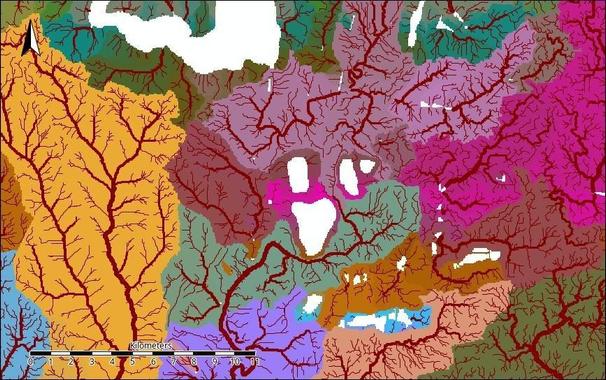
One of the early intermediate products from my broader research on the anthropogenic impacts on the #InhuletsRiver.
This map shows a preliminary delineation of local drainage basins across the study area, derived from high-resolution DEM processing and hydrological modelling.

The goal of this stage is to establish a consistent spatial framework for later analyses — including flow pathways, contaminant transport patterns, and the interaction between surface and groundwater systems.

#GIS #Hydrology #Watershed #Geomorphology #OpenData #RemoteSensing #Geospatial #RStats #SAGA #QGIS #EnvironmentalScience #LandscapeGeochemistry #Copernicus #DEM #GeoDataArt
“If the map does not match the terrain — trust the terrain!”
— Principle of field geoscience

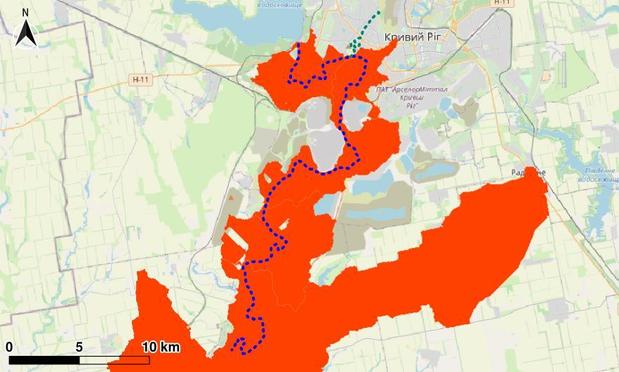
This is how the effective catchment area of the Inhulets River looks within the study region.

The upstream part — above the Karachunivske Reservoir's dam, the outlet of the Saksahan derivative tunnel, and the confluence of the Stara Saksahan River — was excluded from the calculation.

Within the analyzed area, surface runoff is possible only from the highlighted zone.
The rest of the “catchment basin” is hydrologically inactive: runoff is intercepted by ponds, settling tanks, and other anthropogenic landforms.

🌍 The analysis was based on the Copernicus GLO-30 DEM, integrated with hydrological modeling and terrain processing in open-source GIS.

#Hydrology #Geochemistry #InhuletsRiver #GIS #SAGAGIS #QGIS #HydrologicalModeling #RemoteSensing #GeospatialAnalysis #EnvironmentalData #RStats #LandscapeGeochemistry #Copernicus