Democracy Dies in Broad Daylight – The New Yorker

Photograph by Kent Nishimura / Bloomberg / Getty

The Daily

Democracy Dies in Broad Daylight

By David Remnick, February 8, 2026

You’re reading The New Yorker’s daily newsletter, a guide to our top stories, featuring exclusive insights from our writers and editors. Sign up to receive it in your inbox.

Photograph by Kent
Nishimura / Bloomberg
/ Getty

It’s truly impossible to keep up, isn’t it?

Last week—after the Wall Street Journal broke more news about the Trump family’s dodgy crypto-business dealings and before the President shared a racist video of the Obamas depicted as dancing apes—the Amazon entrepreneur Jeff Bezos decided that one of his smaller properties, the Washington Post, has proved such a drag on his two-hundred-and-thirty-billion-dollar fortune that prudence required that he obliterate much of its newsroom.

Early in his proprietorship, Bezos endorsed a new motto for the paper: “Democracy Dies in Darkness.” It turns out that one of democracy’s most celebrated media institutions can be strangled in broad daylight.

On Wednesday, Bezos and the paper’s leadership fired a third of the staff. They shuttered or vastly reduced an array of sections. Lizzie Johnson, one of the Post’s leading foreign correspondents, received her digital pink slip while working in the war zone of Ukraine. Bezos did not offer his staff the decency of a public explanation, much less a gesture of generosity or regret. The publisher and C.E.O. Will Lewis did not appear on the “webinar” at which the cuts were explained to the staff. He did, however, manage to head off to the Super Bowl festivities. By Saturday evening, Lewis had resigned. His work was done. He will be succeeded by the paper’s chief financial officer, Jeff D’Onofrio, who has held posts at Tumblr, Google, and Yahoo.

As someone who worked happily at the Post for a decade a long time ago, and as an ardent reader of the paper, I am sick about all this. I feel like someone forced to watch an arsonist torch the house he grew up in. I cannot imagine how it must feel for the current staff and the hundreds forced to leave. If that is sentimentality or worse, well, then guilty as charged. The loss is terrible, the behavior is beyond heedless. The reporters and editors who remain at the Post will undoubtedly go on doing honorable work, but they must now do so for a proprietor who shows them no respect. And that is no way to live. (Ruth Marcus, a writer and editor at the paper for more than forty years, brings home superbly the anger and the sadness of the situation.)

Over the years, in these pages, I’ve written about both the former owner Katharine Graham and Ben Bradlee, the paper’s Watergate-era editor; for all their complexities, these were figures who built a great newspaper out of a mediocre one, who developed an institution that worked not only in the interest of financial gain but of democratic vitality. That standard of quality endured, but, by 2013, Don Graham, a decent man and a devoted publisher who inherited the leadership of the company from his mother, came to realize that the revolutions in technology and the declines in advertising were so severe that he no longer had the capacity to invest effectively in the paper. After a long search, he sold the Post to Bezos, a vastly wealthier owner who promised to be an effective custodian.

For a while that worked; under Marty Baron, the paper was fiercely competitive, and thrived during Trump’s first term in office. Bezos was a decidedly detached owner, but he gave the newsroom what it needed and invested in both journalism and the technological support it requires.

But during the Biden years, readership declined and, by 2024, as Trump headed toward a second election victory, Bezos clearly reassessed his interests and his sense of risk. His timidity prevailed. He quashed the paper’s impending endorsement of Kamala Harris. He sat in Oligarch Row at the Inauguration. He instructed the Opinion section to set a new, more conservative course. These were his prerogatives, many argued, but they were hardly wise. With every move, more subscribers fled—surely one of the worst own goals in the history of the news business.

Undoubtedly, Bezos believes that all the criticism that has come his way is naïve, self-righteous, and terribly unfair. How could his critics possibly understand the business the way he does? In some sense, every aggressive story on the Administration that the paper publishes allows Bezos to tell himself that he has not retreated at all.

For the sake of financial and moral context, perhaps this is as good a time as any to remind ourselves of the maritime interests of the Post’s proprietor. Some commentators have mentioned that Bezos, in order to better support the Post, might have held on to the tens of millions of dollars he spent to bankroll “Melania,” a documentary portrait of the First Lady worthy of a long run at the Pyongyang Cinematheque. Cooler financial heads will contend that this is a cheap point. The Post’s losses are more significant. And they are right. Better then to turn to one of the Amazon founder’s more expensive recreations, his 125.8-metre, three-masted sailing yacht, Koru. (No need to get into the details of Abeona, the seventy-five-million-dollar “shadow boat” that trails Koru and provides a helipad and adequate space for extra staff.)

Koru cost an estimated five hundred million dollars. This is double what Bezos paid for the Washington Post. Annual maintenance runs tens of millions of dollars. It is, to be sure, a very special boat. According to Architectural Digest, “Bezos’s superyacht has a classical style, with a navy-blue steel hull and a two-level white aluminum superstructure. The ship’s teak decks include spots for outdoor lounging as well as three Jacuzzis and a swimming pool. Robb Report notes that the hull features traditional portholes, while the upper deck windows are smaller than typical, which might help to foil paparazzi trying to capture guests inside.” If that information about the boat is not galling enough, there is more: the Journal published a story on Friday by Richard Rubin headlined “Trump’s New Tax Law Saved Amazon Billions.” But the Ukraine correspondent had to go.

In the world of tech, so many of the leading tycoons and V.C. geniuses have a way of convincing themselves that because they have made a fortune, because they know one big thing, they know everything. Everyone else is a Luddite or a dewy-eyed fool. Maybe Bezos will find a way to stay in good odor with a vindictive President and, at the same time, transform the Post so that it can “do more with less,” and all those other whiteboard phrases popular from Wall Street to Palo Alto. No one doubts that change, even painful change, is necessary. But the scale of the cuts last week, coupled with the lack of any sense of a strategy other than retreat, is beyond demoralizing. Bezos has made it plain that his commitment to the Post, to say nothing of his performative talk about democracy, has diminished to the vanishing point.

The Post is hardly the first major American publication to face a financial crisis. It wasn’t so long ago that the Times was caught in an existential fix. Who would buy it, people asked knowingly, the Mexican billionaire Carlos Slim or Michael Bloomberg? And yet the Sulzberger family, with a tiny fraction of the Bezos fortune but infinitely greater determination and integrity, found a way to thrive.

Bezos, by contrast, is immersed in his primary business, a space race, an active vacation life, and much else. After a promising beginning at the paper, he just does not seem to have the focus or the courage to do what is necessary to guide the Post through an unstable and threatening era. With Trump in office, he refuses to see that, although the Post is valued less in financial terms than his yacht, he is responsible for a priceless commodity. Will he rock the boat? Will he ultimately do the right thing? So far, the evidence offers only misery.

 Editor’s Note: Thank you, David Remnick, good article and journalism. The dying of a national newspaper, which all my life I was proud of say, “Independent,” but no more. –DrWeb

Continue/Read Original Article Here: Democracy Dies in Broad Daylight | The New Yorker

#300Journalists #DavidRemnick #Editorial #Firings #JeffBezos #KamalaHarris #KatherineGraham #Money #NationalNewspaper #OneThirdNewsroom #PersonalEssay #TheNewYorker #TheWashingtonPost #Trump
Democracy Dies in Broad Daylight

From the daily newsletter: the dismantling of the Washington Post is a choice, not a necessity, and the blame lies with Jeff Bezos.

The New Yorker

The real reason why Jeff Bezos killed the Washington Post. – Slate

The Media

Jeff Bezos Killed the Washington Post

The billionaire wanted the Post to die, because a vigorous, well-resourced newspaper does not help his bottom line.

By Alex Kirshner, Feb 05, 202611:07 AM

Photo illustration by Slate. Photos by Arnold Jerocki / FilmMagic and Andrew Harnik /Getty Images.

Copy Link Share Comment

Sign up for the Slatest to get the most insightful analysis, criticism, and advice out there, delivered to your inbox daily.

Jeff Bezos killed the Washington Post on Wednesday. The paper survives as a husk, but the institution that became one of the cathedrals of world journalism is gone. The biggest mistake one could make in analyzing this corporate slaughter is to lay the blame solely on the state of journalism. That’d be wrong.

Times are hard in journalism, just like they always are. The big new problem is A.I. swallowing up search traffic, which itself had already sucked up the ad revenue that used to go to newspapers and magazines. Otherwise, all of the things that have been hard for the past 20 years are still hard now. Powerful corporate interests have captured great newsrooms, or run their own old family businesses into the ground. Fox News, social media, and podcasts—in that chronological order—have cocooned a lot of people to want only “news” that isn’t really news. Megyn Kelly is now a red-meat podcaster instead of an occasionally punchy Fox host.

The Post laid off 300 journalists on Wednesday. This included more or less the entire remaining staff of the paper’s legendary sports section, which produced several of the best writers to ever do the job. The days of the superstar columnist with the biggest megaphone in town were long gone, but the section remained tremendous. The paper slashed its international coverage, laying off a journalist who found out as she reported from Kyiv. Many editors across desks lost their jobs. Worst of all, not that it’s a contest, but the Washington Post will now be a lot less Washingtonian. The paper has fired at least a substantial chunk of its metro reporters, who serviced a city and region that have been under a multifront attack from the Trump administration.

In a stiff email, Post executive editor Matt Murray tried to make this move sound like yet another example of a tough business forcing tough decisions. “The ecosystem of news and information, on- and off-platform, is changing radically,” Murray wrote to his staffers, fired and not. He lamented the “serious decline” of search traffic. He wrote of increased competition from other people, other platforms.

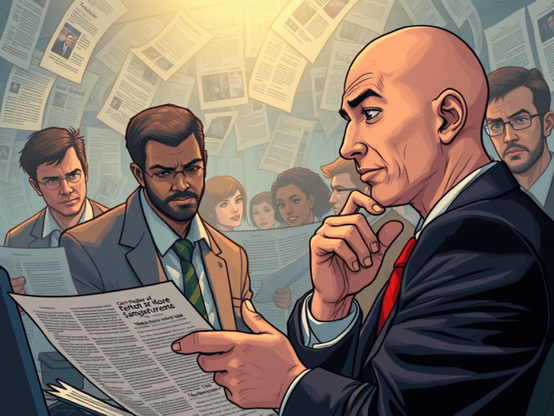
AI image…

He did not write about one specific person: Bezos, who bought the paper from the Graham family in 2013 for $250 million. (Note: Slate is owned by Graham Holdings, the company controlled by the Graham family.)

That is because Murray values his paycheck and didn’t want to point out the Post’s real cause of death—namely, that one of the richest people in human history staged a controlled burn to turn it into ash. Bezos wanted the Post to die, because a vigorous, well-resourced Washington Post does not suit his vision for the world or his own bottom line. The end of the Post is a matter not of journalistic economics but of Bezos’ incentives.

Whatever the Post is worth today is immaterial to Bezos’ wealth. It’s barely even what you’d call a rounding error. Bezos could sustain the Post’s operating losses for hundreds of lifetimes without even threatening his current wealth, let alone the additional wealth he and his heirs will amass passively in years to come from his stakes in Amazon, Blue Origin, and who knows what else.

A man worth more than $240 billion does not care even a little bit, in pure dollar terms, about a $100 million annual loss running a prestige business. When Bezos bought the paper, he made clear to the Post’s prior management that he viewed the paper not purely through a profit lens, the New York Times reported. Bezos wrote to Post employees, “The paper’s duty will remain to its readers and not to the private interests of its owners.” That turned out to be, at best, incredibly misleading.

The Post itself doesn’t affect Bezos’ vast fortune much, but what it represents does. One of the employees he laid off on Wednesday was the paper’s Amazon reporter, Caroline O’Donovan. More critically, even under Bezos’ ownership, the Post frequently published stories that upset the Trump administration, whose vindictive approach to regulation could pose obvious problems for Amazon and Bezos’ space company, Blue Origin.

Related From Slate

Mary ZieglerHow Trump Used a Law Meant to Protect Abortion Seekers to Arrest Members of the Press Read More

Bezos understood this risk more than a year ago, when he drove away 250,000 paying subscribers by stepping in to prevent the paper from endorsing Kamala Harris. Bezos then transformed the Post’s opinion section, away from a broad-based page and into a propaganda arm devoted to promoting “personal liberties and free markets.”

The paper’s executives and owner punted away from aggressively covering Trump’s second term, bleeding both subscribers and a general share of viral stories that instead went to competitors like the Times and Wall Street Journal. There was money to be made by investing in the paper’s reporting staff, who never stopped doing their best to provide honest (and necessarily adversarial) coverage of Trump. Bezos just didn’t want that money.

Editor’s Note: Read the rest of the story, at the below link.

Continue/Read Original Article Here: The real reason why Jeff Bezos killed the Washington Post.

#AI #Competitors #JeffBezos #Journalism #KatherineGraham #Killed #MattMurray #NewspapersChanging #RealReason #Slate #SocialMedia

The real reason why Jeff Bezos killed the Washington Post. – Slate

The Media

Jeff Bezos Killed the Washington Post

The billionaire wanted the Post to die, because a vigorous, well-resourced newspaper does not help his bottom line.

By Alex Kirshner, Feb 05, 202611:07 AM

Photo illustration by Slate. Photos by Arnold Jerocki / FilmMagic and Andrew Harnik /Getty Images.

Copy Link Share Comment

Sign up for the Slatest to get the most insightful analysis, criticism, and advice out there, delivered to your inbox daily.

Jeff Bezos killed the Washington Post on Wednesday. The paper survives as a husk, but the institution that became one of the cathedrals of world journalism is gone. The biggest mistake one could make in analyzing this corporate slaughter is to lay the blame solely on the state of journalism. That’d be wrong.

Times are hard in journalism, just like they always are. The big new problem is A.I. swallowing up search traffic, which itself had already sucked up the ad revenue that used to go to newspapers and magazines. Otherwise, all of the things that have been hard for the past 20 years are still hard now. Powerful corporate interests have captured great newsrooms, or run their own old family businesses into the ground. Fox News, social media, and podcasts—in that chronological order—have cocooned a lot of people to want only “news” that isn’t really news. Megyn Kelly is now a red-meat podcaster instead of an occasionally punchy Fox host.

The Post laid off 300 journalists on Wednesday. This included more or less the entire remaining staff of the paper’s legendary sports section, which produced several of the best writers to ever do the job. The days of the superstar columnist with the biggest megaphone in town were long gone, but the section remained tremendous. The paper slashed its international coverage, laying off a journalist who found out as she reported from Kyiv. Many editors across desks lost their jobs. Worst of all, not that it’s a contest, but the Washington Post will now be a lot less Washingtonian. The paper has fired at least a substantial chunk of its metro reporters, who serviced a city and region that have been under a multifront attack from the Trump administration.

In a stiff email, Post executive editor Matt Murray tried to make this move sound like yet another example of a tough business forcing tough decisions. “The ecosystem of news and information, on- and off-platform, is changing radically,” Murray wrote to his staffers, fired and not. He lamented the “serious decline” of search traffic. He wrote of increased competition from other people, other platforms.

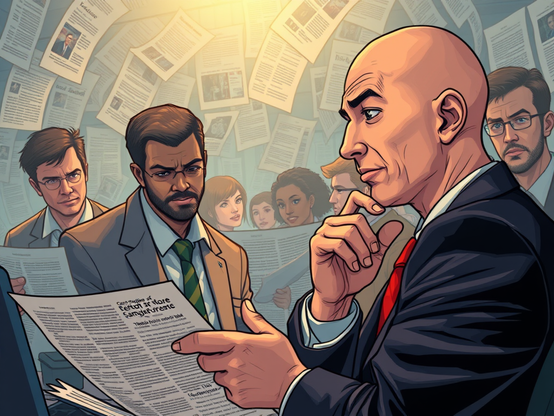
AI image…

He did not write about one specific person: Bezos, who bought the paper from the Graham family in 2013 for $250 million. (Note: Slate is owned by Graham Holdings, the company controlled by the Graham family.)

That is because Murray values his paycheck and didn’t want to point out the Post’s real cause of death—namely, that one of the richest people in human history staged a controlled burn to turn it into ash. Bezos wanted the Post to die, because a vigorous, well-resourced Washington Post does not suit his vision for the world or his own bottom line. The end of the Post is a matter not of journalistic economics but of Bezos’ incentives.

Whatever the Post is worth today is immaterial to Bezos’ wealth. It’s barely even what you’d call a rounding error. Bezos could sustain the Post’s operating losses for hundreds of lifetimes without even threatening his current wealth, let alone the additional wealth he and his heirs will amass passively in years to come from his stakes in Amazon, Blue Origin, and who knows what else.

A man worth more than $240 billion does not care even a little bit, in pure dollar terms, about a $100 million annual loss running a prestige business. When Bezos bought the paper, he made clear to the Post’s prior management that he viewed the paper not purely through a profit lens, the New York Times reported. Bezos wrote to Post employees, “The paper’s duty will remain to its readers and not to the private interests of its owners.” That turned out to be, at best, incredibly misleading.

The Post itself doesn’t affect Bezos’ vast fortune much, but what it represents does. One of the employees he laid off on Wednesday was the paper’s Amazon reporter, Caroline O’Donovan. More critically, even under Bezos’ ownership, the Post frequently published stories that upset the Trump administration, whose vindictive approach to regulation could pose obvious problems for Amazon and Bezos’ space company, Blue Origin.

Related From Slate

Mary ZieglerHow Trump Used a Law Meant to Protect Abortion Seekers to Arrest Members of the Press Read More

Bezos understood this risk more than a year ago, when he drove away 250,000 paying subscribers by stepping in to prevent the paper from endorsing Kamala Harris. Bezos then transformed the Post’s opinion section, away from a broad-based page and into a propaganda arm devoted to promoting “personal liberties and free markets.”

The paper’s executives and owner punted away from aggressively covering Trump’s second term, bleeding both subscribers and a general share of viral stories that instead went to competitors like the Times and Wall Street Journal. There was money to be made by investing in the paper’s reporting staff, who never stopped doing their best to provide honest (and necessarily adversarial) coverage of Trump. Bezos just didn’t want that money.

Editor’s Note: Read the rest of the story, at the below link.

Continue/Read Original Article Here: The real reason why Jeff Bezos killed the Washington Post.

Tags: AI, Competitors, Jeff Bezos, Journalism, Katherine Graham, Killed, Matt Murray, Newspapers Changing, Real Reason, Slate, Social Media
#AI #Competitors #JeffBezos #Journalism #KatherineGraham #Killed #MattMurray #NewspapersChanging #RealReason #Slate #SocialMedia

A National Newspaper Falls — and Democracy Feels It

Why the Dismantling of The Washington Post Is a National Warning

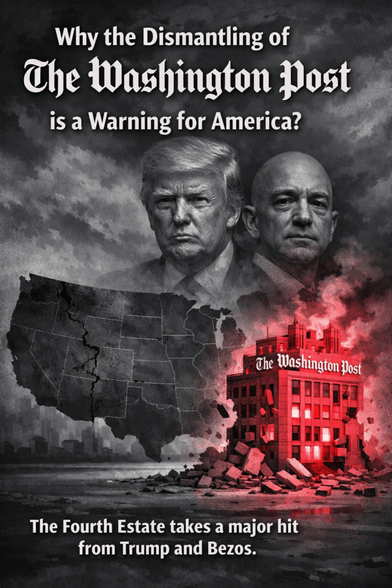
By DrWeb, assisted by AI. All content, images edited and approved. Some images are also public domain, as noted in the captions.

AI image, created by Sora. Washington post Editorial 1 by Michael McCulley is marked CC0 1.0 Universal. To view a copy of this mark, visit https://creativecommons.org/publicdomain/zero/1.0/

On February 4, 2026, the American people lost a vital organ of their democracy. It didn’t happen in a courtroom or through a legislative act; it happened on a Zoom call.

When Executive Editor Matt Murray and CEO Will Lewis announced the termination of over 300 journalists—one-third of a newsroom that once stood as the world’s watchdog—they used the bloodless language of corporate “restructuring.” They spoke of search engine algorithms, the rise of Generative AI, and the “disappointing realities” of the media market. But we must see through the fog. This was not a business adjustment; it was a surrender.

The Washington Post has, for over 150 years, been a “living laboratory” of modern journalism. It was the place where the impossible stories were told, where “Darkness” was fought with a relentless, expensive, and often dangerous pursuit of the truth. By gutting the foreign desks and local Metro coverage, leadership has essentially declared that the world—and the citizens of the nation’s capital—no longer deserve to be seen.

II. A Legacy Forged in Fire: Vietnam and the Pentagon Papers

To understand the depth of this betrayal, one must remember what the Washington Post used to be. In 1971, the paper faced a choice that would define the First Amendment for a generation. When the Nixon administration secured an injunction against the New York Times to stop the publication of the Pentagon Papers, it was Katherine Graham and Ben Bradlee who stepped into the breach.

They knew that publishing those top-secret documents—which proved the government had systematically lied about the Vietnam War—could lead to criminal charges or the financial ruin of the paper. They did it anyway. They understood that the press’s duty is to the governed, not the governors. That Post saved this country by exposing the “GIGO (Garbage in, Garbage out” of the military-industrial complex. It proved that a newsroom, armed with the truth and the courage to print it, could stop a war machine. Today, that same newsroom is being hollowed out by a billionaire who appears more concerned with federal contracts than with the legacy of Graham.

III. The Specter of Anticipatory Obedience

The layoffs of 2026 are the completion of a bow toward power that began in October 2024. When Jeff Bezos spiked the Post’s endorsement of Kamala Harris, he was signaling a pivot toward compliance.

As his other companies —Amazon and Blue Origin— depend on massive federal contracts, the Post’s editorial independence has become a “rounding error” on a billionaire’s balance sheet. We are seeing a return to the dark days of “anticipatory obedience,” where the press silences itself to avoid the wrath of a vengeful administration. When the reporter covering Amazon itself is among the first to be fired, the watchdog is no longer guarding the public; it is guarding the owner.

IV. The Human Cost: Fired in a War Zone

The cruelty of these layoffs is exemplified by the case of Lizzie Johnson. A dedicated Ukraine correspondent, Johnson was notified of her layoff while on the ground in a war zone—working without heat or power in sub-zero temperatures to bring the reality of the Russian invasion to American doorsteps. To fire a journalist while they are literally under fire is the ultimate indictment of modern corporate “news.” By erasing the entire Middle East roster, the Post is blinding the American public to global realities at a moment when awareness is a matter of national survival.

V. What Can We Do?

Washington post Editorial 1 by Michael McCulley is marked CC0 1.0 Universal. To view a copy of this mark, visit https://creativecommons.org/publicdomain/zero/1.0/

My small site, a small but growing blog, remains (for now) a small, independent voice, but we are not silent, nor will we be. The death of the Post as we knew it means the burden of truth-seeking falls back onto We the People, and other media, and the resources they can use to report news and facts and fact-checking.

  • Follow the Outcasts: Support the 300+ journalists who still have the truth but have lost their platform. [See below for the listings we have already of fired staff.]
  • Reject the “New” Post: If a “Doorway” to truth is corrupted by billionaire interests, and with a man with real authoritarian impulses on a hair trigger, it is no longer a doorway; it is a wall. For me, the Post now has DO NOT ENTER signs.
  • Fund Independent Journalism: Our American Democratic Republic depends on newsrooms that are not beholden to corporate authorities. Find voices that sound the missing pieces again, loud as we can.

Names and Work Areas for the Post Wednesday Massacre

While the Washington Post has not released a formal master list of the 300+ employees affected by the February 4, 2026 layoffs, many journalists and editors have confirmed their departures publicly. Source of this information: Google’s Gemini.

Below is a compiled listing of names and roles identified through newsroom reports and public statements as of today, February 5, 2026.

International & Foreign Desks

The entire Middle East team and several major foreign bureaus were reportedly eliminated.

NameRole / BureauIshaan TharoorSenior International Affairs ColumnistGerry ShihJerusalem Bureau ChiefClaire ParkerCairo Bureau ChiefSiobhán O’GradyUkraine Bureau ChiefLizzie JohnsonUkraine CorrespondentAaron WienerBerlin Bureau ChiefPranshu VermaNew Delhi Bureau ChiefEva DouChina Correspondent / TechnologyNilo TabrizyVisual Forensics Reporter (covering Iran/Middle East)

Technology & Corporate Coverage

These cuts notably included reporters covering Jeff Bezos’s own company, Amazon.

NameRoleCaroline O’DonovanAmazon Beat ReporterJoseph MennTechnology Reporter (Cybersecurity/Disinformation)Heather KellyTechnology Reporter (San Francisco)Geoff FowlerTechnology ColumnistNix (First name pending)Tech ReporterDanielle AbrilTech Reporter

Metro & Local Coverage (D.C., MD, VA)

The Metro desk was reduced from over 40 staffers to approximately 12.

NameRoleMichael Brice-SaddlerPeople and Politics ReporterMarissa LangEnterprise ReporterRachel WeinerTransportation ReporterEmma UberCrime and Criminal Justice ReporterKarina ElwoodVirginia Education ReporterDan Rosenzweig-ZiffHigher Education & Youth Culture Reporter

Specialty Desks (Sports, Books, Culture)

The Sports and Books sections were shuttered as standalone departments.

NameRoleJacob BroganBooks EditorNeil GreenbergSports Journalist / AnalyticsJada YuanNational Culture and Entertainment WriterEmmanuel FeltonRace and Ethnicity ReporterBrianna TuckerNational Politics ReporterDino GrandoniClimate/Environmental ReporterJesus RodriguezEditorial Writer / Lifestyle

Editor’s Note: Contact me via the About Page to remove your name or information from this listing.

Tactical Notes

  • The “AI Strategy”: Executive Editor Matt Murray explicitly cited AI-generated content and declining search traffic as the primary reasons for this “strategic reset.”
  • The Sports Desk Legacy: The shuttering of the High School Sports operation ends a department that had run for over 100 years.
  • Ideological Critique: Several departing reporters, including Emmanuel Felton, have publicly challenged the “financial” necessity of the move, characterizing it instead as an ideological shift.

Multimedia Evidence

The Defense of Silence: Watch Jeff Bezos’s direct response to the endorsement crisis that served as the harbinger for this dismantling.

https://www.youtube.com/watch?v=007rGogqDNo

[WATCH] Jeff Bezos defends the Washington Post’s decision

The Fourth Estate (Our Media) Responded as well.. they see what is being done to a legacy national newspaper, over politics and money. It did not fail in its mission. It was no longer allowed to be the Post.
Below is a PDF snapshot of Google News coverage (late night, 2/4/26). You can see the headlines and the sources and the reactions. –DrWeb

Google News – Search – news.google.com Washington post Editorial 2 by Michael McCulley is marked CC0 1.0 Universal. To view a copy of this mark, visit https://creativecommons.org/publicdomain/zero/1.0/Download

Bibliography (MLA Style)

SEE ALSO: Additional Deep-Dive Sources

Additional Historical Links

#2024Signal #300Outcasts #America #BenBradlee #CNN #democracy #DismantlingThePost #DonaldTrump #Education #FourthEstate #GoogleNewsCoverage #History #JeffBezos #KamalaHarris #KatherineGraham #MattMurray #NationalNewspaper #NewsCoverage #OneThirdOfNewsroom #PentagonPapers #Resistance #Surrender #TheWashingtonPost #Trump #TrumpAdministration #UnitedStates #WarningForAmerica #WillLewis #YouTube