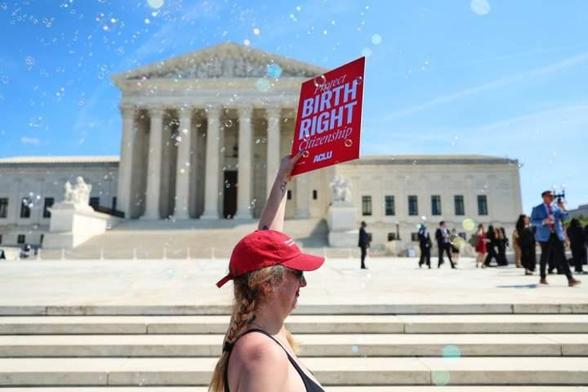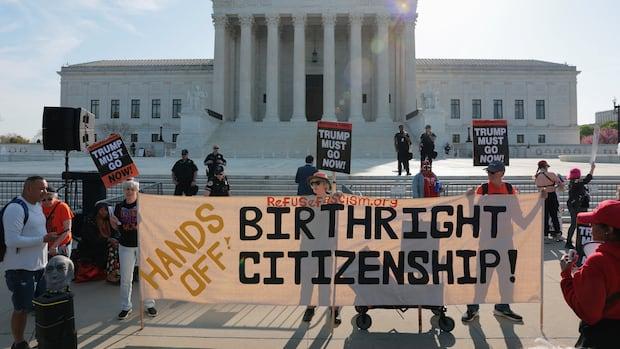
Anybody happen to know how often in the last (and so far in this) SCOTUS session what percentage of temporary holds on a lower court order has wound up being the final decision? #SCOTUS #SCOTUStemporaryholds #courtorders #justices

@verdantsquare

this article gives too much credit to piece of shit Roberts & the other #cancervative corrupt #justices, as though their decision was in good faith, rather than the will of their owners

these are member of the #GDD bought & paid for by the #ACO

giving absolute power to anyone is stupid. giving it to a brainless psychopath is straight up nefarious intent

the 6 venal perjurers of #SCOTUS should all be removed from the bench if #democracy & #justice are ever restored to the US

A justice’s most lasting legacy – SCOTUSblog

(Fred Schilling, Collection of the Supreme Court of the United States)

Home Newsletters, EMPIRICAL SCOTUS

A justice’s most lasting legacy

By Adam Feldman, on Nov 14, 2025

Empirical SCOTUS is a recurring series by Adam Feldman that looks at Supreme Court data, primarily in the form of opinions and oral arguments, to provide insights into the justices’ decision making and what we can expect from the court in the future.

Among a president’s most enduring legacies are the federal judges they appoint – particularly Supreme Court justices. This permanence stems from life tenure, a constitutional provision that ensures judicial independence but also transforms each appointment into a generational bet on the nation’s legal future.

Yet history is littered with presidential miscalculations. President Dwight D. Eisenhower supposedly called his appointment of Earl Warren as chief justice one of his “biggest mistakes,” as Warren became a liberal stalwart for over a decade. Justices John Paul Stevens and David Souter, both nominated by Republican presidents, evolved into some of the court’s most liberal members. Had Republican presidents consistently installed reliably conservative justices since the mid-20th century, the court would have been far more conservative than it actually was (and perhaps even is today).

But presidential legacy is only part of the story. The judges themselves have developed their own succession strategies. In recent years, a striking pattern has emerged: Supreme Court justices now appear ready to retire only with tacit – or perhaps explicit – assurances that they will be replaced by someone they helped shape, typically a former clerk. This, combined with the fact that so many such clerks now serve as judges on the lower courts, has had profound effects – and will continue to do so – on the federal judiciary. 

Judicial successors 

Supreme Court clerkships represent a relatively modern phenomenon, emerging primarily as the court evolved through the 20th century. The number of clerks allocated to each justice has steadily increased, from two until 1969, to three in the 1970s, and to four in 1980. This has also expanded the pool of potential judicial heirs. Justice Byron White was the first justice to have clerked for a former justice – Chief Justice Fred Vinson in his case. Chief Justice William Rehnquist clerked for Robert Jackson, and Stevens for Wiley Rutledge. Stevens was confirmed in 1975. Of the next several justices – Antonin Scalia, Anthony Kennedy, Souter, Clarence Thomas, and Ruth Bader Ginsburg – none held a Supreme Court clerkship. 

Then came Justice Stephen Breyer, confirmed in 1994, who had clerked for Justice Arthur Goldberg. The majority of justices appointed after 1994 held Supreme Court clerkships at one point in their careers – Chief Justice John Roberts for Rehnquist, Elena Kagan for Thurgood Marshall, Neil Gorsuch for Kennedy (although he was originally hired by White before his retirement), Brett Kavanaugh for Kennedy, Amy Coney Barrett for Scalia, and Ketanji Brown Jackson for Breyer. Neither Samuel Alito nor Sonia Sotomayor clerked at the Supreme Court level, leaving them a minority in this regard.

Indeed, since Kennedy retired in 2018, the phenomenon of justices being replaced by their clerks has become the norm rather than the exception. As noted, not one but two of Kennedy’s former clerks were appointed by President Donald Trump in succession: Gorsuch filled Scalia’s seat, which had remained vacant longer than any in court history, and Kennedy’s own seat went to Kavanaugh. According to Politico, Kennedy’s backroom conversations with Trump prior to his departure may have been used to facilitate a transition. For Trump, this was advantageous: he could install more consistently conservative justices than Kennedy, who had occasionally sided with liberals on consequential civil liberties cases like the same-sex marriage decision in Obergefell v. Hodges.

Panorama_of_United_States_Supreme_Court_Building_at_Dusk.jpg

This trend of former clerks joining the court continued with Barrett, a Scalia clerk, replacing Ginsburg after her death, and Jackson, a Breyer clerk, succeeding her former mentor. 

The downstream effects of Supreme Court clerkships can reshape American law across generations. Consider the lineage from Jackson to Rehnquist, who clerked for Jackson, to Roberts, who clerked for Rehnquist. And this chain of influence now spans more than half a century, with each generation of jurists passing their interpretive methods to the next.

Breaking down the numbers

But that is not the full picture. The data also reveals how widespread former Supreme Court clerks are in the federal judiciary as a whole.

Thomas leads by a substantial margin, with 12 former clerks hired as federal judges – a testament both to his long tenure and his deliberate cultivation of conservative judicial talent. Kennedy follows with 10 clerk-judges, including the two Supreme Court justices mentioned earlier. Rehnquist placed eight former clerks, continuing his influence even after his 2005 death.

Justices Sandra Day O’Connor and Ginsburg each count six former clerks in the federal judiciary, and Stevens also placed six. Alito has four clerk-judges, while Breyer and Souter each have three. (Perhaps most surprisingly, given his position as chief justice, Roberts has not yet seen a former clerk become a federal judge.)

Implications: the self-replicating judiciary

These patterns of clerk placement, both on the federal judiciary and the Supreme Court itself, point toward a fundamental transformation in how the federal judiciary perpetuates itself. What began as perhaps an informal preference for continuity has evolved into something approaching a self-replicating system, where judicial philosophies pass from one generation to the next through carefully cultivated mentor-clerk relationships. And the implications extend far beyond individual careers or even the ideological balance of particular courts.

Continue/Read Original Article Here: A justice’s most lasting legacy – SCOTUSblog

#2025 #america #clerks #donaldTrump #education #federalJudiciary #health #history #influences #justice #justices #libraries #library #libraryOfCongress #opinion #politics #resistance #science #scotus #scotusblog #supremeCourtOfTheUnitedStates #trump #trumpAdministration #unitedStates

https://www.thebulwark.com/p/which-conservative-scotus-supreme-court-justices-trump-tariff-power-grab

Which #Conservative #Justices Will Fall for #Trump’s #Tariff Power Grab?
Mona Charen

..."The Constitution carefully apportions power between the legislative and executive branches. The president is commander-in-chief, but the Congress must declare war. The president appoints judges, ambassadors, and other officers and negotiates treaties with foreign powers, but the Senate must give advice and consent. And the Congress retains the power to borrow money o."...

Which Conservative Justices Will Fall for Trump’s Tariff Power Grab?

Emergency powers “tend to kindle emergencies,” as a great justice of yore once observed.

The Bulwark
Face à la proposition de rétablir le délit de séjour irrégulier, la #LDH rappelle que ce n’est pas d’une énième loi sur l’immigration et contre les étrangèr-e-s dont ont besoin les citoyen-ne-s de notre pays, c’est de #progrès social, de mesures de #justices sociales et fiscales qui permettent de vivre dignement de son travail ou de sa retraite.
https://www.ldh-france.org/proposition-de-loi-retablissant-le-delit-de-sejour-irregulier-on-ne-lutte-pas-contre-lextreme-droite-en-votant-ses-propositions/
Republican justices appear poised to destroy what’s left of the Voting Rights Act

The results will be "catastrophic."

Mother Jones

Justice Ketanji Brown Jackson Describes Her Fight Against Injustice | Princeton Alumni Weekly

Supreme Court Justice Ketanji Brown Jackson, left, discussed her memoir with Professor Deborah Pearlstein at Richardson Auditorium.

On the Campus

Justice Ketanji Brown Jackson Describes Her Fight Against Injustice

In a talk on campus, Jackson discussed her new memoir and highlighted lessons from her mother.

Sameer A. Khan h’21 / SPIA / Princeton University

By Lia Opperman ’25, Published Sept. 29, 2025, 3 min read

Supreme Court Justice Ketanji Brown Jackson, speaking on campus Sept. 10, said that her parents — who grew up in the segregated South — gave her the confidence to fight injustice and navigate the challenges she has faced in her career.

“Part of my mother’s lesson was, you’re going to see the injustices, you may even face them, but you have to understand that focusing on them will end up, at times, taking you away from the work, which is really the most important thing,” she told Deborah Pearlstein, director of the Princeton Program in Law and Public Policy. She explained how her mother helped her learn to choose her battles.

Jackson spoke about her new memoir Lovely One, which describes her path to becoming the first Black woman to serve on the nation’s highest court.

One injustice she discussed in her talk happened during her sophomore year at Harvard, when someone in the main area of the quad where she lived put up a Confederate flag. “You have to remember that the very serious function of racism is distraction, that it keeps you from doing your work,” Jackson recalled her mother saying. She remembered repeating this at a Black Students Association meeting, which she said was helpful for the group to continue its advocacy despite the circumstances.

Later, as an assistant special counsel to the United States Sentencing Commission, she fought to bridge disparities between sentences for drug offenses related to crack and powder cocaine, despite knowing it could jeopardize her chances of becoming appointed as a judge. After Congress changed the mandatory minimum, she worked to have sentences revised for people who had been convicted under the previous guidelines, who were predominately Black. While the commission was bipartisan, she worried about being too forceful with her approach. She delivered a passionate speech on the topic, which she said may have contributed to her appointment as a U.S. district judge in 2012.

Jackson said among her most prized possessions is a copy of a petition filed to the Supreme Court by Clarence Gideon, a poor man who was charged with breaking and entering but was denied court-appointed counsel. He was convicted, but on appeal in 1963, the Supreme Court issued a landmark ruling that any criminal defendant who can’t afford a lawyer be provided one. Jackson said as a former public defender, she understood the significance of his case.

When asked about the Supreme Court’s emergency docket, used to address applications that seek immediate action, and the Trump administration’s frequent use of that process, Jackson said, “I think it’s hard to look at the emergency docket and glean anything right now … about the nature of the court.”

Continue/Read Original Article Here: Justice Ketanji Brown Jackson Describes Her Fight Against Injustice | Princeton Alumni Weekly

#Fight #Injustice #JusticeKetanjiBrownJackson #Justices #PrincetonAlumniWeekly #PrincetonUniversity #ProfessorDeborahPearlstein #RichardsonAuditorium #SCOTUS #SupremeCourt #SupremeCourtOfTheUnitedStates #USSupremeCourt

'All 9 #SCOTUS #Justices against #Trump / #MAGA #censorship'

a nice 'act'' (at least from 6 judges) to make a good 'impression'
but it's just a 'show'
trump and his 'administration' already control all the #television and #printed #information channels
'We the People' recive ONLY #State #Propaganda
The only free sane information in #US today is on the #Web
If
you can recognise / avoid state 'Bot' & propagandists (thousands)
mostly on X & Facebook
so
basically
all "Alternative facts"

CAPTCHA check

Amy Coney Barrett: A Deep Dive into the Supreme Court’s Conservative Pivot – A Special SCOTUS Series

By Joe Ravi, CC BY-SA 3.0, Link, article series…

Editor’s Note: Recently, I’ve considered a look at SCOTUS more in depth. It’s moving the law in right wing and conservative directions, and changing by fiat the power of the President, diminishing the power of Congress. This is the first article to examine the justices. The last in the series will talk about changes that should and need to be made to our top court.
–DrWeb

Amy Coney Barrett: A Deep Dive into the Supreme Court’s Conservative Pivot

Supreme Court Justice Amy Coney Barrett has indeed emerged as a pivotal figure on the nation’s highest court since her controversial confirmation in October 2020. Her visibility and influence have grown significantly, particularly following her role in landmark decisions affecting abortion rights and other contentious social issues.

Background and Rise to the Court

Antonin Scalia, By Collection of the Supreme Court of the United States – Collection of the Supreme Court of the United States, Public Domain.

Amy Vivian Coney Barrett, born January 28, 1972, graduated first in her class from Notre Dame Law School in 1997. She clerked for Justice Antonin Scalia, whose judicial philosophy of textualism and originalism she has embraced. After serving as a Notre Dame law professor and later as a federal appeals judge on the Seventh Circuit from 2017-2020, Trump nominated her to fill Ruth Bader Ginsburg’s seat just 38 days before the 2020 election.

Her confirmation was historically contentious – she became the first Supreme Court justice in 150 years confirmed without any support from the minority party, passing by a 52-48 vote with all Democrats opposing. This partisan divide foreshadowed the significant role she would play in reshaping American jurisprudence.

Understanding Barrett’s Judicial Philosophy:
Key Terms Explained

Textualism

Textualism is a method of legal interpretation that focuses exclusively on the plain meaning of statutory and constitutional text as it would have been understood by ordinary readers at the time of enactment. Textualists like Barrett reject consideration of legislative intent, policy outcomes, or evolving social context, instead asking what a “reasonable person” would understand the words to mean in their historical context. As Justice Scalia, Barrett’s mentor, famously illustrated: when a law prohibits “using a firearm” in drug crimes, a textualist would interpret this as using the gun as a weapon, not trading it as barter—because that’s what guns are “normally used for.” While textualism promises objectivity and simplicity by focusing solely on text, critics argue it can oversimplify complex legal issues and ignore how language evolves over time.

Originalism

Originalism is the constitutional interpretation theory holding that the Constitution should be understood according to its “original public meaning”—what the text meant to ordinary readers when it was ratified, not what modern interpreters think it should mean today. Unlike “living constitution” approaches that allow constitutional meaning to evolve with changing times, originalists like Barrett believe constitutional text has a fixed meaning that can only be changed through the formal amendment process, not judicial reinterpretation. This philosophy often leads to conservative outcomes because it anchors legal interpretation in 18th and 19th-century understandings of rights and government power. Barrett has explicitly embraced this approach, arguing that “constitutional text means what it did at the time it was ratified and that this original public meaning is authoritative.” Together, textualism and originalism form the intellectual foundation for Barrett’s approach to cases involving abortion, same-sex marriage, and other contemporary constitutional questions.

Key Rulings and Voting Record

Abortion Rights: The Dobbs Decision

Barrett was indeed central to overturning Roe v. Wade in the 2022 Dobbs v. Jackson Women’s Health Organization decision. In her forthcoming book “Listening to the Law,” she defends this vote, arguing that Roe “bypassed the preferences of the American populace” and that abortion rights were never “deeply entrenched in American history.” She maintains that the court’s role is “to respect choices that people have agreed to, not tell them what they should agree to.”

Same-Sex Marriage: The Next Target?

Via Wikipedia…

Barrett’s potential role in reversing same-sex marriage appears well-founded given her judicial record and stated philosophy. Barrett has connections to religious organizations with anti-LGBTQ+ positions and previously endorsed a 2015 letter affirming traditional marriage as “rooted in the unwavering commitment of a man and a woman.” During her confirmation hearings, she controversially referred to LGBTQ+ individuals as having “sexual preference,” later apologizing.

Several Republican-led state legislatures are currently pushing resolutions urging the Supreme Court to overturn Obergefell v. Hodges, the 2015 decision legalizing same-sex marriage. In her new book, Barrett distinguishes abortion from other rights like marriage, suggesting the “complicated moral debate” around abortion differentiates it from rights that enjoy broader public support.

Barrett’s Growing Independence and Influence

Despite her conservative credentials, Barrett has demonstrated surprising independence from the court’s conservative bloc in some cases. Legal observers note she’s “striking Sandra Day O’Connor’s path” by being “independent of her conservative brethren on some important questions.” This has made her a justice to watch, as Chief Justice Roberts may increasingly need to negotiate with her for crucial fifth votes.

Her voting statistics reflect her conservative alignment but also show strategic positioning: in the 2023-2024 term, she was in the majority 92% of the time, and averaged 91% majority alignment since joining the court.

Her New Book: “Listening to the Law”

Barrett’s memoir “Listening to the Law: Reflections on the Court and Constitution” was released on September 9, 2025. The book provides unprecedented insight into Supreme Court operations and her judicial philosophy. Beyond defending the Dobbs decision, she reveals personal struggles with cases she found “distasteful to cast,” particularly regarding capital punishment.

Barrett’s Writings and Academic Work

Barrett’s notable works include:

  • “Listening to the Law: Reflections on the Court and Constitution” (September 2025) – her memoir
  • Numerous law review articles during her Notre Dame professorship (2002-2017)
  • Federal court opinions from her Seventh Circuit tenure (2017-2020)
  • Supreme Court opinions since 2020

Research Note: For comprehensive access to her academic writings, researchers should check Notre Dame Law School’s faculty repository, legal databases like Westlaw or LexisNexis, and Google Scholar for open-access pieces.

The Broader Implications

Barrett’s position as the court’s potential swing vote on social issues makes her arguably the most consequential justice for the future of American civil rights. At 53, she could serve for decades, shaping law long after current political dynamics change. Her approach of distinguishing between different types of rights based on historical grounding and public acceptance suggests a methodical strategy for rolling back progressive precedents.

Barrett appears “key” to potential rulings on same-sex marriage, given both her stated judicial philosophy and the current legal landscape where conservative activists are actively challenging Obergefell. Her role in the conservative majority’s systematic dismantling of liberal precedents positions her as one of the most watched and influential justices in modern Supreme Court history.

Sources

  • Wikipedia Contributors. “Amy Coney Barrett.” Wikipedia, May 7, 2017. https://en.wikipedia.org/wiki/Amy_Coney_Barrett
  • CNN. “Exclusive: Justice Amy Coney Barrett defends overturning Roe v. Wade and reveals Supreme Court dynamics in new book.” CNN Politics, September 2, 2025. https://www.cnn.com/2025/09/02/politics/amy-coney-barrett-book-supreme-court-abortion
  • National Women’s History Museum. “Amy Coney Barrett.” Women’s History Museum, August 31, 2021. https://www.womenshistory.org/education-resources/biographies/amy-coney-barrett
  • Ballotpedia. “Amy Coney Barrett.” Ballotpedia, September 28, 2020. https://ballotpedia.org/Amy_Coney_Barrett
  • Reuters. “US Supreme Court’s Barrett defends overturning abortion right in new book.” Reuters Legal, September 2, 2025. https://www.reuters.com/legal/government/us-supreme-courts-barrett-defends-overturning-abortion-right-new-book-2025-09-02/
  • Newsweek. “What Amy Coney Barrett Has Said on Gay Marriage as Republicans Push to End Same-Sex Marriage.” Newsweek, March 14, 2025. https://www.newsweek.com/what-amy-coney-barrett-has-said-gay-marriage-republicans-push-end-2044855
  • Alliance for Justice. “USA Today: How Amy Coney Barrett emerged as the Supreme Court Justice to Watch.” Alliance for Justice, July 10, 2024. https://afj.org/article/usa-today-how-amy-coney-barrett-emerged-as-the-supreme-court-justice-to-watch/
  • Reagan Foundation. “A Conversation and Book Signing with Supreme Court Associate Justice Amy Coney Barrett.” Reagan Foundation Events, August 31, 2025. https://www.reaganfoundation.org/events/a-conversation-and-book-signing-with-amy-coney-barrett
  • Justia. “Justice Amy Coney Barrett.” Justia U.S. Supreme Court Center, October 26, 2020. https://supreme.justia.com/justices/amy-coney-barrett/
  • Newsweek. “Amy Coney Barrett Reveals Her ‘Distasteful’ Supreme Court Vote.” Newsweek, September 3, 2025. https://www.newsweek.com/amy-coney-barrett-supreme-court-distasteful-vote-2124025
  • New York Court Watcher. “Splinters in the 6-3 Supreme Court (Part 1: Amy Coney Barrett).” New York Court Watcher, December 30, 2024. http://www.newyorkcourtwatcher.com/2024/12/splinters-in-6-3-supreme-court-part-1.html
  • Newsweek. “Amy Coney Barrett Says ‘Rights to Marry’ Are Different From Abortion.” Newsweek, September 2, 2025. https://www.newsweek.com/amy-coney-barrett-abortion-supreme-court-decision-2123359
  • Library of Congress. “Justice Amy Coney Barrett.” 2025 National Book Festival, July 7, 2025. https://www.loc.gov/events/2025-national-book-festival/authors/item/no2020054095/justice-amy-coney-barrett/
  • Empirical SCOTUS. “The Real A.C.B.” Empirical SCOTUS, March 31, 2025. https://empiricalscotus.com/2025/04/01/the-real-a-c-b/
  • Barnes & Noble. “Listening to the Law: Reflections on the Court and Constitution by Amy Coney Barrett.” Barnes & Noble, August 31, 2025. https://www.barnesandnoble.com/w/listening-to-the-law-amy-coney-barrett/1147168709
  • Cornell Law School. “Textualism.” Wex Legal Information Institute, July 24, 2016. https://www.law.cornell.edu/wex/textualism
  • Wikipedia Contributors. “Textualism.” Wikipedia, November 9, 2005. https://en.wikipedia.org/wiki/Textualism
  • Pacific Legal Foundation. “Originalism vs. Textualism.” Pacific Legal Foundation, December 13, 2023. https://pacificlegal.org/originalism-vs-textualism-vs-living-constitutionalism/
  • EBSCO Research Starters. “Textualism.” EBSCO Research Starters – Law, October 31, 2020. https://www.ebsco.com/research-starters/law/textualism
  • Article researched and compiled September 6, 2025

    #2025 #AbortionRights #AI #America #AmyConeyBarrett #AntoninScalia #artificialIntelligence #DonaldTrump #Education #Health #History #Justices #Libraries #Library #LibraryOfCongress #Marriage #Opinion #Perplexity #Politics #Reading #Resistance #SameSexMarriage #Science #SCOTUS #Trump #TrumpAdministration #USSupremeCourt #UnitedStates