The thread about the Eight Day of Christmas; who were the Maids of the Maiden Castle?

This thread was originally written and published in January 2020.

This part in the Edinburgh and Leith themed Twelve Days of Christmas thread is preceded by a post about Swanston.

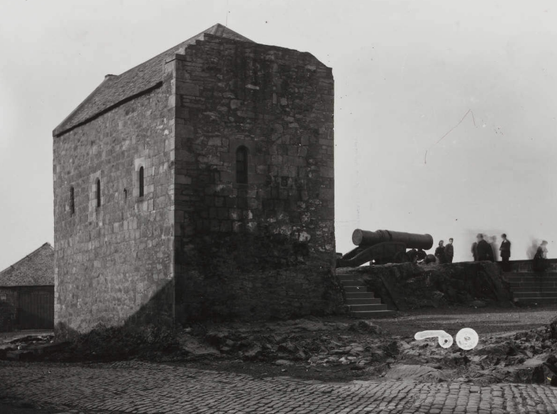
On the eight day of Christmas, my true love gave to me; the Maiden(s, a milking). This, perhaps surprisingly, is the first documented name applied to Edinburgh Castle, in a Charter of King David I in 1142; Castellum Puellarum – the Castle of Maidens. It was not until a century later in the time of King Alexander III, 1265, that it is referred to as Castrum de Edynburgh or Castle of Edinburgh. The oldest remaining structure in the castle, St. Margaret’s Chapel, was built in David I’s time in the middle of the 12th century.

St. Margaret’s Chapel, the oldest structure in Edinburgh Castle and the city itself. 1890 photograph by Alexander Adam Inglis. © Edinburgh City Libraries

No clear explanation exists for the Maiden reference. There are a number of Maiden Castles in England, all except one of which are Iron Age hill forts. This might be a descriptive tame for a “fortification that looks impregnable” or a euphemism implying that it has never been taken in battle. It may also be the evolution of a Brythyonic language term Mai Dun, meaning a “great hill”. Stuart Harris, the man who wrote the book on Edinburgh place names, discounts this theory for Edinburgh; “there is nothing whatsoever to suggests that this was a translation of some[thing] earlier“. He points out that the original references is the Latin – Puellarum – which was translated in the 13th century to its English and French equivalents – Maidens and Pucelles.

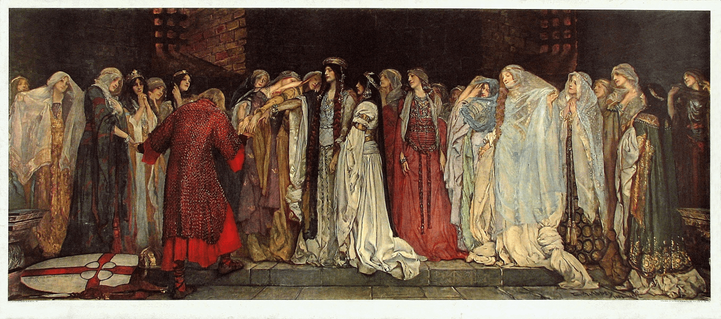
Some of the more improbable tales include an early 14th century reference in the Chronicles of Lanercost to a community of nuns who lived here in the 6th century under the Irish Saint Moninne or Modwenna, before being ejected, or to it being a safekeeping place for Pictish princesses. More likely is that it was a romantic term taken from Arthurian legend, one that may have been applied by David I himself. In Arthurian lore, the Land, Island or Castle of Maidens, is a place visited by a man in his dreams where only women live.

“Galahad at the Castle of Maidens”, by Edwin Austin Abbey (1852-1911)

In the 12th century, the Welsh chronicler Geoffrey de Monmouth – who was one of the prominent figures in popularising the Cult of Arthur at the time – wrote in his History of the the Kings of Britain of the Castellum Puellarum as “facing Albany” i.e. looking towards the Lands of the Picts and Scots. At this time, these would have been north across the Forth from Edinburgh. He is also credited with the invention of the Duke of Loth – husband to a sister of Arthur – and from where Lothian takes its name. Geoffrey de Monmouth’s chief patron was a nephew of David I and it is probable that David had met him. The sixteenth century Scottish historian and intellectual George Buchanan and the 20th century Arthurian scholar Roger Sherman Loomis both lend credence to this theory.

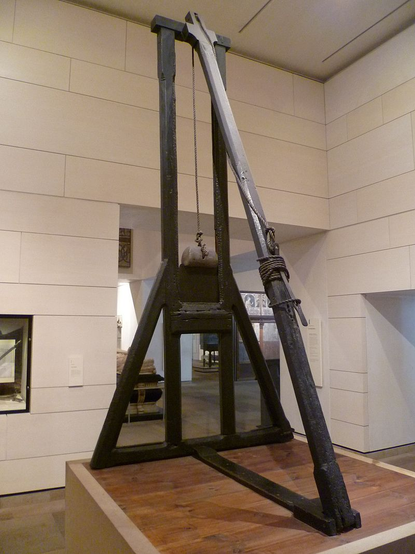
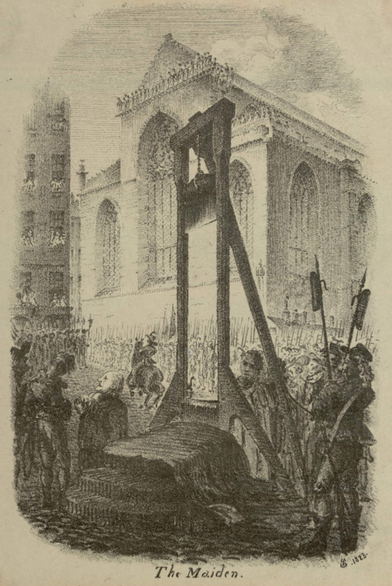
In Edinburgh lore, the term Maiden also has a much more grisly connotation; it was an early modern device of public execution, a form of guillotine.

The Maiden, 1823 sketch by James Skene. © Edinburgh City Libraries

The Maiden was introduced to Edinburgh in 1564 to replace the town’s sword, which was worn out and needed replaced. The Provost and Magistrates of Edinburgh ordered its construction by the carpenters Adam and Patrick Schang and George Tod. The whole contraption could be disassembled for storage, only being moved to the point of execution and erected as required. It was returned afterwards, and this is referred to in the town records as “careying of the Maiden ther and hame agin”.

The Scottish machine is made of oak and consists of a sole beam 5 feet in length into which are fixed two upright posts 10 feet in height, 4 inches broad and 12 inches apart from each other, and 3½ inches in thickness, with bevelled corners. These posts are kept steady by a brace at each side which springs from the end of the sole and is fastened to the uprights 4 feet from the bottom. The tops of the posts are fixed into a cross rail 2 feet in length. The block is a transverse bar 3¼ feet from the bottom, 8 inches in breadth and 4½ inches in thickness, and a hollow on the upper edge of this bar is filled with lead…

The axe consists of a plate of iron faced with steel; it measures 13 inches in length and 10½ inches in breadth. On the upper edge of the plate was fixed a mass of lead 75 lbs in weight. This blade works in grooves cut on the inner edges of the uprights, which are lined with copper…

Proceedings of the Society of Antiquities of Scotland, Vol.III, 1886-8

Notable victims of the Maiden include James Douglas, 4th Earl of Morton, one time Regent of Scotland and the man reputed to have introduced its concept to the country, Archibald Campbell, 1st Marquess of Argyll and his son Archibald Campbell, 9th Earl of Argyll. The Maiden was last used in 1716 to execute John Hamilton at the Mercat Cross for the murder of the landlord of a tavern during a brawl. It was again taken down and carried hame agin but was thereafter forgotten about. The original was rediscovered over a century later and is now on display in the National Museum of Scotland.

The Maiden on display at the National Museum of Scotland. CC-by-SA 3.0 Kim Traynor

The Edinburgh and Leith-themed twelve days of Christmas thread continues with a post about Lady Fife, her house, well and “brae”

Note to readers: unfortunately in April 2026, a third-party plug-in more than exceeded its authority and broke many of the image links on this site. No images were lost but I will have to restore them page-by-page, which may take some time. In the meantime please bear with me while I go about rectifying this issue.

If you have found this site useful, informative or amusing then you can help contribute towards its running costs by supporting me on ko-fi. This includes my commitment to keeping it 100% advert and AI free for all time coming, and in helping to find further unusual stories to bring you by acquiring books and paying for research.
Or please do just share this post on social media or amongst friends and like-minded people, sites like this thrive on being shared.

Explore Threadinburgh by map:

Travelers' Map is loading...
If you see this after your page is loaded completely, leafletJS files are missing.

These threads © 2017-2026, Andy Arthur.

NO AI TRAINING: Any use of the contents of this website to “train” generative artificial intelligence (AI) technologies to generate text is expressly prohibited. The author reserves all rights to license uses of this work for generative AI training and development of machine learning language models.

#Lochend #Logan #Restalrig #StMargaret
A seasonal treat for the urban poor: the thread about Scotland’s New Years steak pie tradition

With the filling for the obligatory Ne’erday steak pie doing its thing in the slow cooker, it inevitably leads to the question of how such a pie should properly be flavoured. Should it have any herbs and spices beyond salt and pepper? A bit red wine or ale perhaps? A few drops of Worcester sauce? And more intriguing for me than the finer points of the recipe, what are the origins of this seasonal pie tradition in Scotland? Let’s try and find out, shall we?

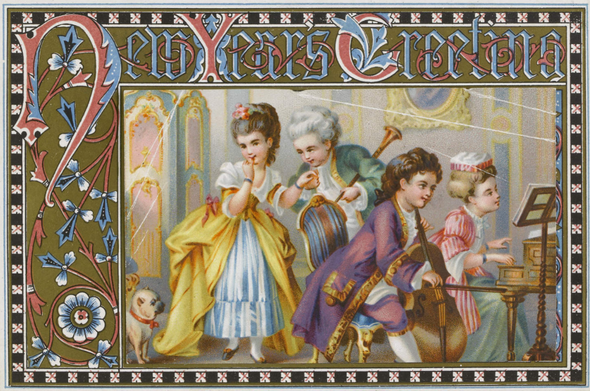
1870 New Year’s Greeting postcard, from the collection of the Stirling-Home-Drummond-Moray family. © Edinburgh City Libraries

There’s a syndicated short story entitled How Shall I hold New-Year’s Day which was printed across Scottish newspapers on the Boxing Day 1851 which discusses new year traditions and in which a “beef steak pie” features. The story takes the form of a conversation between two working class men – Jock and Bob – on their plans for the season and it’s quite obviously the work of the Temperance movement. Jock, the man with the pie, intends not to drink any whisky and instead to spend his time with his family enjoying the fruits of his abstemiousness. Instead of his usual parritch (porrdige) he is having a feast of ham, eggs, hot rolls, cheese, currant buns and “tea along with the elders” for Hogmanay. Bob’s plans, in contrast, mainly involve whisky. Come the morning of the 1st, Bob will have argued with his family and be left with his hangover. But canny Jock has the benefit of his “rest and sobriety of the previous night” and will take his children out to the toy shop, then come home to his pie, followed by a sing-along with invited friends and the treat of fresh fruit. All very sober! An interesting point noted by Jock is that while his wife has “made” the pie, it was “covered and baked by the baker the previous night“; most people would not have had a home oven that could have baked such a pie, so they would take their filling in a dish to their baker who would cook it in the bread oven. The pie could then be reheated atop the range on the girdle (griddle).

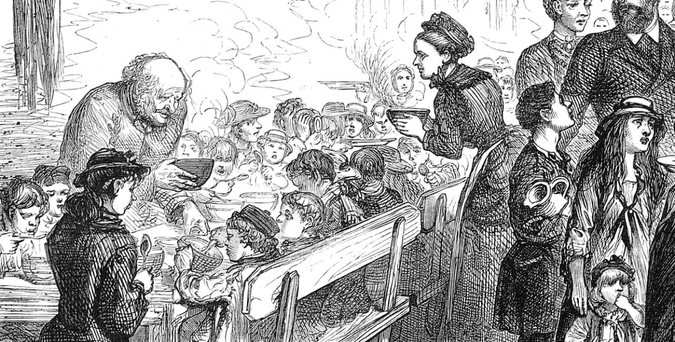
This was the earliest mention of steak pie at New Year that I could find in Scottish newspapers. However the phrase comes up again and again (and again!) over the next 60 or so years of press in one specific context; feeding the poor at new years and (later) Christmas. In January 1863, the Glasgow Herald reported that the inmates of the Paisley Abbey Poorhouse had been treated to an “excellent beef-steak pie” and oranges by the benevolent committee of the parish poor board. In 1876, the Edinburgh Evening News similarly describes the inmates of the City Poorhouse at Craiglockhart had gotten their “usual new year’s treat” of “excellent soup, beef-steak pie and pudding“. Those in St. Cuthbert’s Poorhouse were in contrast served a mutton pie, plum pudding, currant loaf and jugs of beer.


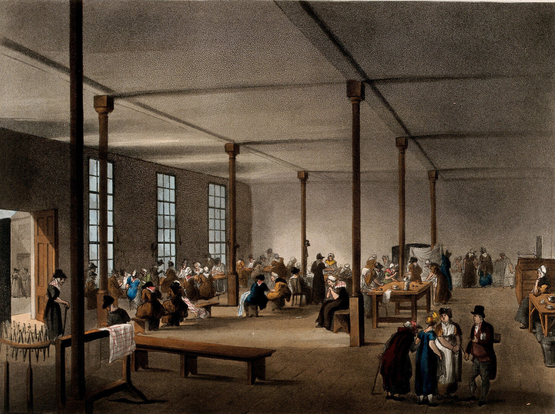
“The Workhouse” – the austere, regimented interior of Poland Street workhouse in Soho. Aquatint by T. Sunderland from 1809. PD via Wellcome Collection

Craiglockhart was still serving New Year steak pie in 1893, but the soup had by this time been downgraded from excellent to mere potato. In 1898, the Evening News reported that an injunction of the Local Government Board had prevented the Parish Board from financing any “special entertainments during the festive season” at the poorhouses from their own funds and these instead had to be met by private benevolence. Fortunately £70 was provided by Alexander Oliver Riddle (or Riddell) of neighbouring Craiglockhart House, a whisky magnate in the distilling firm of Usher & Co. and the inmates of the poorhouses still got their roast beef and mutton “along with a steak pie and fruit“. The men were provided with a treat of an ounce of tobacco, the women got a similar weight in snuff and the children the same but in sweets. A. Oliver Riddle continued to fund the Craiglockhart New Year steak pie dinner thereafter and in 1902 645 mouths were fed. By 1907 times had changed slightly and the women were being provided with sweets instead of snuff. Craigleith seems to have lacked such a sponsor however and the inmates instead were getting a dinner of coffee, bread and butter, soup and mince – all washed down by a visit from local councillors.

Feeding the poor in a Victorian workhouse. Image via National Archives website.

It wasn’t just the poorhouses providing New Year steak pie; The Scotsman in 1896 reported that it was the custom in Glasgow for the merchants of the Royal Exchange to fund a steak pie and potato dinner for the poor, held at the City Chambers. This dinner had by 1905 shifted to Christmas Day at which time 3,000 people got their lunch, but had in turn to suffer a lecture from Lord Provost Bilsland about knowing their place and being grateful for philanthropy. It was noted at this time that the tradition was now 36 years old. Similarly in Edinburgh, in 1904 Lord Provost Sir Robert Cranston (noted champion of Temperance) put on a New Year steak pie dinner for 1,000 of the city’s poor at the Grassmarket Corn Exchange; but it had to be held on January 2nd as a bird show had the venue booked on the 1st!

“Grassmarket – south side, old Corn Exchange” J. C. McKenzi photograph of 1913 © Edinburgh City Libraries

In 1910, the Home for Aged Women in Portobello served a Christmas Day dinner – provided by a Mrs Sellar – of steak pie, plum pudding and fruit, and a New Year’s Day “godly repast” of roast mutton, pudding, jellies, meringues and sweets provided by Mrs Durham and Miss Scott Moncrieff. When Edinburgh wine importer William Crambe Reid died in February 1922, £68,000 of his £184,000 fortune was left to good causes in the city. The interest on one benefaction went to providing an annual Christmas meal for 4-500 of the city’s poor; the “William Crambe Reid Dinner“. The inaugural menu had soup, haggis and mashed potatoes, steak pie, vegetables, more potatoes, plum pudding and fruit. In North Leith Parish, a bequest of property by a Mr Neill paid a £51 annual profit on rents that was still providing such a meal on New Year’s Day as late as 1938.

But what of the actual pies themselves? What were people being actually eating ? We can get an early recipe for a Scottish steak pie from the book “Cookery and Pastry as taught and practised by Mrs Maciver, Teacher of those Arts in Edinburgh“. Susanna Maciver was one of Scotland’s first cookery teachers and published a cookery manual in Edinburgh around 1777. Her steak pie is very different to what we might have today; it was made from alternating strips of lean and fatty beef that had been cut into thin slices and then beaten thinner, much like a schnitzel before it was “seasoned with salt and spices” (she doesn’t say what spices, sadly.) These strips were rolled up into “ollops” (or collops, i.e. like beef olives), packed into a dish with some water, covered in puff pastry and baked.

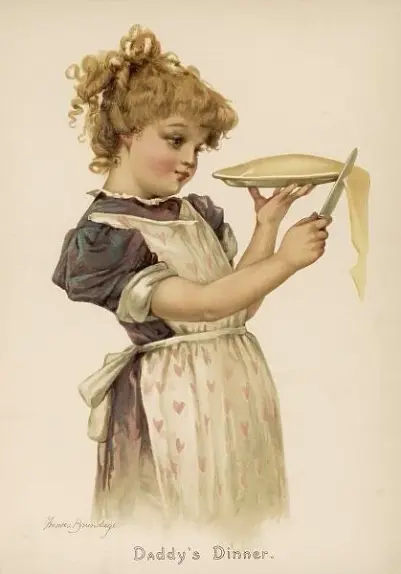
1890 postcard of a girl preparing a pie

The Cook and Housewife’s Manual etc. by Margaret Dods (actually a pseudonymous collaboration between Isobel Christian Johnston and Walter Scott) of 1826 gives fundamentally the same collop-style pie but adds gravy instead of water and the optional taste of some onions. What is much more interesting is that the book also suggests you can add a catsup (a preserved mushroom sauce), cut pickles, “other seasonings“, oysters and/or forcemeat balls (balls of minced offal and breadcrumbs). In February 1882, a Lady Correspondent submitted a recipe to the Dundee Evening Telegraph for a steak pie. It was made with 1lb of fillet steak which was cut thin, layered with oysters and flavoured with mace, walnut ketchup, port, lemon peel, gravy, salt and pepper. The same paper provided a different recipe in 1884, which was made with shoulder steak and included two kidneys “to enrich the sauce“. No mention was made of spices or other flavourings. The most unusual aspect of this pier was that it was served along with a side dish of macaroni cheese (which was actually made with spaghetti!). In 1892, the Aberdeen People’s Journal gives a recipe by a correspondent called Wiganer made from 2lb steak, 1/4lb kidney, salt and pepper with the meat diced up into chunks (rather than strips or collops) as would be recognisable now. The filling was cooked in the dish then covered in a lard shortcrust pastry and returned to the oven.

Serving a pie to children, from “A Apple Pie” of 1886, by Victorian illustrator Kate Greenaway

Economy steak pie recipes were published in the papers in WW1; the Dundee People’s Journal has one made from much cheaper meat – 1½lb of beef hough (shin) – which had to be boiled for 90 minutes before mixing with an instant gravy and boiled again with salt and pepper before it could be topped with pastry. And in 1917, as a reflection of how bad the food supply situation was getting, the Arbroath Herald has a recipe where sliced potatoes are used to bulk out the meat (which was itself a 2:1 ratio of beef and kidneys) and which was topped with a pastry that was ¾ mashed potatoes. This recipe used margarine or butter in the pastry – but things were so dire in January 1918 that the Food Control Committee published a recipe in newspapers for “potato butter“. This awful-sounding ersatz butter was fundamentally real butter that was stretched out by mixing it with boiled and sieved potatoes, dying it with butter colouring, preserving it with butter preservatives and setting it again in pats.

There are an infinite number of genuine and authentic and traditional Scottish steak pie recipes that you can find in cookery books and blogs. In the book “A Scottish feast : an anthology of food and eating” published in 1996, the food writer Catherine Brown gives a recipe for such a pie that attempts to meet the steak pie yardstick of Mr Glasgow (writer, broadcaster, bon viveur and foot critic Jack House) – which was the steak pie served in the Boulevard Hotel in Clydebank! This is an intersting hybrid of older pie recipe techniques, with the meat again beaten thin, but wrapped around pieces of kidney and sausage. It was thoroughly modernised however with the addition of ground clove, chopped parsley and marjoram and mushrooms. The addition of mushrooms was not just for flavouring purposes, but to form a barrier to hold the pastry off of the filling and prevent a “soggy bottom” forming on the pastry lid (which is personally my favourite part of the pie!). In reality, there is no one, authentic Scottish New Years steak pie recipe, beyond the one that you choose to enjoy on that day.

Note to readers: unfortunately in April 2026, a third-party plug-in more than exceeded its authority and broke many of the image links on this site. No images were lost but I will have to restore them page-by-page, which may take some time. In the meantime please bear with me while I go about rectifying this issue.

If you have found this site useful, informative or amusing then you can help contribute towards its running costs by supporting me on ko-fi. This includes my commitment to keeping it 100% advert and AI free for all time coming, and in helping to find further unusual stories to bring you by acquiring books and paying for research.
Or please do just share this post on social media or amongst friends and like-minded people, sites like this thrive on being shared.

Explore Threadinburgh by map:

Travelers' Map is loading...
If you see this after your page is loaded completely, leafletJS files are missing.

These threads © 2017-2026, Andy Arthur.

NO AI TRAINING: Any use of the contents of this website to “train” generative artificial intelligence (AI) technologies to generate text is expressly prohibited. The author reserves all rights to license uses of this work for generative AI training and development of machine learning language models.

#Lochend #Logan #Restalrig #StMargaret
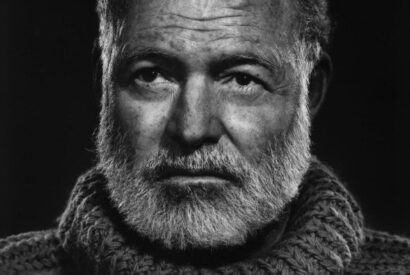
Ross K. Tangedal on Hemingway in 1926 -The Hemingway Society

 The Hemingway Society Search

  • Home
  • Ross K. Tangedal on Hemingway in 1926
  • Ross K. Tangedal on Hemingway in 1926

    Subscribe with Apple Podcasts, Subscribe with RSS, Download this episode

    January 01, 2026

    Happy New Year from One True Podcast! We look forward to a rich, exciting 2026 by looking back to 1926.

    In our first show of the year, we ask an esteemed guest to take us back exactly one hundred years to see what was happening in Hemingway’s life, work, and world. So, to guide us through Hemingway’s 1926 — his travels, his relationships, his publishing, and his writing – we welcome the great Hemingway scholar Ross K. Tangedal. 

    For Hemingway, 1926 was a colossally important year that saw his transition from Hadley to his second wife, Pauline; the transition from Boni & Liveright to Scribner’s; and the publication of The Torrents of Spring and The Sun Also Rises, both crucially important for different reasons. Tangedal guides us through this remarkable year in Hemingway’s life and his writing. We have previously begun calendar years with flashback episodes featuring: Mary Dearborn on 1922; James M. Hutchisson on 1923; Verna Kale on 1924; and J. Gerald Kennedy on 1925. We encourage you to check out those past shows to get up to date!

    RIP: Chris Struble, President of the…

    We at the Hemingway Society are very sad to report the…

    2025 Hemingway Society Board Nominations… This year, the international Hemingway Society election… View All

    Continue/Read Original Article Here: Ross K. Tangedal on Hemingway in 1926 | The Hemingway Society

    #1926 #2026 #ErnestHemingway #Hadley #Hemingway #January1 #MoveToScribnerS #OneTruePodcast #Pauline #Podcast #TheHemingwaySociety #TheSunAlsoRises #TheTorrentsOfSpring

    It's world 🌍 #IceSpice Day 🍿🍬🎈🥂🍾

    Happy #birthday, #icespice #rapper #singer 🎁
    May heaven's celebrate with you today 🌹🥧
    🥧Grow stronger and wax stronger ♥️ #Bahdlexbirthday #January1 #January1st #bahdlexempire #HBD #bahdlexblog #bahdlex #Bahdlexempire #January 🎈🍬🎉

    It's world 🌍 #Frankangella Day 🍿🍬🎈🥂🎉

    Happy 88th #birthday to #FrankLangella 🎂🎁🎉
    May heaven's celebrate with you today 🌹
    🥧Grow stronger and wax stronger ♥️ #Bahdlexbirthday #January1 #January1st 🤍 #bahdlexempire #HBD #bahdlexblog #bahdlex #Bahdlexempire #January

    It's world 🌍 #Mercyaigbe Day 🍿🍾🥂🎉🍬

    Happy🎈🎉 #birthday #NollywoodActress #MercyAigbe Adeoti celebrate as she turns 48 Today 🎈🍬
    🥧Grow stronger and wax stronger ♥️ #Bahdlexbirthday #January1 #January1st #bahdlexempire #HBD #bahdlexblog #bahdlex #Bahdlexempire #January

    It's world 🌍 #MorrisChestnut Day 🍿🍾🥂🎉

    Happy 57th #birthday to #MorrisChestnut
    🎂🎁🎉
    May heaven's celebrate with you today 🌹🥧
    🥧Grow stronger and wax stronger ♥️ #Bahdlexbirthday #January1 #January1st #bahdlexempire #HBD #bahdlexblog #bahdlex #Bahdlexempire
    #January

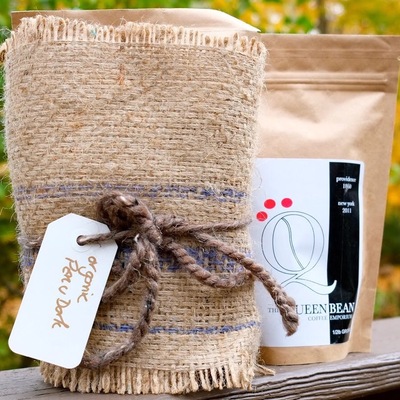
    Save 20% on all coffee blends, including best sellers Mills 1860 Blend, Midnight Rebel, and Seattle Express, all January. TheQueenBean.com

    #sale #january1 #thequeenbean #coffee #coffeelover

    Today, January 1, 2026.
    A quick stroll downtown, quieter streets than usual, and that air of beginning that smells of possibility ✨
    We're starting slowly, but we're starting again. Happy New Year.

    #January1 #NewBeginnings #CityCenter
    #NewYearVibes #StreetMood

    Stardate: 2026.1.1 - "The Start of 2026"

    Happy new year. We've survived 25, let's see if we can survive this year. Wishing everyone the absolute best year filled with happiness and love. 🥳🎊
    #Starting2026 #FirstDayOfTheYear #HappyNewYear2026 #HappyNewYear #NewYear2026 #NewYear #NewYearsDay #Year2026 #2026 #January1 #Jan1 #January1st #Jan1st #JanuaryFirst #JanFirst #Happiness #Love #Fireworks #Event #Sparkler #Neon #Star