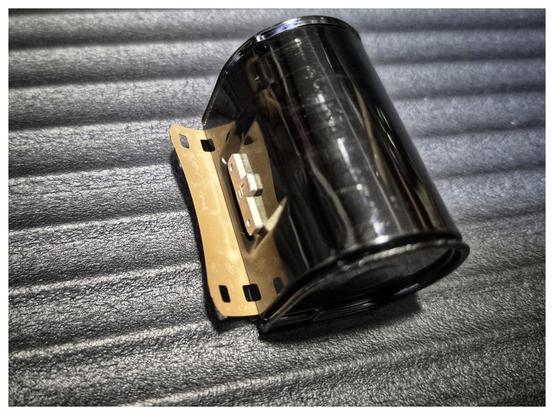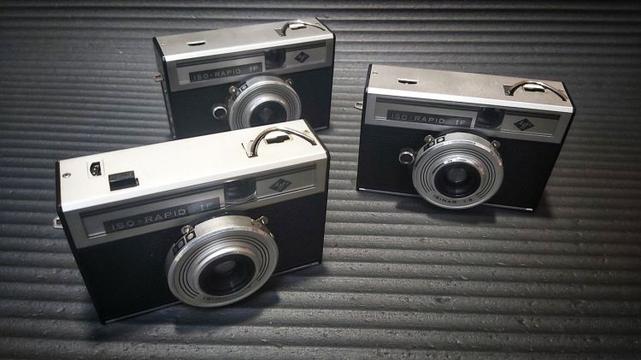
Three more Rapid film cameras (this time bought just for the cassettes)

I’m getting quite into using Rapid cassettes just lately. So much so that I was dreaming about it the other night. I’ve chosen a half-frame Rapid camera, the Welta Penti II, as my camera of choice for the Frugal Film Project, and I have enough cassettes for that, but I think I need a few more cassettes so that I can have several films being used in several cameras at the same time.

Including the expired film Rapid cassette I have five in total, but I’m keen to get more. First of all I checked out that popular auction site, eBay,  but getting individual cassettes is quite expensive, from 18€ upwards, including shipping. That was a little too steep for me, so I took a different tack.

I obtained my original Agfa Iso-Rapid IF cameras from the Kamerastore website for the princely sum of 8€ apiece, and among these collected four Rapid cassettes. I therefore took a look at the other Rapid cameras on the website and found three more that were advertised as having cassettes, a Ricoh 35 K Rapid, which included two cassettes, and two more Agfa Iso-Rapid IFs, which had one cassette each. Thus I could get some cheap cameras to play with for a lower price than going to eBay.

Of course,  all the cameras were in the ‘Not Passed’ category,  they were, ‘Untested … and found to have flaws that will affect typical use.’ For example, in the Ricoh 35 K Rapid, ‘The bulb doesn’t work and there is some oil on the aperture blades,’ but it came with two Rapid canisters, and ‘otherwise it is in good working condition!’ The Agfa Iso-Rapid IFs had some haze on the lens and viewfinder, but otherwise were also in working condition. Both came with one Rapid canister each.

The Agfa Iso-Rapid IF cameras are basic little fixed focus point and shoot cameras from the 60s and 70s, a bit like an updated Agfa Clack but with that typical boxy 60s styling. They have two shutter speeds, 1/40s for cloudy  weather or flash sync, and 1/80s for sunny conditions, and three apertures of f8, f11, and f16. 

The Agfas were in nice condition, though the viewfinder was hazy in one and the other had a hazy lens. I removed the lens assembly from the hazy lens camera to reveal a primitive looking aperture/shutter assembly, very close to the Agfa Clack in design. The lens was a single-element lens and was very easy to clean with a cotton bud.

The Ricoh 35 K Rapid is a different type of camera altogether to the Iso-Rapid cameras, although it still uses Rapid films. It’s a manual focus compact camera made by Ricoh in 1964, and it’s heavy. It’s made of a lot of metal and features a glass three-element 40mm f2.8 lens. A much more sophisticated camera than the Iso-Rapid cameras, it has shutter speeds from 1/25s to 1/200s (plus B, though this doesn’t work), and an iris aperture from f2,8-f16. 

It also features primitive DX coding, which will show the speed of film loaded. Agfa Rapid cassettes featured a little metal tab, and depending on the design of this tab could tell the camera the type of film loaded. In the wind-on side of the camera is a small metal pin that sticks out and when the Rapid cassette is inserted connects with this tab. On the top of the Ricoh is a little wheel which shows the ISO and DIN of the film, and the aperture that you should be using.

One pleasant discovery with the Ricoh was the ‘found film’. I nearly missed it when I first checked out the camera, but sticking just 1-2mm out of one of the Rapid canisters was a little tab of film. Clearly a roll left behind by its last owner, this is always a wonderful find in any new camera, and one that doesn’t happen very often with products from the Kamerastore. 

Actually, you can see the tab of film in the item photos on the Kamerastore website, but if you’re not familiar with what you’re looking at it’s easy to miss. Guessing from my expired Rapid film that this was taken any time up until the 90s, I’m hoping that the roll hasn’t been used for practising with and has remained untouched. I’ve transferred the film to a 35mm cassette, and next time I’m in Aveiro I’ll pop into the lab and see if they can develop it. 

I also spent an hour or so this week decanting (I read that term somewhere and just liked it) some Harman Phoenix film from 35mm to Rapid cassettes. I had pre-planned my technique but it was much easier than I had expected. With a little force the films generally slide smoothly into the Rapid cassettes. Of course, I had to Redscale a couple of the film strips, too.

If you are on Mastodon, you can now follow this blog directly. Just go to Mastodon and follow the ‘Snapshot’ WordPress account at @keithdevereux.wordpress.com. All new posts will be automatically updated to your timeline.

#Agfa #AgfaRapid #Cassette #Experimental #FrugalFilmProject #Harman #HarmanPhoenix #IsoRapid #Phoenix #Rapid #RapidFilm #Redscale #Ricoh35K
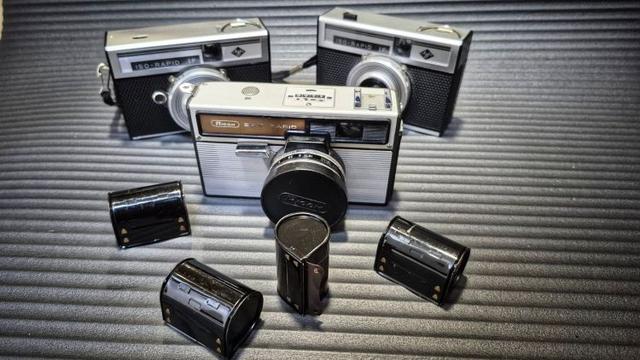

Some Rapid cameras arrived today, bought just for the cassettes. Inside one of them were two cassettes. Peeking out of the cassette was a little bit of film. I think it's colour film, should I get it developed?
#Agfa, #Rapid, #AgfaRapid, #Cassette, #Expired, #IsoRapid, #RapidFilm, #ExpiredFilm, #Experimental,

There’s something about collecting and playing with old cameras that is hugely satisfying. Even better is getting a camera working again that hasn’t been used in decades, or using film in a camera that hasn’t had film made for it in a long time. I’ve a few cameras like this; the Kodak Handle, where I created a film mount for it to work with Instax Square film, the Polaroid Big Shot and a mount for Instax Wide film, and the Ikkosha Start 35k with its homemade 35mm Bolta spools. I also have a couple of longer term ongoing projects, like the Kodak 1A Autographic Jr 118 folding camera and the Vest Pocket Kodak camera that I hope to use with 35mm film spooled into homemade 127 spools.

But one format that has passed me by has been the Agfa Rapid film system. For anyone unaware, Rapid film was developed by Agfa in the 1960s as a competitor to Kodak’s instamatic film. Instead of having the film inside a sealed plastic cassette, the Agfa Rapid system used two small 35mm canisters which when loaded into the camera would pass film from one to the other. The full cassette would then be taken to the lab for development and the now empty cassette switched over to be the take-up cassette, if that makes sense. The advantage over instamatic film was that using 35mm the negatives were a little larger. The downside was that  Rapid films were a maximum length of 12 exposures, or 16 24x24mm frames in cameras like the Agfa Iso Rapid IF.. 

A while ago, a whole batch of Agfa Iso-Rapid IF cameras appeared on the Kamerastore website. They were all in the ‘Not Passed’ category and marked as ‘untested’ but were priced really competitively at 8€ each. The Agfa Iso-Rapid IF is a fixed focus compact camera with three selectable apertures (f8, f11, and f16) and two shutter speeds, 1/80s for sunny conditions and 1/40s for cloudy days and flash synchronisation. There is also a wind-up flash reflector into which flash bulbs are inserted. This is powered by a battery that fits into the bottom of the camera, but otherwise the Iso-Rapid IF is a wholly manual camera.

The snag with the Rapid canisters is that you need two of them, one containing the film and a second empty cassette that acts as the take-up cassette. The Rapid cassettes don’t have a spool inside, like 35mm cassettes, and the film is simply pushed into the canister. When the cassettes are loaded into the camera the film is wound into the empty ‘take-up’ cassette. Back in the day, once the take-up Rapid cassette was filled it was most likely sent away for development, and odds are that nowadays most Agfa Rapid cameras will either contain one cassette or none at all.

So I looked at the Agfa Iso-Rapid IF cameras on the Kamerastore website. All of them were in the ‘Not Passed’ category and were ‘Untested or tested, inspected, and found to have flaws that will affect typical use.’ In the descriptions most were simply described as ‘untested’ or, ‘can’t be tested, Agfa Rapid cassettes aren’t produced anymore’. However, three cameras looked promising. Two were described as having working shutters, although the speeds had not been tested, and the third included a Rapid cassette although the lens was described as the elements having separated.

I took the plunge and ordered these three cameras. I assumed that each of the cameras, apart from the one that specifically stated that it included a Rapid cassette, would not include a cassette, so I looked around for another. There were plenty of Agfa Rapid cassettes online though they were quite expensive, but then I came across a sealed expired Agfacolor film for the same price as an empty cassette. Even better, the seller’s site was in Portugal. I ordered a cassette, and within a few days it had arrived, actually before the cameras came.

When the cameras arrived, on two of them the shutter button was on the front of the camera, next to the lens. On the third camera, which also came with a nice little camera case, the shutter button was on the top. The camera with the case was the one that was described as having a separated lens, and opening the back revealed a single Rapid cassette. I was delighted with that, now I had two cassettes for the next part of the experiment.

I thought I should take a look at the other two cameras, since the plan was to take the cassette from the camera with the separated lens and use this with one of the others. They were both in nice condition and the shutter buttons and aperture selector worked nicely. On these cameras the aperture is just a drilled circle, just like the Agfa Clack series of the 1950s. Opening up the first camera revealed a surprise, the camera contained a Rapid cassette! I was delighted with this as it meant that I could practise with a blank film and still keep my expired film intact. Turning my attention to the third camera, I opened the back and … it contained two Rapid cassettes! So now I have gone from zero cassettes to five cassettes, and of course I was stoked.

I’m not going to have much time these next few weeks, so in the next part of this post, whenever it appears, I’m going to try and load a blank test film into the cassettes to see how they operate. If this is successful, I will then try to load some unexposed film into the cassettes. Looking at the details online for these cameras it looks like they were designed for ISO 200 film, and indeed the Rapid Agfacolor that I have is ISO 200. Checking my collection of film stock, it looks like the only native ISO 200 film stock that I have is a few rolls of Harman Phoenix. Mind you, I also have some Lomochrome Turquoise knocking around and with its wide 50-400 ISO range, so that might be fun to try.

If you are on Mastodon, you can now follow this blog directly. Just go to Mastodon and follow the ‘Snapshot’ WordPress account at @keithdevereux.wordpress.com. All new posts will be automatically updated to your timeline.

https://keithdevereux.wordpress.com/2024/10/01/bringing-an-old-film-format-back-to-life-part-1-and-a-pleasant-surprise-the-agfa-iso-rapid-if/

#Agfa #AgfaRapid #Cassette #Experimental #Expired #ExpiredFilm #IsoRapid #Rapid #RapidFilm

Bringing an old film format back to life, part 1 (and a pleasant surprise): The Agfa Iso-Rapid IF

There’s something about collecting and playing with old cameras that is hugely satisfying. Even better is getting a camera working again that hasn’t been used in decades, or using film …

/ˈsnæp.ʃɒt/
Hej #photobubble, ich bin kürzlich zu einer #agfa #isorapid gekommen...
Nun erwäge ich, mich da mal ran zu wagen und dann zwangsläufig auch selbst zu entwickeln (dazu hab ich dann garantiert noch diverse #Fragen später).
Jetzt suche ich aber erstmal eine leere rapid-patrone (eine war noch im Apparat)!
Hat zufällig jemand noch eine liegen und über? Freue mich über #boost
#lomo #FotoFreitag #fotografie #retro