#HR1057: Penalties for #protesters on #InterstateHighways

"Would create steep new penalties for #protesters deemed to be 'deliberately delaying traffic,' 'standing or approaching a motor vehicle,' or 'endangering the safe movement of a motor vehicle' on an interstate highway 'with the intent to obstruct the free, convenient, and normal use of the interstate highway.' The new federal offense would be punishable by up to $10,000 and 15 years in prison—a far harsher penalty than is the case under many states' laws, which generally already criminalize walking or standing on the highway. The bill provides an exception for 'any lawful activity' authorized by federal, state, or local law. However, it could still seemingly cover far more than 'blocking' the interstate, including a #PeacefulProtest on the shoulder of an interstate or a convoy-style, driving protest that slowed traffic. The sponsor of the bill made clear that it was in response to protesters. The same bill was introduced as HR 7349 in 2024.

Status: pending

Introduced 6 Feb 2025.

Issue(s): Traffic Interference

Press release by bill sponsor Rep. #MikeCollins (GA-10):
https://collins.house.gov/media/press-releases/representative-mike-collins-reintroduces-safe-passage-interstates-act

Full text of bill:
https://www.congress.gov/bill/119th-congress/house-bill/1057
#CriminalizingDissent #AntiProtestLaws #Authoritarianism #Fascism #Clampdown #CiminalizingProtest #Section25 #JustStopOil #SlowMarch #CharacteristicsOfFascism

Representative Mike Collins Reintroduces the Safe Passage on Interstates Act

Washington, D.C. – Today, Representative Mike Collins (GA-10) reintroduced the Safe Passage on Interstates Act, which would make the intentional obstruction of interstate highways illegal.

Representative Collins

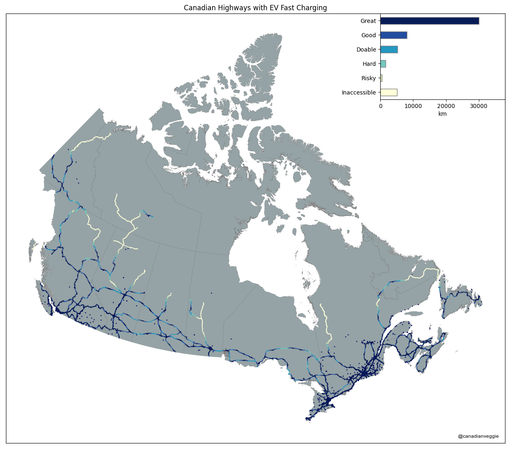
In November 2022, I created a bunch of maps visualizing the EV fast-charging infrastructure in Canada and the USA. It’s time to revisit those maps and see what has changed in the past 18 months, as the number of charging stations has roughly doubled in both countries.

The maps I generated look at sections of major highways in both countries and categorize them based on the distance to the nearest EV fast charger. From our experience taking an EV road trip across Western Canada, range anxiety kicked in when the distance between chargers was over 200 km, especially after encountering malfunctioning charging infrastructure in small towns.

The maps below use the following categorization:

  • Great: < 50 km from a charger. No need to route plan; just look for the next charger when you get low.
  • Good: 50-100 km. Stress-free driving.
  • Doable: 100-200 km. Route planning is required, but you have backup options.
  • Hard: 200-300 km. Pray that there isn’t a broken charger or a queue.
  • Risky: 300-350 km. If everything goes right, you might just make it.
  • Inaccessible: >350 km. Don’t bother.

Canada

In Canada,

  • The number of stations has grown from 739 to 1662 (125% increase).
  • Quebec had good coverage before. Now it is plastered with fast chargers covering all the populous southern parts of the province.
  • The big gaps between Saskatoon and Winnipeg, and Saskatoon and Calgary have been filled in with new fast chargers in places like Kindersley and Yorkton.
  • There is still a big hole around Whitecourt, AB and the highway up to Fort McMurray (which I’m sure is mostly symbolic at this point).
  • The northern parts of Canada are still pretty hostile to EVs, but progress is steadily being made. Pretty soon you’ll be able to road trip from Vancouver to Whitehorse with comfortable fast charging along the way.

United States

In the United States,

  • The number of stations has grown from 4024 to 7675 (91% increase).
  • Almost every interstate highway has good fast-charging infrastructure.
  • The major gaps in Texas, Mississippi, and West Virginia that existed in 2022 have been filled in.
  • The remaining gaps are mostly in Montanna.

Animated Gifs

The animated maps really show the progress since 2015. Range anxiety is quickly becoming a worry of the past.

For simplicity, the maps above look at chargers with the most popular SAE J1772 connectors. I also did some analysis of Tesla’s charging stations which you can find on GitHub, along with all the python code used to generate the maps.

https://canadianveggie.com/2024/06/29/rapid-growth-ev-charging-stations-in-canada-and-usa-analyzed/

#animatedGif #canada #dataNerd #dcFastCharging #electricVehicle #electricVehicles #ev #interstateHighways #mapping #maps #roadtrip #tesla #USA
Data Nerd: Mapping Canada’s EV Chargers

For my analysis, I labelled highways based on their distance to the nearest fast charger. Even if you can travel 300 km on a charge, you don’t want to drive a section of highway that forces y…

Canadian Veggie

Traffic heading into the office this morning was pretty bad. Fortunately for my schedule, I left the house super early and made it to work with plenty of time to spare.

265/365

This weekend is Memorial Day weekend here in the United States. The expectation is that everyone and their uncle will be out on the highways at some point. We’re likely going to see them all. We’re driving from Massachusetts to Florida. The traffic is going to be epic. Or at least the potential for it is there.

I’m just prepping myself for the worst while hoping for the best. We’re giving ourselves a ton of extra time for the drive, so even a slew of awful traffic won’t put us off our schedule. We’re ready and we can hack it. I just hope we don’t have to.

Traffic sucks, man.

https://robertjames1971.blog/2024/05/22/traffic-9/

#365 #365Challenge #highwayTraffic #highwayTravel #highways #interstateHighways #iphoneography #photoADay #photoADayChallenge #photography #traffic #Travel #travelPlans

265/365

Flickr