Our BSPU Open Science Policy is gaining recognition worldwide! 🌍🚀
🌍 Our policy embraces:
✅ FAIR & CARE principles (ethical, open, responsible science)
✅ Hong Kong Principles & DORA
✅ EOSC & Barcelona Declaration
✅ #I4OC (open citations = real transparency!)
🔗Strategy: https://doi.org/10.5281/zenodo.15007508
🔗Roadmap: https://doi.org/10.5281/zenodo.15007421
#OpenScience #FAIRdata #OpenAccess #I4OC
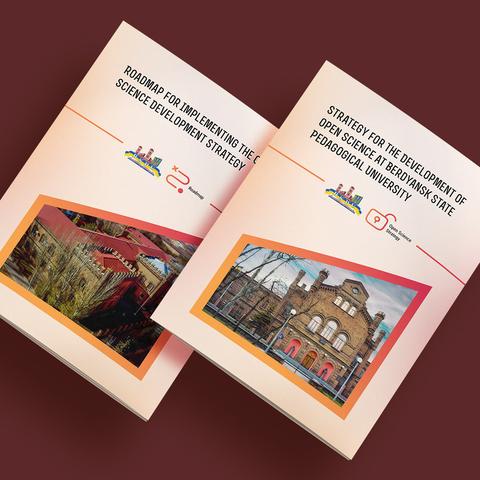
Strategy for Open Science Development at Berdyansk State Pedagogical University
This document defines the key approaches to implementing open science at Berdyansk State Pedagogical University (BSPU). It outlines strategic goals, core principles, and mechanisms for open science implementation, including support for open access, research data management, integration of FAIR and CARE principles, responsible research assessment, and the development of digital infrastructure. This strategy is part of BSPU’s Open Science Policy, which includes three key components: Open Science Development Strategy – defines the mission, vision, strategic goals, and principles of open science implementation. Policy Implementation Roadmap – describes implementation stages, tasks, key performance indicators (KPIs), resources, and monitoring mechanisms. Action Plan – details short-term measures necessary to achieve the defined goals. The strategy aligns with national and international initiatives, including Ukraine’s National Open Science Plan, the European Open Science Cloud (EOSC) principles, the Barcelona Declaration, the San Francisco Declaration on Research Assessment (DORA), and the Hong Kong Principles for Assessing Researchers. This document is a pilot version designed for a one-year period, after which its implementation results will be analyzed to develop a long-term open science policy for the university.

Wellcome Trust and the Chan Zuckerberg Initiative Partner with DataCite to Build the Open Global Data Citation Corpus
Aggregated references to data across outputs will help the community monitor impact, inform future funding, and improve the dissemination of research Amsterdam – 17 January 2023 – DataCite is pleas…

Advancing responsible research assessment
Elsevier signs Declaration on Research Assessment; implementation steps will include making reference lists of all articles openly available via Crossref
The document "Open Citation Identifier: Definition" has been just published on
#Figshare to introduce the Open Citation Identifier (
#OCI) system developed by
#OpenCitations, a
#PID for the identification of open bibliographic citations
https://doi.org/10.6084/m9.figshare.7127816 #I4OC #openscience #opendataOpen Citation Identifier: Definition
This document describes the Open Citation Identifier (OCI), a globally unique persistent identifier (PID) for the identification of open bibliographic citations stored in a specific database or in other kinds of storages.
The slides of my presentation entitled "The Open Citations Movement: the Story So Far" at
#pubmet2018 are available online at
https://doi.org/10.6084/m9.figshare.7110653 — my talk concerned open citations, with a focus on the Initiative for Open Citations (
#I4OC,
https://i4oc.org) and on
#OpenCitations (
http://opencitations.net)
The Open Citations Movement: the Story So Far
The Initiative for Open Citations (I4OC) was launched in April 2016 with
the purpose of promoting the release of structured, separable, and open
citation data. Thanks to the incredible support of a large (and still
growing) number of publishers and stakeholders, in one year more than
500 million citations have been released to the public, and are
currently used by third parties for building new services to serve the
scholarly community. In the first part of my talk, I will recall the
main milestones reached by the Initiative, while, in the second part, I
will focus on outcomes of one of its funders, i.e. OpenCitations,
showing the way Semantic Publishing technologies have been used for
describing and releasing a huge collection of open citation data.
Open Citation: Definition
This document describes what are the requirements that a bibliographic citation must follow to be considered an open citation.
Initiative for #OpenCitations (#I4OC)
"The #publishers who have released their raw #citationdata into the #publicdomain are making the vision of an #opencitationgraph a reality.
We urge the remaining publishers to join this effort -- and #researchers, practitioners, #librarians, scholarly societies, and members of the public who believe in this vision to help us reach our 100% target. The world is waiting for the #citationgraph to become a #publicgood."
#openscience
https://boingboing.net/2018/04/14/open-graphs.html/
The citation graph is one of humankind's most important intellectual achievements
When researchers write, we don’t just describe new findings — we place them in context by citing the work of others. Citations trace the lineage of ideas, connecting disparate lines of …
 Yana Suchikova
 petersuber
 Nemo_bis 🌈
 Open Science Feed
 Silvio Peroni
 J. R.
J. R. Ecologia Digital