The thread about the “Study of the Diet of the Labouring Classes in Edinburgh”; what the poor of Canongate ate in 1901
In 1901, the Public Health Committee of the Town Council of Edinburgh paid £50 to commission a then remarkable and pioneering bit of research: they asked three doctors to go out into the working classes and poor of the city and find out what they actually ate. This study took place in the city’s Canongate and followed the food purchased and eaten over a week by 15 families, totalling 94 mouths. It meticulously catalogued everything that was consumed and discarded in great detail and then analysed it for its equivalent nutritional contents in a laboratory.
Group of Women and Children in the Canongate, 1901. By an unknown photographer from “The Life History of a Slum Child”, from the collection of Edinburgh City Libraries
The authors were Dr. Diarmid Noël Paton, a pioneer in physiology and its links with nutrition; Dr. James Craufurd Dunlop, a paediatrician, pioneer of combined medical and social research and later Superintendent of Statistics, then Registrar General, of the Registry Office for Scotland and; Dr. Elsie Maud Inglis, one of the first female doctors in Scotland; a specialist and pioneer of the medical care – and medical education – of women; a leading suffragist and later founder of the Scottish Women’s Hospitals in WW1.
“A Study of the Diet of the Labouring Classes in Edinburgh” was published the following year (1902). It runs to 104 pages, but I have read it and summarised some of its key findings so that you don’t have to. So lets go find out what people in the city ate 120 years ago
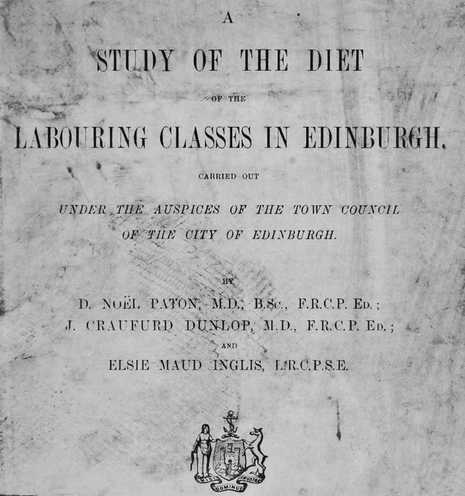
Cover of “A Study of the Diet of the Labouring Classes in Edinburgh Carried Out Under the Auspices of the Town Council of the City of Edinburgh”
The 15 subject families were categorised into 3 classes:
- A. Workmen’s families with irregular wages under 20s (20 Shillings or £1, approximately £98 in 2023) per week
- B. Families with regular wages from 20-23s per week
- C. Families with men in “good” trades and regular wages from 28-40s per week.
There were 15 adult men, 17 adult women and 62 children in the study. Two of the test households were notable for having no man in the house – as a result these were by far and away the financially worst off of the group. The average income of households in the stufy was just under 25s (£1 5/-) a week, about £122 in 2023.
Breakdown of the test subjects, giving occupation (for the man of the house), study class, the numbers of adults and children and the weekly incomes.
The make-up of each household was corrected for age and sex of occupants to turn it into a standardised equivalent number of adult men, based on the understanding at the time of the relative dietary requirements of men, women and children of different ages. For instance an adult woman counted as 0.8x an adult man for the purposes of calorie requirements. The weekly spend on food was counted to the nearest farthing (¼d, d being 1 old penny, with 12d to the shilling and 240d to the £). The average spend on food was 15s 9¼d per week (£77.35 in 2023 money), or 79% of household income. Per “equivalent man”, each house spent on average 6¾d per day on food (~£2.74 in 2023).
Standardised equivalent “Number of Men” per test household and weekly expenditures on food
One of the few “advantages” in life that the poor had was just how cheap accommodation was (even if it was in a slum condition) in Edinburgh in 1901. Per household it averaged 37¼d per week, or about £61 per month in 2023. Some families made half or all their rent by their Co-op dividends alone – a measure of both just how cheap the rent was and also how important the Co-ops were to their members.
Women “getting the messages” talking outside a grocers shop at 2 High Street in the Canongate in 1901. By an unknown photographer from “The Life History of a Slum Child”, from the collection of Edinburgh City Libraries
We come now to what our subjects ate. Let’s just say that their diets were monotonous. 35% by weight of what people ate was bread, a whopping 494g per “man” per day. 80% of everything eaten was one of only 6 food types – bread, potatoes, milk, sugar, beef and veg (mainly cabbage and onion, some carrots and turnips, although the study noted that many of the women didn’t seem to know about any other vegetables than potatoes). For reference, in 2013-15, the average Scottish person consumed just 80g bread (84% less), 64g of potatoes, 22g of beef per day. But milk was almost the same at 201g.
The 6 most important foodstuffs in the 1901 Canongate diet, with total and relative mass and calorific consumption for the study.
People ate quite so much bread because it was cheap: that 35% of bread by weight gave them 41% of their daily calories but cost only 19% of their daily food budget. You can read more about the Scottish working class’s love affair with the Plain Loaf in this thread. In contrast, the beef consumed gave just 6% of daily calories but was 23% of expenditure. Clearly this was a luxury foodstuff relative to the others, and it was eaten for the protein content – and mainly by the man of the house. The authors pointed out an anomaly in that the traditional Scottish meat of mutton was largely lacking in the diet, even though it was cheaper and offered more protein per unit cost than beef.
People got about 11% of their daily calories from butter, jam, “syrup” (canned golden syrup or treacle) and cheese, eaten on slices of bread as a piece (an open sandwich, they weren’t closed back then!). Cheese consumption in 1901 was almost identical to Scotland’s 2013-15 average. Unsurprisingly, oatmeal was important in the diet, eaten as porridge – giving 6% of daily calories for 2.5% of expenditure. Eggs were commonly eaten, although they were relatively expensive they offered a reasonable amount of protein. The amounts of suet, dripping, sausages and offal are notably low. Small amounts of pulses and barley were eaten (in soups and broths).
All the major foodstuff consumed in the study, averaged for both total weight and total calorific intake per day
The subjects ate almost no fruit, except small amounts of raisins and currants in the slightly better off households or in jam. It was potatoes that stopped them getting scurvy. Some teabreads were eaten (a sweetened bread, with dried fruit in it, usually spread with butter), almost nothing was spent on biscuits or sweets. Seasonally they probably did get access some fruit, when there was a glut of cheap apples etc., but it is not recorded. Confections may have been eaten on special occasions.
A woman holds her baby inside a house in the Canongate, 1908. Notice that despite the circumstances of the neighbourhood, the woman, her child and the house are all well kept, with an effort to make the place homely and comfortable; slum did not necessarily mean squalor. By an unknown photographer from “The Life History of a Slum Child”, from the collection of Edinburgh City Libraries
Mealtimes were not coordinated or regular, the report called this the old Canongate style. The man usually kept a schedule aligned to his work, with the largest meal in the evening. Children fitted theirs around schooling with lunch the primary meal, topped up with endless bread to keep them full, if not nourished. The women had to fit in between both It has been noted that much of the meat consumption was by the man of the house; in many of the homes, the children and woman made do mainly with porridge, potatoes, broths and soup topped up with and their endless pieces. One house recorded spending 6d a week on lemonade as a luxury, otherwise children drank milk (fresh, canned or buttermilk) but also lots of tea, coffee (from essence) and cocoa. Women seemed to drink a lot of cocoa – they probably needed the sugar content to keep constantly on the go with heavy domestic labour.
Fish, although it was easily accessible from the fishing fleets of Granton, Newhaven and Fisherrow, and long part of the diet of the Scottish lower classes, was not popular or valued. While it was relatively cheap, it was not felt to be a valuable source of daily calories for the money and it was most prevalent with the poorest households. Dried and smoked fish were particularly lowly thought of and very little was consumed.
In many households the women had either part time or “piece work” (usually cleaning, “charladying” and also making bags) to make ends meet. Although they earned much less than men, in many of the households this was the only regular income on account of irregular wages for the man. The two households with no men in them paint a revealing and sorry tale of life for working class women at that time. In the first, a mother (51) and daughter (15) exist on just 8s 4d per week (£41 in 2023). The daughter made a few shillings selling papers, the rest came from a Benevolent Fund as the son/brother was away in the army in the Anglo–Boer War. They existed largely on white fish (3.3kg per week, gotten cheap through the kindness of neighbours), bread (3.3kg/wk), potatoes (3.4kg), cabbage (2kg) and buttermilk (1.1kg), plus 850g sugar and 880g oatmeal.
The other house with no man resident was described as being that of a “poor, small old woman who lived alone, chiefly occupied in sewing“. She was unable to do other work, was “very weak” and her husband was in the lunatic asylum. Her income was unknown, but she spent only 14¼d per week (!) on food (£5.80 in 2023). When standardised, that’s just over 1/3 of average expenditure on food of all the other study subjects. This pittance bought her a meagre diet, per week, of 840g milk, 840g bread (about 1 modern loaf), 310g beef, 300g dried peas, 300g leeks and carrots, 200g barley and 90g butter, and almost nothing else. This was the equivalent of 1123 calories per “equivalent man” day, less than 1/2 of the average of 2900 per day of all the study subjects. The paper noted that 1527 calories per day was the garrison’s emergency diet at the end of the 4 month Siege of Ladysmith from 1899-1900.
This 2,900 per man per day calorific intake measured for Edinburgh in the study was compared to averages for the working classes of other countries. It was:
- 4,170cal in Germany
- 4,080cal in Sweden
- 3,061cal in Russia
- 4,415cal in the US
The working poor of the slums fared better than those in the poorhouses, who in Scotland at that time got 2,380 calories per day, but worse than in the country’s prisons were it was 3,315 calories per day (or 3,717 on hard labour) and in pauper lunatic asylums where 3,435 per day was provided. The Seamen’s Federation at that time had recently secured a diet for men at sea of 4,526 calories per day. This was the sort of intake needed to live comfortably and healthily for a man (or woman) indulging in heavy physical labour.
I do want to keep this thread focussed on food, and I could go on, and on, and on into ever more detail from the study, but this isn’t really the best place for that, so I’ll look at a few more things before wrapping up. Firstly, lets look at relative costs for some foodstuffs when the report was published compared to now. I’ve worked out an approximate inflated cost of the staple food prices to compare and contrast with typical May 2023 UK grocery prices. The differences speak for themselves.
Comparative costs of the same food items in 1902 and 2023, corrected for inflation
Secondly – apart from rent and food, what else was money spent on? An obvious thing was coal, required for all domestic heating, cooking and hot water. Many got it cheap through their churches or social groups, who had schemes to buy it in bulk and disburse it at a heavily discounted rate to their members. In winter, consumption of coal averaged about 1.5 bags per house per week, costing 1s 9d (about £34 a month in 2023). Some houses had a gas light and paid for that, but the use and cost was small – about £5 per month in 2023 equivalent. Other houses purchased lamp oil. After coal (and sometimes before it), the next biggest expendisture was on subscriptions to societies. Most households paid a few shillings per week towards such societies; these were either to cover sickness or funeral costs, clothing clubs, or even children’s holiday clubs for a week at the sea or in the country for them. The other main noted expenditure was “soap, black lead, etc.”, i.e. household cleaning products, about half a shilling a week (£2.45 in 2023) per household.
Most of the men smoked (women at this time mainly did not); about half a shilling again per week in pipe tobacco. Some were teetotallers, others drank. In only one family was it noted the woman drank and it was implied that both parents in this household were alcoholics. No costs were given for money spent on drink.
Canongate menfolk outside a pub, 1901.
Youngers were one of the two dominant names in Edinburgh brewing alongside McEwans. By an unknown photographer from “The Life History of a Slum Child”, from the collection of Edinburgh City Libraries
In most families the entire wage was turned over by the husband to his wife to manage, with 2s or 3s a week reserved by him for his tobacco, papers and drink. This was most prevalent were wages were reliable and regular. Where the man’s work was irregular, the pattern was different. His wife often had little idea what was in his wage packet from one week to the next. He often turned over just enough for the food and rent but little else, reserving the excess in better weeks for his vices. Very few of the families had enough to keep anything by for a “rainy day” and lived week to week. It was noted some lived day-to-day, buying items of food as and when they were needed throughout the day. This meant they often paid a premium compared to a weekly bulk buy, a problem just as common now for those on limited incomes as then.
I will finish off with two last points. Firstly, the study probably would have failed without Elsie Inglis’ involvement; it was her and her female medical students who convinced reluctant families – usually the housewife – to allow them to intrude on their lives. Misses G. Miller, H. Bell, Isabel Simson, May Simson, Pringle, Cunningham, Robertson, H. Maclaren and Colly and Mrs Shaw Maclaren were the students credited with gathering the actual study data from each family (down to collecting every discarded bit of potato peel to be weighed)
Elsie Inglis, from Dr. Elsie Inglis by Lady Frances Balfour. CC-by-SA 4.0 Wellcome Collection.
And secondly, one little snippet of insight into the life of these families that really gave a lump to my throat when I read it. It came from family number 14, the mason’s labourer, his wife and their 9 children, who lived in a tiny 2 room house, “clean but bare-looking“. The report goes on, “the eldest girl died of consumption [TB] last year. They still keep little frames and bits of fancy-work she was doing. They gave her a grand funeral that cost £10 13s. Black suits had to be bought for the father and eldest boy“. This family had very little, yet they spent everything and more than they had and could afford to give their daughter a decent and dignified send off – over 10 weeks wages – and on account of paying off their debts could no longer pay into their own funeral society. I feet this really hit home how unpredictable life was for people 120 years ago, people living exactly where my own family was living at the time and in exactly the same circumstances. And it brings home a real sense of human dignity to the lives of people in bitter and crushing circumstances, at the bottom of the pile. Their next eldest daughter, 17 but only 4ft 10in tall, now looked after the house and 8 other children when her mother went out to work to make paper bags for 8s a week. Such were the realities of life in the Canongate at the end of the Victorian age and dawn of the 20th century.
Here’s the link to “A study of the diet of the labouring classes in Edinburgh” on Archive dot org for you to read and think about for yourself. I’ve only scratched the surface of it, and there are many other stories and insights contained within it’s yellowing pages.
If you have found this useful, informative or amusing, perhaps you would like to help contribute towards the running costs of this site – including keeping it ad-free and my book-buying budget to find further stories to bring you – by supporting me on ko-fi. Or please do just share this post on social media or amongst friends.
These threads © 2017-2025, Andy Arthur.
NO AI TRAINING: Any use of the contents of this website to “train” generative artificial intelligence (AI) technologies to generate text is expressly prohibited. The author reserves all rights to license uses of this work for generative AI training and development of machine learning language models.
#Canongate #Edinburgh #Food #HolyroodCanongate #Nutrition #OldTown #Poverty #PublicHealth #Slums
 Andy Arthur - Threadinburgh