FAIRsharing welcomes eight new Champions for 2023 – FAIRsharing Blog
If you're going to
#ISMBECCB2023, don't miss
#BOSC2023's panel on Open and Ethical Data Sharing (
https://open-bio.org/events/bosc-2023/bosc-2023-panel/)! We just added a new panelist: Verena Ras is the Training Coordinator at University of Cape Town for
#H3Africa 's
#H3ABionet 🌍
OBF » BOSC 2023 Panel » BOSC 2023 Panel
Bioinformatics Open Source Conference
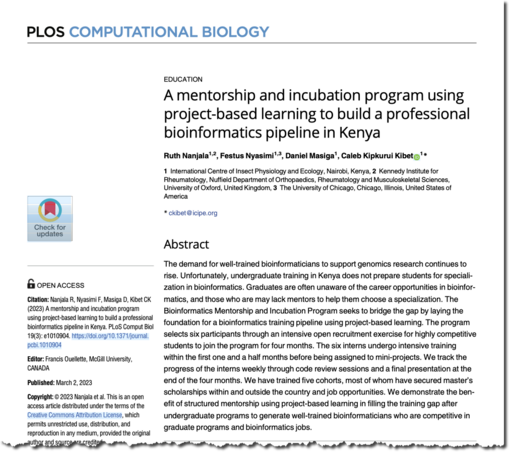

A mentorship and incubation program using project-based learning to build a professional bioinformatics pipeline in Kenya
The demand for well-trained bioinformaticians to support genomics research continues to rise. Unfortunately, undergraduate training in Kenya does not prepare students for specialization in bioinformatics. Graduates are often unaware of the career opportunities in bioinformatics, and those who are may lack mentors to help them choose a specialization. The Bioinformatics Mentorship and Incubation Program seeks to bridge the gap by laying the foundation for a bioinformatics training pipeline using project-based learning. The program selects six participants through an intensive open recruitment exercise for highly competitive students to join the program for four months. The six interns undergo intensive training within the first one and a half months before being assigned to mini-projects. We track the progress of the interns weekly through code review sessions and a final presentation at the end of the four months. We have trained five cohorts, most of whom have secured master’s scholarships within and outside the country and job opportunities. We demonstrate the benefit of structured mentorship using project-based learning in filling the training gap after undergraduate programs to generate well-trained bioinformaticians who are competitive in graduate programs and bioinformatics jobs.
 FAIRsharing
 BOSC (OpenBio's Conference)
 Francis Ouellette