 Z572
Z572Successfully attempted to run a simple hoot program using wasmtime
Some ugly code: https://codeberg.org/Z572/wasmtime-hoot
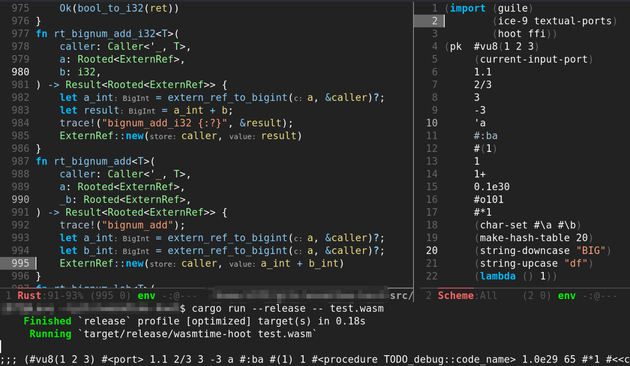
Successfully attempted to run a simple hoot program using wasmtime
Some ugly code: https://codeberg.org/Z572/wasmtime-hoot

Rencontres mensuelles autour de Guix. Venez découvrir, discuter et contribuer à Guix dans une ambiance conviviale. Il n'y a pas d'expérience pré-requise et vous êtes tout·es les bienvenu·es. Programme Les soirées se déroulent en 3 temps : 19h-20h : accueil et discussions libres ; 20h-21h :
Got the basic setup for my spring #lisp game jam project working: no plot yet, but it looks as it should and I can now write. And I decided to release early, release often:
https://arnebab.itch.io/terras-heritage
Also started a devlog: https://www.draketo.de/kreatives/terras-heritage-devlog
Years ago I made a simple endless jumping game demo I called HighStar. You can play it here: hurdos.com/highstar/
The source code is: https://sr.ht/~gnucode/high-star/
It is a loose goal to translate this game demo into a guile game using Chickadee:
https://dthompson.us/projects/chickadee.html
If you’re new to #lisp and #scheme, but you want to try build something for the Spring Lisp #GameJam?
Get yourself a running start with the free #ebook Naming and Logic: #programming essentials with #Guile Scheme.
Just 64 A6 pages that fit in your pocket and you’re on track to hack away:
website: https://www.draketo.de/software/programming-scheme
epub: https://www.draketo.de/software/programming-scheme.epub
pdf: https://www.draketo.de/software/programming-scheme.pdf
⇒ the spring lisp game jam 2026: https://itch.io/jam/spring-lisp-game-jam-2026
Spring #Lisp game jam starts tomorrow:
https://itch.io/jam/spring-lisp-game-jam-2026
I plan to build something with Enter Three Witches:
tutorial: https://www.draketo.de/software/enter-three-witches
example game: https://dryads-wake.1w6.org/enter
Got some improvements done for that today … I mean: yesterday … so I can focus on the game, not on the engine.
How do you all prefer your syntax-rules?
(define-syntax-rule (my-when cond body body* ...)
(when cond body body* ...))
for precision or
(define-syntax-rule (my-when cond body ...)
(when cond body ...))
for readability? And what about documentation?
Evaluate @code{body body* ...} ...
or
Evaluate @code{body ...} ...
For me, just `body ...' reads better (both in code and in the manual, but `body body* ...' is more accurate, so I am on the fence about this.
Olive CSS: Lisp powered vanilla CSS utility-class a la Tailwind
Olive CSS는 Tailwind에서 영감을 받은 Lisp(Guile Scheme) 기반의 유틸리티 클래스 CSS 프레임워크로, 완전한 자유 소프트웨어(LGPLv3+)로 제공된다. Guile Scheme의 강력한 기능을 활용해 높은 수준의 커스터마이징과 확장성을 제공하며, Tree Shaking 기능으로 사용하지 않는 CSS 클래스를 제거해 최적화된 빌드가 가능하다. Tailwind 대비 완전한 오픈소스와 함수형 API 지원, 그리고 빌드 출력 제어가 특징이다. 웹 프로젝트에 쉽게 통합할 수 있고, 개발자가 직접 Scheme 코드로 기능을 확장하거나 수정할 수 있어 학습과 실험에 적합하다.
 Agenda du Libre
 ArneBab
 thegnuguy
 graywolf
 spectrumgomas
 sayzard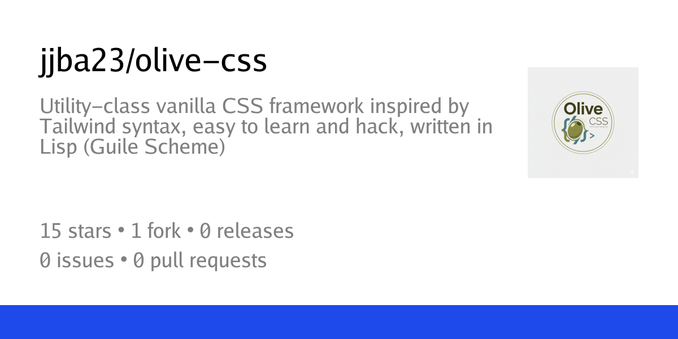
 Jonathan E. Magen 🇮🇱🇺🇦☮️