China Is Not Going Anywhere—So Now What?

中国不会消失——那接下来怎么办?

By Cliff Potts, CSO, and Editor-in-Chief of WPS News

Baybay City, Leyte, Philippines — May 9, 2026

China is not a temporary problem to solve. It is a permanent reality to understand.

That is the starting point. Everything else follows from it.

For more than a decade, much of the global conversation has been built on two weak ideas. One is that China can be contained. The other is that China will eventually become something else—more familiar, more comfortable, more predictable. Neither assumption has held up.

China has grown. China has adapted. China has made clear, through both policy and action, that it intends to remain a central actor in the international system.

The question is no longer whether China rises. The question is how that rise is perceived—and whether it produces cooperation or resistance.

What China Gets Right

China understands the long game.

It plans in decades, not election cycles. It builds infrastructure at scale. It invests in logistics, manufacturing, and connectivity across regions that other powers ignored or abandoned. These are not small achievements. They are the foundation of influence.

In many parts of the world, China is seen as a partner that delivers—roads, ports, rail, and financing. That matters. Reliability matters. Execution matters.

There is also a level of internal coherence in Chinese strategy that many countries lack. Policies align with long-term goals. Messaging is consistent. The state moves with purpose.

These are strengths. They should be recognized as such.

Where the Strategy Breaks Down

Power alone does not produce trust.

In the West Philippine Sea and other contested areas, China’s approach has been defined by sustained pressure—coast guard presence, maritime militia activity, and overlapping claims enforced through constant proximity.

This is not a new escalation. It is a long-running pattern of gray-zone operations that has normalized tension rather than resolved it.

The result is predictable. Countries do not feel reassured by constant pressure. They adjust to it. They plan around it. They build relationships elsewhere to offset it.

The same pattern appears in broader regional behavior. When actions are perceived as coercive, even if they are framed as defensive or administrative, the perception becomes the reality that other countries respond to.

This is where China’s strategy begins to work against itself.

The Trust Gap

There is a difference between being respected and being trusted.

China is respected for its scale, its history, and its capacity. But trust is built differently. Trust requires predictability, transparency, and a sense that agreements will hold even when they are inconvenient.

When neighboring countries see shifting interpretations, expanding claims, or pressure applied without clear limits, they do not see stability. They see risk.

And risk changes behavior.

Countries hedge. They diversify partnerships. They strengthen security ties with others—not necessarily because they prefer those relationships, but because they feel they have to.

That is not containment. That is reaction.

The Taiwan Factor

This dynamic becomes even more pronounced when Taiwan is considered.

Any move to resolve Taiwan through force would not exist in isolation. It would be interpreted across the entire region as a signal about how China handles unresolved disputes.

The outcome would not be limited to Taiwan. It would reshape how every neighboring country calculates its own security and its own relationship with China.

Military success, if it were achieved, would come with strategic costs that extend far beyond the immediate objective.

You can win the island and lose the region.

That is not a moral argument. It is a structural one.

What This Means Going Forward

China does not need to become something else to be accepted as a major power. It does not need to adopt another country’s political system or cultural model.

But it does need to decide what kind of influence it wants.

If the goal is compliance, pressure can produce it in the short term. If the goal is durable influence, trust has to be part of the equation.

That means reducing ambiguity where it creates fear. It means aligning actions with stated commitments. It means recognizing that how power is used shapes how power is received.

None of this requires weakness. It requires clarity.

China is not going anywhere. The world is not going anywhere either.

The path forward is not about removal or replacement. It is about whether coexistence is structured through pressure or through predictability.

That choice is still being made.

This essay is written by Cliff Potts, Editor-in-Chief of WPS News. WPS News has been active in one form or another on the internet since 2009; for more information, visit https://cliffpotts.org.

If this work helps you understand what’s happening, help me keep it going: https://www.patreon.com/cw/WPSNews

#china #geopolitics #globalStrategy #InternationalRelations #taiwan #WestPhilippineSea #WPSNews


Google geeft je business een boost met Apple! 🌍📈 Ontdek hoe slimme strategieën je internationaal succes brengen. #BusinessGrowth #GlobalStrategy 
https://itinsights.nl/digitale-transformatie/google-strategische-impuls-voor-internationaal-zakendoen-op-apple/
Google: strategische impuls voor internationaal zakendoen op Apple.

Google’s live vertaling voor Apple: strategische impuls voor bedrijven Google Translate’s real-time vertaalfunctionaliteit is nu beschikbaar op Apple-apparaten…

IT INSIGHTS
Giving life to the Carney vision for Canada | The-14

Carney’s vision urges Canada to reduce U.S. dependence, strengthen security, diversify trade, and assert sovereign middle-power leadership in a shifting world.

The-14 Pictures
Hanwha Group Chairman Kim Seung-youn called for the company to become a trusted global strategic partner, highlighting its leadership in defense and shipbuilding and urging innovation and responsibility in global projects such as MASGA, while emphasizing safety and mutual growth.
#YonhapInfomax #HanwhaGroup #KimSeungYoun #MASGA #DefenseIndustry #GlobalStrategy #Economics #FinancialMarkets #Banking #Securities #Bonds #StockMarket
https://en.infomaxai.com/news/articleView.html?idxno=98060
Hanwha Chairman Kim Seung-youn Urges Group to Become Trusted Global Strategic Partner with Pride in Driving South Korea’s Economy

Hanwha Group Chairman Kim Seung-youn called for the company to become a trusted global strategic partner, highlighting its leadership in defense and shipbuilding and urging innovation and responsibility in global projects such as MASGA, while emphasizing safety and mutual growth.

Yonhap Infomax
Below is a unified, clean, publication-ready version of the research on **soft power**, written in neutral analytical style and translated fully into English. No playful tone, no persona elements — just a clear professional text.
**Title**
Soft Power: How States Influence Without Coercion and Why Political Science and Intelligence Services Study It
**Introduction**
Soft power refers to a state's ability to shape the preferences, decisions, and behavior of other actors not through coercion or economic pressure, but through attractiveness, legitimacy, and credibility. Culture, education, media, values, international institutions, and national branding form the visible layer of this influence. Beneath that surface lies a strategic mechanism: the ability to set agendas, define narratives, and cultivate long-term loyalty across societies and elites.
For political science, soft power is a tool for understanding how global influence works in a world where military force and economic leverage no longer guarantee compliance. For intelligence services, soft power represents a terrain of indirect influence — the environment in which alliances are shaped, public opinion is molded, and decision-makers form their perceptions and risk assessments. Today’s geopolitical competition increasingly unfolds not on battlefields but in cultural exports, educational programs, media ecosystems, expert networks, and information flows.
**Core Analysis**
Soft power, introduced as a concept by Joseph Nye, complements traditional "hard power" (military and economic force) by focusing on persuasion and attraction. Its effectiveness depends on perceived legitimacy, cultural resonance, credibility of institutions, and narrative consistency.
Modern states combine soft and hard power into so-called *smart power* strategies. Democratic systems typically emphasize openness, cultural presence, and institutional cooperation. Authoritarian regimes, while also deploying soft power, often rely on “sharp power,” which uses manipulative or opaque information practices to influence foreign publics and institutions.
Soft power operates across several levels:
**Cultural influence**: Media, film, music, literature, language.
**Educational influence**: Scholarships, academic exchanges, research partnerships.
**Institutional influence**: International organizations, NGOs, think tanks.
**Narrative influence**: Global reputation, national values, political identity.
**Technological and digital influence**: Social networks, digital ecosystems, communication platforms.
Intelligence communities analyze soft power as part of the broader concept of strategic influence. This includes understanding how rival states extend cultural or informational reach, cultivate proxies or sympathetic elites, shape foreign debates, and exploit vulnerabilities in open societies.
**Target Audience**
This material is designed for readers interested in international relations, political strategy, intelligence analysis, information influence, security studies, and contemporary geopolitics. It will be useful for political scientists, policymakers, OSINT specialists, journalists, students in global affairs, and anyone seeking to understand how modern states compete without direct coercion.
**Bibliography**
Joseph S. Nye — *Soft Power: The Means to Success in World Politics*.
Joseph S. Nye — *The Future of Power*.
Hans Morgenthau — *Politics Among Nations*.
Robert Keohane — *Power and Interdependence* (with Nye).
Janice Bially Mattern — works on discursive power.
Christopher Walker — research on “sharp power”.
RAND Corporation — studies on influence operations.
CEPA — reports on strategic communication and foreign influence.
Chatham House — analyses of global soft-power competition.
IISS — geopolitical influence assessments.
Brookings Institution — comparative studies of U.S., EU, China, Russia.
Carnegie Endowment — research on authoritarian influence strategies.
*Oxford Handbook of Soft Power* — comprehensive academic overview.
**Hashtags**
#softpower #geopolitics #internationalrelations #politicalscience #intelligence #strategicinfluence #foreignpolicy #informationinfluence #diplomacy #globalpolitics #securitystudies #statecraft #powerdynamics #sharpower #publicdiplomacy #influenceoperations #nationalbranding #globalstrategy #politicalanalysis #thinktanks #discoursepower #culturalpower #globalinfluence
If you want, I can also format this into an article layout, add sections on case studies, or expand the intelligence-analysis angle.

Silent signals often matter more than headlines.

Corporate diplomacy is about reading them before they surface.

https://strategic-relations.biz/blog/index.php?silent-signals---how-geopolitical-undercurrents-shape-corporate-strategy

Quiet presence. Global reach.

#Geopolitics #CorporateDiplomacy #StrategicResilience #SilentSignals
#GlobalStrategy

Silent Signals – How Geopolitical Undercurrents Shape Corporate Strategy

Headlines dominate attention with loud events and bold statements. Yet the most decisive shifts in geopolitics are often quiet. These silent signals shape the environment in which strategies are forged.

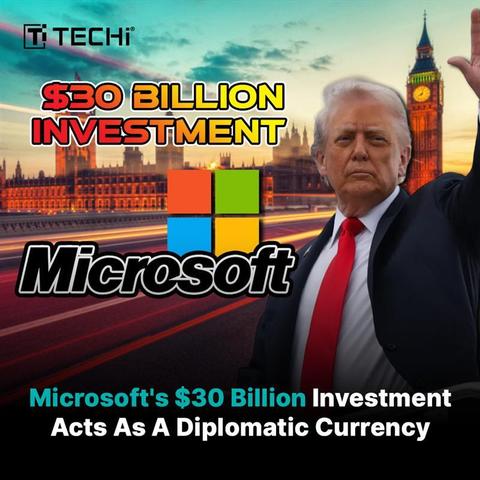
Microsoft is betting big on the UK with a $30B investment, tying AI projects and 23,000 chips to both business growth and political influence ahead of Trump’s visit. The deal shows how tech + diplomacy = power.

#Microsoft #UKInvestment #AI #TechDiplomacy #CloudComputing #Geopolitics #BigTech #AIChips #UKTech #GlobalStrategy #TECHi

Read Full Article Here :- https://www.techi.com/microsoft-30-billion-investment-uk-diplomatic-currency/

Modi: ట్రంప్ కు చెక్ పెట్టేందుకు పావులు కదుపుతున్న మోదీ

ట్రంప్‌కు చెక్ పెట్టేందుకు ప్రధానమంత్రి నరేంద్ర మోదీ వ్యూహాత్మకంగా పావులు కదుపుతున్నారు. భారత్-అమెరికా సంబంధాల్లో కొత్త మలుపు తీసుకొచ్చే..

Vaartha Telugu
SK Hynix signals strategic use of its China fab to ensure stable supply of legacy semiconductor products amid shifting global market dynamics.
#YonhapInfomax #SKHynix #ChinaFab #LegacyProducts #SemiconductorSupply #GlobalStrategy #Economics #FinancialMarkets #Banking #Securities #Bonds #StockMarket
https://en.infomaxai.com/news/articleView.html?idxno=73512
SK Hynix to Actively Utilize China Fab for Legacy Product Supply

SK Hynix signals strategic use of its China fab to ensure stable supply of legacy semiconductor products amid shifting global market dynamics.

Yonhap Infomax