''…seek collaborators not within disciplinary boundaries, but around shared research questions.''

👋 Meet Robert Piotrowski, geomythologist and folklorist!

In this #GeoTalk, he shares how geomythology is used for science communication and education, and how it helps people engage with the geosciences.

👉 Read more: https://egu.eu/1ZM6KS

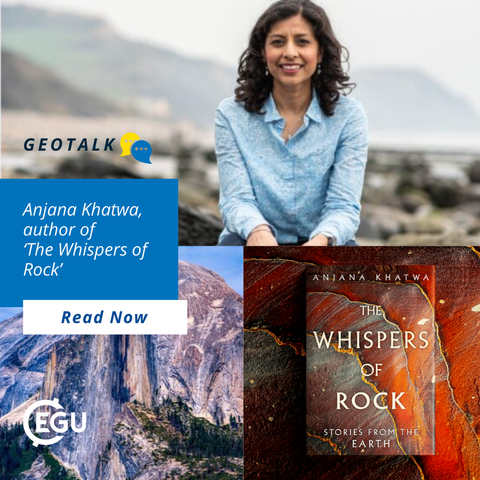
👋 Meet Anjana Khatwa , the author of the new #geoscience book ‘The Whispers of Rock’, and an award-winning Earth Scientist, science communicator, writer, presenter and advocate for diversity in natural heritage spaces.

💫 She shared with us her journey and inspirations while writing her book ‘The Whispers of Rock’.

🧵 Continue reading here in our #GeoTalk: https://egu.eu/7NKGCM

#Hauntology is a word adopted from the social sciences. It was popularised by Jacques Derrida in the 1990s. It is a compound word – haunt + ontology.

"👻Long-melted #glaciers 🧊 haunt us, as terraformers that shaped the land👻".

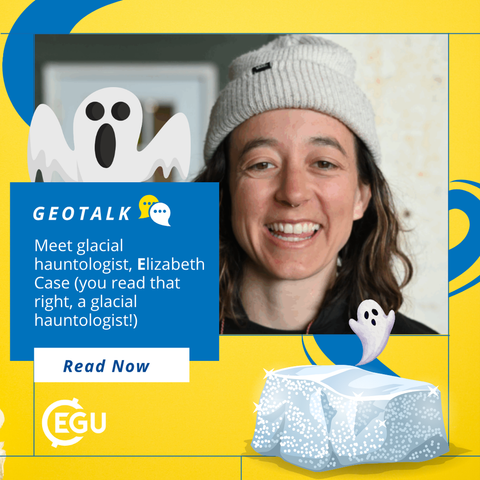
👋 Meet Elizabeth Case, a glacial hauntologist. In this #GeoTalk, you will learn about her journey and her science-art projects.

🧵 Read more: https://egu.eu/3WHTRN

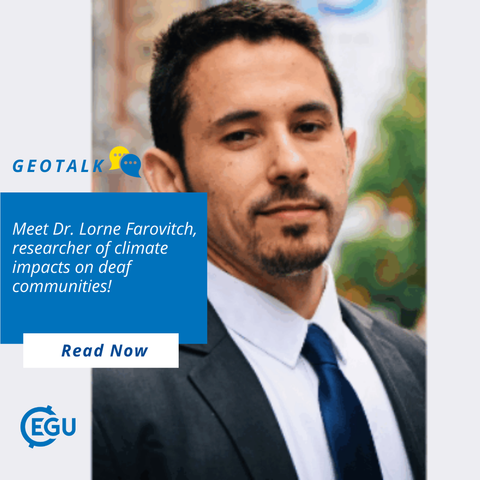
👋 Meet Dr. Lorne Farovitch, researcher of #climate impacts on #deaf communities!

In this #GeoTalk, EGU's project manager, Simon Clark, spoke with Dr.Lorne Farovitch about the challenges faced by deaf people, the importance of community-based research, and solutions for better integration

🧵 Read the full interview here: https://egu.eu/6754WW/

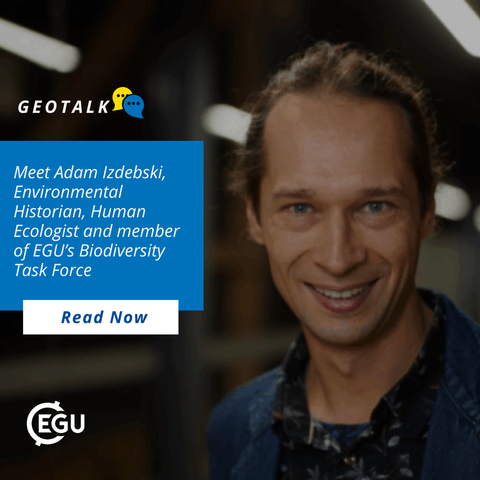
👋 Meet Adam Izdebski, Environmental Historian, Human Ecologist and member of EGU’s Biodiversity Task Force.

In this #GeoTalk series, Chloe Hill asked him a range of questions- including:
"As someone working between the social and natural sciences, why do you think more integration between the two communities is important?"

📖 Read the full interview here: https://egu.eu/4NF9JL/

GeoTalk: Meet Adam Izdebski, Environmental Historian, Human Ecologist and member of EGU’s Biodiversity Task Force

Adam, welcome to GeoTalk! You’re an environmental historian and human ecologist, with an interest in biodiversity. Can you tell us how understanding historic changes to social and ecological systems can provide an insight into biodiversity loss today? This is a question that environmental historians face every time they talk about their work! Let me put it this way; we are at a certain point in the “middle” of a long process. More concretely, the point where quite a bit of biodiversity around us has been lost and we would like to stop or even reverse this as the process goes on. So, we are not happy about how this point in the process looks and we would like the future stages of the process to change it in a way that would make us happier. In other terms, we want to project our values and needs into the future and somehow imagine the process going forward – to identify where and how we could intervene in it. But while we can model future scenarios and imagine how it may look, the future is still something that does not exist. This is where looking in the other direction within the same process – backwards, not forwards – comes in handy! The past phases of the process already happened and if we work hard enough as scientists we can learn what happened and how. We can go back 10 years, 100 years, or 1000 years, depending on the time horizons or turning points of interest. And once we understand it, we can better imagine or model the future of the process – and design interventions to steer it. And crucially – steer not just ecological processes, but also the social processes that co-determine them.   What motivated you to join the EGU’s Biodiversity Task Force? I believe geosciences in general and environmental history in particular has important insights to share with those who make policy decisions. By the time I applied to join the Task Force, I had already been looking for ways to get involved in policy advice as a scientist and I attended a series of science for policy sessions organised at the EGU General Assembly – sort of a science for policy crash course that I would recommend to everyone! Lene Topp at EGU22 presenting on the Science for Policy Competence Framework for Researchers Thus, when the call for Task Force members came out, I already knew what kind of involvement I was looking for. I was aware that acting alone, just based on my own research, is not the way to go, but rather I should get involved in some larger initiative, where I could act as a generalist representing my whole field. In brief, I was looking for well-organised and supported initiatives that I could join to get involved in science for policy advice. And of course, related to my research profile – climate change and society, epidemics, biodiversity and more broadly ecological crises, past and present…   Why do you think it’s important for scientists to be involved in the policymaking process? The world is getting increasingly complicated and it is difficult to predict which policy measures can be effective and what their unintended consequences might be. This is where scientists, who could provide evidence-based information on what options are out there, and what could be their consequences (and how certain of these insights we actually are), can be really useful. In other words, scientists can help politicians and policymakers take into account more of the complexity they handle on everyday basis. In this context, you could also think of scientists in the way Bruno Latour proposed, as representatives of non-human actors – other living beings or “just” physical processes – in the world around us; actors involved in the very same network of relations and mutual impacts, who bear consequences of human decisions. Scientists are often in the best position to tell other humans what could happen to these non-humans if we do this or that. Of course, the same often applies to social scientists speaking about the situation of human communities.   What advice would you give to scientists looking to engage with policymakers? EGU Biodiversity Task Force and other stakeholders in front of the European Parliament If you research something directly relevant to policy, be patient. Follow what’s going on and wait for the moment when this suddenly attracts the public opinion and the attention of politicians. You have to be ready! This will be just a moment and will not last long. Being vigilant is key, and you need to be ready to actively engage as most of the time policymakers and journalists will not seek you out to hear what you have to say. Policymaking and politics happen at a very fast pace compared to science. However, if your own research work is less directly relevant, but you want to get involved in science for policy more broadly, think of yourself as a generalist. Build communication skills or other skills you feel good about, take advantage of different internships, support programs, trainings and so on, and try to get involved. Become part of something bigger, and perhaps work toward creating a critical mass and institutional support within your own scientific institution.   As someone working between the social and natural sciences, why do you think more integration between the two communities is important? There is just one reality. Ecosystems and societies are interwoven, and they act on each other, they often build hybrid networks that you cannot really distill into separate parts in responsible research. If our goal is not only to understand the physical process of climate change, but also the societal dynamics that drives it, we need both the social and the natural sciences – the same for the biodiversity loss. And if we want to come up with the solutions, it is not enough to identify the “natural” processes that need fixing, but also the underlying social processes (and their mechanics) that we may want to influence. This, of course, requires respectful conversations between people coming from both communities, and the emergence of social and natural scientists that are eager to gain basic ‘scientific literacy’ in the disciplines of their colleagues from the other side of the aisle. This, I believe, is a precondition to successful interdisciplinary research.   How do you think the EGU’s scientific community can encourage this integration? This integration is already happening at the EGU General Assembly. Every year there are more environmental and climate historians around, for instance. One way to go beyond this would be to recognise social environmental sciences, or some similar generic field/discipline, as one of the EGU divisions: to give social scientists an official place at the table. Another way to encourage this could be to launch a workshop at the General Assembly or series of webinars that would encourage more conversation, with an effort to invite more social scientists to come and join these events. Members of the EGU Biodiversity Task Force before a meeting with a meeting with representatives from the EU Commission Such integration needs time and presence. We need to talk with each other and develop trust. And obviously an interest in what others too – curiosity, in the end, is what motivates us. Here, showcasing social science research of interest/relevance to more naturally-oriented geoscientists could do a nice job of raising awareness of why it could be interesting to talk and listen to the social sciences.
GeoLog

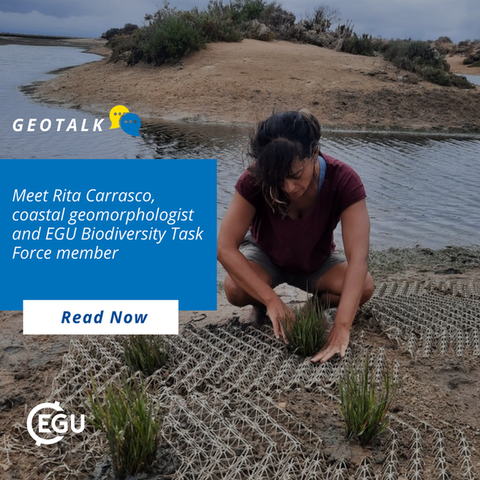
👋 Meet Rita Carrasco, coastal geomorphologist and EGU Biodiversity Task Force member

This time in this #GeoTalk💬, Chloe Hill, EGU's Policy Manager, spoke with her about her scientific journey and contributions to EGU's #BiodiversityTaskForce.

📖 Read the full #GeoTalk here: egu.eu/32LCBK

Meet Annegret Larsen, Biogeomorphologist and Quaternary Scientist.
In this #GeoTalk💬, Chloe Hill, EGU's Policy Manager, spoke with her about her scientific journey and her contributions to EGU's Biodiversity Task Force.

👉 Read the full discussion here: https://egu.eu/7Q59SV/

GeoTalk: Meet Annegret Larsen, Biogeomorphologist and Quaternary Scientist passionate about rewilding and a member of EGU’s Biodiversity Task Force.

Annegret, welcome to GeoTalk! You’re a researcher who focuses on abiotic-biotic environmental interactions. Can you tell us how the implications of your research extend to sustainable management practices?  The United Nations, European Union, and national governments require us to restore landscapes to a ‘natural’ state. However, European landscapes have been shaped by human activity for thousands of years, leaving us with little to no clear understanding of what nature truly is. Furthermore, human-dominated landscapes are often governed by physical processes rather than biotic-driven ones. Over time, this has eroded our understanding of the feedback mechanisms between abiotic and biotic components in natural landscape systems. My research focuses on uncovering how these feedbacks operate in natural environments, their impacts, and how they can be recreated to support restoration efforts. Additionally, I aim to understand how pre-human landscapes functioned and appeared. These natural systems can also be described as “wild,” which is why I find the concept of rewilding in conservation particularly compelling. Can you tell us a bit about your projects that will provide data to manage ecosystems more sustainably? At the Wageningen University, the topic of nature-based solutions is all around you, the setting is perfect to do research on new approaches towards a more resilient ecosystem management. Our Soil Geography and Landscape Department is leading several projects on how nature-based solutions can be included in management of landscapes. More specifically, we just finished a project funded by the Swiss Federal Organization for the Environment (FOEN) during which we produced a spatial model on beaver ecosystem services, using existing data and citizen science. The model’s results were incorporated into the Swiss Government’s spatial platform, influencing national riparian corridor management nation-wide. The objective is to optimise beaver site management, allowing beavers to inhabit areas where they offer vital ecosystem services like water purification or drought resilience, while relocating them from areas where they clash with infrastructure or agricultural needs. We also investigated if, how much, and under which circumstances beaver dams can lead to water purification and soil carbon sequestration. Annegret Larsen, understanding human-landscape interactions The European Union’s Nature Restoration Law aims to restore 25,000 kilometres of rivers to a natural state within the next decade. However, centuries of human impact have altered Europe’s rivers to such an extent that many restoration projects rely on arbitrary targets, lacking crucial information about what constitutes a naturally functioning river system. These efforts often overlook the feedback between physical and biotic processes that are essential for sustainable restoration. I am about to start a new project that focuses on addressing this gap by advancing our understanding of these interactions and establishing a robust baseline for effective river restoration. Exciting new genetic methods are emerging as valuable tools, offering innovative ways to unravel the complexities of past river ecosystems and support more informed restoration strategies!   In what ways do you engage with non-academic stakeholders and how does this engagement increase the value of your research and its outcomes? I didn’t consciously reflect on stakeholder engagement during my first transdisciplinary project—it simply unfolded naturally and felt intuitive. In hindsight, the project was a true eye-opener that very much influenced my path. When transdisciplinary projects are well-executed, they can make a meaningful impact, are great fun, and enrich everyone involved. However, I have to say that these projects are very time consuming and need a lot of coordination and communication. Why do you think it’s important for scientists to engage with practitioners? What advice would you give to scientists looking to engage with practitioners or those outside of academia? Identifying the right primary stakeholder is often underestimated, yet it is a critical step that requires significant time and effort. It can feel like searching for a needle in a haystack. Success probably comes from a combination of actively engaging with others, clearly communicating your ideas, attending the right meetings, and building a strong network. Luck may play a role, and relocating internationally can disrupt existing connections, making the process even more challenging. Annegret Larsen. Photo Credit: Nicolas Stettler Once you identify the right stakeholder(s), it’s essential to collaboratively develop the questions and priorities from different perspectives. If you can form a real team, applied research becomes mutually beneficial, highly enjoyable, and often reveals insights that can be truly transformative in many ways.   What motivated you to join the EGU’s Biodiversity Task Force? Biodiversity is defined by both species abundance and diversity, which form the foundation of most conservation efforts. As a river scientist, I have always struggled with conservation strategies that prioritise a single species at the expense of natural dynamics. I’ve often felt that the overall decline in biodiversity is partly due to ineffective conservation practices. It’s also important to recognise that conservation is a business, and I have observed how this influences the selection of conservation measures. The Biodiversity Task Force was established to engage with the new Nature Restoration Law, which I hoped would challenge some of the more questionable conservation approaches and create new opportunities for improvement. This motivation is what led me to join the task force in the first place.   What aspect of your involvement in the Biodiversity Task Force do you find most enjoyable or rewarding? Besides having a lot of fun working with the colourful mix of task force members, my biggest learning curve was understanding just how complex and different the policy world is, and it was fascinating to get an inside look! On one hand, I realised that creating pathways for science to influence policy is not only worthwhile but absolutely essential. On the other hand, I was impressed to find policy documents that were fully up to date with the latest scientific research—some of which ultimately shaped the Nature Restoration Law. I also had the opportunity to meet exceptionally smart individuals working in policy, and in combination this reassured me that published research is being read and genuinely contributes to science-based policy decisions. My brief experience in the policy world made it clear to me that most policymakers (or better: their team) recognise and value high-quality science. This reinforces the importance of publishing well-developed, scientifically sound research—prioritising quality over quantity of publication. By doing this, it also enhances the likelihood of making an impact beyond the scientific community.

GeoLog

👀 In this stunning Grand Hall of the Serbian Academy of Sciences and Arts, our Elisabeth Probst attended the 13th Danube Academies Conference in Belgrade.

🌊 The event brought together experts from the #Danube region to discuss #sustainability challenges, such as pollution, food security, and green energy.

👉 Read more on our #blog: https://www.geo.lmu.de/geographie/en/latest-news/news-overview/news/elisabeth-probst-attended-the-13th-danube-academies-conference-in-belgrade.html

#geography #hydrology #sciencenews #conference #GreenDeal #climatechange #climateaction #geonews #geotalk #research

Elisabeth Probst attended the 13th Danube Academies Conference in Belgrade

The conference brought together experts from the Danube region to discuss key sustainability challenges.

#Microplastics are said to be an unseen, invasive environmental threat, but to what extent is this true? And how do they impact #corals? In June's #Geotalk, Simon Clark talks to Freija Mendrik, researcher of microplastics pollution in coral reefs.

Read now! https://egu.eu/34SUOL/

GeoTalk: meet Freija Mendrik, researcher of microplastics pollution in coral reefs!

Hi Freija. Thank you for joining us today! Could you tell our readers a bit about yourself before we dive in? Hi Simon, thanks for inviting me! I’m a marine scientist based in the UK specialising in microplastic pollution but my work has taken me across many different disciplines from physical geography to ecotoxicology. Recently my research has focused on trying to understand what impacts the transport of microplastics in aquatic systems from rivers out to the oceans which included field work in the Mekong River of Cambodia and Vietnam but also experiments in the lab. My current project is all about how coral reefs of Vietnam are being impacted by microplastic pollution. I’m also really passionate about marine conservation and collaborative scientific communication, and express my research and advocacy through art, social media and film. I also lead expeditions with Sail Britain, an organisation working to promote ocean literacy through exploration and education.   How does microplastic pollution impact corals and the environment? Freija Mendrik Microplastics are defined as pieces of plastic less than 5 mm in size which means they are easily transported and available to organisms of all sizes. This means they are a huge environmental threat. They have been found to cause harm in so many different species but can also carry disease and have now been found inside humans with the full repercussions currently unknown. As for corals, as they are filter feeders they can easily accidentally ingest microplastics that are in the water column. Lab studies have shown that this can harm coral health, growth and survival. This may have implications for the entire reef ecosystem which is already threatened by many environmental issues such as climate change. However, many questions remain about what is actually happening on reefs right now in terms of plastic pollution, which is what my research is exploring.   Media coverage of microplastics often evoke fears of an unseen, invasive threat. As a science communicator, do you have any advice about discussing such a sensitive topic with non-experts? I think it’s important to be realistic – microplastics are everywhere now and it is a huge environmental crisis that needs urgent action. But media coverage can be a bit over the top with fear mongering which is not always helpful. There are some “facts” out there about plastic pollution that have maybe been a bit exaggerated but have been spread by the press. Yes, it might spur people into action but if all you talk about is doom and gloom, people are going to switch off. I think there is a fine balance which can be hard to achieve – it’s important to talk about the facts but it’s equally important to talk about solutions and what is being done. So, when communicating these issues to non-experts make sure what you are saying is backed by evidence and try and put a positive side on it too, maybe even a call to action, so people can get involved and remain optimistic.   You are also conservationist who advocates for better ocean health, including microplastics and beyond. Do you think it’s important that scientists engage with topics beyond the research environment? Freija Mendrik Yes absolutely! Engaging the public with science is so important if we want to push for change. We’ve seen what public pressure can do, especially recently, and it’s more important than ever. It’s also great for your communication skills if you can explain an abstract concept to the public.  When you have the public talking about these things too that’s when you really see the big changes. For example, with Blue Planet II, the increased media attention on ocean issues, especially plastic pollution, is thought to have caused a huge change in consumer behaviours and policy changes. Of course, you don’t have to be part of a huge documentary to make a difference; getting people interested and involved in science in any way, from school talks to social media and science festivals, is vital to getting them excited about these topics. This will then hopefully lead to people wanting to help protect the environment too.   Finally, what’s next on the horizon for you? Hah well that’s a very good question! I’m coming to the end of my current project and so I’m looking for my next role. To be completely honest, I’m unsure if that will be in academia. Science communication and outreach is really important to me, as is research – so whatever I do next needs to include all of those! I want to get more involved with communities and education. Sharing my love for the ocean with others is really rewarding so I hope to do more of that!

GeoLog