
#BC007 ist ein potenzieller Wirkstoffkandidat gegen das #PostCovidSyndrom und andere #Autoimmunkrankheiten mit funktionellen Autoantikörpern gegen #GProtein gekoppelte Rezeptoren #gpcr Es handelt sich um ein #aptamer das diese krankmachenden #Autoantikörper blockieren soll. Die klinische Phase-II-Studie reCOVer der Augenklinik des #Uniklinikums #Erlangen untersucht den molekularen Weg bestimmter Autoantikörper beim Post-COVID-Syndrom. In diesem Zusammenhang startet in …

(1/2)

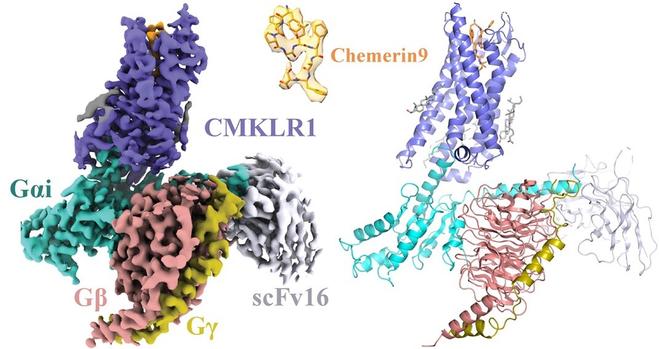
The #GPCR CMKLR1 responds to the #adipokine #chemerin and is abundant in #InnateImmune cells. Structure of CMKLR1 in complex with #Gprotein and a peptide agonist (+ mutagenesis & simulations) reveals mechanisms of action #PLOSBiology https://plos.io/4a6Igvd
Structural basis of G protein–Coupled receptor CMKLR1 activation and signaling induced by a chemerin-derived agonist

Chemokine-like receptor 1 (CMKLR1) responds to the adipokine chemerin and is highly expressed in innate immune cells. A high-resolution structure of CMKLR1 in complex with G protein and a peptide agonist, together with mutagenesis and computational simulations studies, reveals mechanisms of peptide agonist recognition, receptor activation, and G protein-coupling.

therapeutische Strategien umzusetzen, um die klinischen Ergebnisse von ME/CFS-Patienten zu verbessern.

Abschnittsausschnitte
ME/CFS gehört zum Spektrum des Post-COVID-Syndroms
Yehuda Shoenfeld eröffnete das Treffen mit einem #Expertenüberblick über Autoimmunität im Hinblick auf das autonome #Nervensystem, wobei der Schwerpunkt auf der Rolle von #GProtein-gekoppelten Rezeptoren (GPCR)-Autoantikörpern (AAbs) lag, einem Thema, das in letzter Zeit intensiv erforscht wurde. Mehrere Studien

2/3

Researchers visualize communication of G protein-coupled receptors, paving way for new drug discovery

A group of researchers led by Prof. Arun K. Shukla in the Department of Biological Sciences and Bioengineering at the Indian Institute of Technology Kanpur (IIT-K) has unraveled a previously unknown mechanism that regulates an important class of drug targets known as G protein-coupled receptors.

Phys.org

A major #hydrogenbond network within #Angiotensin II #receptor 1 determines signaling towards #Gq #Gprotein or beta-#arrestin in response to balanced or biased receptor agonists

#CryoEM structural and functional data by Haitao Zhang and coworkers with implications for #pharmacological targeting to control #bloodpressure and confer heart protection

https://www.embopress.org
/doi/10.15252/embj.2022112940

Development of #biosensor for real-time detection of the #Gprotein molecular switch.

https://phys.org/news/2023-03-biosensor-real-time-g-protein-molecular.html

Development of biosensor for real-time detection of the G-protein molecular switch

A research team led by Professor Byung-Chang Suh has investigated the real-time effect of the G-protein cycle, which acts as a switch in the body, on the structural changes in G protein-coupled receptors (GPCRs). Their study is published in the journal Nature Communications.

Phys.org