Reaching for the skies. Ish: the thread about the Edinburgh aviation craze of 1910

This thread was originally written and published in February 2023.

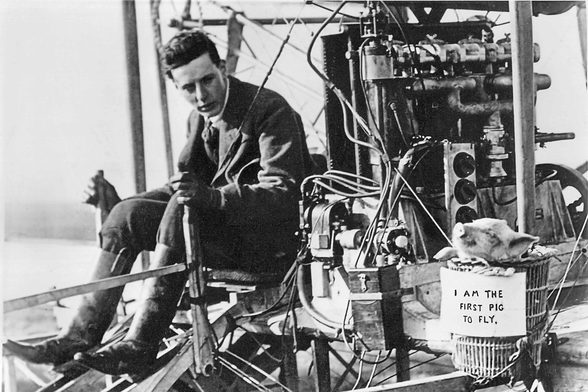
It was the year 1909 and aviation fever was sweeping Britain. In May of that year, John Moore-Brabazon made the first heavier-than-air flight, in Britain, by a British citizen; in June, Alliott Verdon Roe flew the first, fixed-wing aircraft of all-British manufacture. Come July, Frenchman Louis Blériot made the first flight across the English Channel and the Barnwell brothers – Harold and Frank – make the first powered flight in Scotland at Causewayhead in Stirling. To cap off a thrilling year, in November Moore-Brabazon made pigs fly when he strapped one into a basket and attached it to the wing of his aeroplane.

John Moore-Brabazon makes pigs fly – as a joke, but also the first flight of a live animal cargo. November 4th 1909.

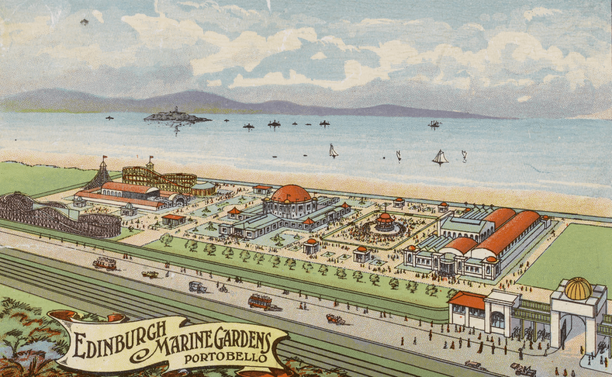
Inspired by the Barnwells, others in Scotland decided to get themselves involved. There were, declared The Scotsman, a large number who are following the development of aviation with an educated, scientific interest“; Scotland was “forging ahead” in this field boasted the Daily Record. And at the epicentre was Edinburgh, with an entire four (count them!) different parties vying to get themselves off of the ground. To add incentive to local pioneers, in September 1909 the directors of the Marine Gardens amusement park in Portobello offered a £500 prize, good for 1 year, for the first flight across the Firth of Forth by a Briton in a British-built plane; so long as it started from Marine Gardens.

Portobello’s Marine Gardens, with the island of Inchkeith and the Fife coast in the distance. © Edinburgh City Libraries

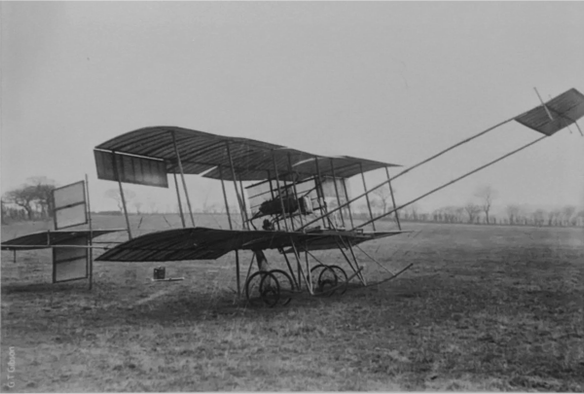
John Gibson, a cycle repair shop owner and engine-tinkerer of Leith, was the most prolific builder of flying machines in Edinburgh, running through a series of quarter and then half-scale models before moving on to full size machines of the Farman type. The flying experiment s of John Gibson and his son John Gibson Gibson were conducted at Buteland Farm outside Balerno and some short flights were managed. Machines made for paying customers also took successfully to the skies. The full story of these are covered in a separate thread.

The Gibson’s first full-size aeroplane – Caledonia No. 1 – probably at Balerno. Photograph donated by John Gibson’s son G. T. Gibson to the National Museums of Scotland and on display at the East Fortune Museum of Flight

Wilfrid Venour Foulis (1884-1951) was the son of Henrietta Fraser and James Foulis, a general practitioner, and grew up on Heriot Row in Edinburgh’s New Town. The family later moved to a villa at Barnton known as The Grove. A practical engineer, Wilfrid studied at the Heriot-Watt Technical College (as it was) before serving an engineering apprenticeship first in the foundry of Aciéries Tilleur & d‘Angleur in Liege, Belgium and then at the Hyde Park Locomotive Works in Glasgow. He then spent two years testing engines for Argyll Motors and then Arrol-Johnson Motors before going into the car business, based at Sunbury Mews off Belford Road. The 1910-11 Post Office directory lists him as a dealer in luxury French cars; Hotchkiss, Berlict and Delage.

Sunbury Mews, where Foulis had his garage and workshop

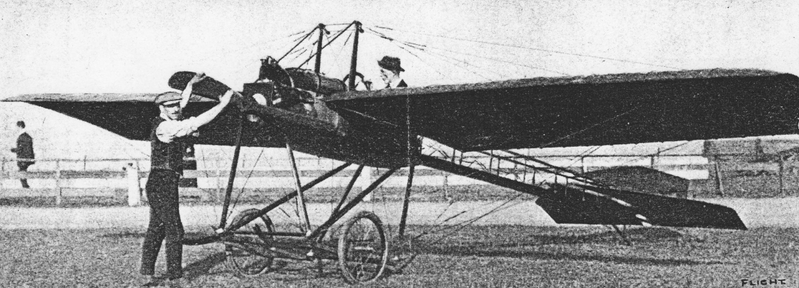
He is described in a newspaper article as “young man of fine physique, standing over 6ft 3in” and as having “devoted a large part of his life to the study of aviation“. By 1909 he is referred to as “an aviator” who had built for himself a biplane that he tried – and failed – to fly near The Grove. In that year, he married Clara Millington Dow, a well known actress and operatic soprano, who had been trained by none other than the W. S. Gilbert of Gilbert & Sullivan. The couple announced to the newspapers that they would be settling down in Edinburgh after their honeymoon tour of South France, but back in Edinburgh, Wilfrid did not to settle down. Instead, he took himself off to Brooklands in England and learned to fly. On his return he began construction of a new flying machine; a Lane monoplane, a British adaptation of the Blériot monoplane

Flight magazine details of the Lane monoplane from April 1910.

Foulis’ made a successful flight in this aircraft some time in early February 1910, but was extremely secretive about his project. The Daily Record wrote that he “will not divulge any particulars as to his machine… [and he] refuses to state where his flights take place“. The location was later gleaned by the Linlithgowshire Gazette as being West Briggs Farm, between Turnhouse and Kirkliston, west of Edinburgh. Coincidentally, this spot is now directly under the runway of Edinburgh Airport. The Gazette‘s reporter was watching when, on 26th March 1910 at 630PM, he made a number of high speed loops of the airfield (on the ground) and managed a number of hops off the ground to a height of three feet.

West Briggs farm, as used by Foulis for his flying experiments, now beneath the runway of Edinburgh Airport. OS 6 inch Survey, 1890 vs. modern satellite imagery. Reproduced with the permission of the National Library of Scotland

The distance from his business and workshop in Edinburgh to the flying strip limited flights to weekends or the very early morning or late evenings, and his ability to practice was not helped by the weather. However he persisted, trying 8 different propellers before settling on one that worked to his satisfaction. The experiments were not without incident; on two occasions the plane crashed and overturned. One early morning in late July, around 4AM, he made his “highest and most successful flight“.

The secretive Wilfrid found himself in court in November 1910, being sued by a man he had employed as an engineer to help him build the planes. It is from this court case that we learn most of the details about his flying experiments. Henry Funke was a motor mechanic in Foulis’ employ and alleged that the latter owed him £20 overtime, having spent all his spare time and Sundays assisting in the construction of the aircraft, sleeping in the workshop in a hammock, but had only been paid a flat weekly rate. Funke declared under oath that while the biplane had “failed entirely“, the monoplane had indeed taken to the skies. On one occasion they had taken it to Newton Stewart to make a public display but it was too wet to fly so they had to cancel: the bitterly disappointed crowd became angry and started throwing stones at the visitors, who had to hide from them. The court found in Funke’s favour and he was awarded £10.

Wilfrid continued his flying experiments after the court case, until a serious accident in early 1911 totally incapacitated him and he had to retire from flying and retreat to France for a number of years to recuperate. His aeroplane was advertised for sale from Edinburgh (for some reason, in the Belfast Telegraph, to Ireland!) in February 1911.

Classified advert selling Foulis’ aeroplane, February 1911

He was still in France, in convalescence, when war broke out in 1914 and he returned home to “sign up”. But he did not join the Royal Flying Corps, he instead entered the Army Supply Corps, where he would rise to the rank of Captain. Making use of his engineering and motoring background, he made a name for himself by converting a moulding machine into a tyre press for the repair of army lorry wheels, receiving “a mention in despatches” and promoted to the head of the 3rd Army Supply Corps’ repair shop. While in this position he invented the “Foulis Walking Stick Gun” and was sent back to Britain in December 1915 with it by none other than Field Marshall Haig (a fellow son of Edinburgh). He was seconded to the ministry of munitions to further this invention and took 9 back to the front for trials with the 2nd Army in 1916. Not one to stop inventing, he is also credited with the “Foulis Adaptor for Howitzers” and the “Foulis Safe Red Cartridge for Stokes Mortars“, although I am unsure of what any of these devices actually look like or did.

Wilfrid and Clara settled in England after the war but divorced in 1923. Their son, Michael Venour Primrose Foulis, joined the RAF in 1940 and served in the Mediterranean as a pilot, where he died in action in 1943. Wilfrid re-married in 1924, to Ida Brookes. In 1935 his career took a significantly different direction when he was appointed director of the London Academy of Music and Dramatic Arts, a position he held until his death in 1951 aged 67. He is buried in the family plot in the Dean Cemetery in Edinburgh.

Wilfrid’s final resting place in Dean Cemetery, photo credit JSF via Findagrave.com

In April 1910, it was reported that Charles Hubbard, an English-born engineer and factory manager living at Viewforth, had built for himself a Blériot type monoplane of the sort in which Loius Blériot had recently managed his cross-Channel flight. The machine is described as being 28 feet long and with a wing span the same. It was constructed mainly from a bamboo framework with a propeller of butternut wood, and was powered by the unusual arrangement of two 5hp Rex motorcycle engines coupled together by a chain. Hubbard was in the process of constructing a 3 cylinder, 25hp Anzani engine and hoped to have his machine ready for the Royal Aero Club’s inaugural Scottish flying meeting at Lanark Racecourse in August of that year.

Louis Blériot prepares for his epic cross-channel flight, 25th July 1910.

Hubbard deviated from the standard Blériot design, by having square wing-tips instead of rounded ones and in sitting himself on a hammock seat inside the framework of the fuselage, underneath the wing, rather than above it looking over the top surface. Testing was being carried out on Portobello Golf Course in the early mornings. On 25th April it was reported that he had managed to make a number of powered hops in it, although with only 10hp total engine output – less than the Wright Flyer of 1903 – it was unlikely he would actually have ever sustained flight. A serious crash required a period of recovery for Charles and the machine to be entirely rebuilt. By June the following year, the more powerful engine was ready and fitted, when Hubbard is photographed in it at Portobello.

The Hubbard-Blériot monoplane at Portobello, June 1911

No more is heard of Hubbard’s flying experiments after this time. He and his brother would later go into business in car sales, hire and repairs from the workshop in Viewforth where his flying machine had been built.

Henry (1882-1964) and Alfred (1891-1965) Alexander were the sons of Margaret Wilson and James Robert Alexander. The latter had found success in the boot and shoe trade, before expanding into piano sales. Obviously adept at spotting the next new thing, he then moved into the bicycle trade. The whole Alexander family were keen cyclists, and all four of “JR’s” sons had been high school cycling champions. Just as their father progressed the business on to motorcycles, Henry and Alfred graduated from cycle to motorcycle racing. The former had several district championships to his name and the latter had won 13 first prizes in the 14 races he had contended in 1910.

With a passion for speed, engineering and dangerous thrills, it was only natural that flight should interest them. They decided to build their own aeroplane, in their motorcycle tuning workshop on St. James’ Street, off St. James’ Square (the family business at this time was nearby in the district of Greenside). Their monoplane was exhibited at the Scottish Motor Exhibition at the Waverley Market in January and February 1910. It was of the Santos-Dumont type, named for its Brazilian inventor. This was a particularly lightweight aircraft, where the pilot sat slung beneath the wing, and the brothers constructed it from bicycle tubing and fitted it with a small 20hp engine of their own design and construction. It was 19 feet long, with a wing span of 20 feet, a fuselage 4 feet wide and an all-up weight of 240lb – about 25% less than a regular Santos-Dumont Demoiselle. It was their intention to be able to produce a low-cost flying machine for £225 (about £33k in 2023).

1910 Postcard image of the Santos-Dumont “Demoiselle” type that the Alexanders constructed. The caption reads “Grand Aviation Week at Bordeaux-Merignac. The aviator Audemars Bayard-Clement piloting a “Demoiselle” type Santos-Dumont, wingspan 6m, total length 6m, wing surface 12m², cruciform tail which pivots in any direction, landing gear with pneumatic wheels. Engine Bayard-Clement 30hp, 2 cylinders. Gross weight in running order 145kg.”

In early April, the Edinburgh Evening News reported that they had been secretly testing it on the ground at an undisclosed “sports enclosure” on the outskirts of Edinburgh, towing it there behind their car in the early mornings. Following extensive ground runs they had managed a 20 yard flight in the dusk of Monday April 4th. When interviewed by the reporter of the Daily Record, the brothers informed them that their intention was to overhaul and improve the engine before trying for the sky again. The description of the site, along with a grainy photo of it, identifies it as Myreside, the playing fields of the brothers’ old school, George Watson’s. They were limited to runs of only 150 yards by the confines of the grounds, surrounded by high walls.

Period newspaper photo of the Alexanders’ aeroplane at their test ground at Myreside. The pavilion of Craiglockart Playing fields is in the background

The Alexanders, who proclaimed themselves “Scotland’s largest motorcycle dealers,” became the first and sole distributor for Ford vehicles in Scotland in 1911 and Henry, ever the adventurer and showman, hit on a publicity scheme to promote the new 20hp “Model T” and showcase its practicality and ruggedness: he would drive one up Ben Nevis! Taking a stock, 4 seat, touring model for his adventure, he spent a week on the mountain (on foot), scouting out potential routes, making notes of obstacles etc., finally picking on a start point at Inverlochy. The attempt began on the 9th May and the climb would take 5 days in all. Numerous times the car sank up to its axles in marshes, only to be pulled, coaxed and dug out. Where the path was too narrow, a gang of workmen widened it. Where streams were to be crossed, a portable ramp was used to bridge them. The snow on the summit was 12 feet deep in places, and Henry had to dash between patches of bare rock and boulders, building up enough speed to slither across the snow to the next clear patch.

Henry at the Summit, with the old observatory and “hotel” behind him. Note the snow chains on the rear wheels. Credit: BFIHenry sets off from the summit through the snow to begin the descent. Credit: BFI

Ford’s general manager in Britain had invited the press to view, photograph and film the descent; driving them to the foot of the mountain in a Convoy of Ford cars, and carrying their gear up by pony. In contrast to the climb, Henry’s return journey took only 2.5 hours (although split into two legs, with an overnight stop half-way down at 2,000ft altitude). A newsreel film of this remarkable journey can be seen at the British Film Institute website. Henry’s feat was used extensively by Alexander & Co. in their newspaper adverts.

The Scotsman, 31st May 1911

In November 1912, Henry was fined 10s for failing to show a licence when requested and £1 (or 10 days imprisonment) on a charge of having driven in a negligent manner on a country road in Fife, resulting in the death of 3 sheep from a flock he hit. In September 1928 he repeated the feat of “motor mountaineering” on Ben Nevis, this time ascending on the bridle path on the western side in the new Model A. The car broken down a few hundred feet from the summit and required an axle to be replaced, probably the highest ever “roadside repair” undertaken in the UK. This ascent took 9h 20m on a route that had been prepared in advance.

Patrick Thomsons, one of Edinburgh’s premier department stores, cashed in on the enthusiasm for all things flying and took out large adverts in the local papers capitalising on the successes of the Alexanders and Foulis (Hubbard didn’t get a mention), inviting shoppers to land on their roof by aeroplane (“Ours is a big, broad, flat, asphalt roof. You can tell it from almost any height by the green and white P.T. flag. An ideal place for a bird-like descent, we should say. Leave your machine up top and take the elevator down”.

Edinburgh Evening News advert, from June 1910

The Daily Record reported in April 1910 that an unknown machine, based at Swanston farm to the south of the city, had been flying high over the southern outskirts of the city on more than one night, with people seeing “a flying machine, brilliantly illuminated, which was at a considerable height from the ground“. On the 5th April, the “moving lights of the aeroplane were seen by several people over the Hunter’s Tryst“. Given the progress (or lack of) of the known aviators in the city at this time, and that there are no other corresponding news or magazine reports, it is likely that this was Scotland’s first Unidentified Flying Object caused by local hearsay, rumour and excitement. Despite the intense efforts, none of Edinburgh’s home-grown flyers enjoyed much success on their home-made machines. All seem to have been distinctly underpowered and hard to control, and made little more than short, high-speed hops at low altitude. It would take another man to bring success to the city’s pilots.

William Hugh Ewen (1879 – 1947) , usually known as W. H., was born in Shanghai to Selina Blakeway and William Ewen, who were Scottish missionaries. On returning to Scotland they lived in the Pilrig area of Leith before moving to Willowbrae, and W.H. studied music at Edinburgh University. After graduating, he worked as a printer’s clerk, served in the Territorial Army and was an organist in the United Free Church. Perhaps inspired by the well-reported exploits of the Alexanders, of Foulis and of Hubbard, in February 1911 he took himself to Hendon and was awarded Royal Aeronautical Society flying licence no. 63, making him the 6th Scot to be so accredited. He was something of a natural, he flew on his first attempt and graduated on his third.

W. H. Ewen in 1913, from Flight Magazine

In June of that year, Ewen relocated himself to Lanark Aerodrome, which had been built the previous summer a the Lanark Racecourse to host the Royal Aero Club’s inaugural Scottish flying meeting, and set himself up as a flight school, W. H. Ewen Aviation Co. Ltd., offering tuition (or just joyrides) on Blériot or Deperdussin monoplanes, for the princely sum of £75 (c. £11,300 in 2023) plus a refundable £15 deposit for damages to the machines!). And then on August 16th 1911, the news wires brought exciting news to Edinburgh; not only was Ewen going to fly through from Lanark, and not only was he going to spend a week giving demonstration flights from the Portobello Marine Gardens, he was going to also take up the now-expired challenge to fly an aeroplane across the Forth from there!

Midlothian Journal, August 1911

Ewen didn’t make things easy for himself; he was going to fly a brand new aeroplane – a French Deperdussin monoplane – which had never yet flown and had an engine of only 28hp (50hp was by this time a standard for longer distance flights). For the start of the aviation week the poor weather prevented him flying, but then on the morning of Wednesday 30th, the skies cleared and the winds dropped, and he made the decision to try for his pioneering flight across the Forth. At 6AM he took a practice flight, the first time he had flown the new machine, making a loop at 150ft altitude towards Leith, circling over Seafield, before climbing to 350ft and passing across Craigentinny Golf Course, Duddingston and Joppa, before being caught in an unfavourable wind and deciding to land in a field at Northfield Farm. Mr Graham, the farmer, towed the plane back to Marine Gardens on his horse and cart.

W. H. Ewen (at the controls) in his Deperdussin aircraft, probably at Marine Gardens. From Flight magazine, September 1911

Just before 7PM, dressed in a suit of black oilskins, Ewen lined up the Deperdussin on the tiny 150 yard “flight strip” at the Marine Gardens sports field, started his engine, pointed his craft out to sea and opened the throttle. He only just cleared the boundary fence (which had been lowered to accommodate him) and then rose “gracefully” into the sky and headed Fifewards. Finding the wind stronger than expected, he carried on climbing until he reached an altitude of 1,000ft at which point the air was calm. By this time he was just to the east of the island of Inchkeith, and continued on his course until he crossed the Fife coast about a mile from Kinghorn. He now turned for Leith, and crossed back across the water – a period which he described as a “bad five minutes” on account of the turbulence, turning homewards for Portobello about 2 miles short of the port. Returning to the field where he had taken off, he made an attempt to land but aborted at the last moment when he was caught by a gust of wind. Deciding the landing there would be too difficult he instead put himself down nearby on Craigentinny Meadows. The whole flight had covered 12 miles and had lasted for 10 minutes

The wings were taken off and the Deperdussin was pushed back to a heroes welcome at Marine Gardens by the band of the 3rd Dragoon Guards who struck up “See the Conquering Hero Comes“. Asked to make a speech to the cheering crowd, W. H. expressed his pleasure at how the flight had gone and that he was “pleased that a Scotsman had been able to do something in the way of mechanical flight”.

An advert for the Deperdussin monoplane, September 1911, celebrating Ewen’s flight across the Forth

At the end of the week, a celebratory function was thrown by the directors of the Marine Gardens in Ewen’s honour. The band struck up “Scotland the Brave” and he was presented with a commemorative silver bowl after which a concert was held. Asked once again to make a speech, he joked that what he did not think himself particularly brave or adventurous because in 2 or 3 years time, flying would be so normalised that everybody in attendance would have done it. “Flying” he said “was the safest means of travel, if one had the common sense to know when to stop.” A few weeks later, W.H. was again celebrated by the newspapers, this time for flying the Deperdussin from Lanark to Edinburgh, a distance of 32 miles, in 35 minutes. Navigating by following the Caledonian Railway from Carstairs, he put down at Gorgie Farm, where the Chesser and Hutchison housing estates would later be built. He was followed on this journey by the mechanics from the flying school at Lanark, chasing him on the ground by car.

The Deperdussin is readied for Ewen’s flight from Lanark to Edinburgh in October 1911

Flushed with success, in early 1912 W.H. moved himself to Hendon to open a new branch of his flying school. Here he also became an agent for and constructor of British-built French Caudron biplanes. “Scotland’s Greatest Aviator, the Hero of a Hundred Flights” returned home that summer to fly at both Lanark and a second season at Marine Gardens. He had a narrow escape on 26th July when his machine failed to take off, ran up an embankment and fell, nose-first, into a 6 feet deep ditch.

Ewen, in his Caudron biplane, at Lanark, ready to fly to the 1912 aviation week at Marine Gardens.

After training some 350 pilots, Ewen sold his business, and it was renamed the British Caudron Co., it would later move to Alloa, the town on the north bank of the Forth, and construct an aeroplane factory there. At the age of 36, W.H. enlisted in the Army Ordnance Department in 1915 before being posted to the Royal Flying Corps. Transferring to the Royal Air Force on its formation in 1918, he retired at the rank of Major due to ill health in November that year and spent most of the rest of his life living in London, working as a composer and orchestrator of music. He died in Edinburgh in 1947.

If you have found this useful, informative or amusing and would like to help contribute towards the running costs of this site (including keeping it ad-free) or to the book-buying budget, why not consider supporting me on ko-fi.

These threads © 2017-2023, Andy Arthur

#Aircraft #Aviation #Firsts #FirthOfForth #Flight #Fling #Lanark #MarineGardens #Portobello #Seafield #Suburbs

The Grand Edinburgh Fire Balloon: the thread about James Tytler and the first manned aerial flight in the British Isles

This thread was originally written and published in August 2023.

Today is August 27th 2023. So what is special about this date? Well, it was today, 239 years ago, when the eccentric Edinburgh character of James Tytler ascended in his “Grand Edinburgh Fire Balloon” and flew the 3,000 or so feet from Comely Gardens to Restalrig on the outskirts of the city, thus making the first, manned aerial flight in the British Isles, immortalising himself in the process as Balloon Tytler.

A rather optimistic engraving of Tytler’s balloon flight, from “The Literary World”, 25th July 1840. In reality the bird-like gondola and the stove was absent during his flight and he sat instead in a small, wicker basket

James Tytler hailed from Fearn in Forfarshire, the son of a minister of the Kirk of modest means, who had been sent to Edinburgh to pursue and education and make a better life for himself. He was many things, but he was mainly persistently skint and in debt. Had he not been so, he may have been remember as a polymath. He had failed as a preacher, as a doctor as an apothecary and as a poet, but succeeded in scraping a living and keeping his creditors at bay as a pen for hire; he wrote much of the 2nd edition of the Encyclopædia Britannica. But we are interested in him here as an aviator.

James Tytler, engraving of him as author of Encyclopaedia Britannica

In September 1783, a “fire balloon1” constructed by France’s Montgolfier brothers successfully flew with a sheep, a duck and a rooster on board (the animals all survived!) In late November, Pilâtre de Rozier and the Marquis d’Arlandes were the first human passengers in one of the brothers’ machines. Tytler, reading of these endeavours in far away Edinburgh, was captivated and – like many of his contemporaries -caught the flying bug . Working on the second edition of the encyclopaedia at the time, he devoted a whole 8-page section of the Encyclopaedia to ballooning, writing “In future ages, it will be as usual to hear a man call for his wings, when he is going on a journey, as it is now for him to call for his boots“. “By this invention” he continued “the schemes of transporting people through the atmosphere, formerly thought chimerical, are realised”.

The first flight of a Montgolfier fire balloon from Versailles in September 1783, the passengers were a sheep, duck and rooster
  • At the time, hot air balloons were known as fire balloons and hydrogen balloons as inflammable air balloons ↩︎
  • It was around this time, late in 1783 or early 1784, that Tytler took the bold step of determining that he would not just read and write about ballooning, he would also build and fly one of his own. This whole scheme may have arisen as an after-dinner wager in one of the dining rooms of enlightenment Edinburgh, as a scrap of handwritten paper was kept by Professor Dugald Stewart, in the style of a newspaper advertisement, announcing the intention:

    We have the authority to assure the Public that it is neither Mr Tytler of Woodhouselee nor Mr Frazer Tytler, Advocate and Professor of Civil History in the University of Edinburgh, that means to go up with the Air Balloon on the 7th of May, but Mr James Tytler an ingenious chemist and distant relation of the others, whose friends it is hoped will accept of this intimation of their having no intentions of going up with air balloons at present, what ever-malicious or interested persons may chuse (sic) to give out, or credulous people may believe.

    Wager or not, Tytler certainly had the brains, the self-confidence and the ambition to see this project through, but there was a big stumbling block; he had not the money. Indeed, this lack of funding would plague the project from beginning to end and seriously compromised his results. But he pressed on with planning nevertheless. On June 19th he took out a front page advert in the Edinburgh Evening Courant newspaper announcing a public demonstration of a scale model hot air balloon, both for his own testing and to try and raise precious funds by charging an admission fee:

    On Monday next, the 21st current, will be exhibited
    AT COMELEY GARDEN
    By JAMES TYTLER, CHEMIST
    A FIRE BALLOON, of 13 Feet Circumference,
    AS A MODEL OF
    THE GRAND EDINBURGH FIRE BALLOON,
    with which he intends to attempt the Navigation of the Atmosphere

    Edinburgh Evening Courant, June 19th, 1784

    Comely Gardens, if you didn’t know, was a Georgian pleasure garden between Holyrood and Abbeyhill, “a wretched imitation of Vauxhall“, where for a few pennies you could stroll the ornamental garden, take tea, and listen to whatever music or entertainment had been laid on. The gardens both offered shelter within their walls and trees, from (most of) the prevailing winds, and an ability to charge people for entry. This tethered exhibition was successful and enough money was raised to fund construction of the full-scale “Grand Edinburgh Fire Balloon

    1804 Edinburgh Town plan by John Ainslie, centred on Comely Gardens. Reproduced with the permission of the National Library of Scotland

    James got to work at once. The basic machine was quite crude – unlike the gaily decorated French contemporaries – limited both by his funds and his skills. The design was basically a 30 feet wide by 40 feet tall linen cylinder, lined with paper to make it “leak proof” and surrounded by ropes to attach a basket for the occupant and a stove to heat the air. Unfortunately, many of those gentlemen who subscribed to the scheme refused to part with their money until after the machine had flown (or at the very least risen from the ground), so he was caught in a Catch 22 situation, between having to follow through to prove himself to his sponsors, but also lacking the money or credit to actually do so.

    Engraving of Tytler’s balloon from his own promotional tickets. The characters in the balloon are well out of scale. The “wings” projecting from the car were intended to “row” and “steer” it through the air but were entirely useless.

    There was also the threat of the Edinburgh Mob, there being rumblings that they would either destroy the balloon as some sort of affront to God before it could fly or destroy it in disappointment if it failed to fly. The authorities were nervous and made it be known they might forbid the scheme entirely on public order grounds. Somehow Tytler managed to scrape together enough funds to complete the basic balloon envelope and resolved to demonstrate a public inflation of it to try and confound his doubters and convince some of the sponsors to convert their paper promises into actual money. But he needed somewhere enclosed to trial the inflation of his fragile linen and paper balloon and there was only one building big enough in town; the incomplete shell of the Register House – “the largest pigeon house in Europe“, still incomplete after 10 years of stop-start construction and a lot of finance.

    The Register House, partially complete, some time before 1787. Sketch by John Brown, Cc-by-NC National Galleries Scotland

    And so an advert was placed in the Courant on July 17th 1784, requesting the presence of “the Gentlemen who have subscribed or intended to subscribe“. The reporters from that paper and its rival The Advertiser were also invited to help publicise the scheme. This demonstration was also a success – sort of… the balloon did inflate – but the stove was inefficient and smoky, it coated the inner walls of the envelope in soot and sent up sparks and cinders which burned holes in the paper and linen, causing it to leak like the metaphorical sieve and slowly deflate. Tytler put a brave face on things, but couldn’t afford to start from scratch or buy a better stove, so resolved to patch up the leaky balloon and go for broke. The week of the Leith Races commences on 2nd August and it would provide the crowds and occasion to launch a flight.

    William Reed, the Leith Races, late 18th century or early 19th. © Edinburgh City Libraries

    There was a further reason to pick race week for the demonstration; it gave Tytler the perfect cover if things went wrong and the Mob was stirred. In this event, he could say it was the fault of the races for whipping up any trouble and not his flying machine. So the day after the test inflation at Register House he took out adverts across the local papers. In these, he announced the Edinburgh Fire Balloon would fly (tethered) after the first race, and every day thereafter, and that on the Friday it would be unleashed and might “cross the Frith (sic) of Forth”. He made yet a further appeal for financial support and made sure to note that Major Masters, commanding officer of the garrison at Edinburgh castle, had offered up his men to guard the balloon and any “Ladies and Gentlemen that may attend the different exhibitions“, lest the Mob spoil the occassion.

    Tytler’s announcement in the Caledonian Mercury, 31st July 1784

    So in amongst the drinking, the gambling, the debauchery, the freak shows and the general chaotic merriment of the Leith Races, Tytler was going to fly across the Forth! He removed the balloon back to the Comely Garden and got to work at once. For the occasion, he had tickets printed up, which he signed and numbered by hand. He also scored out the printed line “Constructed by William Brodie“, being unable to afford to pay a subcontractor he would now be doing all the work for himself.

    Ticket to the Edinburgh Fire Balloon, British Museum number C,2.11-28

    With what remained of his scant funds, he had constructed a mast 50ft tall, with a 64ft long arm at the top, to hold the envelope of the balloon as it inflated. But his relentless scrimping meant it was built too weak, and the day before race week began, Sunday 1st August, it collapsed under test. The crowd that nevertheless assembled at Comely Garden the next day to see the tethered flight was therefore denied such a spectacle. On each of the subsequent 3 days the west wind did blow – a direction from which the site was not sheltered – so disappointment prevailed again and again. Things were getting desperate for Tytler, he needed a success, and so he moved the balloon and the repaired mast to the most sheltered corner of the garden and on Friday 6th August – the date he had promised to fly across the Forth – he lit the stove and started inflating. But the wind again started to blow as the envelope filled and it strained at its mooring ropes. Tytler’s helpers struggled to contain it and it was only the ripping of the envelope and partial deflation that probably saved it from being blown clean away. The crowds left angry and dismayed. The Courant was scathing: “The Edinburgh Fire Balloon has been struggling hard to make its public appearance during the race week. Masts and yards and scaffolds and furnaces had lent their aid, but to little purpose. Its gravity and affection for the earth cannot be overcome“.

    But Tytler was irrepressible, the winds dropped and the next day he tried again. This time the balloon inflated, but as he was about to clamber aboard the basket “a gust of whirlwind, as if send by divine command to blast the hopes of this devoted projector, attacked the Balloon, drove it hither and thither and by compressing it on all sides, soon reduced it to a state of flaccidity” and it once more deflated. The Mob had finally had enough; angry scenes followed this failure and Tytler fled before he could be accosted for any refunds. When the crowd could not find him they turned instead on his balloon, detached its basket and paraded it around the local streets in triumph before throwing it on the still-glowing stove and burning it to ciders. Their anger thus sated, they drifted home. Tytler was at rock-bottom and wrote about his feelings at this time:

    I was obliged to hear my name called out wherever I went, to hear the insults of every black-guard boy, to hear myself called Cheat, Rascal, Coward and Scoundrel by those who had neither courage, honesty nor honour. I was proscribed in the newspapers and pointed out by tow of the Edinburgh News-mongers as a public enemy

    His name may have been mud with the Courant and the Advertiser, but the Caledonian Mercury was more sympathetic about the failure, giving him the benefit of the doubt – he could after all not control the weather. It also pointed out that if more of his claimed backers would pay up, he might have the funds needed to succeed.

    Perhaps encouraged by that forgiving take on events, Tytler soon slunk back to Comely Garden to examine the remains of his machine. The main flaw of his design was that it lacked a neck, so the wind easily blew or sucked the hot air out. About this he could do nothing, but he could at least try patch it up and get a new basket. The fragile paper lining was now covered in soot and full of cinder-holes and tears, so he painstakingly removed it, and instead varnished the linen to try and make it airtight. He could not afford to build a proper basket, and so one used to carry crockery was sourced as a passenger compartment. But this meant that the stove could no longer be carried. In fact this was probably a good thing as it weighed 300lbs and had a habit of mainly burning holes in the balloon. So he had to settle to try and fly without it, using only whatever hot air he could fill it with on the ground (and keep captive within it) to provide the lift for flight. His reasoning was simple, if he could make any sort of flight in the repaired machine, he should be able to raise the money for a full rebuild. In his own words it was “the resolution of a madman and which nothing but my desperate situation could excuse“.

    And so the word went out that he would try again for a flight within a fortnight. Fortunately at this time, the attention of the public and of the press was drawn to the election of a new MP for Edinburgh, giving him some breathing space from both (even if there was only one candidate and the only electors were the Town Council!) Not wanting to incur the attention of the Mob again, the next attempted inflation on Wednesday August 25th had no crowd invited. The balloon was filled for over an hour to help dry out the varnish. At about 630AM, the fire was put out and Tytler climbed into his basket. The restraining ropes were cast away, the balloon floated, and then… nothing happened! Perhaps there was not enough hot air, or the morning was too cold, but at least there had not been a disaster and he had demonstrated “the practicability of the scheme“. The previously sympathetic Caledonian Mercury was not convinced however and under the title of “The Rise and Fall of the Edinburgh Fire Balloon”, they took a satirical imagination of his first flight,with it ending with the balloon pierced by a church steeple and its occupant being cast into a duck pond.

    But success was in Tytler’s grasp and after a final few tweaks and another coat of varnish, he was ready to go again. It was Friday 27th August, 1784, 239 years ago today, it was about 5AM and the stove was once again lit beneath the envelope. An uninvited crowd had formed, either to be sure to see success or to be amused by failure. The balloon slowly filled, straining at its mooring ropes. Maybe Tytler – a deeply religious but unaligned man – said a prayer for success or salvation first, but he soon climbed into his basket again and the ropes were once more undone. And this time, to everyone’s surprise, up he went, eliciting a great cheer from them. Ascending rapidly, a loose rope caught a tree and the mooring mast, but such was the lifting force it simply snapped free of both. A height of 350ft was reached, the length of that loose rope, the crowd tried to grab it but it tore free from their grasp too. Up, up, and quite literally away he went! Carried on the western breeze, he drifted slowly eastwards and away from the city. The crowd gave chase, Tytler recalling afterwards that he was much amused by “looking at the spectators running about in confusion below“.

    With no stove to keep the balloon hot, it rapidly cooled and the intrepid aviator was soon drifting back to earth. He came down about half a mile distant in the village of Restalrig, possibly in the minister’s glebe (but neither in a dung heap or a duck pond as his detractors had forecast). And for once, Tytler, the crowd, his supporters, and the press were all jubilant. The downtrodden little man with a moth-eaten coat, whose shoes were falling apart and who had a hole in his hat had succeeded! The previously hostile Advertiser declared him “the first person in Great Britain to have navigated the air“. The Courant were “amazed at the boldness of the undertaking” and made something of a mealy-mouthed apology for their previous scepticism. The Caledonian Mercury called it “a decisive experiment” and that Scotland could at last “boast of its aerial navigator“.

    Filled with the confidence of success a 2nd flight – well advertised to the public – was planned for the 31st, the day of the foregone conclusion of the election of Sir Adam Fergusson as the city’s new MP. After completing the requisite formalities, the newly elected member and the Council committee hastily made their way to Comely Garden to join the assembled spectators. Once again the balloon inflated. Once again Tytler climbed bravely aboard and once again it took off. But it had been under-inflated and this time it rose to only about a hundred feet, coming down not far over the garden boundary wall. But it had still flown and it was enough to convince some of his backers to finally follow through financially and he was able to raise enough money to rebuild his basket properly and to have a new stove built for it. The clock was now ticking in the “Balloon madness” capturing the country and on September 15th Italian Vincenzo Lunardi made a balloon flight from Moorfield Barracks, in London. In Perthshire, an enterprising but unknown gentleman sent up a model balloon, 22 feet in diameter, which was seen to travel as far away as Moulin, some 25 miles, before being blown back on the wind almost to where it had lifted off.

    Lunardi makes his first balloon flight in London. Note the different balloon design to Tytler’s, but that he too carries the useless oars and rudders © The Trustees of the British Museum

    The autumn weather delayed proceedings in Edinburgh, it rained or it was too windy, or both, for weeks for any inflation or flights. But on September 29th Tytler was ready to go again. And so the balloon was hoisted on the mast and the new stove was lit beneath. A huge crowd assembled, packing out St. Ann’s Yards (now part of Holyrood Park) and the slopes of the Calton Hill. The first attempt deflated and so it was hoisted and filled again. But once again a sudden and spiteful gust of wind caught it. This time the supporting mast broke, the balloon collapsed and the whole lot came crashing down. One helper on the mast leapt for his life and landed in a tree, another was badly injured in his fall. Tytler’s luck and popularity was now trickling rapidly away from his grasp, as was the support of the press, who once again took up their sceptical stances. But he was no stranger to this and refused to give up, and went back to his repairs and planning another attempt.

    That day came on October 11th. Everything proceeded as before. When the balloon tugged at its ropes Tytler climbed aboard and cast off. Nothing happened. He climbed out again to see what was wrong and now it took off! The Courant described that the balloon “rolled about a short time like an overgrown porpoise“, reaching a height of about 300 feet before falling sideways back to the ground and landing heavily, destroying itself in the process. Excuses were made – the stove was too small, the calculations had been gotten wrong, but surely now it was all over? Indeed it was not – Tytler just would not give up. He tried to raise more money for repairs but by March 1785 he had fled to the debtors’ sanctuary of Holyroodhouse (to which he was no stranger). It may have been he was being sued by the proprietor of Comely Garden for damages caused. Amusingly, his entry in the Register of Protections in the sanctuary recorded him as “James Tytler, chemist and balloon maker“. In the sanctuary, he was safe from his creditors but could not work on his balloon, and he was not safe from the fever that incapacitated him for 6 weeks.

    The Canongate looking towards the Abbey Sanctuary, by James Skene 1820. A debtor, his coat flying behind him, is chased by his creditors and their batten-wielding henchmen © Edinburgh City Libraries

    By the time he was free of debt and fever however, ballooning had moved on and a simple half mile flight wouldn’t cut it. He would – in his own estimations – have to fly at least as far as Dundee! A date was set of July 26th. And so once more, Tytler lit his stove. And once again it began to inflate. An ominous rumble of thunder was heard in the distance, the wind suddenly got up, the balloon was torn from its moorings and upended, the stove smashed to pieces and the envelope totally destroyed. And that was that. Tytler finally admitted defeat and gave up. He was consoled by kind words in letters from none other than Vincenzo Lunardi, now a national hero. In reply, Tytler composed a sad poem, including the couplet: “Lost are my wishes, lost is all my care, And all my projects, flutter in the air“. While the two were rivals they were so on friendly terms, Tytler beat Lunardi into the air, but it was the latter who made a success of it. Edinburgh satirist John Kay captured the two of them in a caricature entitled “Fowls of a Feather, Flock Together“, Lunardi holding out a conciliatory hand.

    Lunardi, centre, holds out his hand to Tytler, 3rd left, in John Kay’s caricature of 1785, “Fowls of a Feather Flock together”

    Robert Burns corresponded with Tytler, and gives as a contemporary opinion of him:

    An obscure, tippling, but extraordinary body known by the name of Tytler, commonly known by the name of Balloon Tytler, from his having projected a balloon – a mortal, who, though he trudges about Edinburgh as a common printer, with leaky shoes, a skylighted hat and knee buckles as unlike as “George-by-the-Grace-of-God and Solomon-the-Son-of-David”, yet that same unknown drunken mortal is author and complier of three-fourths of Elliott’s pompous ‘Encyclopaedia Britannica’, which he composed at half a guinea a week.

    Robert Burns, describing James Tytler

    Tytler very soon had to flee Edinburgh, on the run yet again from his creditors, apparently a method he had devised for bleaching linen, which could have made him his fortune, had been stolen from him by unscrupulous dyers. His wife sued for divorce in 1788 on account of him having taken up with another woman with whom he fathered twins. He returned to the city in 1791 to work again on the third edition of the Encyclopædia Britannica but he did not stay long; in 1792 he wrote a seditious pamphlet calling the House of Commons “a vile junto of aristocrats” and was outlawed. In 1795 he left for America, writing a further radical pamphlet en route, “Rising the sun in the west, or the Origin and progress of liberty“. He lived out his last decade in Salem, scraping a living from his writing and selling medicines. Turning increasingly to drink as a counter his disappointments in life, he left his house one day in January 1804, inebriated, never to return. The sea washed his body up 2 days later.

    James Tytler, an 1804 portrait by American artist Hannah Crowninshield. Copy of a missing watercolour supposedly held by the Peabody Essex Museum

    James Tytler is long gone, but he’s not quite forgotten locally. On the 200th anniversary of his achievement, a hot air balloon meeting was held in Holyrood Park, over the wall from the location of Comeley Gardens, the largest balloon being decorated specially for the occassion

    James Tytler bicentennial commemorative balloon in 1984

    Two modern streets are named for him in the vicinity of where the Comeley Gardens were located, Tytler Gardens and Tytler Court and there are two murals dedicated to his aerial adventures in Abbeyhill, the most recent by the Abbeyhill Colony of Artists in 2021 at the top of Maryfield.

    The Colony of Artists mural to James Tytler at Maryfield. Note the map marks Tytler Court and Tytler Gardens.

    If you have found this useful, informative or amusing, perhaps you would like to help contribute towards the running costs of this site – including keeping it ad-free and my book-buying budget to find further stories to bring you – by supporting me on ko-fi. Or please do just share this post on social media or amongst friends.

    Explore Threadinburgh by map:

    Travelers' Map is loading...
    If you see this after your page is loaded completely, leafletJS files are missing.

    These threads © 2017-2026, Andy Arthur.

    NO AI TRAINING: Any use of the contents of this website to “train” generative artificial intelligence (AI) technologies to generate text is expressly prohibited. The author reserves all rights to license uses of this work for generative AI training and development of machine learning language models.

    #Lochend #Logan #Restalrig #StMargaret
    The Irrepressible Mr Binko: the thread about the Engineer and Edinburgh’s first Electric Railway

    My sources tell me it is was Electrification Friday and although I was saving a picture for another day it seems right to share it now. Behold! Mr Binko’s Electric Railway!

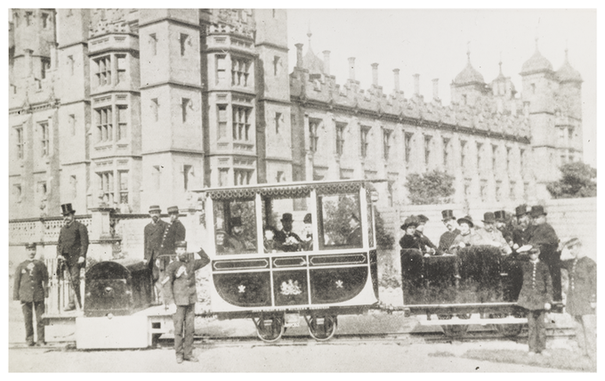
    Mr Binko’s Electric Railway. © Edinburgh City Libraries

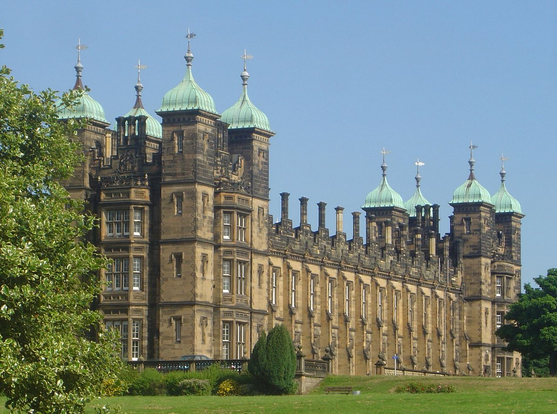
    The passengers in the car are the Prince of Wales (future King Edward VII) and his wife Princess Alexandra, Princess of Wales. Regular viewers may recognise the backdrop as Donaldson’s Hospital.

    Donaldson’s Hospital. CC-BY-SA 3.0, David Monniaux

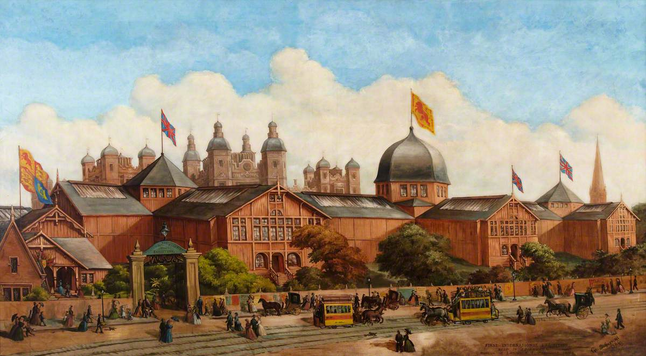
    It was the setting of the First International Forestry Exhibition of 1884 – held in a grand, wooden, temporary pavilion on the Hospital’s lawns – and that was the reason for Mr Binko bringing his railway to there. When the Royal Party toured the exhibition and rode his railway on 22nd August they became the first British Royals to be moved by electric power.

    The 1884 exhibition, colour oil painting © Museums & Galleries Edinburgh

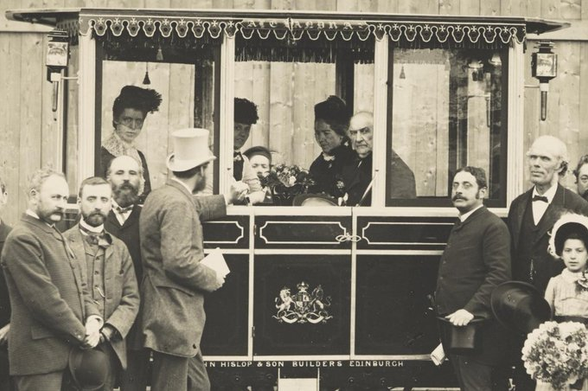
    The carriage was named Alexandra after the Princess of Wales and was made locally by coachbuilders John Hislop & Son. The carriage was “richly upholstered in silk plush of the Royal scarlet, while the sides and roof were elegantly decorated. In the centre of the roof a brilliant prismatic lamp was placed, lit within by electricity… and by an ingenious arrangement a beautiful bouquet on the centre table was lighted up by miniature lamps on a button being pressed”. The only other time the carriage was officially used was for the visit of William Ewart Gladstone – four time Prime Minister – and a (grand) son of Leith. He is seen on the right in the car below.

    William Ewart Gladstone at the Edinburgh Exbibition of 1884, photograph by John Moffat. CC-by-NC National Galleries Scotland

    Zooming in, we see some of the occupants seem more enthusiastic than others. Mr Binko is seen on the right of shot, he with dark hair and moustache infront of the carriage window and clutching his top hat.

    Gladstone, seated in the carriage, does not look impressed! Mr Binko is on his right, holding his top hat.

    In the background we can make out a showbill to do with Electricity. An experimental display of electric lights was also part of the Exhibition.

    This was the first electric vehicle in Edinburgh and its inventor and promoter was the splendidly named Mr Binko. Henry Bock Binko was born in Vienna in 1836, becoming a naturalised British citizen in 1881. He brought to Edinburgh a modified version of an electric locomotive that he had exhibited in London in 1882. His experiments were a few years behind Werner von Siemens who had exhibited the worlds first practical electric railway in Berlin in 1879. In 1883, Magnus Volk opened the first electric railway to the public in Britain with his Volk’s Electric Railway on the sea front in Brighton (remarkably, it’s still going!). However, as far back as 1842 the Scottish inventor Robert Davidson had trialled an electrically powered locomotive using batteries on the Edinburgh to Glasgow Railway, his Galvani could unfortunately only propel itself at walking speed and could pull no useful load. The inability to recharge its batteries rendered it completely impractical.

    Volks Marine Electric Railway, CC-BY-SA Robert Cutts

    Binko was described as a chemist, and seems to have been a serial inventor and patentee, intent on making his fortune by licensing out his contraptions to others. His Spectrograph achieved some success, and it was advertised for a reasonable sum as a money making scheme, the idea being people could get one and then duplicate photographs for sale by using it. Binko later fell out with the licensees.

    Advert for a Binko patent Spectrograph

    The locomotive brought to Edinburgh was called Ohm and was a rebuild of the Volta that he had exhibited in London. “The line was eventually opened as a ½ mile circular route in the grounds, the charge being 3d (three pence) for the 2.5 minute journey.” 30,000 passengers were carried by the railway during its time at the exhibition. The Railway News reported;

    It has been met with extensive public patronage, besides being honoured by a journey taken by the Prince and Princess of Wales and their family and subsequently by Mr and Mrs Gladstone. The length of the line laid down at Edinburgh is about double the length of that at the Crystal Palace and traverses the length of the exhibition building on the outside twice, besides making a wide sweep for turning.

    Railway News – 6th September 1884

    Power came from a stationary 8hp Robey steam engine coupled to a dynamo which supplied DC electric power through the rails. Speed was changed by resistors built into the locomotive. The locomotive or “guiding car” weighed about 2 tons and that the whole train weighed 6 tons when loaded. It could pull up to 3 passenger cars, each with capacity for 10, and it was noted that each car had its own motor, so the train was what we would nowadays call a DC EMU or Direct Current Electric Multiple Unit.

    All was not well for Binko and his railway however. Construction over-ran and it was not ready for the opening. When it finally got going on July 17th, technically it was a triumph but financially proved a disaster. Binko was unable to pay his creditors, having borrowed heavily to finance the scheme, and one of them seized his railway before it was even in operation. An arrangement was made with the creditor that he would lease it back off of them for £650 to work off the debt, payable over 13 weeks in instalments. However, even though he was making up to £20 a day (approximately £2,800 in 2022) off of ticket sales, he remained seriously in debt and the creditors lost patience. Well before the end of the exhibition they advertised the whole thing for sale – obviously they had decided that Binko could or would never pay them what he owed and storage costs would be too high. On 30th September the electric railway was cancelled and Binko locked out from using it any more.

    Advert selling Binko’s Electric Railway, Scotsman 20th September 1884

    On 10th October 1884, Binko was taken to court in London and bankrupted, still owing the creditor £100. Being in Edinburgh with his railway, he did not appear in person to defend himself. The court heard that now that the exhibition had ended, Binko did not have any way to recoup any more money from it to settle his debts, but had not provided any accounts of his income from it during the exhibition. The court adjourned to give him time to prepare the accounts and to appear in person.

    But that wasn’t the end for Binko in Edinburgh. The reason he hadn’t come to London to face court was that somehow he managed to convince the Edinburgh Street Tramways Company to undertake an experiment in electric traction. He somehow managed to convince his creditors to allow him the use of the steam engine, dynamo and mechanical components from the Ohm. A few hundred yards of copper strip were laid between the horse tram rails between the exhibition at Donaldson’s Hospital and Haymarket Station, the moving parts from the Ohm were bodged into a horse tram of the Street Tramways Co. and the whole lot was hooked up to the dynamo and steam engine. On 11th October 1884, with 10 passengers on board, Mr Binko’s Electric Tram became the first electric tram to run in the British Isles when it haltingly made the short journey between Donaldson’s and Haymarket. Three journeys were made, the third (and final) hauling a second horse tramcar, and then no more was heard of Henry Bock Binko or his experiments in electrical traction.

    For now.

    An Edinburgh Street Tramway Company horse tram of 1884 of the the sort electrified by Mr Binko © Edinburgh City Libraries

    But once again this was not the end of the irrepressible Mr Binko and his experiments in electrical traction. He resurfaced in 1886 in Great Yarmouth where he tried to start up a seaside railway, but ended up being tried for unlawfully obtaining credit while being an undeclared bankrupt – it having transpired that he was bankrupted in 1871. He was eventually acquitted, largely on the grounds of his reputation from the 1884 railway in Edinburgh being taken in evidence that his schemes were serious and practical and not just a swindle. He died in London in 1911, being recorded on censuses in the last 10 years of his life as being employed as an electrical engineer.

    Electric railways returned to Edinburgh the same year at the 1886 International Exhibition of Industry, Science and Art held in the Meadows.

    The 1886 pavilion of the International Exhibition on the West Meadows, a temporary building believe it or not! Peter Fletcher Riddell bequest to National Galleries Scotland

    This scheme had nothing to do with Henry Binko and seems to have been something of a collaboration, directed by the energetic architect, builder and local politician Sir James Gowans, who was the organiser of the exhibition. The scheme is described as being a line 500 yards long, with electricity supplied to a central live rail by a 7 horsepower static steam engine. An electric locomotive hauled two tram cars sent by the Northern Metropolitan Tramway Company, a double decker with 20 inside and 26 outside upstairs and an open single decker with 25 seats. It could make 10 miles per hour. The steam engine was by Marshall & Co. of Gainsborough and the rails were made to Gowans’ own design (he had engineered Edinburgh’s first horse tramway some 15 years before), being supplied complimentary from a foundry in Barrow-in-Furness. The electric equipment was provided by King, Brown & Co. of Rosebank in Edinburgh. The fare was 2d and in the course of the exhibition it carried 80,000 passengers.

    Ground Plan of the 1886 Edinburgh International Exhibition, the electric railway is highlighted in yellow

    Despite all the engravings and photos taken at the exhibition, I have struggled to track down a good picture of the electric railway, but you can see a bit of it in the corner of the larger photo of the Exhibition pavilion. You can make out a sheeted vehicle, possibly the tram car, on the left behind the flag pole. The rails run parallel to the fence, off to the right.

    Hints of the 1886 Electric Railway, Peter Fletcher Riddell bequest to National Galleries Scotland

    If you have found this useful, informative or amusing, perhaps you would like to help contribute towards the running costs of this site – including keeping it ad-free and my book-buying budget to find further stories to bring you – by supporting me on ko-fi. Or please do just share this post on social media or amongst friends.

    Explore Threadinburgh by map:

    Travelers' Map is loading...
    If you see this after your page is loaded completely, leafletJS files are missing.

    These threads © 2017-2026, Andy Arthur.

    NO AI TRAINING: Any use of the contents of this website to “train” generative artificial intelligence (AI) technologies to generate text is expressly prohibited. The author reserves all rights to license uses of this work for generative AI training and development of machine learning language models.

    #Lochend #Logan #Restalrig #StMargaret

    She’s Electric: the thread about the electrification of Edinburgh

    Electricity first arrived in Edinburgh in 1881 when, on an experimental basis, a number of temporary public lights were installed around the city by the Corporation. Locations included on North Bridge, around Holyrood Square and Waverley Station.

    Lawnmarket, 1954. H. D. Wyllie. © Edinburgh City Libraries

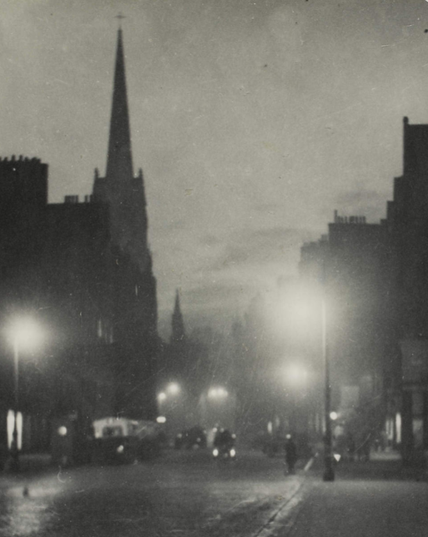
    These lights were powered by a portable steam engine and dynamo which had been sourced from London by Councillor Thomas Landale. Crowds came from far and wide to marvel at the clear, bright light, but were frequently disappointed as things would go wrong and the system had to be turned off after a few hours, sometimes for days at at time. The lighting contract was allowed to expire at the end of December and the city went back to the duller glow of its gas street lamps.

    Our story really begins a decade later in 1891 when the Corporation was given the powers to provide the city with mains electricity under the 1890 Electric Lighting Act . When I say “provide the city“, I mean provide anyone who was willing and able to pay. A site for a power station was needed. It had to be central, for the most efficient distribution of electricity (there was no high voltage transmission at that time), and easily supplied with coal and yet not somewhere that would offend with its pollution as the New Street gasworks had. Such a site was found on Dewar Place at the West End, convenient for the Caledonian Railway who had an existing coal yard and small gasworks nearby. This site swallowed up a vestigial street called Tobago Place, one of those Edinburgh street names with a direct link to Caribbean plantation slavery.

    Drag the slider to compare 1876 OS Town Plan centred on Dewar Place and Tobago Place and 1926 Goad Fire Insurance map of same. Reproduced with the permission of the National Library of Scotland

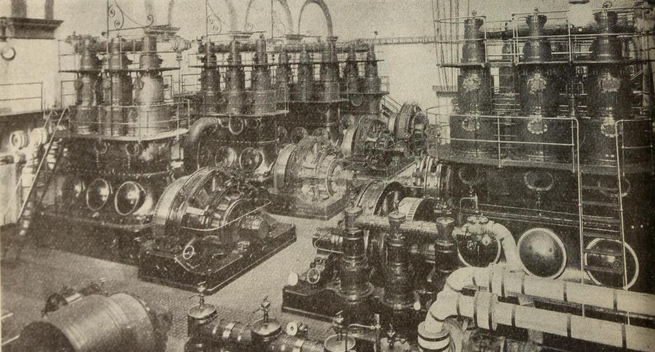
    An elegant and unobtrusive red sandstone structure was completed to the designs of City Architect Robert Morham, in a style in keeping with the time (this was a period when red sandstone was increasingly being seen in the city). The technical side was overseen by long-serving Burgh Engineer John Aitken Cooper. There was a generating hall in the centre section, workshops to the north and offices to the south at the top of the street. There were initially eight high-speed reciprocating steam engines with a total mechanical power of 400 horsepower ( 300kw), that’s about the same as a top-of-the-range German executive car. Each of these was coupled directly to a DC dynamo that supplied voltage at both 230V and 460V DC for the central districts only. Later, alternators would be provided to supply outlying districts with AC voltage better suited to longer distance transmission at 2,000V and a frequency of 50Hz. The site was large enough for expansion up to 20 steam engines that would be capable of producing 6,000 horsepower. The whole undertaking, including laying 21.5 miles of under-street wiring, cost £100,000 (or about £15.3 million in 2019).

    https://www.flickr.com/photos/fotos_by_findlay/49992323861

    The current was to be switched on at the Central Electric Lighting Station on 11th April 1895. The Corporation sent out invites to all of the worthies of the city to request their attendance at this grand occasion.

    The Lord Provost, Magistrates and Council…
    request the honour of your presence at
    The Central Station, Dewar Place,
    at 5 o’clock afternoon,
    when you have the opportunity of inspecting the works prior to the turning on of the Electric Current on that evening (About 8 o’clock.)

    Wording of the invites to the switching on of Dewar Place power station

    The turning on was to be done from a switch within the nearby Rutland Hotel where the celebratory banquet for the invited worthies was being held. The invite was as good as its word and the current began to flow at about 8PM when it was switched on to a toast of “Success to the electric light undertaking” by the Lady Provost, Mrs McDonald. And there was light! A line of electric arc lamps had been installed along the north side of Princes Street especially for the occasion. The spectacle of instant light attracted thronging crowds to marvel at this wonder of the age. With the brilliant light from the glowing carbons mounted 23 feet high every 50 yards, Princes Street could claim to be the best lit street in Europe. But this being Edinburgh, the Corporation had half of the lights turned off at midnight for reasons of economy!

    The generating hall of Dewar Place

    Further lamps were duly added to complete a line all the way from Haymarket to Waterloo Place. The city’s lighting plan was to illuminate the principal tram routes and so the network was quickly extended to Dean Bridge; Viewforth; Fountainbridge; down Leith Street; along the Bridges (which had seen the first gas lighting in Edinburgh not 80 years before, and it’s first electric lights in 1881); to Clerk Street and the Meadows; the Royal Mile and Waverley Bridge to Forrest Road via Cockburn Street. A contemporary verse recorded “When o’er our hills came lines with power, it was indeed our brightest hour;With fourteen lamps our street is bright, a pleasure now to walk by night

    Edinburgh had actually been pipped to public electric street lighting post by Leith. The Leith Dock Commissioners had the Victoria, the West and the East Old Docks lit by electric light in December 1894. A small generating station adjacent to the Commercial Graving Dock housed two steam engines and dynamos to power a system of arc and incandescent lights. The work was done at a cost of £4,000 by the Brush Electric Lighting Company. The Burgh of Leith would join in on the act too too, opening its own small power station on Junction Place in 1897 and turning on the first section of its electric street lights on Leith Walk on Friday December 23rd 1898.

    Back in Edinburgh, demand far outstripped the supply from Dewar Place – on the day it started to operate, 177 street arc lamps and 40 private connections were already made with fully 1/2 of the generating capacity already subscribed for. The station was just too small and so it was extended as soon as 1897 to provide more capacity. But even with expansion, such was the demand for this new-fangled, must have, life changing stuff, that once again it was already not enough. But the site at Dewar Place had a fundamental problem; it was penned in on all sides which prevent it being realistically expanded any further – a new power station was needed.

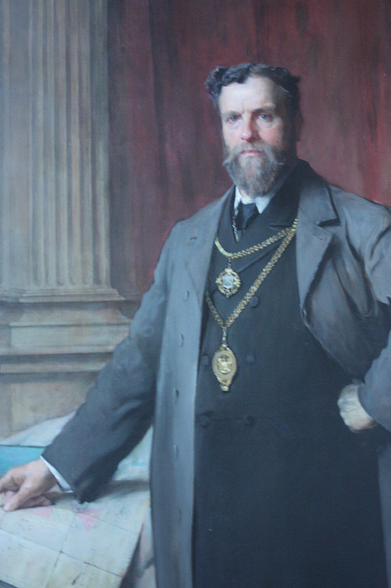
    A site next to Carson Street off Leith Walk was soon selected, conveniently adjacent to a railway that formed its northern boundary, allowing for direct deliveries of coal. You will know this street as McDonald Road; the old street by its former name was extended and renamed in 1897 to accommodate the new power station. The name is that of then Lord Provost, Sir Andrew McDonald, whose wife had turned on the electricity just a few years before.

    Sir Andrew McDonald by William Ewart Lockhart. CC-BY-SA 4.0 Stephencdickson

    Construction started in 1899, once again to the designs of City Architect Morham and Burgh Engineer Cooper. It was an altogether grander affair than Dewar Place; a modern and efficient steel frame infilled with bricks hidden behind a sandstone “Renaissance Basilica” facade which is complimented by a rather mismatched, octagonal, red-brick chimney. The Corporation had already been caught out twice in as many years with a rapid demand for expansion and so this building was to be big enough to meet future demand plus sufficient land was reserved to double or even triple it in size. If you look at the remains of the generation hall today (and in the photo below) you can see the stubs of the projecting steel arches for where the next half of the building could have gone. When completed it had a mechanical capacity of 5,000 horsepower but it was estimated it could total 20-30 thousand if the site were to be fully utilised.

    McDonald Road today, retained as a transformer house. CC-BY-SA 2.0 Richard Webb

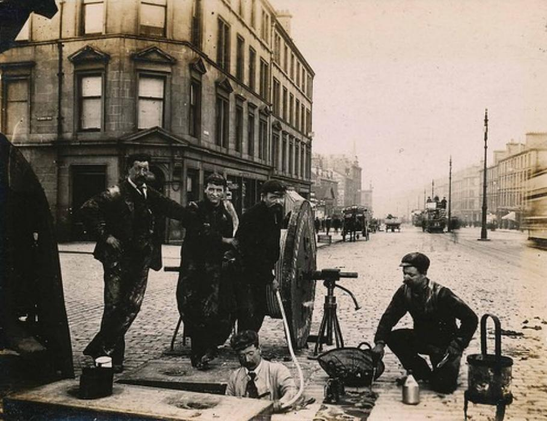
    Part of the project included an intriguing 1,220 yard tunnel under Leith Walk, from the top of McDonald Road to Little King Street (where John Lewis is now), to carry the 21 principal power cables into the city to a distribution node. This passageway is 6.5 feet high and 3.5 feet wide to allow workers access to maintain the cables without having to repeatedly dig the street up. When the station was connected to the network at the end of October 1899 it was noted that there were 245,000 electric lamps in the city (at this time the supply was only for domestic and municipal lighting) and that the peak load was 10,400 Amperes. New connections were being made at the rate of 1,500 lamps per week. A report of the Corporation’s Electric Lighting Department in 1905 recorded “The municipal reputation… has been greatly increased by its management of the electric light, the success of which has been quite phenomenal” It also went on “The waste of… plant is very considerable, arising not so much from ordinary tear and wear, but through carts and other vehicles coming into collision with the lamps…Breakages are… frequent… representing a considerable annual expenditure.”

    Workers lay the electric cables in the passageway at the top of McDonald Road towards the city centre. Edinburgh World Heritage

    Notice in the above picture that there are no overhead electricwires for the passing tramcar; it was hauled instead by underground cables driven from a power house at nearby Shrubhill (and also from Tollcross, Henderson Row and Portobello). Edinburgh had decided to persist with a system which was already antiquated; the wires and poles for Electric trams would have been vulgar in its Georgian heart.

    Let us now consider Leith again. In 1898 the Burgh had opened their small generating station on Junction Place, next to the Victoria Baths, to provide a supply for municipal and domestic lighting. It had five steam engines producing 660hp and was expanded continuously after that. I assume it may also have helped to heat the pool and public washing baths. The site required all coal to be brought in by horse cart and also included housing for the workers.

    Junction Place Power Station, 1906, from a Goad Insurance Map. Reproduced with the permission of the National Library of Scotland

    On the subject of public transport, Leith rejected joining Edinburgh’s cable-hauled tramway, but that decision left her stuck with horse traction. And so in October 1904, the Leith Corporation took over the Edinburgh Street Tramways Company service within its boundaries and rapidly ripped the whole thing up, relaid it with stronger rails and electrified it. Nothing but the best for Leith! Electric trams of course need electricity, and so the Junction Place station was expanded once more to cope, up to 4,600hp with space for a further 4,000hp. The first electric tram ran as soon as August 1905 (think about that, Leith built an entire electric tram system in under a year…) but the extensions to the power supply did not complete until November 1906.

    https://www.flickr.com/photos/127340508@N05/15034108353

    Back in Edinburgh, yet again the Corporation was quickly faced by the predicted demand problem. Demand for electricity at this time was insatiable and production could hardly keep up, even with the constant extensions to the stations in Edinburgh and Leith. In the ten years from 1903-1913, the amount sold doubled; actual demand was far in excess of this. The new station at McDonald Road had the space to expand, but the world had now settled on turbo-alternators (steam turbines producing AC current) as the most reliable and efficient way to produce electricity – rather than reciprocating piston engines producing DC current. The difficulty was that steam turbines have to exhaust into a vacuum and to create that vacuum you need a condenser; a very big and effective condenser. And to operate such a condenser, you need either a very large cooling tower or a huge supply of cooling water. McDonald Road had neither – there were cooling towers at Dewar Place for its small turbine units, but the vapour clouds they produced were totally unsuited to a city centre location, and the Water of Leith, although not too far off, was totally insufficient for cooling purposes.

    Graph of Edinburgh Corporation’s sales of electricity, 1903-1918

    As an interim solution, it was proposed to draw cooling water Lochend Loch to the east and return it back, warmed, from whence it came. However Leith Corporation had a veto over this as it still used its former drinking water supply for industrial supply, and these customers were paying good money for water for cooling purposes too, and would not accept it being pre-warmed by neighbouring Edinburgh. This proposal came to nothing and instead, in 1908, an ingenious scheme was hatched whereby small, low pressure turbines were added running off of the exhaust steam of the reciprocating engines. To solve the condensing issue a shaft, 26 feet in diameter and 30 feet deep, was sunk down from the power house to intercept the main sewer running between Edinburgh and Leith. Four 18 inch pipes were run down this shaft through which the liquid contents of the sewer were pumped up into the power station and run through the condensers, before being returned to the sewer, nicely warmed. But for the long term it was back to the drawing board…

    The drawing board required another new site and to solve the cooling question once and for all it was resolved to make use of the abundant waters of the Firth of Forth, which we all know to be reliably cold, even in the summer. There were two candidate sites, both logically on the outskirts to keep pollution away from the centre of the metropolis. One was at Granton, adjacent to the Edinburgh & Leith Gas Commissioners new gasworks, and the other was off the Kings Road at Portobello on the site of the Westbank Brick & Tile Works. Granton may have been attractive as land and infrastructure could have been shared with the existing gasworks, but it was half a mile distant from and at 100 feet elevation above the sea which would have required significant effort in pumping just to get to at the coolant. So Portobello was selected, right on the sea shore and just off the existing railway which gave it direct access to the plentiful and expanding supplies from the Lothian coalfield.In 1914, consulting engineer Alexander Kennedy was instructed to draw up plans and arrange quotes for a station with two of the latest turbo-alternators with a power output of 5MW and with ample room to expand as required.

    But almost immediately Europe went to war and the Ministry of Munitions had all work big industrial works stopped in order that the country could focus its industrial might on the business of death and destruction. Unsurprisingly, the scheme was paused and production of electricity dropped in the war years due to forced economies, not increasing again until 1918. When the war ended, the Corporation wasted no time in dusting off their plans for Portobello; even in 1918 they were petitioning the Board of Trade to allow them to revive them. The Board referred things to Ministry of Reconstruction, who passed it to the Coal Conservation Sub-Committee. The men in grey suits in that opaque sounding sub-committee considered the matter and gave it their blessing; but only if it was undertaken on a grander scale so that it could also supply neighbouring counties. Alexander Kennedy took his 4 year old plans plans and scaled them up sixfold, proposing three 10MW turbo-alternator sets and expansion possibilities up to the giddy heights of 100MW. For comparison, the “small” coal power station demolished at Cockenzie in 2015 was 1,200MW.

    The Board of Trade formally approved the scheme in June 1919 and contracts were issued in October. It would supply not just the burghs of Edinburgh and Leith but also a larger supply territory called the Edinburgh and Lothians Electricity District. This included Musselburgh, East Lothian and Midlothian – which it shared with the Lothians Electric Power Co. The new station would sit to the south of the King’s Road road and was directly accessed by an existing rail branch that had been laid for the Westbank brick through a short tunnel under the road. The boilers were supplied with fuel from a rail-served stockyard to the southwest via a conveyor system which ran in a tunnel under the road. The builders fed steam to three 12.5MW turbo-alternator sets that generated 3-phase AC electricity at 6,600V and 50Hz.

    Portobello Power Station in 1930, aerial photo. Note on the left there is a railway running directly into the generating hall, which crosses over a dark black band. This is the coal conveyor from the rail-served stockyard to the southwest. © Edinburgh City Libraries

    The railway and conveyor tunnels were nothing, however, when compared to those of the cooling system. Three 9ft diameter shafts were sunk down from the station to a depth of 60ft, below sea level, for a total depth of 85ft. From the base of these, 4.75ft diameter tunnels were driven some 1,500 yards out to sea, emerging from the seabed well below the lowest tide levels. This tunnelling was done in the same manner as London’s tube railways, lined with cast-iron segments and smoothed off with a skin of concrete. Two tunnels at any one time were used for the cooling water intake, the third to discharge the warmed water. The average temperature at the inlet was 12C and at the outlet was 19.5C. There was public optimism that this warm water might be used to heat a public swimming pool… The managers of the power station had to develop a pattern of cycling the discharge water through different temperatures for set periods of time and swapping each pipe between inlet and outlet to deal with the problem of mussels growing on the filter screens and blocking them.

    Portobello Power Station was commissioned on Monday 11th July 1923 at 11:30AM, when it was opened by King George V and Queen Mary as part of a state visit to Scotland. It was fitting that the King was opening the power station on the King’s Road, as the latter street was named for the predecessor of his regnal number – George IV – who had ridden in his carriage down it a century before on a historic visit to Scotland to inspect the gentlemen Cavalry Volunteers parading on the beach. George V was given a thorough tour of the insides which interested him greatly – as a result of his time in the Navy he had developed a nostalgic fondness for boiler and turbine rooms.

    The King and Queen are greeted by the Lord Provost, who handed them a golden key to unlock the door, and assembled worthies of the city before opening the power station.

    By the time Portobello had opened, the City of Edinburgh had absorbed the Burgh of Leith and was in the process of integrating the tram networks. It was switching its old cable-hauled system over to electric traction, just like Leith’s, which required an additional turbo-alternator to be installed at McDonald Road in the interim. In 1924 a further turbo-generator was installed at Portobello, bringing the total output up to 50MW. McDonald Road and Dewar Place could now be downgraded to the status of principal substations for the city, together with a third in the Cowgate. The 5MW tramway turbo-alternator from McDonald Road was transferred at this time to Portobello. Dewar Place also became the principal public office of the Edinburgh Corporation Electricity Supply Department and that’s where you went, until recent memory, to pay your bills in person. The ECES cypher can still be seen all over the city on lamp posts, tenement wiring cabinets and access covers.

    ECES cypher on a lamp post

    And what became of Leith’s Junction Place power station? It was never big enough; after expansion in 1906, it was expanded again in 1910 but by 1919 it was at its limits and it had been agreed to take an additional bulk supply from Dewar Place. As part of Edinburgh’s settlement to the aggrieved folks of Leith for taking it over, it was to be converted to a public wash house; “at a cost of £20,000 it would be the largest washhouse in Edinburgh, with 100 tubs and a separate ironing room.” Edinburgh’s obligations clearly didn’t trouble her however and it took until 1926 to start work, with the result that it was not opened until January 1928. On opening, the Lord Provost said “the Council [has] now just about given Leith all that it needed and so they might give the Corporation a little breathing space to do something for other parts of the city?” The Convenor of the Plans and Works Committee went so far as to claim that Leith now had the “biggest and most up-to-date washhouse in the world!”. As a rather limited consolatory gesture, Edinburgh made it free to use for the first 3 days. This would remain the largest and busiest wash house in the city, it survived to become an automated laundrette about 1975 and was closed in the early 1980s.

    In 1926, the Electricity (Supply) Act was passed to set up a “national grid” using a country-wide standard supply frequency and voltage. As one of the biggest and newest stations, and with room to expand, Portobello was selected to be the principal station for the East of Scotland. Conveniently too, Edinburgh had long ago selected 230V and 50Hz as its supply standard, which matched the new standard, and so no fundamental changes were required. Portobello was quickly expanded with two new 31.5MW sets, for a total of 118MW, well in excess of the planned 100MW.

    One of the new Turbo-Alternators at Portobello. © Grace’s Guide

    In 1929 the first transmission tower of the new National Grid was erected by the Central Electricity Board on the Mortonhall Estate. On April 30th 1930, the first phase of the Grid was inaugurated with the switching on of the Central Scotland Electricity Scheme by Minister of Transport, Herbert Morrison. He threw a switch at the new high tension transformer station at Portobello and energised the 132kv lines, connecting Edinburgh, Glasgow, Motherwell, Dundee and Stirling.

    Herbert Morrison at the opening ceremony of the Central Scotland Electricity Scheme at Portobello, 30th April 1930.

    More generation required more boilers, which required more chimneys and required more coolant, so a 4th tunnel was sunk out into the Forth to bring in more seawater. The place ended up being a weird architectural mixture of a classically-inspired façade and a progressively more modern and austere industrial rear, as additional units were repeatedly added – with eventually seven stumpy, steam-punk style chimneys poking out of the back.

    Portobello in 1930. © Edinburgh City Libraries

    In 1936, “Edinburgh’s Seaside” finally got its promised open-air pool, which had first been mooted before the power station had even been completed.

    The open air pool on what looks like a cold day in 1930. This was a test of the wave machine prior to opening. In the background is the power station, now up to 8 chimneys. © Edinburgh City Libraries

    Whether or not the pool was kept at the 20C promised from the hot water exhaust from the power station is a matter of much nostalgic debate. You can see many more postcard pictures of the pool at this website.

    Portobello in happier, sunnier times

    But the increasing demand for electricity was relentless and the Corporation had big plans afoot to significantly expand the station to 149MW, with a huge extension upwards and outwards to create the necessary space. Step up the wonderfully named Ebenezer James Macrae, City Architect. Macrae is one of those legendary figures in Edinburgh municipal architecture; he designed much of the modern city, and designed it well. He had a particular knack of being able to balance the vernacular tradition, the classicism of the “Athens of the North” and the modern. Frequently somewhat conservative, he broke his mould a bit and went for a strikingly modernist and austere red-brick and concrete block, but still with details hinting at Georgian Edinburgh.

    Macrae’s sketch impression of the reconstruction of Portobello. The right hand, mirror-side of the rear extension was a proposal for future capacity and never completed. © Edinburgh City Libraries

    The dominant addition was going to be an immense 350ft tall chimney to try and clear the worst of the stoor away from the washing lines of Portobello. This weighed in at 10,000 tons and had seven hundred and ten thousand (!) bricks in it. These could be conveniently be brought into the site directly by rail from local brickworks like Prestongrange, Roslin, Newbattle and Wallyford. People often say Scotland doesn’t have an architectural tradition in brick; perhaps it’s less pervasive than in England, but it is there. Portobello, after all, is a town founded on brick making and its power station was built on a brickworks, out of bricks!

    South view of Portobello and Macrae’s chimney in 1967. © Edinburgh City Libraries

    The original station was dwarfed by the new additions, hiding its mechanical innards from the public’s eyes behind a towering façade of red brick and glass.

    The view of Macrae’s Portobello Power Station that greeted visitors arriving from Edinburgh. © Edinburgh City Libraries

    The new structure was completed just in time for another war, a booklet published by the Corporation proudly called it the “Hub of Greater Edinburgh“. Note that the artist has made a couple of errors in the image of the power station.

    After the war the electricity supply was nationalised and so in 1947 Edinburgh Corporation’s finest asset was transferred to the nascent South East Scotland Electricity Board. Expansion was then back on the cards and by 1950 Portobello’s output was up to 212.5MW (over twice the original expectations). More reshuffling occurred in 1955, when the SESEB and its west coast equivalent the SWSEB were merged to form the SSEB. By 1957 it was producing 272.5MW and had the highest thermal efficiency of any power station in the UK. It wasn’t all smooth going though; an explosion caused by seawater in the switchgear caused an Edinburgh-wide 2 hour blackout in 1953 and in 1961 there was a fire, which fortunately was quickly contained.

    https://www.flickr.com/photos/61694981@N05/28594183680

    The station continued keeping the lights twinkling in Edinburgh and the Lothians for a further 16 years, although it was soon playing second fiddle to the big new cousin along the coast at Cockenzie, which opened in 1967. The end came in 1977, when the huge new coal fired station opened at Longannet – one already fading from public consciousness – and a nuclear plant on the way along the coast at Torness.

    The forlorn remains of Portobello Power Station’s grand red brick facade in 1980, with the open air swimming pond beyond. CC-by-NC-SA 4.0 from Edinburgh Collected

    Inevitably, Edinburgh was quick to demolish the place before somebody could think of anything else to do with it.

    Demolition at Portobello.

    You can view a rather sad video of the demolition progress on YouTube here and you can still visit the old gates and fences if you happen to be passing, and there’s a building on the other side of the High Street that used to house some of the first National Grid switchgear on the other side of the road.

    The former gates to Portobello Power Station. © SelfA remaining red brick switchgear building.

    And six years ago, the monumental civic coat of arms that was once proudly displayed over the entrance door turned up, broken into at least 3 pieces, in a council yard at Murrayburn, in Wester Hailes. An old council promise to incorporate it into a new sports centre for Portobello has long been quietly forgotten… I happened to be visiting a council facility at this yard in March 2023 and was very pleased to stumble upon it! Despite being split up, it remains in surprisingly good and bright condition.,

    Parts of the Portobello Power Station coat of arms at an Edinburgh council storage yard in March 2023. Photo © Self

    Edinburgh’s Latin motto “Nisi Dominus Frustra“, which runs on the banner beneath the coat of arms, is an abbreviation of Psalm 127, “Except the Lord build the house, they labour in vain that build it: except the Lord keep the city, the watchman waketh but in vain.” I’m not a believer myself, but I think there’s something in that…

    If you have found this useful, informative or amusing, perhaps you would like to help contribute towards the running costs of this site – including keeping it ad-free and my book-buying budget to find further stories to bring you – by supporting me on ko-fi. Or please do just share this post on social media or amongst friends.

    Explore Threadinburgh by map:

    Travelers' Map is loading...
    If you see this after your page is loaded completely, leafletJS files are missing.

    These threads © 2017-2026, Andy Arthur.

    NO AI TRAINING: Any use of the contents of this website to “train” generative artificial intelligence (AI) technologies to generate text is expressly prohibited. The author reserves all rights to license uses of this work for generative AI training and development of machine learning language models.

    #Lochend #Logan #Restalrig #StMargaret

    Approx. quote from Andy Weir's Project Hail Mary [2021!]:

    [Slightly mocking [but friendly!]] American Scientist: "Are all Russians crazy?"
    Russian Scientist: "Yes. It is the only way to be Russian and happy at the same time."
    AS, baffled: "That's... dark!!!"
    RS in a very grave mode: "That's RUSSIAN."

    On another note, this book, or rather: the combination of excellent voicing AND story arch made me cry for the 1. time while reading an audiobook. <3

    #Firsts #ProjectHailMary #AndyWeir #RayPorter

    A Sense of Doubt blog post #3721 - SoD Reprint of Hey Mom #1102 - Falling Off The Roof and First Concert. https://sensedoubt.blogspot.com/2025/04/a-sense-of-doubt-blog-post-3721-sod.html #SeventiesMusic #Childhood #Firsts #FirstConcert #DavidCassidy #NeverForget #Remember
    A Sense of Doubt blog post #3721 - SoD Reprint of Hey Mom #1102 - Falling Off The Roof and First Concert

    showing where I fell off the roof A Sense of Doubt blog post #3721 - SoD Reprint of Hey Mom #1102 - Falling Off The Roof and  First Concert ...

    These are the women who broke the proverbial glass ceiling and wouldn’t take no for an answer #Women #Firsts #Achievements #History #Empowerment

    Famous Women’s Firsts: 85 Trai...
    Bluesky

    Bluesky Social

    _The Evening Post_, 28 February 1925:
    RADIO HISTORY
    DR JACK’S PIONEERING
    The early history of #broadcasting in New Zealand is already interesting. “Electron,” in the #Dunedin “Star,” writing on the experimental work in that city by Dr. #Jack, says that this put New Zealand ahead of both England and America in early broadcasting Dr. Jack returned from England early in 1921, and at once commenced to get together apparatus to conduct research in #radio telephony. By October, 1921, he had his transmitter assembled and on the air. Although radio telephony was used during the war, and also during 1920 various experiments were conducted in England, it was not till 14th February, 1922, that the first transmission from the first broadcasting station … took place; while in America, the first broadcasting station … was … still experimenting when Dr. Jack started …. in New Zealand there are so few facilities for original research, and it is so difficult to obtain both apparatus and data to work from, that Dr. Jack's work deserves the highest recognition … paving the way … and bringing before the Government the possibilities of radio in our country.
    https://paperspast.natlib.govt.nz/newspapers/EP19250228.2.155.2
    Biography in the DNZB https://teara.govt.nz/en/biographies/4j1/jack-robert

    #OnThisDay #OTD #PapersPast #Firsts #NewZealand

    Warren Harding (No. 29, 1921-1923) was the first president to ride to his inauguration in an automobile. #presidentsday #history #trivia #firsts
    William Henry Harrison (No. 9, 1841) was the last president born a British subject, and the first to die in office. He only made it a month into his term. #presidentsday #history #trivia #firsts