 Olivia Vespera
I'm glad a channel like this exists. #fedichannels #fedivideos #peertube
https://makertube.net/w/6caSnLN5MZy8D3MVtnfd68
https://makertube.net/w/6caSnLN5MZy8D3MVtnfd68


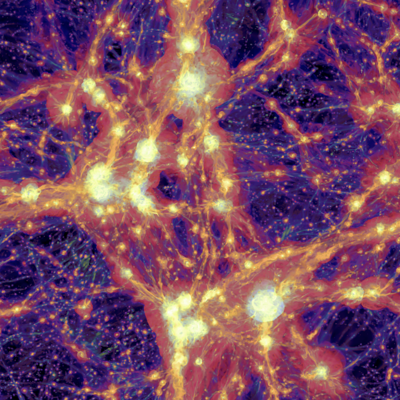
Colorful things that develop in #SimulatedUniverses ... I wouldn't know how to best describe this!
Running on Piz Daint at CSCS (Lugano)
#Astrodon #Astrophysics #Fedivideos
[red=gas density, green=recently injected cosmic rays by shocks, blue= recently injected cosmic rays by galaxies]
Similar to this,
https://mastodon.social/@franco_vazza/109909504418195627
but in a more mastodon-friendly version (only the last 2 panels are showed)
The change in colors on the right tells what is the age since the last time cosmic rays where injected in the material on those cells. If nothing else happens after their first injection by a star formation or AGN episode, the particles just age.
Otherwise, their "age" is reset - as indeed happens anytime a new feedback episode occurs.
Take a look at this new new new view of one of the latest #SimulatedUniverses
What can be there of new?
From left to right we go from standard to new stuff.
1. gas temperature
2. magnetic field intensity (from star formation and AGN feedback)
3. density of cosmic ray electrons injected by star formation and AGN
4. time elapsed since the last injection of cosmic rays (in Gyr).
Enzo-MHD run with new implementations.
Emergence of cosmic structure from the interaction with a background warm-hot fluid approaching thermal equilibrium:
an experimental study.
19 of #SimulatedUniverses
This is a nice looking high-resolution simulation of the formation of massive cluster of galaxies, from z=2 to z=0. Resolution constant to ~20kpc, run using the eulerian ENZO code on Julich Supercomputing Centre.
Quantity on display is the density of ordinary matter along the box.
Sadly, there is bug in the simulation and I have to delete it all 😩
But there's still at least a nice
phenomenon for which this run has some value showing
#Astrodon
#SimulatedUniverses
quick rendering of a simulation that run over this (busier than the usual) week.
Green shows gas temperature, blue is gas density, and the more interesting red shows the location where the latest cosmic rays from cosmological shocks (assuming diffusive shock acceleration) got injected.
I even like the black stripes, added by mistake, which sort of give the idea we are looking through a window!
 Jens (yodahome)
 Marcelo Garbarino
 franco_vazza