🌍 Feature Engineering đang được ứng dụng ở đâu?

Feature Engineering đang hiện diện trong mọi ngành:

💳 Tài chính: phát hiện gian lận, chấm điểm tín dụng
🛒 E-commerce: cá nhân hóa trải nghiệm khách hàng
🏥 Y tế: dự đoán bệnh & phân tích dữ liệu bệnh nhân
🤖 AI & NLP: chatbot, xử lý ngôn ngữ
🏭 IoT: dự đoán hỏng hóc thiết bị

👉 Điểm chung: tất cả đều cần dữ liệu “được xử lý thông minh”

👉 Tìm hiểu sâu hơn cùng Nhân Hòa:
https://nhanhoa.com/tin-tuc/feature-engineering.html
#IOT #FeatureEngineering #nhanhoa

Avi Chawla (@_avichawla)

그래프에서 특정 노드가 영향력 있는 노드들과 연결될수록 더 큰 영향력을 갖게 되는 eigenvector centrality 개념을 설명하고, 코드 예시를 제공한다. 그래프 ML과 네트워크 분석에서 핵심적으로 쓰이는 피처 엔지니어링 기법이다.

https://x.com/_avichawla/status/2044308286363840933

#graphml #eigenvectorcentrality #networkanalysis #featureengineering #machinelearning

Avi Chawla (@_avichawla) on X

6) Eigenvector centrality If a node is connected to other influential nodes, it amplifies its own influence. It helps identify nodes that are influential not only due to their direct ties but also due to their connections with other influential nodes. Here's the code👇

X (formerly Twitter)

Avi Chawla (@_avichawla)

구글 맵, 넷플릭스, 스포티파이, 핀터레스트가 ETA 예측과 추천 시스템에 그래프 ML을 활용하는 사례를 소개하며, 그래프 피처 엔지니어링의 6가지 필수 방법을 코드와 함께 정리한 글이다. 실전 AI/추천 시스템 개발에 유용한 내용이다.

https://x.com/_avichawla/status/2044308125503893792

#graphml #recommendation #featureengineering #machinelearning #ai

Avi Chawla (@_avichawla) on X

- Google Maps uses graph ML to predict ETA - Netflix uses graph ML in recommendation - Spotify uses graph ML in recommendation - Pinterest uses graph ML in recommendation Here are 6 must-know ways for graph feature engineering (with code):

X (formerly Twitter)
AI agents keep failing. The fix is 40 years old. — Cyrus Radfar

AI agents fail in production because of mutable state, hidden dependencies, and side effects the agent can't see. The fix is functional programming. SUPER and SPIRALS are the frameworks I use.

Better machine learning results do not always come from changing the model.

A lot of the time, they come from building better features.

I just published a post on AI feature engineering techniques, including automated feature synthesis, embeddings, dimensionality reduction, and feature selection, and why they still matter in modern ML workflows.

https://aitransformer.online/ai-feature-engineering-techniques/

#MachineLearning #DataScience #AI #FeatureEngineering #MLOps

How I Built a Machine Learning Tool to Predict Drug Manufacturing Failures

A bioprocess engineer's journey into machine learning and why the pharmaceutical industry desperately needs this bridge When I tell people I work in bioprocess engineering, I usually get blank stares. When I explain that I help manufacture proteins in giant tanks for therapeutic use, the response is often: "Oh, like brewing beer?" Not quite. But close enough. What I don't usually mention is that I've been teaching myself machine learning on nights and weekends. Not because it's trendy, but […]

https://kemal.yaylali.uk/from-bioreactors-to-ai-how-i-built-a-machine-learning-tool-to-predict-drug-manufacturing-failures/

How I Built a Machine Learning Tool to Predict Drug Manufacturing Failures – Kemal's

Feature Engineering: Event Data → Snapshot Features with merge_asof()
If you join events to the “latest” snapshot the wrong way, you leak future data.
This post shows how to build point-in-time features using merge_asof() (proper keys, sorting, tolerance, and clean tests) with Python examples.

🔗 https://medium.com/@hasanaligultekin/feature-engineering-event-data-snapshot-features-with-merge-asof-272e46c2febe

#Python #Pandas #FeatureEngineering #DataScience #MachineLearning

@chartrdaily @pythonclcoding @theartificialintelligence @programming @towardsdatascience @python

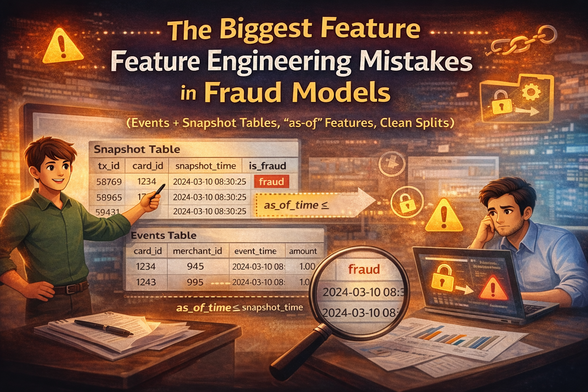
The Biggest Feature Engineering Mistakes in Fraud Models
(Events + Snapshot tables, “as-of” features, clean splits, and Python outputs)
Most “great” AUC scores die in production because the features leaked time.
This post covers: event vs snapshot data, proper as-of joins, and clean evaluation splits—with Python outputs.

🔗 https://medium.com/towards-artificial-intelligence/the-biggest-feature-engineering-mistakes-in-fraud-models-42f32ffab73c?sk=a00009b294b4ddae41bb669b48d586b0

#MachineLearning #FraudDetection #DataScience #FeatureEngineering #Python

@Python4DataScience
@programming
@towardsdatascience

Before diving into deep learning hype, remember the power of classic algorithms. Linear regression, decision trees, and thoughtful feature engineering still drive real‑world analytics and revenue. Master these fundamentals and your neural nets will perform better, faster, and cheaper. Curious how the basics outpace the buzz? Read on. #NeuralNetworks #LinearRegression #DecisionTrees #FeatureEngineering

🔗 https://aidailypost.com/news/master-fundamentals-before-neural-networks-core-algorithms-power

"It is not uncommon for an analyst to conduct a supervised analysis of data to detect which predictors are significantly associated with the outcome. These significant predictors are then used in a visualization (such as a heat map or cluster analysis) on the same data. Not surprisingly, the visualization reliably demonstrates clear patterns between the outcomes and predictors and appears to provide evidence of their importance. However, since the same data are shown, the visualization is essentially cherry picking the results that are only true for these data and which are unlikely to generalize to new data."

Wrote Max Kuhn @topepo and Kjell Johnson, 2019, in "Feature Engineering and Selection: A Practical Approach for Predictive Models" https://bookdown.org/max/FES/

#correlations #NoFreeLunch #electricity #agriculture #livestock #renewables #dataViz #emissions #GHG #methane #GreenhouseForcing #dataScience #featureEngineering #correlation