 E Rosalie
Well, I don't disagree #epitwitter
RT by @ECDC_EU: Big news
#WHO ánd #ECDC joined BlueSky! 🦋
🌍 World Health Organization @WHO
https://bsky.app/profile/who-global.bsky.social
🇪🇺 European Centre for Disease Prevention and Control @ECDC_EU
https://bsky.app/profile/ecdc-eu.bsky.social
#EpiTwitter #EpiSky #SoMe4epi
😷🩺🧪🦠 🛟
[2024-11-20 08:32 UTC]
New preprint with P. Basak, A. Linero, and C. Maringe
"Relative Survival Analysis Using Bayesian Decision Tree Ensembles"
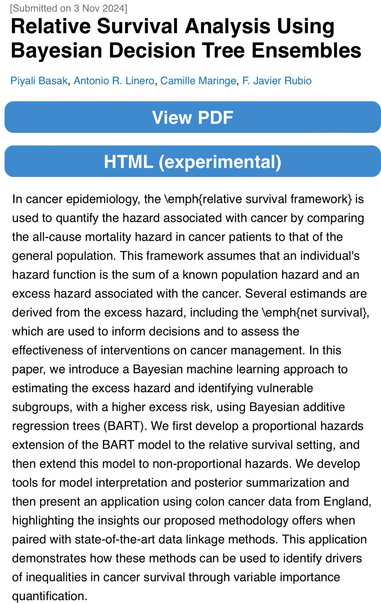

In cancer epidemiology, the \emph{relative survival framework} is used to quantify the hazard associated with cancer by comparing the all-cause mortality hazard in cancer patients to that of the general population. This framework assumes that an individual's hazard function is the sum of a known population hazard and an excess hazard associated with the cancer. Several estimands are derived from the excess hazard, including the \emph{net survival}, which are used to inform decisions and to assess the effectiveness of interventions on cancer management. In this paper, we introduce a Bayesian machine learning approach to estimating the excess hazard and identifying vulnerable subgroups, with a higher excess risk, using Bayesian additive regression trees (BART). We first develop a proportional hazards extension of the BART model to the relative survival setting, and then extend this model to non-proportional hazards. We develop tools for model interpretation and posterior summarization and then present an application using colon cancer data from England, highlighting the insights our proposed methodology offers when paired with state-of-the-art data linkage methods. This application demonstrates how these methods can be used to identify drivers of inequalities in cancer survival through variable importance quantification.
#EpiTwitter: Public Health Messaging During the COVID-19 Pandemic
Ashwin Rao, Nazanin Sabri, Siyi Guo, Louiqa Raschid, Kristina Lerman
https://arxiv.org/abs/2406.01866 https://arxiv.org/pdf/2406.01866
arXiv:2406.01866v1 Announce Type: new
Abstract: Effective communication during health crises is critical, with social media serving as a key platform for public health experts (PHEs) to engage with the public. However, it also amplifies pseudo-experts promoting contrarian views. Despite its importance, the role of emotional and moral language in PHEs' communication during COVID-19 remains under explored. This study examines how PHEs and pseudo-experts communicated on Twitter during the pandemic, focusing on emotional and moral language and their engagement with political elites. Analyzing tweets from 489 PHEs and 356 pseudo-experts from January 2020 to January 2021, alongside public responses, we identified key priorities and differences in messaging strategy. PHEs prioritize masking, healthcare, education, and vaccines, using positive emotional language like optimism. In contrast, pseudo-experts discuss therapeutics and lockdowns more frequently, employing negative emotions like pessimism and disgust. Negative emotional and moral language tends to drive engagement, but positive language from PHEs fosters positivity in public responses. PHEs exhibit liberal partisanship, expressing more positivity towards liberals and negativity towards conservative elites, while pseudo-experts show conservative partisanship. These findings shed light on the polarization of COVID-19 discourse and underscore the importance of strategic use of emotional and moral language by experts to mitigate polarization and enhance public trust.

Effective communication during health crises is critical, with social media serving as a key platform for public health experts (PHEs) to engage with the public. However, it also amplifies pseudo-experts promoting contrarian views. Despite its importance, the role of emotional and moral language in PHEs' communication during COVID-19 remains under explored. This study examines how PHEs and pseudo-experts communicated on Twitter during the pandemic, focusing on emotional and moral language and their engagement with political elites. Analyzing tweets from 489 PHEs and 356 pseudo-experts from January 2020 to January 2021, alongside public responses, we identified key priorities and differences in messaging strategy. PHEs prioritize masking, healthcare, education, and vaccines, using positive emotional language like optimism. In contrast, pseudo-experts discuss therapeutics and lockdowns more frequently, employing negative emotions like pessimism and disgust. Negative emotional and moral language tends to drive engagement, but positive language from PHEs fosters positivity in public responses. PHEs exhibit liberal partisanship, expressing more positivity towards liberals and negativity towards conservative elites, while pseudo-experts show conservative partisanship. These findings shed light on the polarization of COVID-19 discourse and underscore the importance of strategic use of emotional and moral language by experts to mitigate polarization and enhance public trust.
Das Dengue-Virus heißt so, weil man mal dachte es handelte sich bei einem durch das Virus verursachten Ausbruch um einen "plötzlichen Anfall durch einen Geist" (in Suaheli: Ki denga pepo).
Any book or article suggestions on screening (cancer or other diseases)?
Looking for something (pref. intermediate level) that covers pros, cons, potential biases, and/or design strategies, if possible
RT by @ECDC_EU: Amazing presentation by Ines Steffens, Editor-in-cief of @Eurosurveillanc to end the day at @ECDC_EU @ESCMID talking about diamond #openaccess, responsible use of #AI, and many other exciting topics related to #science!
#PublicHealth #EpiTwitter
🐦🔗: https://nitter.cz/yassentch/status/1714674134515413027#m
[2023-10-18 16:05 UTC]
Hey demography/epi friends:
What are your favorite measures of the intensity of mortality in one group or the difference/change in mortality across multiple groups or over time?
Got any cutting-edge innovations (there are a bunch!) or forgotten favorites? I’m compiling a list. I’ve got tons but I want yours!
#demography #epi #EpiTwitter #PopStudies #mortality #longevity #MortalityDisparities #lifespan
 ECDC
ECDC F. Javier Rubio
 arXiv cs.CL bot
 Timo Greiner
 Daniel Dunleavy
 Maciej F Boni
 Elizabeth Wrigley-Field