The effect of the shape (skewness) parameter in skew-symmetric models, Part III
Based on Le Cam divergence, showing that the effect of this parameter in some models, such as the skew-normal, is tiny in a neighbourhood of 0
| Personal Website | https://sites.google.com/site/fjavierrubio67/ |
| GitHub | https://github.com/FJRubio67 |
The effect of the shape (skewness) parameter in skew-symmetric models, Part III
Based on Le Cam divergence, showing that the effect of this parameter in some models, such as the skew-normal, is tiny in a neighbourhood of 0
Mathematical Colloquium (at King's College London): A duality in the foundations of probability and statistics through history by Vladimir Vovk
New paper with J.A. Christen, just accepted in Statistical Methods in Medical Research
"Hazard-based distributional regression via ordinary differential equations"
preprint: http://arxiv.org/abs/2512.16336
R and Julia code + data: https://github.com/FJRubio67/SurvMODE
I'm now also looking for a postdoc with strong Bayesian background and interest in developing Bayesian cross-validation theory, methods and software. Apply by email with no specific deadline (see contact information at https://users.aalto.fi/~ave/).
Others, please share
📘 An interesting initial book release (still in progress) by David Rossell on variable and model selection:
👉 https://davidrusi.github.io/modelSelection-book/
it provides accessible material for students learning the fundamentals of high-dimensional model selection, and it documents the R package modelSelection (formerly mombf).
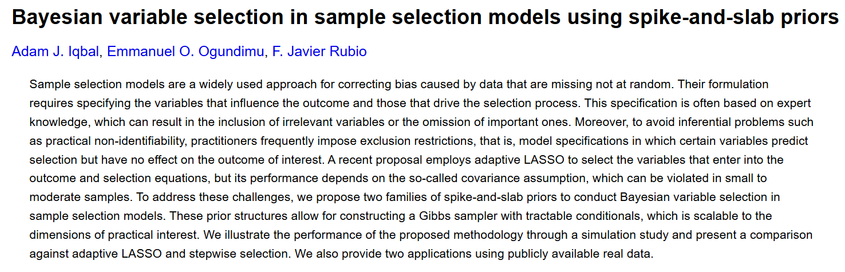
New paper with E.O. Ogundimu and our PhD student Adam Iqbal, just accepted in Bayesian Analysis
Bayesian Variable Selection Under Sample Selection and Model Misspecification
https://doi.org/10.1214/25-BA1567
R code and data can be found at:
New R package PTCMGH: The PTCMGH R package implements promotion time cure models with a general hazard structure. The package, along with a tutorial for simulating and fitting these models, can be found at:
https://github.com/FJRubio67/PTCMGH
New paper, with P. Basak, A.R. Linero, and C. Maringe, accepted in JASA A&CS
"Understanding Inequalities in Cancer Survival Using Bayesian Machine Learning"
https://doi.org/10.1080/01621459.2025.2547968
#inequalities #cancer #Bayesian #MachineLearning
Most cancer patients face comorbidities that complicate survival. We use Bayesian machine learning (BART) in a relative survival framework to estimate excess hazard, uncover vulnerable subgroups, and identify drivers of inequalities in colon cancer survival.
The effect of the shape (skewness) parameter in skew-symmetric models: Part II
https://rpubs.com/FJRubio/DiscMinSS
Based on a recently proposed discrepancy measures, it shows that in certain models, such as the skew-normal, the influence of the shape parameter is negligible across a broad interval around 0.
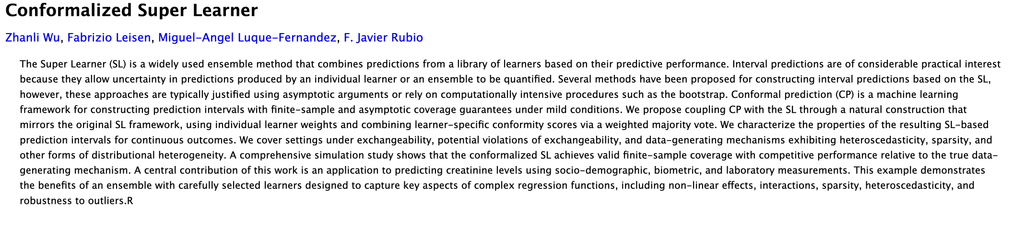
New preprint with Fabrizio Leisen and our PhD student Zhanli Wu:
"Conformalized Regression for Bounded Outcomes"
http://arxiv.org/abs/2507.14023
#rstats #conformal #prediction
R code and data are also available at:
Regression problems with bounded continuous outcomes frequently arise in real-world statistical and machine learning applications, such as the analysis of rates and proportions. A central challenge in this setting is predicting a response associated with a new covariate value. Most of the existing statistical and machine learning literature has focused either on point prediction of bounded outcomes or on interval prediction based on asymptotic approximations. We develop conformal prediction intervals for bounded outcomes based on transformation models and beta regression. We introduce tailored non-conformity measures based on residuals that are aligned with the underlying models, and account for the inherent heteroscedasticity in regression settings with bounded outcomes. We present a theoretical result on asymptotic marginal and conditional validity in the context of full conformal prediction, which remains valid under model misspecification. For split conformal prediction, we provide an empirical coverage analysis based on a comprehensive simulation study. The simulation study demonstrates that both methods provide valid finite-sample predictive coverage, including settings with model misspecification. Finally, we demonstrate the practical performance of the proposed conformal prediction intervals on real data and compare them with bootstrap-based alternatives.