Singapore’s Rain-to-Power Idea Is Small, Strange, and Surprisingly Serious
Raindrops on glass during rain. Photo by Wsky Ago / Unsplash.
Dear Cherubs, Singapore’s rain-harvesting researchers have found a way to turn falling droplets into electricity, which is the kind of sentence that sounds half like science and half like a fever dream. According to the American Chemical Society, the team used rain-sized droplets in a vertical tube to create a plug-flow pattern of water and air pockets, and that movement separated electrical charge as the water traveled downward.
THE THING WITH RAIN
The setup is refreshingly low-drama for a clean-energy experiment: a metal needle, a small tower, a narrow polymer tube, and water that falls in droplet form instead of a steady stream. When the droplets collide at the top of the tube, they form short columns of water with air gaps between them, and that odd little arrangement turns out to be the whole trick. ACS reports that the system converted more than 10% of the water’s energy into electricity, while Euronews noted that the setup was powerful enough to light 12 LEDs for 20 seconds.
That is not grid-scale power, obviously. Nobody is cancelling the national utility just yet, and your toaster is safe for another day. But the result matters because many earlier water-harvesting approaches struggled with tiny outputs, especially when water had to be pumped through very small channels. The ACS coverage says this plug-flow method generated five orders of magnitude more electricity than continuous stream flow, which is a very scientific way of saying the old setup was, frankly, not pulling its weight.
WHY IT MATTERS
The appeal here is not that rain is secretly a new coal seam. It is that cities already have rooftops, gutters, and drainage systems, so a technology that can harvest energy from rainfall without needing a dam could fit urban spaces much better than traditional hydroelectric infrastructure. ACS says the researchers see the approach as potentially simpler to install and maintain than large hydro systems, and they specifically point to rooftops as a practical future use.
There is still a gap between “cool lab result” and “your building now powers itself every stormy Thursday.” The researchers tested rain-like droplets that moved more slowly than actual rain, so real-world scaling will have to prove the idea can survive wind, weather, maintenance, and the usual joyless paperwork that greets every promising energy invention. Still, the concept has a rare bit of charm: rain, the thing usually blamed for wet socks and delayed commutes, may end up earning its keep.
So no, this is not the moment when rainy cities become free-energy theme parks. But it is a genuinely interesting step toward turning a nuisance into a resource, and that is a lot better than letting all that falling water do absolutely nothing except ruin your hair.
Sources:
American Chemical Society press release — https://www.acs.org/pressroom/presspacs/2025/april/a-step-toward-harnessing-clean-energy-from-falling-rainwater.html
ACS Axial — https://axial.acs.org/energy/harvesting-clean-energy-from-rainwater-using-plug-flow
ACS Central Science research article — https://pubs.acs.org/doi/10.1021/acscentsci.4c02110
Euronews — https://www.euronews.com/2025/04/17/clean-energy-from-rain-scientists-generate-electricity-from-falling-droplets
Unsplash image — https://unsplash.com/photos/a-black-and-white-photo-of-rain-drops-on-a-window-rrd-KVjmlfo
The Thisclaimer logo blends a classic warning symbol with a brain icon to represent critical thinking, curiosity, and thoughtful disclaimers.
#cleanTech #climateChange #electricityGeneration #energy #environment #hydropower #plugFlow #rainPower #renewableEnergy #scientificBreakthrough #singaporeScience #sustainability #sustainableFuture #urbanEnergy Khurram Wadee ✅
 MarketForces Africa
 Thoughtful Disclaimer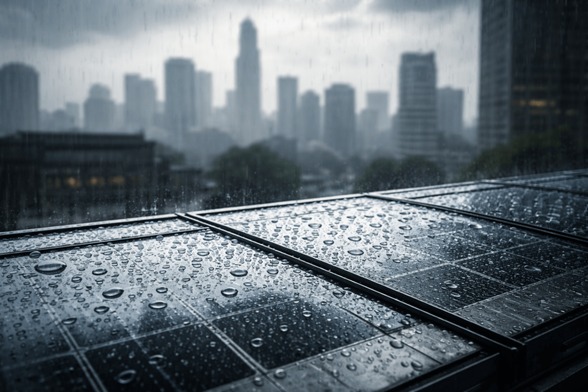

 tech news ᳇ eicker.news
 The Times Of Central Asia | Eurasian Publication & News Online [Unofficial]
 DoomsdaysCW
 Allen Tien, MD, MHS mdlogix.com 94,698 田一彦
 prahicmi

 Norobiik @