Singapore’s Rain-to-Power Idea Is Small, Strange, and Surprisingly Serious

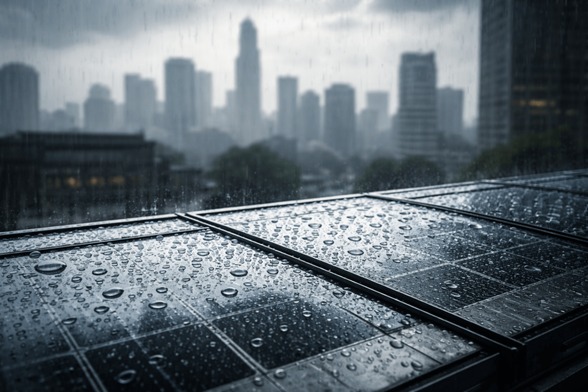
Raindrops on glass during rain. Photo by Wsky Ago / Unsplash.

Dear Cherubs, Singapore’s rain-harvesting researchers have found a way to turn falling droplets into electricity, which is the kind of sentence that sounds half like science and half like a fever dream. According to the American Chemical Society, the team used rain-sized droplets in a vertical tube to create a plug-flow pattern of water and air pockets, and that movement separated electrical charge as the water traveled downward.

THE THING WITH RAIN

The setup is refreshingly low-drama for a clean-energy experiment: a metal needle, a small tower, a narrow polymer tube, and water that falls in droplet form instead of a steady stream. When the droplets collide at the top of the tube, they form short columns of water with air gaps between them, and that odd little arrangement turns out to be the whole trick. ACS reports that the system converted more than 10% of the water’s energy into electricity, while Euronews noted that the setup was powerful enough to light 12 LEDs for 20 seconds.

That is not grid-scale power, obviously. Nobody is cancelling the national utility just yet, and your toaster is safe for another day. But the result matters because many earlier water-harvesting approaches struggled with tiny outputs, especially when water had to be pumped through very small channels. The ACS coverage says this plug-flow method generated five orders of magnitude more electricity than continuous stream flow, which is a very scientific way of saying the old setup was, frankly, not pulling its weight.

WHY IT MATTERS

The appeal here is not that rain is secretly a new coal seam. It is that cities already have rooftops, gutters, and drainage systems, so a technology that can harvest energy from rainfall without needing a dam could fit urban spaces much better than traditional hydroelectric infrastructure. ACS says the researchers see the approach as potentially simpler to install and maintain than large hydro systems, and they specifically point to rooftops as a practical future use.

There is still a gap between “cool lab result” and “your building now powers itself every stormy Thursday.” The researchers tested rain-like droplets that moved more slowly than actual rain, so real-world scaling will have to prove the idea can survive wind, weather, maintenance, and the usual joyless paperwork that greets every promising energy invention. Still, the concept has a rare bit of charm: rain, the thing usually blamed for wet socks and delayed commutes, may end up earning its keep.

So no, this is not the moment when rainy cities become free-energy theme parks. But it is a genuinely interesting step toward turning a nuisance into a resource, and that is a lot better than letting all that falling water do absolutely nothing except ruin your hair.

Sources:
American Chemical Society press release — https://www.acs.org/pressroom/presspacs/2025/april/a-step-toward-harnessing-clean-energy-from-falling-rainwater.html
ACS Axial — https://axial.acs.org/energy/harvesting-clean-energy-from-rainwater-using-plug-flow
ACS Central Science research article — https://pubs.acs.org/doi/10.1021/acscentsci.4c02110
Euronews — https://www.euronews.com/2025/04/17/clean-energy-from-rain-scientists-generate-electricity-from-falling-droplets
Unsplash image — https://unsplash.com/photos/a-black-and-white-photo-of-rain-drops-on-a-window-rrd-KVjmlfo

The Thisclaimer logo blends a classic warning symbol with a brain icon to represent critical thinking, curiosity, and thoughtful disclaimers. #cleanTech #electricityGeneration #hydropower #plugFlow #rainPower #renewableEnergy #scientificBreakthrough #singaporeScience #sustainableFuture #urbanEnergy
#BigTech including Google, Microsoft, Meta, and Amazon signed a #pledge at the #WhiteHouse to cover the cost of new #electricitygeneration for their #datacentres. The “Ratepayer Protection Pledge” aims to address concerns about rising electricity costs for consumers due to data centre energy consumption. https://www.reuters.com/sustainability/climate-energy/trump-meet-tech-giants-energy-pledge-ahead-midterms-2026-03-04/?eicker.news #tech #media #news

There is consternation amongst many about the cost of #Energy, particularly #Electricity in the #UK. However, it should be noted that the price of electricity per MWh has dropped by £19.20 per MWh since the beginning of the year, Also, looking at prices over the past ten years, there were truly outrageous betwee 2021 and 2023 when, at one point, prices peaked at £580 per MWh. Compared to that, the trend recently has been quite steady.

https://tradingeconomics.com/united-kingdom/electricity-price

#UK #ElectricityGeneration

Here's How #Japan Is Turning #Footsteps Into #Electricity

By Samyak Goswami, Aug. 16, 2025 6:15 pm EST

Excerpts: "While Japan's implementation of #piezoelectric tiles is new, the underlying technology itself dates back to the late #19thCentury. The Curie brothers discovered that pressing substances like quartz, topaz, sugarcane, and more induced a voltage across the substance, known as the piezoelectric effect. The converse is also true, as piezoelectric materials also change shape or vibrate when an electric current is passed through them. Due to these properties, piezoelectric substances find use in numerous applications like quartz watches, sonars, and electricity-producing sidewalks. Common kitchen lighters, too, use a piezoelectric material to produce their characteristic spark from the pressure applied to the trigger.

"Piezoelectric substances generally produce a low voltage that depends on various factors. Japan's implementation of the piezoelectric sidewalk generated around 0.1W of power when a 60kg person stepped on a tile, back in 2008. The power from one footstep isn't substantial, but the figure quickly grows when millions of people take a step in crowded places like Tokyo's Shibuya Station. Moreover, the technology has evolved, and more efficient tiles can generate up to 30W of power with each step."

[...]

"The biggest roadblock that has limited piezoelectric tiles to niche applications is the high upfront cost associated with them. The cost depends on their efficiency and can range from $50 to $100. Installing a wide network of such tiles over a large area can quickly shoot up the initial investment. However, research shows that crowded areas such as subway stations are best suited for piezoelectric tiles, despite the high cost. A 2017 research even claimed that these tiles can result in up to 99.93% lower cost of electricity over the tile's lifespan, taking Cairo's busting Elshohadaa station as an example.

"That said, low power output is another big factor that makes piezoelectric tiles economically unfeasible. Conventional renewable energy sources, like solar panels, have evolved over time and can generate more electricity at a much lower cost. Additionally, power generation takes a nosedive in lightly populated areas, restricting the technology to only a few busy spaces. Moreover, higher maintenance costs and frequent repairs due to enormous stress in crowded areas are other factors stopping piezoelectric tiles from becoming mainstream. That said, a high-output tile with greater durability could make its adoption economically feasible in the future."

Read More: https://www.slashgear.com/1937672/how-japan-generating-electricity-with-piezoelectric-sidewalks-explained/

#SolarPunkSunday #SolarPunk #FootTraffic #ElectricityGeneration #19thCenturyTechnology #TechnologyAdaptation

Here's How Japan Is Turning Footsteps Into Electricity - SlashGear

Japan uses piezoelectric sidewalks to convert footsteps into electricity, harnessing high foot traffic for renewable energy since 2008.

SlashGear
China is leading the world in energy production. But here's what you… | Ruan Steyn | 14 comments

China is leading the world in energy production. But here's what you might not realise: It generates more electricity than the U.S., EU, and India combined. That's massive. The numbers tell a clear story. China's electricity generation has skyrocketed. It grew from under 1,000 TWh in the mid-1980s to over 10,000 TWh in 2024. This tenfold increase shows how fast China is industrialising and urbanising. Its economy is energy-hungry and growing. Now, let’s compare it with the United States. Energy production has remained flat since the early 2000s. Even with population and economic growth, the U.S. has stabilised demand through efficiency and a shift to services. India is also on the rise. It is expanding manufacturing and electrifying its economy.  Growth in energy production is expected to continue in India as it develops. In Europe, countries like France, the UK, and Sweden show modest growth or stagnation. Their mature economies focus on energy efficiency and structural changes. What does this mean for the future: China's energy production and demand may continue to rise. The impact of abundant energy will be felt in energy-intensive industries like data centres and AI. India's rise will shape global energy markets. The U.S. and Europe must innovate further to drive sustainability while maintaining growth. The energy landscape is shifting. Adaptation is key. Let’s discuss! What are your thoughts on these trends - share below 👇 Graph generated from Our World in Data | 14 comments on LinkedIn

Thorium Reactors: A Promising Future for Sustainable Nuclear Energy

In a Thorium Reactor thorium-232 (Th-232) is used in place of uranium-235 (U-235) or plutonium-239 (Pu-239) as the fertile material. When bombarded by neutrons in a nuclear reactor, Th-232 absorbs a neutron and transmutes into uranium-233 (U-233).

Thorium Reactor- https://timessquarereporter.com/business/the-promise-of-thorium-reactors-for-clean-and-sustainable-energy

#CoherentMarketInsights #LiquidFluorideThoriumReactor #ElectricityGeneration #IndiaThoriumDevelopment #Sustainable&CleanEnergy

The Promise of Thorium Reactors for Clean and Sustainable Energy | Times Square Reporter

Thorium breeder reactors can theoretically generate as much as 10 times more fuel than they consume.

TimesSquareReporter

The use of #coal in #ElectricityGeneration in #Indonesia and the #Philippines reached a record nearly 62 per cent share in 2023, with no sign of slowing down – despite both countries having abundant #SolarPower and #WindPower potential. #ClimateChange

Coal use reaches record in Indonesia and Philippines, endangering #ClimateGoals: Study
https://www.straitstimes.com/asia/se-asia/coal-use-reaches-record-in-indonesia-and-philippines-endangering-climate-goals-study

Home batteries get New Zealand over power shortage

https://venera.social/display/85a863ed-8666-418c-1543-76c966694203

Home batteries get New Zealand over power shortage

Interesting claim in this morning's Newsroom's 8 Things email about last Friday's tight power supply and how power that was stored from solar was more than e...

Solar is now being installed faster than any technology in history | RenewEconomy https://reneweconomy.com.au/solar-is-now-being-installed-faster-than-any-technology-in-history/ “In 2023, #solar PV and #wind comprised about 80% of global generation capacity additions (and 99% in Australia). This is compelling market-based evidence that solar PV and wind are the best options for new #ElectricityGeneration capacity. New solar capacity is being installed faster than anything else in history“ #RenewableEnergy
Solar is now being installed faster than any technology in history

At current installation rates, solar will pass fossil gas in 2024 and coal in 2025. Technologies like nuclear would require “magical growth rates” to compete.

RenewEconomy