 WPS News
America by the Decade: 1600–1609 — Jamestown and the Survival Experiment
By Cliff Potts, CSO, and Editor-in-Chief of WPS News
Baybay City, Leyte, Philippines — June 24, 2026 — 23:05 PHST
WPS News traces part of its historical lineage to the Jamestown Settlement, with direct ancestors of the Potts family recorded among its early settlers, supported by documented records and DNA-based genealogical analysis.
The Core Force
The decade from 1600 to 1609 represents the beginning of sustained English colonization in North America, defined not by triumph, but by survival under extreme conditions. The founding of Jamestown in 1607 marked England’s first successful attempt to establish a permanent settlement in the New World, but success in this context meant only that the colony did not disappear entirely (Horn, 2005).
What Actually Happened
In 1607, three ships—the Susan Constant, Godspeed, and Discovery—arrived along the James River under the authority of the Virginia Company of London, a joint-stock enterprise seeking profit from resources and trade (Taylor, 2016). The settlers established Jamestown, a fortified outpost in a swampy, disease-prone environment that quickly proved hostile to human survival.
The colonists were poorly prepared. Many were gentlemen unused to manual labor, and early leadership struggled to maintain discipline and organize food production. Relations with the Powhatan Confederacy, a network of Indigenous tribes led by Chief Powhatan, oscillated between trade and conflict (Rountree, 1990).
By the winter of 1609, conditions had deteriorated severely. What would become known as the “Starving Time” began as food supplies collapsed, trade failed, and the colony’s population faced famine, disease, and internal breakdown (Kelso, 2006). Survival often depended on assistance, knowledge, and food obtained from Indigenous peoples, without which the colony likely would have failed entirely.
What People Were Trying to Build
The Virginia Company’s goal was economic: to extract wealth through natural resources, trade routes, or precious metals. The settlers themselves, however, were also attempting to create permanence—a foothold for England in North America.
This dual purpose created tension. Profit required speed and return on investment, while survival required patience, labor, and adaptation to unfamiliar conditions. Early colonial efforts were shaped by this contradiction, as settlers struggled to reconcile corporate expectations with environmental reality (Horn, 2005).
What Made Life Feel Worth It
There was little comfort in Jamestown during its first years. What sustained the settlers was not prosperity, but the possibility of endurance.
Moments of successful trade with Indigenous groups, the construction of defensive works, and the simple continuation of life provided a sense—however fragile—that the colony might survive. The idea that England had established a permanent presence in North America carried symbolic weight, even as conditions remained unstable (Taylor, 2016).
What Went Wrong
Almost everything that could go wrong did.
The colony’s location exposed settlers to contaminated water and disease. Leadership failures led to poor resource management. Social divisions undermined cooperation. The Virginia Company’s expectations proved unrealistic, prioritizing profit over sustainability.
Relations with the Powhatan Confederacy were inconsistent and often deteriorated into violence, limiting access to food and trade networks. By the end of the decade, famine, disease, and conflict had reduced the colony to a fraction of its original population (Kelso, 2006).
Jamestown survived, but only narrowly, and not because it functioned well. It survived because it adapted slowly and relied heavily on external support.
What This Decade Left Behind
The 1600–1609 decade established the foundation of English America, but it did so under conditions that revealed the fragility of colonization.
Jamestown demonstrated that permanent settlement was possible, but only with significant adjustment to local realities. It exposed the limits of corporate colonial models and the necessity of labor, discipline, and cooperation. It also set patterns that would shape future history, including reliance on land expansion, conflict with Indigenous populations, and the gradual development of systems to secure labor and resources.
What followed would build on this unstable foundation. The colony did not represent success in any conventional sense. It represented persistence—and the beginning of a long, uneven process that would eventually produce the United States.
References
Horn, J. (2005). A Land as God Made It: Jamestown and the Birth of America. Basic Books.
Kelso, W. M. (2006). Jamestown: The Buried Truth. University of Virginia Press.
Rountree, H. C. (1990). The Powhatan Indians of Virginia: Their Traditional Culture. University of Oklahoma Press.
Taylor, A. (2016). American Colonies: The Settling of North America. Penguin Books.
#17thCentury #AmericanOrigins #colonialAmerica #EarlyAmericanHistory #Jamestown #PowhatanConfederacy #VirginiaCompany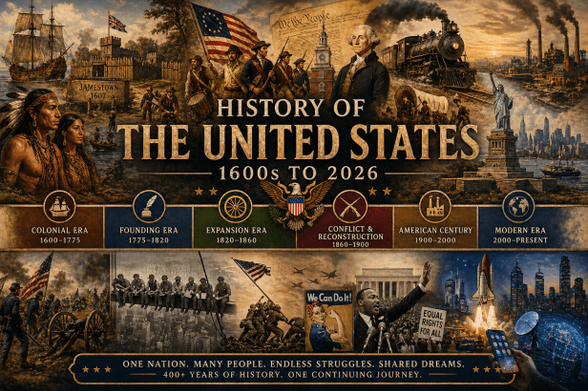
 Liz Covart
 Jonathan Emmesedi
 Stessa Cohen
 Shari Reid
 Julian Davis Mortenson
 Weston Richey