Temporary e-tattoo sensors have been developed for EEG brain monitoring, w/ potential for prosthetics, VR, or human-robot teaming. A robot 3D scans, then prints a thin stretchy film—even on hairy scalps—in 15 mins.

Long, thick, & curly hair is a problem (and source of racial bias), as had already been for traditional EEG caps. Not yet durable enough to survive abrasion from a pillow for sleep studies.

https://www.youtube.com/watch?v=Gjv2cywyoB8
https://www.cell.com/cell-biomaterials/fulltext/S3050-5623(24)00004-7


#ETattoos #EEGs #Electroencephalography

3D Printable EEG Electrode E-Tattoo

YouTube
The #BETD24 has ended!
For me, these have been two unforgettable days with several inspiring discussions, foremost with Hans-Josef Fell (President Energy Watch Group, Author of the #EEGs during his active time in German Bundestag)! Thanks for the networking and being a remarkable model for just, global #ClimateProtection!
He gathers information here: https://hans-josef-fell.de/
See you soon!
#StayActive
Hans-Josef Fell - Botschafter für 100% Erneuerbare Energien

Präsident der Energy Watch Group

Hans-Josef Fell - Botschafter für 100% Erneuerbare Energien

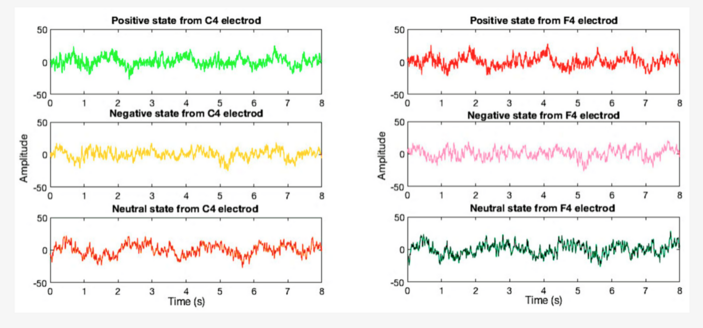
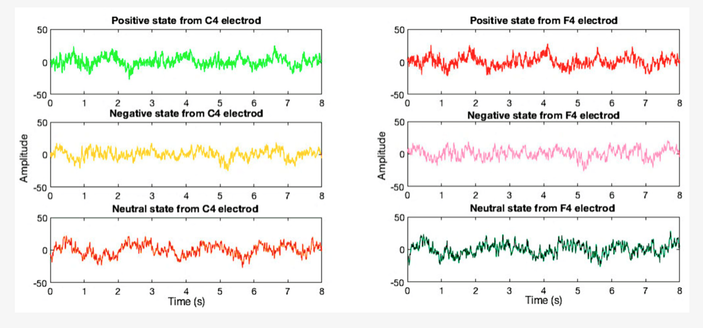
Automatically detecting emotions from #EEGs is expected to become a major task of #BCIs. However, inaccuracies, high error rates and a lack of stability still occupy #research. A research group has now succeeded in using Deep Convolutional Neural Networks #DCNNs to classify positive, neutral and negative #emotions from EEG signals with 96% accuracy by having volunteers listen to different music.
#Bioelectronics

https://mdpi.com/2079-9292/12/10/2216

Automatic Emotion Recognition from EEG Signals Using a Combination of Type-2 Fuzzy and Deep Convolutional Networks

Emotions are an inextricably linked component of human life. Automatic emotion recognition can be widely used in brain–computer interfaces. This study presents a new model for automatic emotion recognition from electroencephalography signals based on a combination of deep learning and fuzzy networks, which can recognize two different emotions: positive, and negative. To accomplish this, a standard database based on musical stimulation using EEG signals was compiled. Then, to deal with the phenomenon of overfitting, generative adversarial networks were used to augment the data. The generative adversarial network output is fed into the proposed model, which is based on improved deep convolutional networks with type-2 fuzzy activation functions. Finally, in two separate class, two positive and two negative emotions were classified. In the classification of the two classes, the proposed model achieved an accuracy of more than 98%. In addition, when compared to previous studies, the proposed model performed well and can be used in future brain–computer interface applications.

MDPI

Emotionen aus #EEGs automatisch zu erkennen, soll zu einer wesentlichen Aufgabe von #BCIs werden. Ungenauigkeiten, hohe Fehlerquoten und mangelnde Stabilität beschäftigen allerdings noch die #Forschung. Einer Arbeitsgruppe gelang es nun durch Deep Convolutional Neural Networks #DCNNs positive, neutrale und negative #Emotionen aus EEG-Signalen mit 96%iger Genauigkeit zu klassifizieren indem sie Freiwillige verschiedene Musik hören ließen.
#Bioelektronik

https://www.mdpi.com/2079-9292/12/10/2216

Automatic Emotion Recognition from EEG Signals Using a Combination of Type-2 Fuzzy and Deep Convolutional Networks

Emotions are an inextricably linked component of human life. Automatic emotion recognition can be widely used in brain–computer interfaces. This study presents a new model for automatic emotion recognition from electroencephalography signals based on a combination of deep learning and fuzzy networks, which can recognize two different emotions: positive, and negative. To accomplish this, a standard database based on musical stimulation using EEG signals was compiled. Then, to deal with the phenomenon of overfitting, generative adversarial networks were used to augment the data. The generative adversarial network output is fed into the proposed model, which is based on improved deep convolutional networks with type-2 fuzzy activation functions. Finally, in two separate class, two positive and two negative emotions were classified. In the classification of the two classes, the proposed model achieved an accuracy of more than 98%. In addition, when compared to previous studies, the proposed model performed well and can be used in future brain–computer interface applications.

MDPI

Ich habe in den letzten Wochen von verschiedenen Betroffenen gehört, dass der Netzbetreiber einer Privatperson den Anschluss der eigenen Dach-PV-Anlage (garantiert <20kW) verbietet, da das Netz keine Kapazitäten mehr hat o.ä.

Weder #Energiegemeinschaften (#EEGs) noch die #Energiewende können so funktionieren.

Ideen was man tun könnte?
Wie verhindert man solch abschreckende Beispiele, die sich dann ewig (als Märchen) halten?

#PV #Netzbetreiber #Sonnenenergie

How to Hack Toy EEGs | Frontier Nerds

Frontier Nerds is a blog documenting Eric Mika's work at NYU's ITP masters program between the Fall of 2009 and the Spring of 2011.