Weekly Update from the Open Journal of Astrophysics – 09/05/2026

It’s Saturday once again, so time for another update of activity at the Open Journal of Astrophysics. Since the last update we have published a further five papers, bringing the number in Volume 9 (2026) to 99 and the total so far published by OJAp up to 547. We didn’t quite make it to a hundred for the year last week, but will do so with the next paper.

I will continue to include the posts made on our Mastodon account (on Fediscience) to encourage you to visit it. Mastodon is a really excellent service, and a more than adequate replacement for X/Twitter (which nobody should be using); these announcements also show the DOI for each paper.

The first paper to report this week is “Formation of Close Binaries through Massive Black Hole Perturbations and Chaotic Tides” by Howard Hao-Tse Huang and Wenbin Lu (University of California at Berkeley, USA). This one was published on Wednesday 6th May 2026 in the folder Astrophysics of Galaxies. The paper presents a model of massive black hole-binary systems, showing that repeated tidal interactions can lead to the creation of hyper-velocity stars and other nuclear transients.

The overlay for this paper is here

You can find the officially accepted version on arXiv here and the announcement on Fediverse here:

https://fediscience.org/@OJ_Astro/116526323790020433

The second paper for this week, also Wednesday 6th May, but in the folder Cosmology and Nongalactic Astrophysics is “Detection of supernova magnitude fluctuations induced by large-scale structure” by Andrew Nguyen (Swinburne Institute of Technology, Australia) and 58 others based all around the world. This study uses supernovae and galaxy velocities to measure the universe’s structure growth rate, confirming the Planck LambdaCDM model prediction. The methodology is validated and shows potential for future research.

The overlay for this one is here:

The official version of the paper can be found on arXiv here and the Fediverse announcement here:

https://fediscience.org/@OJ_Astro/116526449130876366

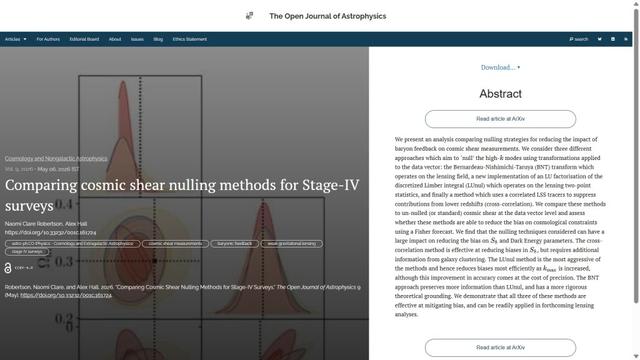
Next one up, the third paper of the week, also published on Wednesday 6th May in the folder Cosmology and Nongalactic Astrophysics is “Comparing cosmic shear nulling methods for Stage-IV surveys” by Naomi Clare Robertson and Alex Hall (University of Edinburgh, UK). This study compares three strategies for reducing baryon feedback impact on cosmic shear measurements. All methods effectively mitigate bias, with varying degrees of efficiency and information preservation.

The overlay for this one is here:

The final, accepted version can be found on arXiv here and the Mastodon announcement is here:

https://fediscience.org/@OJ_Astro/116526251813375105

The fourth paper this week, published on Thursday May 7th, is “Egent: An Autonomous Agent for Equivalent Width Measurement” by Yuan-Sen Ting & Serat Mahmud Saad (Ohio State University, USA), Fan Liu (National Astronomical Observatories, Beijing, China), and Yuting Shen (Georgia Institute of Technology, USA). Egent is an autonomous agent that combines multi-Voigt profile fitting with large language model visual inspection for efficient, automated analysis of raw flux spectra, validated against expert measurements. This one is in the folder Instrumentation and Methods for Astrophysics. The associated software can be found here.

The overlay is here:

The officially accepted version can be found on arXiv here and here is the Mastodon announcement:

https://fediscience.org/@OJ_Astro/116531924397498394

The fifth and final article of this week was published on Friday 8th May in the folder Astrophysics of Galaxies. The title is “DiffstarPop: A generative physical model of galaxy star formation history” and it is by Alex Alarcon (Institute of Space Sciences, Barcelona, Spain), Andrew P. Hearin , Matthew R. Becker & Gillian Beltz-Mohrmann (Argonne National Laborarory, USA), and Andrew Benson & Sachi Weerasooriya (Carnegie Observatories, USA). DiffstarPop is a model that accurately and rapidly reproduces statistical distributions of galaxy star formation histories (SFH), using parameters related to galaxy formation physics.

The overlay is here:

You can find the authorized version of this paper on arXiv here and the Fediverse announcement is here:

https://fediscience.org/@OJ_Astro/116537709130989142

Here endeth this week’s update. There shall be another next Saturday.

P.S. Just a reminder that, thanks to the efforts of a member of our Editorial Board, the Open Journal of Astrophysics now has a Wikipedia page.

#arXiv251007673v2 #arXiv251027604v3 #arXiv251111965v2 #arXiv251201270v2 #arXiv251215604v2 #AstrophysicsOfGalaxies #BaryonicFeedback #blackHoleBinaries #cosmicShear #CosmologyAndNonGalacticAstrophysics #DiamondOpenAccess #DiamondOpenAccessPublishing #Egent #EquivalentWidth #galaxyEvolution #hyperVelocityStars #InstrumentationAndMethodsForAstrophysics #nuclearTransients #OpenAccess #OpenAccessPublishing #peculiarVelocities #supernovae #VoigtProfiles #weakGravitationalLensing
MANUSCRIPT UPDATE: We are excited to announce that we will shortly be publishing a new research article - make sure to keep an eye on the JCRR social media accounts and website for more!

https://journalofcrr.com/

#JCRR #DiamondOpenAccess #Risk #Insurance #ClimateChange #ClimateRisk #RiskModelling

RE: https://openbiblio.social/@sedoa/116493045790406054

Join us tomorrow for this session on the overlay #diamondopenaccess #journal Transformations by @dariaheu and meet the editors @anne_baillot and Françoise Gouzi let's talk about #openaccess models and learn from each other...
BTW: the time is 14:30 CEST !

Weekly Update from the Open Journal of Astrophysics – 02/05/2026

Here we are, on schedule, with another update of activity at the Open Journal of Astrophysics. Since the last update we have published a further seven papers, bringing the number in Volume 9 (2026) to 94 and the total so far published by OJAp up to 542. I checked the corresponding update for last year (on 3rd May 2025), and we’ve had an increase from 54 to 94 in papers published (about 74%) between the first four months of 2025 and the first four months of 2026.

I will continue to include the posts made on our Mastodon account (on Fediscience) to encourage you to visit it. Mastodon is a really excellent service, and a more than adequate replacement for X/Twitter (which nobody should be using); these announcements also show the DOI for each paper.

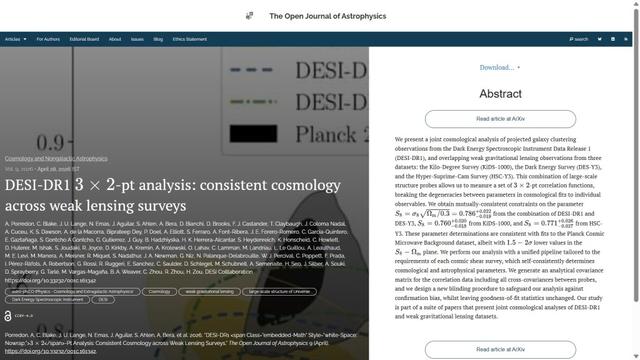
The first paper to report this week is “DESI-DR1 3 × 2-pt analysis: consistent cosmology across weak lensing surveys” by Anna Porredon (CIEMAT, Madrid, Spain) and 72 others (DESI Colllaboration). This paper was published on Tuesday 28th April in the folder Cosmology and Nongalactic Astrophysics. This paper presents a joint cosmological analysis of galaxy clustering and gravitational lensing observations, providing consistent constraints on cosmological parameters. The analysis also introduces a new blinding procedure to prevent confirmation bias. See this post for news of an important DESI milestone.

The overlay for this paper is here

You can find the officially accepted version on arXiv here and the announcement on Fediverse here:

https://fediscience.org/@OJ_Astro/116480407578621011

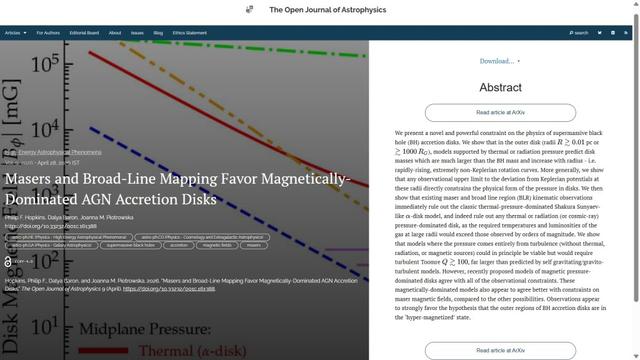
The second paper for this week, also published on Tuesday 28th April but in the folder High-Energy Astrophysical Phenomena is “Masers and Broad-Line Mapping Favor Magnetically-Dominated AGN Accretion Disks” by Philip F. Hopkins (Caltech, USA), Dalya Baron (Stanford U., USA) and Joanna M. Piotrowska (Caltech). This one presents a new constraint on supermassive black hole accretion disks physics, suggesting that outer regions are likely in a ‘hyper-magnetized’ state, as thermal or radiation pressure models appear inconsistent.

The overlay for this one is here:

The official version of the paper can be found on arXiv here and the Fediverse announcement here:

https://fediscience.org/@OJ_Astro/116480505354195181

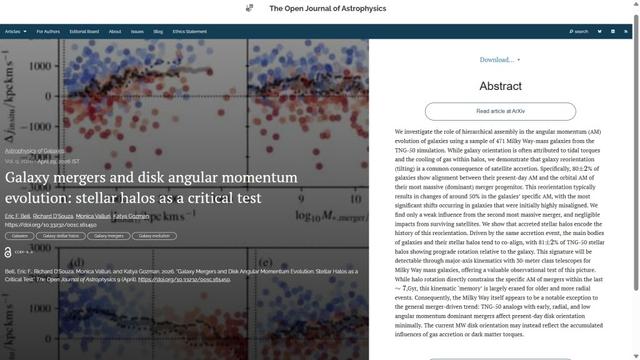
Next one up, the third paper of the week, is “Galaxy mergers and disk angular momentum evolution: stellar halos as a critical test” by Eric F. Bell (U. Michigan, Ann Arbor, USA), Richard D’Souza (Vatican Observatory), Monica Valluri & Katya Gozman (U. Michigan). This was published on Wednesday 29th April in the folder Astrophysics of Galaxies. The paper argues that satellite accretion impacts the angular momentum evolution of galaxies, often causing significant reorientation. This process is detectable in Milky Way-mass galaxies so the idea is testable observationally.

The overlay for this one is here:

The final, accepted version can be found on arXiv here and the Mastodon announcement is here:

https://fediscience.org/@OJ_Astro/116486649450860283

The fourth paper this week, published on Thursday April 30th, is “Time-Dilation Methods for Extreme Multiscale Timestepping Problems” by Philip F. Hopkins and Elias R. Most (Caltech, USA). This paper is in the folder Instrumentation and Methods for Astrophysics: it presents a new method for astrophysical simulations that modulates time evolution with a variable dilation/stretch factor, improving efficiency and accuracy in modeling processes across different scales.

The overlay is here:

The finally accepted version of this paper can be found here and the Mastodon announcement follows:

https://fediscience.org/@OJ_Astro/116492226856595031

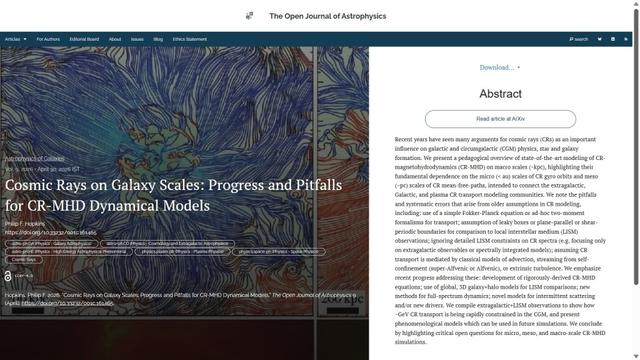
The fifth article of this week was also published on Thursday 30th April, but in the folder Astrophysics of Galaxies. The title is “Cosmic Rays on Galaxy Scales: Progress and Pitfalls for CR-MHD Dynamical Models” and the author is Philip F. Hopkins (Caltech, USA) who has three papers featured this week. The paper presents an overview of cosmic ray (CR) modeling, highlighting its influence on galactic physics and star formation. It addresses previous modeling errors and presents new methods for full-spectrum dynamics.

The overlay is here:

You can find the authorized version of this paper on arXiv here and the Fediverse announcement is here:

https://fediscience.org/@OJ_Astro/116492282488422075

The sixth paper of the week is “Baryonification III: An accurate analytical model for the dispersion measure probability density function of fast radio bursts” by MohammadReza Torkamani (Universität Bonn, Germany) and 8 others based in Germany, Switzerland, UK and Sweden. This article was also published on Thursday April 30th in the folder Cosmology and Nongalactic Astrophysics. It presents a framework for predicting dispersion measures of fast radio bursts using the baryonification model, providing a cost-effective alternative to hydrodynamical simulations. The model’s accuracy is validated through full numerical simulations. The overlay is here:

You can find the officially-accepted version on arXiv here and the Mastodon announcement here:

https://fediscience.org/@OJ_Astro/116492403170125062

Seventh and finally for this week we have “The stellar and dark matter distributions in early-type galaxies measured by stacked weak gravitational lensing” by Momoka Fujikawa and Masamune Oguri (Chiba University, Japan). This study uses weak gravitational lensing to investigate stellar mass and dark matter density in red galaxies, suggesting a stronger feedback effect than current simulations predict. This was published on Friday 1st May 2026 in the folder Astrophysics of Galaxies. The overlay is here:

You can find the officially-accepted version on arXiv here and the Fediverse announcement is here:

https://fediscience.org/@OJ_Astro/116497987401632687

And that concludes this week’s update. I’ll do another one at the end of next week. Will Vol. 9 have reached a hundred by then?

P.S. Just a reminder that, thanks to the efforts of a member of our Editorial Board, the Open Journal of Astrophysics now has a Wikipedia page.

#32PtAnalysis #ActiveGalacticNuclei #AGN #arXiv250907104v2 #arXiv251009756v2 #arXiv251209342v2 #arXiv251215960v3 #arXiv260106253v2 #arXiv260118784v2 #arXiv260424965v1 #AstrophysicsOfGalaxies #baryonification #ComputationalAstrophysics #cosmicRays #CosmologyAndNonGalacticAstrophysics #DarkEnergySpectroscopicInstrument #DESI #DiamondOpenAccess #DiamondOpenAccessPublishing #DispersionMeasures #fastRadioBursts #galacticCosmicRays #galaxyEvolution #galaxyFormation #galaxyMergers #HighEnergyAstrophysicalPhenomena #InstrumentationAndMethodsForAstrophysics #magnetohydrodynamics #masers #MilkyWay #OpenAccess #OpenAccessPublishing #SolarAndStellarAstrophysics #SolarCorona #supermassiveBlackHoles #VeraCRubinObservatory #weakGravitationalLensing #wikipedia

Weekly Update from the Open Journal of Astrophysics – 25/04/2026

So here we are again, on a Saturday morning, with another update of activity at the Open Journal of Astrophysics. Since the last update we have published a further five papers, bringing the number in Volume 9 (2026) to 87 and the total so far published by OJAp up to 535.

I will continue to include the posts made on our Mastodon account (on Fediscience) to encourage you to visit it. Mastodon is a really excellent service, and a more than adequate replacement for X/Twitter (which nobody should be using); these announcements also show the DOI for each paper.

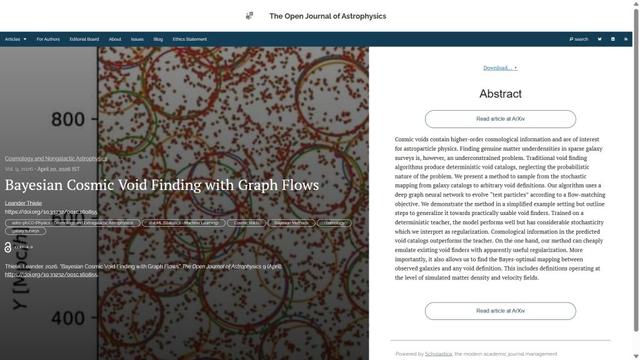
The first paper to report this week is “Bayesian Cosmic Void Finding with Graph Flows” by Leander Thiele (U. Tokyo, Japan). This was published on Monday 20th April in the folder Cosmology and Nongalactic Astrophysics. The paper presents a method using a deep graph neural network to identify cosmic voids in sparse galaxy surveys, improving upon traditional deterministic algorithms by considering the problem’s probabilistic nature. The overlay is here:

You can find the officially accepted version on arXiv here and the announcement on Fediverse here:

https://fediscience.org/@OJ_Astro/116435864086025246

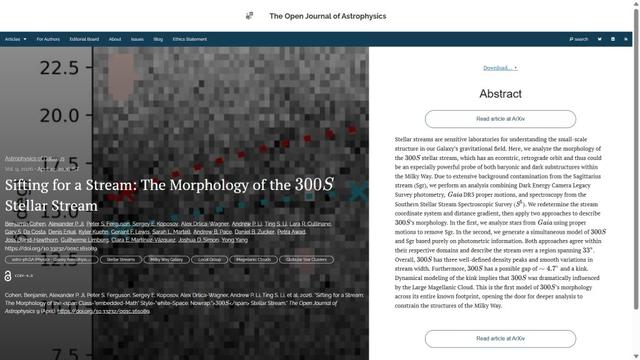
The second paper for this week, published on Wednesday 22nd April in the folder Astrophysics of Galaxies, is “Sifting for a Stream: The Morphology of the 300S Stellar Stream” by Benjamin Cohen (U. Chicago, USA) and 20 others distributed around the world. This study analyzes the morphology of the $300S$ stellar stream, revealing three density peaks, a possible gap, and a kink, suggesting significant influence from the Large Magellanic Cloud on its structure.

The overlay for this one is here:

The official version of the paper can be found on arXiv here and the Fediverse announcement here:

https://fediscience.org/@OJ_Astro/116447005556180402

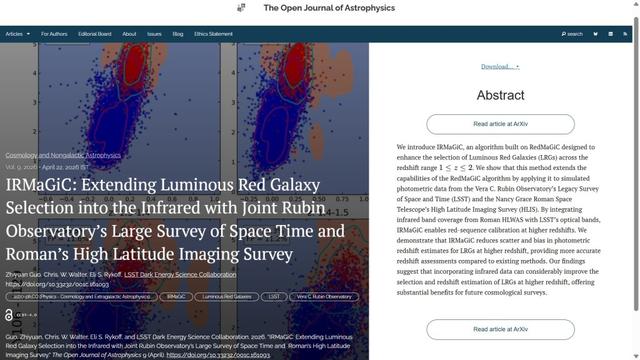
Next one up, the third paper of the week, is “IRMaGiC: Extending Luminous Red Galaxy Selection into the Infrared with Joint Rubin Observatory’s Large Survey of Space Time and Roman’s High Latitude Imaging Survey” by Zhiyuan Guo & Chris. W. Walter (Duke U., USA) and Eli S. Rykoff (Stanford U., USA) on behalf of the LSST Dark Energy Science Collaboration. This was published on Wednesday April 22nd in the folder Cosmology and Nongalactic Astrophysics. The paper introduces IRMaGiC, an algorithm that improves the selection and redshift estimation of Luminous Red Galaxies (LRGs) by incorporating infrared data, enhancing future cosmological surveys.

The overlay for this one is here:

The final, accepted version can be found on arXiv here and the Mastodon announcement is here:

https://fediscience.org/@OJ_Astro/116447067337351283

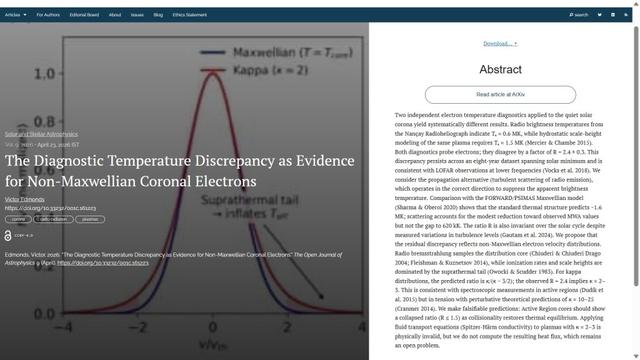
The fourth paper this week, published on Thursday April 23rd, is “The Diagnostic Temperature Discrepancy as Evidence for Non-Maxwellian Coronal Electrons” by Victor Edmonds (Final Stop Consulting, USA). This paper, in the folder Solar and Stellar Astrophysics, presents two methods of measuring electron temperature in the quiet solar corona yielding different results, suggesting non-Maxwellian electron velocity distributions may be responsible for the discrepancy.

The overlay is here:

The finally accepted version of this paper can be found here and the Mastodon announcement follows:

https://fediscience.org/@OJ_Astro/116452775389963618

The fifth and final paper for this week was published on Friday 24th April in the folder Astrophysics of Galaxies. The title is “Galaxy evolution in the post-merger regime. IV – The long-term effect of mergers on galactic stellar mass growth and distribution” by Sara L. Ellison (U. Victoria, Canada) and Leonardo Ferreira (Universidade Federal do Rio Grande, Brazil). This study uses a large sample of post-merger galaxies to demonstrate that galaxy mergers trigger significant and extended stellar mass growth in their central regions, independent of stellar population modelling.

The overlay is here:

You can find the authorized version of this paper on arXiv here and the Fediverse announcement is here:

https://fediscience.org/@OJ_Astro/116458316824739014

The overlay for this one is here:

You can find the officially-accepted version on arXiv here and the Mastodon announcement here:

https://fediscience.org/@OJ_Astro/116458316824739014

And that concludes this week’s update. I’ll do another one at the end of next week.

P.S. Thanks to the efforts of a member of our Editorial Board, the Open Journal of Astrophysics now has a Wikipedia page.

#300SStellarStream #arXiv250621410v2 #arXiv251121512v2 #arXiv260114554v2 #arXiv260214630v2 #arXiv260310040v3 #AstrophysicsOfGalaxies #BayesianMethods #CosmicVoids #CosmologyAndNonGalacticAstrophysics #DiamondOpenAccess #DiamondOpenAccessPublishing #EarthAndPlanetaryAstrophysics #GAIA #galaxyEvolution #galaxyFormation #galaxyMergers #InstrumentationAndMethodsForAstrophysics #IntergalacticMedium #IRMaGiC #LargeMagellanicCloud #LSST #LSSTDarkEnergyScienceCollaboration #MilkyWay #OpenAccess #OpenAccessPublishing #SolarAndStellarAstrophysics #SolarCorona #VeraCRubinObservatory #wikipedia

💎 In PKP's Archipelago, Regional Feature: Reflections from the 3rd Global Summit on #DiamondOpenAccess in conversation with Mark Huskisson (@markhusk)

This article is packed full! India #OA landscape, #OpenJournalSystems use, important takeaways and more:

https://pkp.sfu.ca/2026/03/31/reflections-3rd-global-summit-diamond-open-access-mark-huskisson/

Some mentions in the article: @tibhannover @DOAJ @crossref @SCOSSfunding @unesco

#OpenAccess #DiamondOA #ScholComm #ScholarlyPublishing #FOSS #OpenInfrastructure #AcademicChatter

Reflections from the 3rd Global Summit on Diamond Open Access in Conversation with PKP’s Mark Huskisson - Public Knowledge Project

PKP's Mark Huskisson is interviewed by Famira Racy to discuss the diamond landscape in India, use of PKP software, sustainability, and key takeaways for PKP Communities.

Public Knowledge Project

Weekly Update from the Open Journal of Astrophysics – 18/04/2026

It is Saturday morning, and therefore time for yet another update of activity at the Open Journal of Astrophysics. Since the last update we have published a further six papers, bringing the number in Volume 9 (2026) to 82 and the total so far published by OJAp up to 530.

I will continue to include the posts made on our Mastodon account (on Fediscience) to encourage you to visit it. Mastodon is a really excellent service, and a more than adequate replacement for X/Twitter (which nobody should be using); these announcements also show the DOI for each paper.

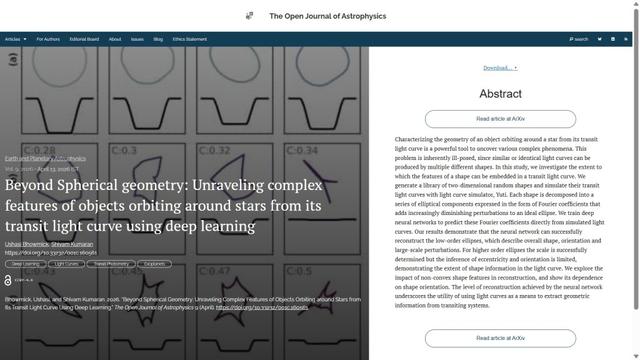
The first paper to report this week is “Beyond Spherical geometry: Unraveling complex features of objects orbiting around stars from its transit light curve using deep learning” by Ushasi Bhowmick & Shivam Kumaran (Indian Space Research Institute, Ahmedabad, India). This study uses deep neural networks to predict the shape of objects orbiting stars based on their transit light curves, demonstrating the potential to extract geometric information from these systems. It was published on Monday 13th April in the folder Earth and Planetary Astrophysics and the overlay can be seen here:

You can find the officially accepted version on arXiv here and the announcement on Fediverse here:

https://fediscience.org/@OJ_Astro/116395992732332356

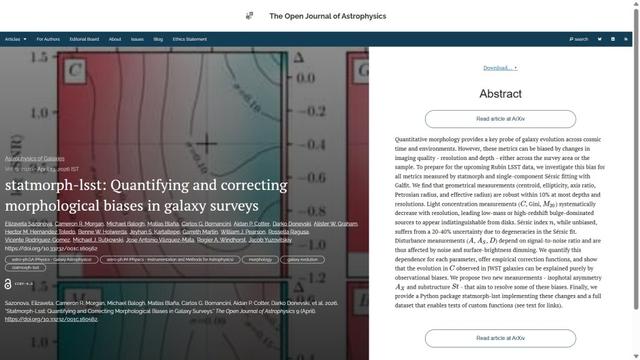
The second paper for this week, also published on Monday 13th April but in the folder Astrophysics of Galaxies, is “statmorph-lsst: Quantifying and correcting morphological biases in galaxy surveys” by Elizaveta Sazonova (U. Waterloo, Canada) and an international cast of 18 others. This paper presents an investigation of potential biases in quantitative morphology metrics used in galaxy evolution studies, proposing two new measurements to resolve biases, and provides a related Python package (statmorph-lsst), which can be found here on github.

The overlay for this one is here:

The official version of the paper can be found on arXiv here and the Fediverse announcement here:

https://fediscience.org/@OJ_Astro/116396069424189312

Next one up, the third paper of the week, one of four published on Friday 17th April, is “Disentangling the galactic and intergalactic components in 313 observed Lyman-alpha line profiles between redshift 0 and 5” by Siddhartha Gurung-López (Universitat de València, Spain) and 7 others based in Spain and Germany. Published in the folder Astrophysics of Galaxies, this paper uses the zELDA package to analyze Lyman-alpha photons from star-forming galaxies, revealing IGM effects dominate Lyman-alpha observability at high redshifts, while galactic outflows become more important at lower z.

The overlay for this one is here:

The final, accepted version can be found on arXiv here and the Mastodon announcement is here:

https://fediscience.org/@OJ_Astro/116418831864134501

The fourth paper this week, also published on Friday 17th April is “Using Symbolic Regression to Emulate the Radial Fourier Transform of the Sérsic Profile for Fast, Accurate and Differentiable Galaxy Profile Fitting” by Tim B. Miller (Northwestern University, USA) and Imad Pasha (Yale University, USA). This one is published in the folder Instrumentation and Methods for Astrophysics: it develops an emulator for galaxy profile fitting in Fourier space, improving speed by 2.5 times with minimal accuracy loss, aiding in managing increasing data flow.

The overlay is here:

The finally accepted version of this paper can be found here and the Mastodon announcement follows:

https://fediscience.org/@OJ_Astro/116418855010158656

The fifth paper for this week is “The THESAN project: Lyman-alpha emitters as probes of ionized bubble sizes” by Meredith Neyer (MIT, USA) and 6 others based in the USA, Colombia, Canada, Japan and UK. The study uses THESAN simulations to explore how Lyman-alpha emitters (LAEs) trace ionized bubble sizes during the Epoch of Reionization, providing a framework for interpreting LAE surveys. This was published on Friday 17th April in the folder Astrophysics of Galaxies.

The overlay for this one is here:

You can find the authorized version of this paper on arXiv here and the Fediverse announcement is here:

https://fediscience.org/@OJ_Astro/116418887225003954

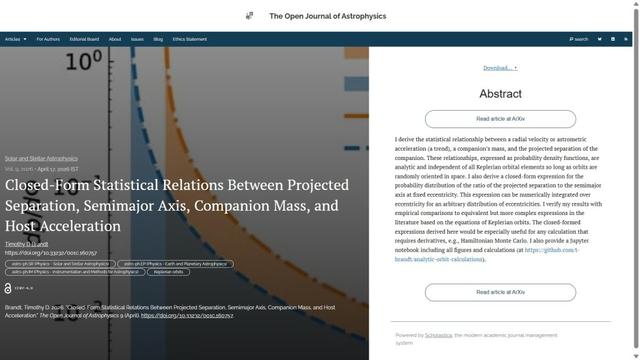
The sixth and final paper for this week is “Closed-Form Statistical Relations Between Projected Separation, Semimajor Axis, Companion Mass, and Host Acceleration” by Timothy D Brandt (Space Telescope Science Institute, USA). This was published on Friday 17th April in the folder Solar and Stellar Astrophysics. In this paper the author derives statistical relationships between radial velocity, a companion’s mass, and projected separation, useful for calculations requiring derivatives. The results are verified with empirical comparisons to existing literature.

The overlay for this one is here:

You can find the officially-accepted version on arXiv here and the Mastodon announcement here:

https://fediscience.org/@OJ_Astro/116418938017199814

And that concludes this week’s update. I’ll do another one at the end of next week.

P.S. Just a reminder, for those of you into LinkedIn, that we now have a page there.

#arXiv250303824v4 #arXiv250820266v2 #arXiv250914875v2 #arXiv251018946v2 #arXiv251109644v2 #arXiv260114688v2 #AstrophysicsOfGalaxies #binaryStars #ComputationalAstrophysics #CosmologyAndNonGalacticAstrophysics #DiamondOpenAccess #DiamondOpenAccessPublishing #EarthAndPlanetaryAstrophysics #EpochOfReionization #galaxyFormation #GalaxyMorphology #galaxyProfiles #InstrumentationAndMethodsForAstrophysics #IntergalacticMedium #Ionization #LAEs #lightCurves #LSST #LymanAlphaEmitters #OpenAccess #OpenAccessPublishing #Orbits #SérsicProfile #SolarAndStellarAstrophysics #statmorphLsst #stellarHalos #strongGravitationalLensing #THESAN #zELDA

As explored by Scott Kehler and Matthieu Desorcy, Weatherlogics Inc, in this free-to-read paper, a majority of the variation in the hail-thunderstorm ratio can be explained by elevation. Learn more about their approach as the authors describe the data used, outline their methods, and finally reveal, compare, and discuss their results: https://journalofcrr.com/research/03-06-kehler-desorcy/

#JCRR #DiamondOpenAccess #Hail #Thunderstorms #Climatology

📢 Recrutement

La Direction pour la Science Ouverte d’INRAE recrute un·e ingénieur·e d’études pour contribuer au pilotage de Peer Community In (PCI).

📄 Contrat : CDD de 15 mois
🎯 Mission : accompagner le développement et la coordination de PCI au cœur des enjeux de la science ouverte.

Détails de l'offre : https://jobs.inrae.fr/ot-28928

👉 N’hésitez pas à partager dans vos réseaux et à candidater!

#OpenScience #INRAE #Hiring #DiamondOpenAccess #ScholarlyPublishing

Responsable du pilotage du projet Peer Community In F/H

INRAE est engagé dans la science ouverte et s’est doté d’une Direction pour la Science Ouverte (DipSO) pour mettre en place sa politique dans ce domaine. L’ouverture des publications et la défense de la bibliodiversité fait partie de ses engagements. A ce titre, l’institut soutient des initiatives de publication ouverte innovantes comme Peer Community In (PCI, www.peercommunityin.org), projet fondé par 3 chercheurs INRAE et reconnu à l’international.PCI est un ensemble de plateformes thématiques d’évaluation par les pairs et de recommandation de preprints ; 21 plateformes existent actuellement et plusieurs sont en cours de création. L’évaluation des articles au sein de chaque PCI se déroule de façon similaire à celle des articles soumis aux revues scientifiques. PCI publie également une revue en open access diamant, Peer Community Journal (PCJ, https://peercommunityjournal.org/), qui offre un espace de publication et de diffusion pour les preprints recommandés, à la demande des auteurs. A sein du Pôle Accès Capitalisation et Diffusion des Connaissances de la Direction pour la Science Ouverte, vous aurez la charge du fonctionnement de PCI et PCJ. Vous travaillerez en étroite collaboration avec les administrateurs de PCI pour piloter de façon progressivement autonome :le management fonctionnel des communautés PCI : animation de la communauté des représentants des PCIs thématiques, aide au fonctionnement des PCIs et au démarrage de nouvelles PCIs, conception et la mise en œuvre de nouvelles fonctionnalités des plateformes en lien avec l’équipe des développeurs informatiques, suivi de la politique relative à l’intégrité scientifique et éditoriale ; la gestion des articles PCJ : gestion d'une équipe de vérification et d’amélioration du formatage des articles transmis des PCI à PCJ, gestion du flux des articles de la soumission à la publication, et développement/automatisation du workflow ;le développement global de l’initiative PCI : organisation du fonctionnement de l’association (AG, réunion mensuelles, webinaires trimestriels), suivi des réponses aux appels d’offres, suivi des appels à subvention, organisation du processus de validation des propositions de nouvelles PCIs thématiques, développement de l’interopérabilité entre les PCIs et les archives ouvertes, communication interne et externe.Missions transversales : dans le cadre du projet FNSO Diamant’Air conduit par l’Université de Lorraine et dont INRAE est partenaire, vous accompagnerez les utilisateurs et contribuerez à renforcer le lien entre PCI et les autres acteurs nationaux de l’édition ouverte diamant.Au sein de l’équipe édition et du réseau des revues de l’institut, vous apporterez notamment votre expertise et assurerez le transfert de connaissance dans la mise en place d’expérimentations ou de contribution à des projets éditoriaux innovants impliquant l’équipe d’appui à l’édition.

INRAE Jobs
👉 N’hésitez pas à partager dans vos réseaux et à candidater! #OpenScience #INRAE #Hiring #DiamondOpenAccess #ScholarlyPublishing