The thread about a Christmas-themed A to Z of Edinburgh and Leith place names

For no particular reason other than the time of year, let’s take an A to Z look into some of the street and place names of Edinburgh and Leith and see what festive or seasonal connections we might find.

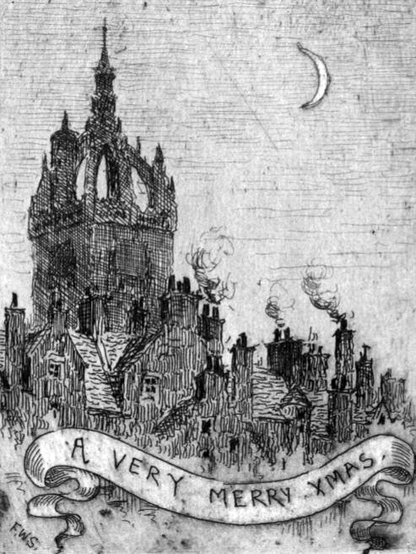
A Very Merry Xmas, a Christmas card featuring the spire of St. Giles High Kirk and a stylised Old Town roofscape c. 1900 © Edinburgh City Libraries

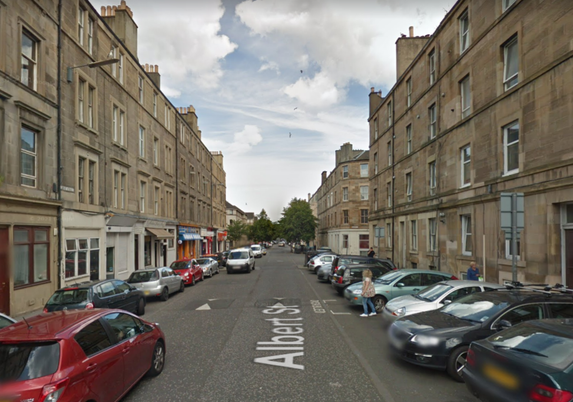
A is for Albert Street. This street in Leith was named for the Prince Consort, Albert of Saxe-Coburg and Gotha, around 1870 to commemorate his death in 1861. Albert is credited with introducing the first Christmas trees to Britain (he didn’t apparently it was Queen Charlotte – of Mecklenburg-Strelitz – in 1800)

Albert Street, off Leith Walk

B is for Bethlehem Way. This is a rather insipid development of modern flats in the Lochend area of the city, built on the site of the old Hawkhill Quarry. I’m afraid I cannot offer an explanation as to why this name was picked – this area has no biblical or Middle Eastern connection that I know of.

Bethlehem Way

B is for Bell’s. There are a number of Bell place names in the city, but I have picked Bell’s Brae, that charmingly steep street that connects Queensferry Street to the Water of Leith Village (which you might call Dean Village). At one time this was in the parish of the West Kirk so had to be climbed each week to attend church, so this was known as the Kirk Brae. It was named Bell’s after the millers of that name further upstream at Bell’s Mill.

Bell’s Brae

C is for Chestnut Street. This is named for a rock just off of Granton’s western breakwater and for a street name is rather odd as it was first named as late as 1985, before disappearing again when the industrial area of Granton docks was cleared. It was then being re-used in a street nearby within the last few years for new build housing. It is named for the rock of that name in the Forth.

Chestnut rock marked on a coastal chart. Reproduced with the permission of the National Library of Scotland

D is for Drum. As any parent knows, the worst gift you can ever receive for your small child is a drum. From the Gaelic Druim meaning literally “back”; it describes a ridge or raised ground. See also The Drum in Gilmerton, Drumbrae in Corstorphine, etc. The Drum in Leith is not that obvious now that it has been built on, but is the higher ground above Lochend Loch and was once a house and market garden of that name here, it was once the district name and is what the Hibernian F.C. ground was called before it was named Easter Road.

OS 1893 Town Plan, Reproduced with the permission of the National Library of Scotland

E is for Elf Loch. One of the sometimes overlooked bodies of water in the city boundary. Also called the Diedman’s Pool, this more festive name is possibly from the Gaelic ailbhinn or British elfin, meaning a rocky precipice, of which there are many nearby . An ancient, natural water feature it’s easily mistaken for a water obstacle on the golf course which surrounds it.

Elf Loch, cc-by-SA Richard Webb

F is for Fir Hill. The suburb of Firrhill or Firr Hill is a mid-19th century mapmaker’s corruption of Fir Hill, in reference to the festive trees that grew there once upon a time. The school of this name features a fir tree on its badge and has the Gaelic motto Air Carraig, or “on the rock”.

“Fir Hill”. OS 6 inch survey, 1855. Reproduced with the permission of the National Library of Scotland

G is For Guse Dub. Guse is the old Scots word for a Goose, and the Dub referred to a pond and spring where geese were once raised. This has long been the name of a little corner of Causewayside, where it meets the Crosscauseway.

Guse Dub and Buccleuch Street. CC-by-NC Leo Reynolds

H is for Holly and I is for Ivy, two streets in the Merchiston and Shandon “colonies” houses built by the Edinburgh Co-operative Building Company, who often used the names of trees and flowers for their terraces of high-quality model workers houses.

OS 1893 Town Plan, Reproduced with the permission of the National Library of Scotland

J is for St. Joseph’s, the name of a Catholic Church and Primary school in the Broomhouse area of the city. It was one of the last R.C. parishes in Edinburgh to be formed, to serve the expanding post-war population in the council housing estates in the west of the city.

St. Joseph’s RC Church, CC-by-SA 4.0 Walker287

K is for the King’s Stables. Now the name of the road which connects Lothian Road to the Grassmarket, it was here in 1335 that Edward III of England’s occupying garrison built a royal stables for the King’s cavalry horses. As the centre of Royal power in the city migrated to Holyrood in the 16th century, the stables fell out of use and were sold in 1527. The name stuck though, and it has been as such ever since.

Castle from the King’s Stables Roads, unknown photographer and date. Cc-by-NC National Galleries Scotland

L is for Lamb’s House. OK, perhaps a bit contrived but I was struggling on this one and I’m pretty sure the shepherds brought at least one lamb with them to the stable in Bethlehem. Lamb’s House, named for the merchant and shipowner Andrew Lamb, is a 17th century house in Leith and one of that Port’s oldest buildings. It was sold by the National Trust for Scotland and restored in 2012.

The restored Lamb’s House, CC-by-SA 2.0 Stephen Craven

M is for Mary. There are lots of Mary- place names in Edinburgh and more than a few churches and cathedral’s dedicated to her as a Saint. There are two Maryfields in Edinburgh. One was an old 1840s house at the head of Easter Road, giving its name to the area, and a current street and colony row in Abbeyhill. These fancy -field names after female relatives, were common. e.g. Annfield, Elizafield. Jessfield.

OS 1893 Town Plan, Reproduced with the permission of the National Library of Scotland

N is for St. Nicholas. If we go back to pre-reformation times, St. Nicholas was the chapel and burial ground of North Leith (although not its parish church). It was occupied by Cromwell’s Protectorate army after the Scottish Covenanters’ defeat at Dunbar in 1650, later being swept away when his Citadel was built in 1655. The only image I know if it is in the corner of the “Petworth House Map” of the Siege of Leith, when it was fortified as a strong point (note the trench around it and the cannons).

St Nicholas’ Chapel, from the 1560 “Petworth House Map” of the Siege of Leith. PHA 4640, Reproduced by the kind permission of Lord Egremont and with acknowledgements to the County Archivist, West Sussex Record Office

O is for Oxford Street, both London’s centre of festive shopping and a short street in Newington. Named for Oxford Park which was here beforehand, the reason behind that is long lost to memory and time.

Oxford Street

P is for Perdrixknowe. The house of this name was built as Waverley House by the fountain pen magnate Duncan Cameron, but reverted to its old area name of Perdrixknowe (Partridge Hill) when converted into sheltered housing in the 1980s.

Perdrixknowe, once Waverley House

Q is for Quality Street. Chocolates anyone? There were once two Quality Streets; one in Leith and one in Blackhall. Usually the duplicate streets in Leith and Edinburgh had one renamed to avoid postal confusion, in this case it was Leith that changed, to Maritime Street, which was ironic as the one in Blackhall was most likely named after it about 150 years later! It was possibly named after a fashionable property in London at the time.

OS Town Plan, 1849, Reproduced with the permission of the National Library of Scotland

R is for Red (as in Rudolph the Reindeer). There’s lots of Edinburgh place names with “Red” in them. Redford, Redbraes, Redheughs, etc. Redhall is one of the longest established, being recorded in the 13th century and referring to a hall house built out of the local reddish sandstone from the Redhall quarry. It was later fortified and eventually referred to as a castle. It was reduced by Oliver Cromwell’s New Model Army before the Battle of Dunbar in 1650 and fell into disrepair. George Inglis of Auchendinny later built a mansion house on the estate.

Redhall House. CC-BY-SA Anne Burgess

S is for Sleigh Drive, named – along with a number of other streets in the Lochend council housing estate – after Sir William Lowrie Sleigh, DL, LLD, JP, Lord Provost of Edinburgh (1923–1926). The Corporation had a bit of a habit of naming their new housing schemes after recent Lord Provosts at this time (see also Chesser, Hutchison, Stevenson and Whitson). Sleigh made his name and money in the bicycle trade with a partner – Ross – trading under the name Rossleigh. they later moved into the motor and chauffeuring trade and are still going in the latter business.

Sir W. L. Sleigh by Cowan Dobson, © Edinburgh Museums and Galleries

T is for The East Way. How else did the Three Wise Men get where they were going? The East Way is a named footpath in the pioneering 1919 council housing development of Northfield which was laid out on Garden City principles with concentric rings of streets connected by footpaths. The others are named The North Way and The High Way.

The East Way, Northfield

U is for Upper Bow. Bow (pronounced Bough, traditionally, but Bow these days) was an old Scots term for an arched gateway, and before the construction of the West Port the West Bow was the western entrance into the city. The street was an awkward, steep dog-leg, the upper part of which was the Upper Bow, the top being the Bowhead where in antiquity there was a tron or public weigh house in the centre of the Lawnmarket. When George IV Bridge was built in the 1830s, the West Bow was redirected to connect to it, leaving the Upper Bow as a little stub, connected to it by a public stairway.

V is for Victoria Street. It is the Victorians who are credited with popularising the celebration of Christmas in the UK after all, and instituting many of the British traditions associated with it. Conveniently, this is what the West Bow was renamed to when it was diverted to connect to George IV bridge, to commemorate the recent accession of Queen Victoria. It is one of Edinburgh’s most picture postcard little streets, but is usually covered in cars despite recent attempts to make it pedestrianised.

Victoria Street. CC-by-SA 3.0 Daniel Kraft

W is for Whisky Row. Now renamed Elbe Street to reflect Leith’s North Sea trade with Hamburg on that river, it was once an address of numerous wine and spirits merchants in the Port. Cheers! Slàinte is Nollaig Cridheil!

Ainslie’s Town Plan of 1804. Reproduced with the permission of the National Library of Scotland

X is for Nothing. What naughty children get in their stockings – but mainly as there are no X- placenames in Edinburgh or Leith.

Y is for Yool. Yool’s place was an old street in Portobello. Thomas Yool or Yoole set up the pottery on the site with his nephew, Thomas Rathbone and a business partner John Thomas, and gave his name to a short street. Pottery was the once prosperous industry of the town, built as it was by claypits to house the workers of the brick and later pottery industries. After Yool’s death the business continued as T. Rathbone & Co., by Rathbone’s son – John – before being bought in 1839 by new owners.

OS 1944 Town Plan. Reproduced with the permission of the National Library of Scotland

Z is for Nothing, there’s only one Z- placename in Edinburgh and that’s named after Zetland, the traditional county name for the Shetland Islands.

Note to readers: unfortunately in April 2026, a third-party plug-in more than exceeded its authority and broke many of the image links on this site. No images were lost but I will have to restore them page-by-page, which may take some time. In the meantime please bear with me while I go about rectifying this issue.

If you have found this site useful, informative or amusing then you can help contribute towards its running costs by supporting me on ko-fi. This includes my commitment to keeping it 100% advert and AI free for all time coming, and in helping to find further unusual stories to bring you by acquiring books and paying for research.
Or please do just share this post on social media or amongst friends and like-minded people, sites like this thrive on being shared.

Explore Threadinburgh by map:

Travelers' Map is loading...
If you see this after your page is loaded completely, leafletJS files are missing.

These threads © 2017-2026, Andy Arthur.

NO AI TRAINING: Any use of the contents of this website to “train” generative artificial intelligence (AI) technologies to generate text is expressly prohibited. The author reserves all rights to license uses of this work for generative AI training and development of machine learning language models.

#Lochend #Logan #Restalrig #StMargaret
The thread about the First Day of Christmas; an Edinburgh Pear Tree connection

This thread was originally written and published in December 2019.

Because of the time of year, let’s do a “Twelve Days of Christmas“-themed thread based around some Edinburgh and Leith local history. Do you remember the tune and the words? Altogether now! And a 1, and a 2, and a 1, 2, 3!

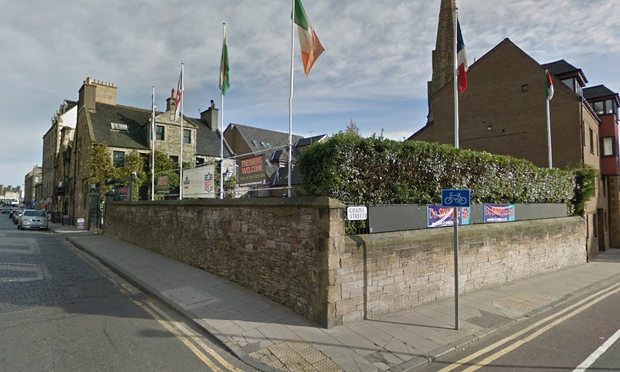
On the first day of Christmas, my true love gave to me, a Partridge in The Pear Tree House. Better known to most these days as the as The Pear Tree pub and beer garden on West Nicolson Street. It’s an early Georgian 2-storey merchant’s house, built in 1756 for William Reid as his residence as West Nicolson House. There is a date stone of 1749 embedded in its walls, but apparently this is a later, anachronistic addition.

The Pear Tree House and its popular beer garden

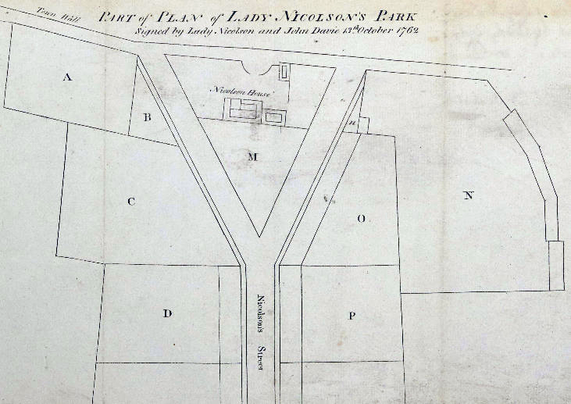
Lady Nicolson, Elizabeth Carnegie, moved here after 1762 when she allowed her own house and parklands to be feud and cleared to make way for Nicolson Street and Square (which took her family name). The Nicolson Baronets had owned the land here since the early 16th century, the title becoming dormant in 1743 on the death of Elizabeth’s husband, the 7th Baronet.

RHP5587 Plan of part of Lady Nicolson’s Park, Edinburgh 1762 © Crown copyright

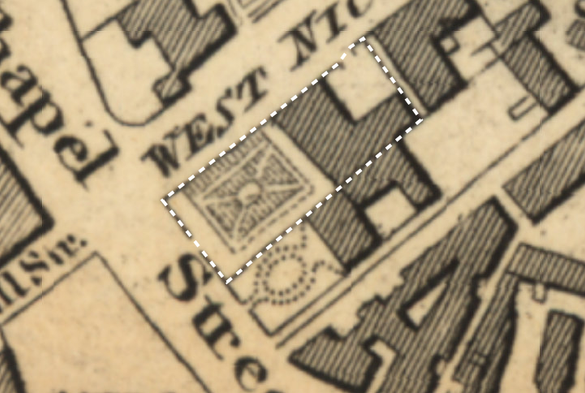
The building is typical of the Edinburgh style from the time, with a gable end and chimney on the façade. It is faced with rubble but would likely have been harled. Part of the fueing conditions were that the front courtyard be enclosed and used only for “the planting of trees;” the beer garden area was this garden and a coach drive.

Outline of the Pear Tree House, Kirkwood’s Town Plan of 1817. Reproduced with the permission of the National Library of Scotland

The house passed to the Kilkerran Baronets – the Fergusson Family. Sir Adam Fergusson (3rd Baronet) entertained James Boswell here in the late 1760s and took tea with him. He sold it in 1770. The poet and minister, the Rev. Dr Thomas Blacklock then resided in rented rooms here and entertained both Dr Johnson and Robert Burns, again tea was taken along side various other “refreshments”. Blacklock had been blind since infancy and gives his name to the upstairs bar of the Pear Tree, the Blind Poet. He is credited with having saved the life of Burns, as a letter he wrote to him in 1789 dissuaded Burns from travelling abroad to the West Indies; the ship he had been due to travel on sank on the voyage.

Thomas Blacklock, 1721-1791, © Edinburgh City Libraries

After Blacklock’s time, the ownership changed again, this time coming into the hands of the Usher family, in whose time it was known as The Usher House.

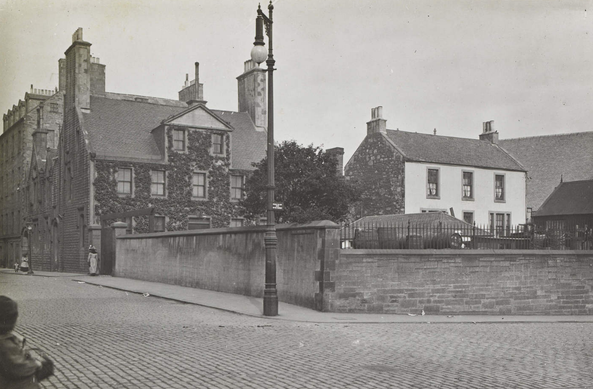
The Pear Tree House in 1905, “the” tree is on the left of the shot. photography by A. H. Baird. © Edinburgh City Libraries

The Ushers, who gave their name to the concert hall, were an Edinburgh brewing and distilling dynasty. They donated c. £13 million in today’s money to build the hall, and its internal dome is reputed to be modelled on the one at the top of the stairs in the Pear Tree House. Andrew Usher (senior) was a brewer and for a time in the mid-19th century, they used the house as such. However it was with whisky and distilling where they really made it big. Usher pioneered blending malt with grain whisky; his son Andrew (junior) made a fortune in this business and in 1885 – along with John “Green Ginger” Crabbie and William “VAT69” Sanderson – founded the North British Distillery at Gorgie. This is one of the biggest and most successful vertical column grain distilleries and is still going strong.

A photo of the Pear Tree during the Usher’s days, 1905. The front wall is being rebuilt. The eponymous tree can clearly be seen. The house is the neighbour of the Pear Tree House and the bulk of the Buccleuch Free Church towers behind. © Edinburgh City Libraries

When the brewery outgrew the house, it moved nearby to St. Leonards at the Park Brewery, with the house used as offices, storage and distribution. In 1918, Usher’s whisky business was acquired by the Distillers Company Limited (DCL) and formed into Scottish Malt Distillers, DCL’s lowland whisky operation. The house passed to a subsidiary, J. & G. Stewart, another long-established Edinburgh whisky name and responsible for Stewart’s Cream of the Barley. It became known locally as The House of Stewart.

The Pear Tree, the Pear Tree House and its neighbour, in 1912. © Edinburgh City Libraries

When Stewarts moved to Leith in 1972, the house was shut up and abandoned behind its courtyard wall. It was mooted for a potential site of the City Arts Centre, but in 1976 it was restored for use as a pub with the courtyard becoming a beer garden. It took its modern name from an old pear tree growing in the corner of the courtyard.

The Edinburgh and Leith themed Twelve Days of Christmas continues with a thread about The Lochend Dovecot.

Note to readers: unfortunately in April 2026, a third-party plug-in more than exceeded its authority and broke many of the image links on this site. No images were lost but I will have to restore them page-by-page, which may take some time. In the meantime please bear with me while I go about rectifying this issue.

If you have found this site useful, informative or amusing then you can help contribute towards its running costs by supporting me on ko-fi. This includes my commitment to keeping it 100% advert and AI free for all time coming, and in helping to find further unusual stories to bring you by acquiring books and paying for research.
Or please do just share this post on social media or amongst friends and like-minded people, sites like this thrive on being shared.

Explore Threadinburgh by map:

Travelers' Map is loading...
If you see this after your page is loaded completely, leafletJS files are missing.

These threads © 2017-2026, Andy Arthur.

NO AI TRAINING: Any use of the contents of this website to “train” generative artificial intelligence (AI) technologies to generate text is expressly prohibited. The author reserves all rights to license uses of this work for generative AI training and development of machine learning language models.

#Lochend #Logan #Restalrig #StMargaret
A seasonal treat for the urban poor: the thread about Scotland’s New Years steak pie tradition

With the filling for the obligatory Ne’erday steak pie doing its thing in the slow cooker, it inevitably leads to the question of how such a pie should properly be flavoured. Should it have any herbs and spices beyond salt and pepper? A bit red wine or ale perhaps? A few drops of Worcester sauce? And more intriguing for me than the finer points of the recipe, what are the origins of this seasonal pie tradition in Scotland? Let’s try and find out, shall we?

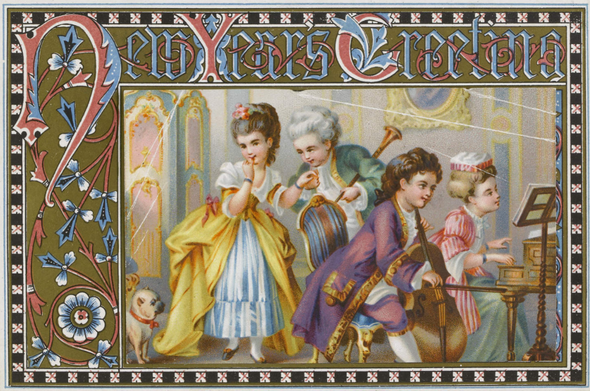
1870 New Year’s Greeting postcard, from the collection of the Stirling-Home-Drummond-Moray family. © Edinburgh City Libraries

There’s a syndicated short story entitled How Shall I hold New-Year’s Day which was printed across Scottish newspapers on the Boxing Day 1851 which discusses new year traditions and in which a “beef steak pie” features. The story takes the form of a conversation between two working class men – Jock and Bob – on their plans for the season and it’s quite obviously the work of the Temperance movement. Jock, the man with the pie, intends not to drink any whisky and instead to spend his time with his family enjoying the fruits of his abstemiousness. Instead of his usual parritch (porrdige) he is having a feast of ham, eggs, hot rolls, cheese, currant buns and “tea along with the elders” for Hogmanay. Bob’s plans, in contrast, mainly involve whisky. Come the morning of the 1st, Bob will have argued with his family and be left with his hangover. But canny Jock has the benefit of his “rest and sobriety of the previous night” and will take his children out to the toy shop, then come home to his pie, followed by a sing-along with invited friends and the treat of fresh fruit. All very sober! An interesting point noted by Jock is that while his wife has “made” the pie, it was “covered and baked by the baker the previous night“; most people would not have had a home oven that could have baked such a pie, so they would take their filling in a dish to their baker who would cook it in the bread oven. The pie could then be reheated atop the range on the girdle (griddle).

This was the earliest mention of steak pie at New Year that I could find in Scottish newspapers. However the phrase comes up again and again (and again!) over the next 60 or so years of press in one specific context; feeding the poor at new years and (later) Christmas. In January 1863, the Glasgow Herald reported that the inmates of the Paisley Abbey Poorhouse had been treated to an “excellent beef-steak pie” and oranges by the benevolent committee of the parish poor board. In 1876, the Edinburgh Evening News similarly describes the inmates of the City Poorhouse at Craiglockhart had gotten their “usual new year’s treat” of “excellent soup, beef-steak pie and pudding“. Those in St. Cuthbert’s Poorhouse were in contrast served a mutton pie, plum pudding, currant loaf and jugs of beer.


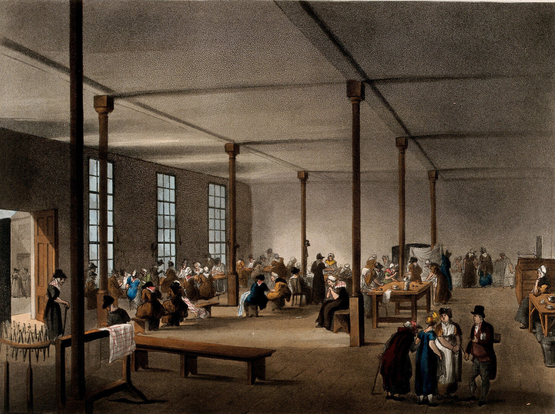
“The Workhouse” – the austere, regimented interior of Poland Street workhouse in Soho. Aquatint by T. Sunderland from 1809. PD via Wellcome Collection

Craiglockhart was still serving New Year steak pie in 1893, but the soup had by this time been downgraded from excellent to mere potato. In 1898, the Evening News reported that an injunction of the Local Government Board had prevented the Parish Board from financing any “special entertainments during the festive season” at the poorhouses from their own funds and these instead had to be met by private benevolence. Fortunately £70 was provided by Alexander Oliver Riddle (or Riddell) of neighbouring Craiglockhart House, a whisky magnate in the distilling firm of Usher & Co. and the inmates of the poorhouses still got their roast beef and mutton “along with a steak pie and fruit“. The men were provided with a treat of an ounce of tobacco, the women got a similar weight in snuff and the children the same but in sweets. A. Oliver Riddle continued to fund the Craiglockhart New Year steak pie dinner thereafter and in 1902 645 mouths were fed. By 1907 times had changed slightly and the women were being provided with sweets instead of snuff. Craigleith seems to have lacked such a sponsor however and the inmates instead were getting a dinner of coffee, bread and butter, soup and mince – all washed down by a visit from local councillors.

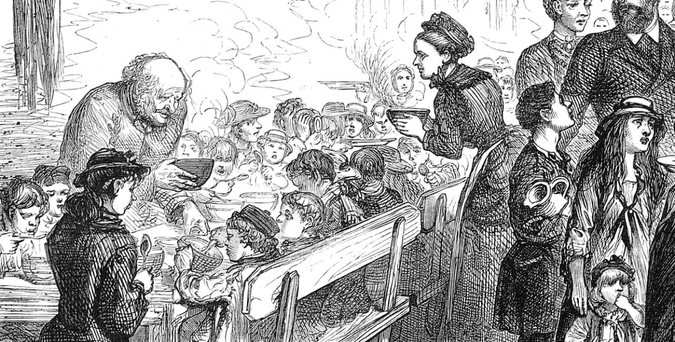
Feeding the poor in a Victorian workhouse. Image via National Archives website.

It wasn’t just the poorhouses providing New Year steak pie; The Scotsman in 1896 reported that it was the custom in Glasgow for the merchants of the Royal Exchange to fund a steak pie and potato dinner for the poor, held at the City Chambers. This dinner had by 1905 shifted to Christmas Day at which time 3,000 people got their lunch, but had in turn to suffer a lecture from Lord Provost Bilsland about knowing their place and being grateful for philanthropy. It was noted at this time that the tradition was now 36 years old. Similarly in Edinburgh, in 1904 Lord Provost Sir Robert Cranston (noted champion of Temperance) put on a New Year steak pie dinner for 1,000 of the city’s poor at the Grassmarket Corn Exchange; but it had to be held on January 2nd as a bird show had the venue booked on the 1st!

“Grassmarket – south side, old Corn Exchange” J. C. McKenzi photograph of 1913 © Edinburgh City Libraries

In 1910, the Home for Aged Women in Portobello served a Christmas Day dinner – provided by a Mrs Sellar – of steak pie, plum pudding and fruit, and a New Year’s Day “godly repast” of roast mutton, pudding, jellies, meringues and sweets provided by Mrs Durham and Miss Scott Moncrieff. When Edinburgh wine importer William Crambe Reid died in February 1922, £68,000 of his £184,000 fortune was left to good causes in the city. The interest on one benefaction went to providing an annual Christmas meal for 4-500 of the city’s poor; the “William Crambe Reid Dinner“. The inaugural menu had soup, haggis and mashed potatoes, steak pie, vegetables, more potatoes, plum pudding and fruit. In North Leith Parish, a bequest of property by a Mr Neill paid a £51 annual profit on rents that was still providing such a meal on New Year’s Day as late as 1938.

But what of the actual pies themselves? What were people being actually eating ? We can get an early recipe for a Scottish steak pie from the book “Cookery and Pastry as taught and practised by Mrs Maciver, Teacher of those Arts in Edinburgh“. Susanna Maciver was one of Scotland’s first cookery teachers and published a cookery manual in Edinburgh around 1777. Her steak pie is very different to what we might have today; it was made from alternating strips of lean and fatty beef that had been cut into thin slices and then beaten thinner, much like a schnitzel before it was “seasoned with salt and spices” (she doesn’t say what spices, sadly.) These strips were rolled up into “ollops” (or collops, i.e. like beef olives), packed into a dish with some water, covered in puff pastry and baked.

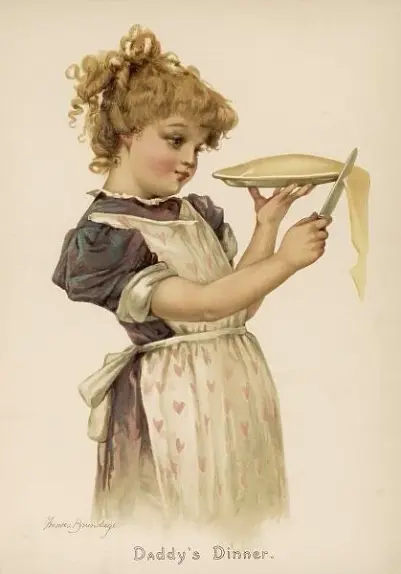
1890 postcard of a girl preparing a pie

The Cook and Housewife’s Manual etc. by Margaret Dods (actually a pseudonymous collaboration between Isobel Christian Johnston and Walter Scott) of 1826 gives fundamentally the same collop-style pie but adds gravy instead of water and the optional taste of some onions. What is much more interesting is that the book also suggests you can add a catsup (a preserved mushroom sauce), cut pickles, “other seasonings“, oysters and/or forcemeat balls (balls of minced offal and breadcrumbs). In February 1882, a Lady Correspondent submitted a recipe to the Dundee Evening Telegraph for a steak pie. It was made with 1lb of fillet steak which was cut thin, layered with oysters and flavoured with mace, walnut ketchup, port, lemon peel, gravy, salt and pepper. The same paper provided a different recipe in 1884, which was made with shoulder steak and included two kidneys “to enrich the sauce“. No mention was made of spices or other flavourings. The most unusual aspect of this pier was that it was served along with a side dish of macaroni cheese (which was actually made with spaghetti!). In 1892, the Aberdeen People’s Journal gives a recipe by a correspondent called Wiganer made from 2lb steak, 1/4lb kidney, salt and pepper with the meat diced up into chunks (rather than strips or collops) as would be recognisable now. The filling was cooked in the dish then covered in a lard shortcrust pastry and returned to the oven.

Serving a pie to children, from “A Apple Pie” of 1886, by Victorian illustrator Kate Greenaway

Economy steak pie recipes were published in the papers in WW1; the Dundee People’s Journal has one made from much cheaper meat – 1½lb of beef hough (shin) – which had to be boiled for 90 minutes before mixing with an instant gravy and boiled again with salt and pepper before it could be topped with pastry. And in 1917, as a reflection of how bad the food supply situation was getting, the Arbroath Herald has a recipe where sliced potatoes are used to bulk out the meat (which was itself a 2:1 ratio of beef and kidneys) and which was topped with a pastry that was ¾ mashed potatoes. This recipe used margarine or butter in the pastry – but things were so dire in January 1918 that the Food Control Committee published a recipe in newspapers for “potato butter“. This awful-sounding ersatz butter was fundamentally real butter that was stretched out by mixing it with boiled and sieved potatoes, dying it with butter colouring, preserving it with butter preservatives and setting it again in pats.

There are an infinite number of genuine and authentic and traditional Scottish steak pie recipes that you can find in cookery books and blogs. In the book “A Scottish feast : an anthology of food and eating” published in 1996, the food writer Catherine Brown gives a recipe for such a pie that attempts to meet the steak pie yardstick of Mr Glasgow (writer, broadcaster, bon viveur and foot critic Jack House) – which was the steak pie served in the Boulevard Hotel in Clydebank! This is an intersting hybrid of older pie recipe techniques, with the meat again beaten thin, but wrapped around pieces of kidney and sausage. It was thoroughly modernised however with the addition of ground clove, chopped parsley and marjoram and mushrooms. The addition of mushrooms was not just for flavouring purposes, but to form a barrier to hold the pastry off of the filling and prevent a “soggy bottom” forming on the pastry lid (which is personally my favourite part of the pie!). In reality, there is no one, authentic Scottish New Years steak pie recipe, beyond the one that you choose to enjoy on that day.

Note to readers: unfortunately in April 2026, a third-party plug-in more than exceeded its authority and broke many of the image links on this site. No images were lost but I will have to restore them page-by-page, which may take some time. In the meantime please bear with me while I go about rectifying this issue.

If you have found this site useful, informative or amusing then you can help contribute towards its running costs by supporting me on ko-fi. This includes my commitment to keeping it 100% advert and AI free for all time coming, and in helping to find further unusual stories to bring you by acquiring books and paying for research.
Or please do just share this post on social media or amongst friends and like-minded people, sites like this thrive on being shared.

Explore Threadinburgh by map:

Travelers' Map is loading...
If you see this after your page is loaded completely, leafletJS files are missing.

These threads © 2017-2026, Andy Arthur.

NO AI TRAINING: Any use of the contents of this website to “train” generative artificial intelligence (AI) technologies to generate text is expressly prohibited. The author reserves all rights to license uses of this work for generative AI training and development of machine learning language models.

#Lochend #Logan #Restalrig #StMargaret
It's world 🌍 #TCOkafor Day 🍿🍾🎈🎉

Happy birthday, #TCOkafor #nollywood 🎉🎈 🍿🍾🍬🥧 May heaven's celebrate with you #nollywoodcelebrities 🍬🥧🎀
#birthdaycelebration #birthday #Bahdlexbirthday #December25th #december25 #bahdlex #birthdaywishes #bahdlexempire #HBD

It's world 🌍 #rubyojiakor Day 🍿🍾🥂🎉🎀

Happy birthday, #RubyOjiakor #nollywood 🎉🎈
‼️May heaven's celebrate with you #nollywoodcelebrities 🍬🥧🎀
#birthdaycelebration 🎉🎀 #birthday #Bahdlexbirthday #December25th #december25 #bahdlex #birthdaywishes #bahdlexempire #HBD

🎄✨ On December 25th, cultures across history marked renewal and light. Romans celebrated Saturnalia, early Christians embraced it as the birth of Christ, and communities worldwide continue to shape its meaning. A day where history and tradition meet in shared celebration.

#December25 #CulturalHistory #SharedTraditions

This Christmas, find the love that lasts forever 🎄

Begin your beautiful journey with Dhakad Matrimony.
Because the best gift is a perfect life partner 💍🎄

🔗https://zurl.co/jDOQi

#MerryChristmas2025 #DhakadMatrimony #ChristmasVibes #christmas #merrychristmas #christmastree #christmasdecor #xmas #christmastime #love #winter #natale #christmasgifts #handmade #santa #family #december25 #santaclaus #gifts #christmaslights Christmas2025 #WeddingGoals #FindYourMatch #NewBeginnings

Ho ho ho our Christmas single is here. This year we covered “December 25” by the Canadian power-pop institution,
Sloan!! 🎅🏻🤘 Please enjoy and share frequently!

https://faircamp.snapinfraction.com/december-25/

#december25 #christmassong #newmusic #faircamp #powerpop #sloanmusic

December 25

December 25