#OxLancs2026
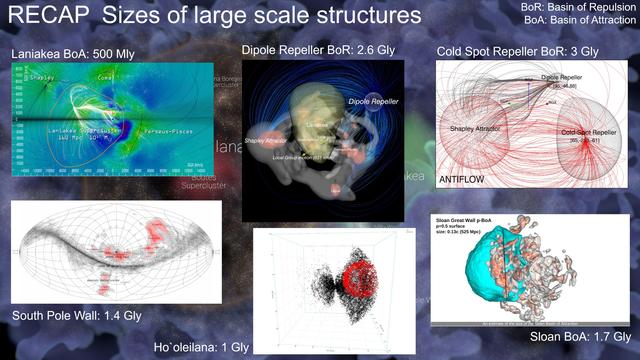
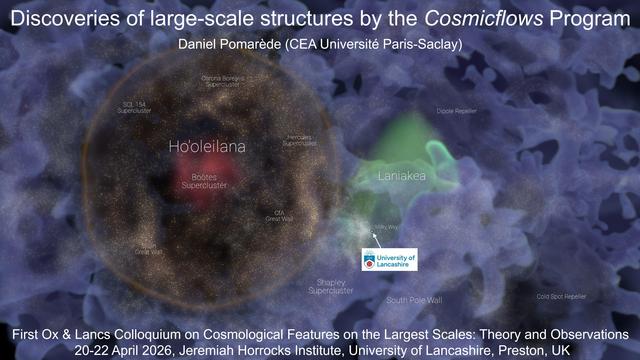
Final slide of my talk this morning at the First Ox & Lancs Colloquium on Cosmological Features on the Largest Scales, held at the University of Lancashire: a recap of the discoveries of the Cosmicflows program.
https://www.star.uclan.ac.uk/ox-lancs-2026/
#Cosmology #Laniakea #DipoleRepeller #ColdSpotRepeller #SouthPoleWall #Hooleilana #SloanBasinOfAttraction #cosmography #cosmicflows #astrodon
#OxLancs2026
Preparing my talk for the 1st Ox & Lancs Colloquium on Cosmological Features on the Largest Scales at U. of Lancashire. Highlight of the meeting: a talk by Sir Roger Penrose (Nobel Prize 2020) on "Dark matter in Conformal Cyclic Cosmology and Lopez Galactic Rings".
https://www.star.uclan.ac.uk/ox-lancs-2026/
#Cosmology #OxLancs #science #conference #Oxford #Lancashire #university #universities #ULancs #astrodon #astronomy #astrophysics #cosmicflows #Hooleilana #Laniakea #supercluster #galaxies

Hidden Vela Supercluster Revealed by First Hybrid Redshift & Peculiar Velocity Reconstruction
A large fraction of the extragalactic sky is obscured by foreground dust and stars along the plane of the Milky Way, leaving a major gap (~ 20%) in whole-sky maps of large-scale structures -- an incompleteness that is even more severe for peculiar velocity samples. This has long limited an unambiguous interpretation of observed cosmic flows and their connection to the underlying mass-density field.
We present a new hybrid reconstruction methodology which combines 65,518 galaxy peculiar velocity distances from the CF4++ catalogue (Courtois2025) with 8283 new galaxy redshifts observed near the southern Galactic plane (|b| <= 10 degrees) Zone of Avoidance. A major advance is the inclusion of 2176 high-sensitivity, interferometric HI redshifts obtained with the SARAO MeerKAT telescope which for the first time provide coverage of the innermost 3degrees-wide strip of the southern ZOA and to unprecedented depth.
This hybrid redshifts & peculiar velocities approach yields a substantially revised view of the inferred overdensities in and around the ZOA. In particular, the Vela supercluster emerges as a dominant mass concentration, rivaling the Shapley concentration and exceeding the mass associated with Laniakea and the Great Attractor region. With a total mass of 33.8 10^16 Msol, a characteristic radius of 70 hmpc, and a double core morphology at a distance of 189 hmpc, Vela dominates the mass budget and gravitational influence of the southern Zone of Avoidance. These results provide the most complete and dynamically consistent picture to date of the southern Zone of Avoidance and demonstrate the transformative potential of hybrid reconstruction techniques tailored for the next generation of large-scale surveys.
Constraining cosmological simulations with peculiar velocities: a forward-modeling approach
by Aurélien Valade and co-authors
https://arxiv.org/abs/2602.03699
#Cosmology #Cosmicflows #galaxies #astronomy #astrophysics #astrodon #science #news #simulation
Cosmography alert 🚨
How well is the local Large Scale Structure of the Universe known? CosmicFlows vs. Biteau's Galaxy Catalog with Cloning
by Yifei Li and Glennys Farrar
https://arxiv.org/abs/2601.20808
#Cosmology #Cosmicflows #Cosmography #Universe #Astrodon #Astronomy #Astrophysics #cosmicrays #science #news #arXiv

How well is the local Large Scale Structure of the Universe known? CosmicFlows vs. Biteau's Galaxy Catalog with Cloning
Knowledge of the actual density distribution of matter in the local universe is needed for a variety of purposes -- for instance, as a baseline model for ultrahigh energy cosmic ray sources in the continuum limit and for predicting the diffuse Dark Matter annihilation signal. Determining the local mass density and velocity distribution is the aim of the CosmicFlows project. An alternate approach is based on catalogs of galaxies, supplemented with some scheme for filling in for unseen galaxies. Here, we compare the density field proposed by Biteau (2021) with the quasi-linear density field of CosmicFlows2 (Hoffman et al. 2018) and the mean posterior field of CosmicFlows4 (Valade 2026). We find factor-two level differences in some regions and even greater in regions toward the Galactic center zone of avoidance (ZoA) (|l| < 30°, |b| < 20°) as filled by Biteau using "cloning". Within 11 Mpc the density field is well-determined by the Local Volume catalog (Karachentsev et al. 2018) which Biteau directly incorporates; at larger distances, Biteau (2021) should not be used in the ZoA where "galaxies" are entirely fictitious but otherwise is to be preferred over CosmicFlows emphasizing the direction and integrated mass of structures; the radial distribution of mass in Biteau (2021) is less robust due to line-of-sight peculiar velocities. The angular positions of structures in CosmicFlows are sometimes not congruent with evidence in the galaxy catalog.
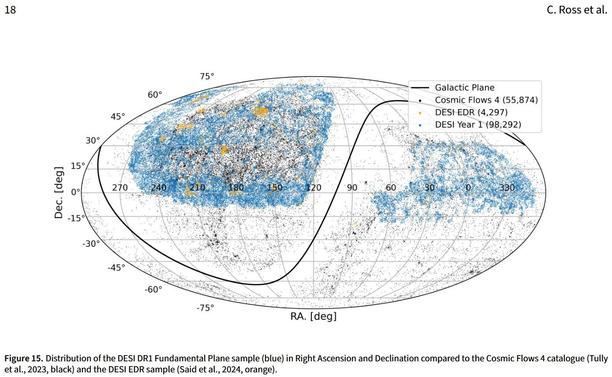
Wow 98,000 peculiar velocities
The DESI DR1 Peculiar Velocity Survey: Fundamental Plane Catalogue
by C.E. Ross and co-authors
https://arxiv.org/abs/2512.03226
For comparison: the Great Attractor was discovered with 400 PVs, Laniakea with 8000 PVs, South Pole Wall with 18,000 PVs
#Cosmicflows #Cosmology #DESI #Laniakea #GreatAttractor #SouthPoleWall #science #news #astrodon #arXiv #galaxies #peculiarvelocities
in the #arXiv
Revealing Hidden Cosmic Flows through the Zone of Avoidance with Deep Learning
by Alexandra Dupuy and co-authors
https://arxiv.org/abs/2511.03919
#Cosmology #Cosmicflows #GreatAttractor #Laniakea
in the #arXiv
Prior-free cosmological parameter estimation of Cosmicflows-4
The analysis suggests a Hubble constant value of 75.8±0.4 km/s /Mpc, exacerbating (or independently confirming) the existing "Hubble Tension".
by Chaimongkol Duangchan and co-authors
https://arxiv.org/abs/2507.22236
#Cosmology #Cosmicflows #HubbleConstant #HubbleTension #Astrophysics #Astrodon #galaxies #physics #science
Prior-free cosmological parameter estimation of Cosmicflows-4
As tracers of the underlying mass distributions, galaxies' peculiar velocities are valuable probes of the Universe, allowing us to measure the Hubble constant or to map the large scale structure and its dynamics. Yet, catalogs of peculiar velocities are noisy, scarce and prone to various interpretation biases. We aim to measure the bulk flow and the Hubble constant directly from the largest available sample of peculiar velocities, and without imposing a cosmological prior on the velocity field. To address these issues, we analyze the Cosmicflows-4 catalog, the most extensive catalog of galaxy peculiar velocities, reaching a redshift $z=0.1$. Specifically, we construct a forward modeling approach assuming only a flat Universe, which reconstructs the radial and bulk flows of the velocity field directly from measurements of peculiar velocities. Our method accurately recovers cosmological parameters within a radius of $120\ \mathrm{Mpc/h}$ that can then be compared with the predictions from $Λ{\rm CDM}$. Apart from a $3σ$ tension with $Λ{\rm CDM}$ on the magnitude around $120\ \mathrm{Mpc/h}$ associated with a $4σ$ tension on the supergalactic $X$ direction, we find a general agreement between the standard model and the observations. Lastly, our analysis suggests a Hubble constant value of approximately $75.8\pm0.4\ \mathrm{km/s/Mpc}$, exacerbating (or independently confirming) the existing ``Hubble tension", however, for the first time accomplished with the largest set of peculiar velocities in existence.

The Unapologetic Vatican in the Shapley Supercluster
In 1992, the Vatican admitted that Galileo Galilei was right and the Earth is not at the center of the Universe. This was a bit late, 350 years after Galileo died and 33 years after humans landed on…
On my way to the Cosmic Flows 2025 Conference, that is going to be held at Tamborine Mountain near Brisbane, in Australia.
https://indico.global/event/12931/ #cosmicflows2025
This is my first conference in 5 years - last one was the AAS235 in Honolulu back in January 2020, before the Covid crisis...
#Cosmology #Cosmicflows #Conference #Astronomy #Astrophysics #Astrodon #Science #STEM #Australia #Queensland #Brisbane #Tamborine #Mountain #TamborineMountain
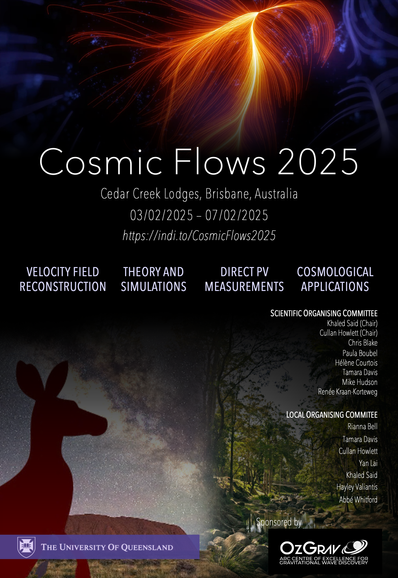

Cosmic Flows 2025: Probing the Universe with Peculiar Velocities
Join us for the next instalment in the prestigious Cosmic Flows conference series, to be held from February 3-7, 2025, all-inclusive at the picturesque Tamborine Mountain Glades (formerly Cedar Creek Lodges) on Tamborine Mountain, Brisbane, Australia. About the Conference Cosmic Flows 2025 continues a two-decade tradition of international gatherings dedicated to the study of cosmic flows. Following successful events in Queensland (2012), Marseille (2013), Quy Nhon (2016), and Cape Town...
 Daniel Pomarède