Weekly Update from the Open Journal of Astrophysics – 02/05/2026
Here we are, on schedule, with another update of activity at the Open Journal of Astrophysics. Since the last update we have published a further seven papers, bringing the number in Volume 9 (2026) to 94 and the total so far published by OJAp up to 542. I checked the corresponding update for last year (on 3rd May 2025), and we’ve had an increase from 54 to 94 in papers published (about 74%) between the first four months of 2025 and the first four months of 2026.
I will continue to include the posts made on our Mastodon account (on Fediscience) to encourage you to visit it. Mastodon is a really excellent service, and a more than adequate replacement for X/Twitter (which nobody should be using); these announcements also show the DOI for each paper.
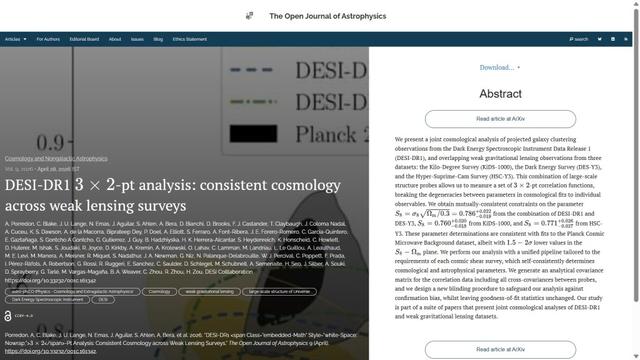
The first paper to report this week is “DESI-DR1 3 × 2-pt analysis: consistent cosmology across weak lensing surveys” by Anna Porredon (CIEMAT, Madrid, Spain) and 72 others (DESI Colllaboration). This paper was published on Tuesday 28th April in the folder Cosmology and Nongalactic Astrophysics. This paper presents a joint cosmological analysis of galaxy clustering and gravitational lensing observations, providing consistent constraints on cosmological parameters. The analysis also introduces a new blinding procedure to prevent confirmation bias. See this post for news of an important DESI milestone.
The overlay for this paper is here
You can find the officially accepted version on arXiv here and the announcement on Fediverse here:
https://fediscience.org/@OJ_Astro/116480407578621011
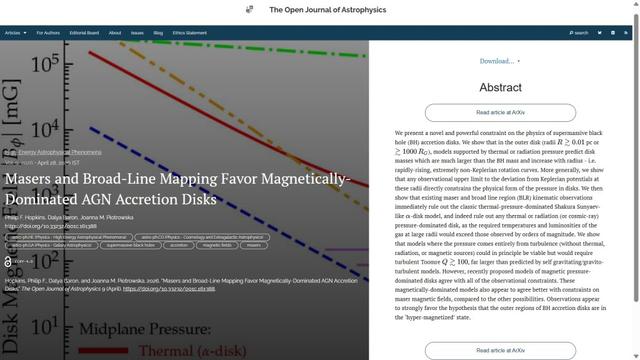
The second paper for this week, also published on Tuesday 28th April but in the folder High-Energy Astrophysical Phenomena is “Masers and Broad-Line Mapping Favor Magnetically-Dominated AGN Accretion Disks” by Philip F. Hopkins (Caltech, USA), Dalya Baron (Stanford U., USA) and Joanna M. Piotrowska (Caltech). This one presents a new constraint on supermassive black hole accretion disks physics, suggesting that outer regions are likely in a ‘hyper-magnetized’ state, as thermal or radiation pressure models appear inconsistent.
The overlay for this one is here:
The official version of the paper can be found on arXiv here and the Fediverse announcement here:
https://fediscience.org/@OJ_Astro/116480505354195181
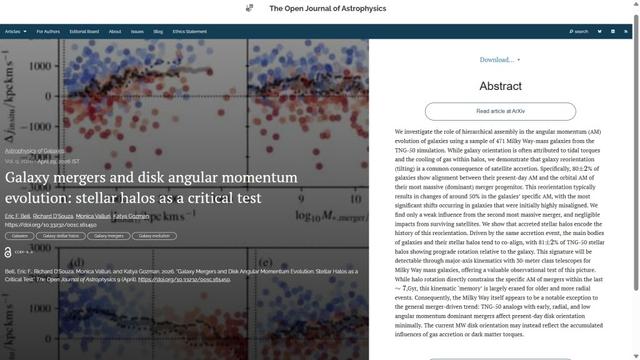
Next one up, the third paper of the week, is “Galaxy mergers and disk angular momentum evolution: stellar halos as a critical test” by Eric F. Bell (U. Michigan, Ann Arbor, USA), Richard D’Souza (Vatican Observatory), Monica Valluri & Katya Gozman (U. Michigan). This was published on Wednesday 29th April in the folder Astrophysics of Galaxies. The paper argues that satellite accretion impacts the angular momentum evolution of galaxies, often causing significant reorientation. This process is detectable in Milky Way-mass galaxies so the idea is testable observationally.
The overlay for this one is here:
The final, accepted version can be found on arXiv here and the Mastodon announcement is here:
https://fediscience.org/@OJ_Astro/116486649450860283
The fourth paper this week, published on Thursday April 30th, is “Time-Dilation Methods for Extreme Multiscale Timestepping Problems” by Philip F. Hopkins and Elias R. Most (Caltech, USA). This paper is in the folder Instrumentation and Methods for Astrophysics: it presents a new method for astrophysical simulations that modulates time evolution with a variable dilation/stretch factor, improving efficiency and accuracy in modeling processes across different scales.
The overlay is here:
The finally accepted version of this paper can be found here and the Mastodon announcement follows:
https://fediscience.org/@OJ_Astro/116492226856595031
The fifth article of this week was also published on Thursday 30th April, but in the folder Astrophysics of Galaxies. The title is “Cosmic Rays on Galaxy Scales: Progress and Pitfalls for CR-MHD Dynamical Models” and the author is Philip F. Hopkins (Caltech, USA) who has three papers featured this week. The paper presents an overview of cosmic ray (CR) modeling, highlighting its influence on galactic physics and star formation. It addresses previous modeling errors and presents new methods for full-spectrum dynamics.
The overlay is here:
You can find the authorized version of this paper on arXiv here and the Fediverse announcement is here:
https://fediscience.org/@OJ_Astro/116492282488422075
The sixth paper of the week is “Baryonification III: An accurate analytical model for the dispersion measure probability density function of fast radio bursts” by MohammadReza Torkamani (Universität Bonn, Germany) and 8 others based in Germany, Switzerland, UK and Sweden. This article was also published on Thursday April 30th in the folder Cosmology and Nongalactic Astrophysics. It presents a framework for predicting dispersion measures of fast radio bursts using the baryonification model, providing a cost-effective alternative to hydrodynamical simulations. The model’s accuracy is validated through full numerical simulations. The overlay is here:
You can find the officially-accepted version on arXiv here and the Mastodon announcement here:
https://fediscience.org/@OJ_Astro/116492403170125062
Seventh and finally for this week we have “The stellar and dark matter distributions in early-type galaxies measured by stacked weak gravitational lensing” by Momoka Fujikawa and Masamune Oguri (Chiba University, Japan). This study uses weak gravitational lensing to investigate stellar mass and dark matter density in red galaxies, suggesting a stronger feedback effect than current simulations predict. This was published on Friday 1st May 2026 in the folder Astrophysics of Galaxies. The overlay is here:
You can find the officially-accepted version on arXiv here and the Fediverse announcement is here:
https://fediscience.org/@OJ_Astro/116497987401632687
And that concludes this week’s update. I’ll do another one at the end of next week. Will Vol. 9 have reached a hundred by then?
P.S. Just a reminder that, thanks to the efforts of a member of our Editorial Board, the Open Journal of Astrophysics now has a Wikipedia page.
#32PtAnalysis #ActiveGalacticNuclei #AGN #arXiv250907104v2 #arXiv251009756v2 #arXiv251209342v2 #arXiv251215960v3 #arXiv260106253v2 #arXiv260118784v2 #arXiv260424965v1 #AstrophysicsOfGalaxies #baryonification #ComputationalAstrophysics #cosmicRays #CosmologyAndNonGalacticAstrophysics #DarkEnergySpectroscopicInstrument #DESI #DiamondOpenAccess #DiamondOpenAccessPublishing #DispersionMeasures #fastRadioBursts #galacticCosmicRays #galaxyEvolution #galaxyFormation #galaxyMergers #HighEnergyAstrophysicalPhenomena #InstrumentationAndMethodsForAstrophysics #magnetohydrodynamics #masers #MilkyWay #OpenAccess #OpenAccessPublishing #SolarAndStellarAstrophysics #SolarCorona #supermassiveBlackHoles #VeraCRubinObservatory #weakGravitationalLensing #wikipedia BGDon 🇨🇦 🇺🇸 👨💻
 Daniel Fischer
 Daniel Pomarède
 Mashable India [Unofficial]

 In the Dark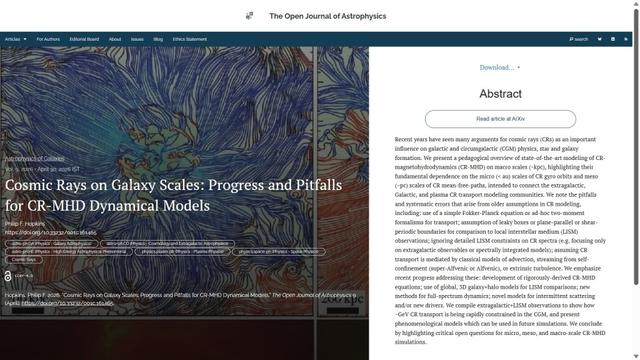
 AlcorNews
 AlcorNews