The next #RESQUE consultation hour:
17th of June, 9-10am CEST
https://www.resque.info/news/2026-06-01-consultation%20hours.html

The Research Quality Evaluation (RESQUE) framework provides recommendations for responsible #ResearchAssessment for hiring and promotion in #psychology
www.resque.info

The session will also highlight specific topics such as applying RESQUE in #ClinicalPsychology with the clinical expansion pack.

See also previous post for more links and info:
https://mastodon.social/deck/@jrboehnke/116652740649620274

#ECRs #OpenScience #CoARA #sfDORA

RESQUE Consultation Hours – The RESQUEFramework

📢 Published

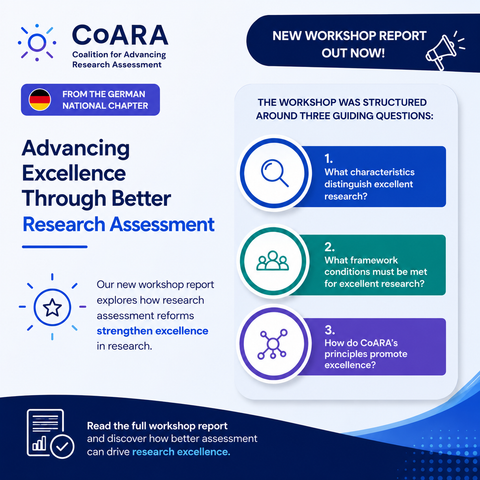
German #CoARA National Chapter Workshop Report
on the connection between #ResearchAssessment reforms and #excellence in research

👉 EN: https://doi.org/10.5281/zenodo.20348689
👉 DE: https://doi.org/10.5281/zenodo.20348630

@CoARAssessment @DORAssessment #DORA #OpenScience

Another opportunity to work w #RESQUE

The Research Quality Evaluation framework provides recommendations for responsible research assessment beyond typical metrics for hiring and promotion in #psychology:
www.resque.info

Maybe of interest for other areas as well?

#CoARA #DORA #ResearchAssessment

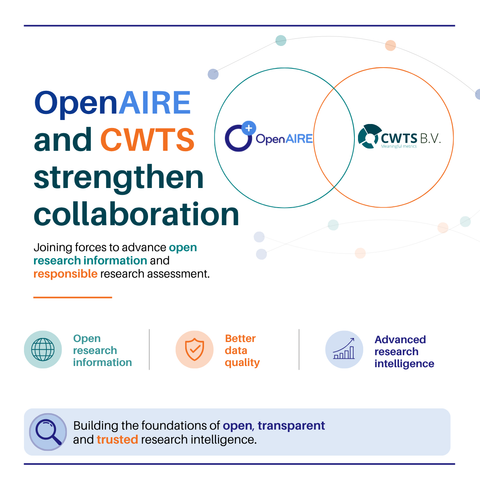
Research intelligence shapes funding, policy, and careers.
That means the systems behind it should be open, transparent, and aligned with public values.
OpenAIRE and CWTS are strengthening their collaboration to:
🔹 improve the quality of open research information
🔹 move from proprietary to open research intelligence
🔹 develop trusted, community-governed analytics
🔗 https://www.openaire.eu/cwts-and-openaire-strengthen-collaboration
#OpenScience #ResearchIntelligence #OpenInfrastructures #CoARA

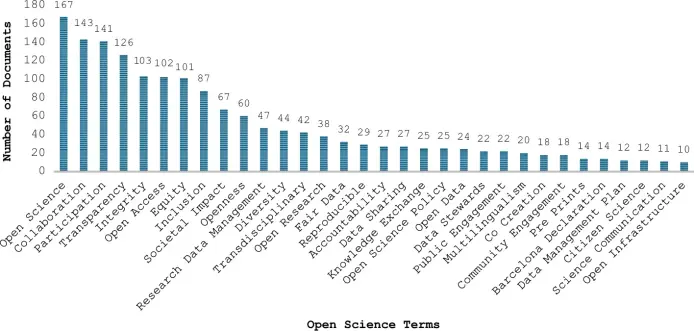
A new study analysing 248 CoARA action plans suggests that many organizations still treat Open Science more as a set of values than as concrete research practices.

 https://doi.org/10.1007/s11192-026-05650-w

Open Access remains the dominant and most institutionalized form of Open Science, appearing in 41% of plans. Meanwhile, key UNESCO-promoted practices such as Open Evaluation or Open Methods are barely mentioned at all.

#OpenScience #CoARA #ResearchAssessment #OpenAccess

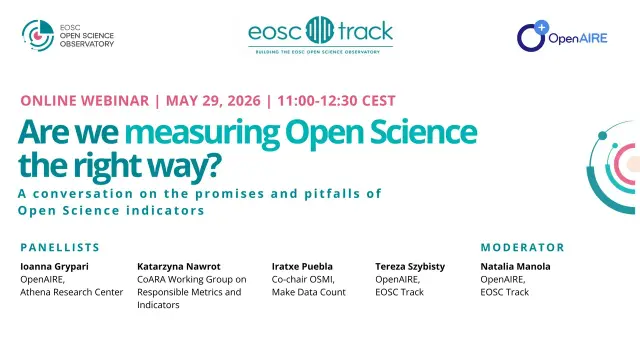
Are we measuring Open Science the right way? 🔍
Indicators shape incentives, researcher behaviour, and funding decisions – so getting them right matters.
Join OSMI Co-chair Iratxe Puebla & other experts at a free EOSC Track webinar:
📅 29 May 2026 | 11:00–12:30 CEST
🔗 https://eu01web.zoom.us/webinar/register/WN_wMKgM2QwR-SC622nths_gg#/registration
Especially relevant for research policy makers, funders, #CoARA & #EOSC communities.
#OpenScience #OSMI #ResponsibleMetrics #ResearchReform

#CoARA, #DORA etc. want to (rightfully) broaden the evaluative criteria for academic performance - to not just reward the quantity of publications (which led to paper mills and fake publications that you can buy).

See Goodhart's law in action: Now academics can also buy patents:

"Patents, like peer reviewed publications, look impressive in CVs, and many institutions reward them. [...] A research team with lead at Northwestern University in the United States reports a new type of academic fraud: fake patents. They have found multiple companies which sell credits on UK registered designs to academics, mostly in India, who can use them to boost promotion scores and institutional rankings."

 https://zenodo.org/records/14889136

Found on Sabine Hossenfelder’s blog: https://sabine.beehiiv.com/p/patent-fraud-a-record-battery-satellite-pollution-and-energy-from-the-vacuum

#ResponsibleResearchAssessment

Exploitation of intellectual property systems for the manipulation of academic reputations

Patents are sought by academics and their institutions to protect their inventions. Academics also seek patents to enhance their individual profile and status for the purpose of job and promotion opportunities. Some institutions recognize the awarding of a patent to an individual academic as equivalent to or sometimes greater than publication in an international peer-reviewed journal. This article addresses the concerning development of patent inventorship credit being offered for sale by established education fraud companies alongside offers for authorship on academic papers and thesis writing. This article focuses on design registration in the United Kingdom (UK) but the issues identified are globally applicable. We characterize in detail the footprint of eight firms that are likely involved in the sale of thousands of UK registered designs to Indian academics for the purpose of academic reputation manipulation. Unlike patents, design registration applications are not examined for novelty or individual character (i.e. for whether the designs are actually new or innovative). Due to this limited examination process, these registrations generally issue quite quickly. We argue that exploitation of intellectual property systems should be considered one facet of the global enterprise of education fraud, alongside essay mills, diploma mills and research paper mills.The authors are grateful to Kendra Albert for their pivotal feedback on this work. RAKR was supported in part by the National Institutes of Health Training Grant [T32GM008449] through Northwestern University's Biotechnology Training Program. RAKR gratefully acknowledges funding from the Dr. John N. Nicholson fellowship from Northwestern University; Moderna Inc., Identifying bias and improving reproducibility in RNA-seq computational pipelines. SSH gratefully acknowledges support from the Ryan Fellowship and the International Institute for Nanotechnology at Northwestern University. This manuscript is now published in the International Journal for Educational Integrity.

Zenodo

@fresseng @juliengossa

Tout à fait ! ... sauf que #DORA / #CoARA reste mal connu des collègues élus ou nommés dans des instances de recrutement, évaluation ou promotion.

Il faut aussi leur proposer des méthodes pour pouvoir faire le travail demandé (qui finit quand même par mettre une relation d'ordre sur un groupe de projets/gens brillants qui font des choses très différentes...) en respectant ces principes.

Ça existe, mais c'est du boulot.

Das #Bundesverfassungsgericht hat die #Zweitveröffentlichungspflicht im Hochschulgesetz BW für nichtig erklärt.

Was bedeutet das für die Steuerung der #OpenAccess Transformation in der Zukunft?

🔍 Ich habe dazu ein paar Gedanken beim @verfassungsblog notiert.

💡 Zentrale These:
Verpflichtende rechtliche Steuerungsmodelle stoßen schnell an kompetenz-, grund- & unionsrechtliche Grenzen.
Ein wirksamer Hebel ist dagegen die Reform der #Forschungsbewertung #CoARA

👉 
https://dx.doi.org/10.59704/e39eae0d69d843a7

Open Access zwischen Zwang und Anreiz


Verfassungsblog

As is the case for nearly all complex systems, changing a process is going to be not only difficult, take a long time but also meet a "chicken & egg" problem (causality dilemma). The goal of science is to create and disseminate knowledge. At least for publicly funded research projects, the deliverables should be publicly available. In the past decade, much progress has been made to reach #openscience, including moving from a closed journals to an "open-access" model (whether it actually reduced the financial burden on organizations is another matter entirely).

In the case of the open science reform, the "chicken & egg" problem asks whether researchers should practice open science first, or should the research ecosystem adopt open science first?
1) With strict resource constraints (time, funding, workforce), researchers don't have time to dedicate to deliverables that don't provide a direct value. The values of open science are laudable, but they are not rewarded. Why would researchers spend time creating and sharing a FAIR dataset when publishing another paper with that time is preferable for career advancement?
2) If the research ecosystem adopts open science (one way or another), e.g., researchers MUST publish code, data, register protocols, etc., then there is a huge non-adoption risk, or even worse a malicious compliance risk. A highly valued right for researchers is their academic freedom. In some ways, project-based funding is already threatening academic freedom, then what would it look like if grant agencies started withholding further funding because they didn't publish X or Y dataset?

In an era and a society where work is often meaningless or people are not convinced by their company's values and purposes, research is probably one of the remaining job where the work is driven by the person themselves. For that reason, the culture is very strong and/or opinionated because people actually like their jobs.

Hidden in the problem above is the interdependency between culture, trust and research reforms. Jonny Coates points many issues in a thoughtful piece [1], including that researchers MUST be at the center of the system reform: "Many reform initiatives are designed for researchers, but not often with them. If open science, assessment reform, and research culture initiatives are to succeed, active researchers need to be more than subjects. They need to be participants in designing the systems they are expected to use.".

[1] https://upstream.force11.org/connecting-reform-movements-linking-research-culture-trust-and-open-research-publishing/

#OpenScience #CoARA #ReformingRA
Connecting reform movements: linking research culture, trust and open-research publishing

Over the past few decades, several reform movements have emerged across scholarly communication and academia. Open science, open access, efforts to reshape research culture, research assessment reform and growing discussions around trust in science are all trying to address genuine problems in how research is produced, evaluated, and communicated. Yet

Upstream