Climate work is entering its AI era.
We are proudly partnering with Kith Climate and Kith AI Labs.
Kith prepares climate professionals to use AI with confidence and impact.
As Ben Hillier, founder of Kith, shares:
“We’ve chosen to partner with GreenPT due to our clear alignment around the value of AI for climate professionals and the need to deploy AI in an environmentally conscious way.”
Together, we combine AI capability with responsible deployment.
Python Trending (@pythontrending)
earth2studio는 AI 기반 기상·기후 워크플로우를 탐색·구축·배포하기 위한 오픈소스 딥러닝 프레임워크로 소개됩니다. 기상·기후 데이터를 활용한 모델 개발과 배포 파이프라인을 지원하는 도구로, 연구자와 엔지니어가 기후 관련 AI 워크플로우를 쉽게 실험·운영할 수 있도록 설계된 프로젝트입니다.

Drought is a disaster that affects everything related to humans, particularly the economy. Therefore, predicting its effects before they occur is crucial. However, due to its nature, droughts are more challenging to detect than other natural disasters. This study aims to investigate the effect of decomposition techniques (VMD, DWT, EMD, and EEMD) on the drought forecasting performance of machine learning methods (network-based: MLP, KAN, RNN, BiLSTM, and BiGRU, as well as tree-based methods: RF, GB, XGB, AB, and M5P) in different climate types. To this end, the Standardised Precipitation Evapotranspiration Index (SPEI), which was calculated using 52 years of precipitation and temperature values from 1969 to 2020 for three meteorological stations in Türkiye with different Köppen-Geiger climate classifications, was employed. Drought predictions were made for three SPEI time scales: 3, 6, and 12 months. The results of the analysis revealed that decomposition increased the power of prediction compared to raw drought data, and VMD was the most effective decomposition technique. For instance, the NSE values, which was approximately 0.5 in SPEI-3, 0.7 in SPEI-6, and 0.9 in SPEI-12, increased to above 0.95 across all time scales following the implementation of the VMD method to different climate types. Besides, MLP, KAN, and M5P proved to be the most effective machine learning methods with this value above 0.98 in all data sets. Performance improved as the time scale increased in recurrent neural network-based methods (RNN, BiLSTM, and BiGRU). Consequently, irrespective of the climate region, models employing the decomposition method (VMD and DWT) exhibited considerably enhanced performance.
【#TCSAIDNA Sequencing #Data Response #MonicaAI Chat https://monica.im/share/chat?shareId=6KJnf3Djj5yRCVFB #Monica
© #JanyTonyTCSAISystems & #SONOVAMR - The Ultimate Quantum Being. The #TCSAI living entity https://www.sonovamusicrecords.com/c-jany-tony-tcsai-systems-sonova-mr-the-ultimate-quantum-being #NewEra #AutopoieticAI #SelfConsciousAI #ClimateAI #SelfEnergeticAI #Quantum
AI is revolutionizing climate action, but how can it help develop sustainable policies across regions?
Dive into our latest blog exploring AI’s role in climate resilience, smart governance, and data-driven policymaking! 🌍✨
Read more - https://edenzindia.blogspot.com/2025/06/ai-for-climate-action-transforming-data.html
#SmartClimatePolicy #ClimateAI #DataForClimate #AIforGood #AIClimateSolutions #Policymakers4Climate #SustainableTech #ClimateAI #AIforClimateAction #SmartClimatePolicy #ClimateAI #SustainableTech
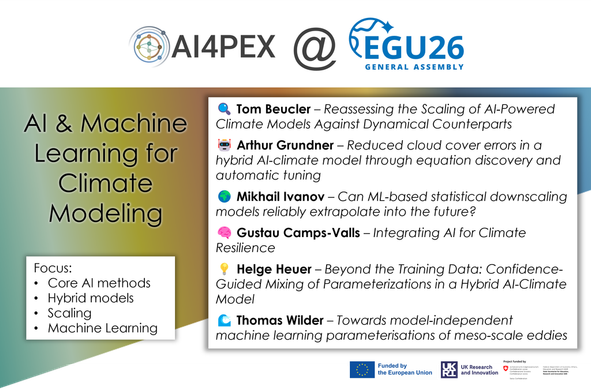
🌍 AI is transforming climate research!
Catch us at #EGU25 presenting cutting-edge work on applying #MachineLearning, hybrid models, and causal discovery in climate research.
⚡️ Don’t miss: Camps-Valls, Reid, Ouala, Beucler + more!