Surprising bacterium from Canadian lake shines new light on ancient photosynthesis https://phys.org/news/2024-03-bacterium-canadian-lake-ancient-photosynthesis.html

Anoxygenic phototroph of the #Chloroflexota uses a type I reaction centre https://www.nature.com/articles/s41586-024-07180-y

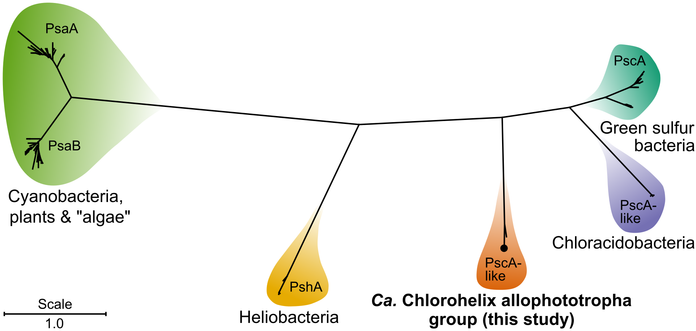
"Certain core #photosynthesis genes we had expected to see weren't there, but in their absence, there was a completely novel clade of photosynthetic reaction center protein... This breakthrough challenged current scientific knowledge of how photosynthesis came to be"

Surprising bacterium from Canadian lake shines new light on ancient photosynthesis

Sometimes an experiment doesn't go as planned. That's science. But a "failed" experiment or unexpected results can be the avenue to a discovery you could never anticipate. University of Waterloo Ph.D. student Jackson Tsuji had a poorly growing bacterial sample he wasn't ready to give up on, which ultimately led to a once-in-a-lifetime finding that could change how scientists view photosynthesis and its origins.
Surprising bacterium from Canadian lake shines new light on ancient photosynthesis

Sometimes an experiment doesn't go as planned. That's science. But a "failed" experiment or unexpected results can be the avenue to a discovery you could never anticipate. University of Waterloo Ph.D. student Jackson Tsuji had a poorly growing bacterial sample he wasn't ready to give up on, which ultimately led to a once-in-a-lifetime finding that could change how scientists view photosynthesis and its origins.

This finding has BIG implications for the evolution of photosynthesis. The phylogenomic patterns we see imply that the two newly discovered phototrophic groups in the #Chloroflexota have a common phototrophic ancestor. What reaction centre(s) did that ancestor use? 14/
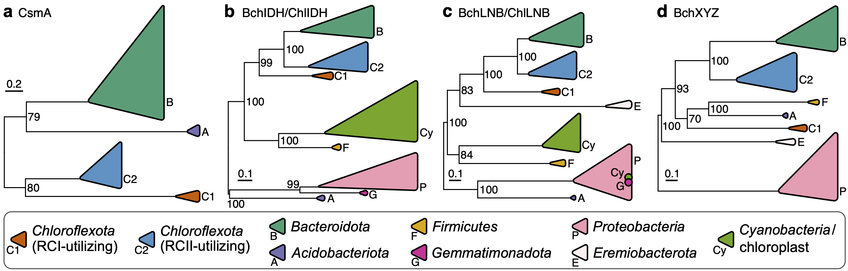
Phylogenomic approaches showed us that pretty much all other phototrophy-related genes and taxonomic marker genes pointed to a consistent phylogenetic topology, with our novel bacterium placing in a basal clade (novel order) compared to canonical #Chloroflexota phototrophs 12/
What was going on? We didn't believe these data at first but eventually backed them up with rigorous genomic and then physiological analyses that all agreed that the typical photosynthetic reaction centre used by #Chloroflexota members was absent from the bacterium. 11/
The bacterium seemed related in some ways to known phototrophs in the #Chloroflexota phylum, but the gene for its photosynthetic reaction centre -- the "heart" of photosynthesis that converts light into chemical energy -- was in a completely novel clade 10/

Novel endolithic bacteria of phylum Chloroflexota reveal a myriad of potential survival strategies in the Antarctic desert

A new paper from our lab, led by T.Williams, working alongside the Coleine lab 🦠🏔️❄️

#Antarctica #endoliths #Chloroflexota

https://journals.asm.org/doi/abs/10.1128/aem.02264-23

New research finds marine #bacteria ditched their #flagella and other traits when migrating back to the ocean.

#Chloroflexota #extremophiles #evolution

https://phys.org/news/2023-10-marine-bacteria-ditched-flagella-traits.html

New research finds marine bacteria ditched their flagella and other traits when migrating back to the ocean

Scientists have discovered flagella in an unexpected place: hot spring-dwelling bacteria from the phylum Chloroflexota. Research shows that flagella were lost in other forms of Chloroflexota that adapted to marine environments hundreds of millions of years ago.

Phys.org