Excited to share our surprising discovery of a highly novel photosynthetic bacterium from #Boreal #Shield #lakes in Canada! Now published in @Nature , over six years after our first enrichment culture
A long thread 🧵 ⬇️ 1/

https://www.nature.com/articles/s41586-024-07180-y

Anoxygenic phototroph of the Chloroflexota uses a type I reaction centre - Nature

Cultivation of a new anoxygenic phototrophic bacterium from Boreal Shield lake water—representing a transition form in the evolution of photosynthesis—offers insights into how the major modes of phototrophy diversified.
Nature

Back in 2017, we sampled iron-rich #Lake227 at the IISD-Experimental Lakes Area to hunt for novel photosynthetic bacteria. We had just published initial data suggesting that #Boreal #Shield #lakes like L227 could be nice analogues of ancient oceans on Earth 2/

https://doi.org/10.1038/srep46708

Why were we looking for photosynthetic bacteria in L227? Our hypotheisis was that that bacteria with metabolisms relevant to early Earth biogeochemistry might thrive there. Maybe we could find clues of what ancient photosynthesis was like 🤔 3/
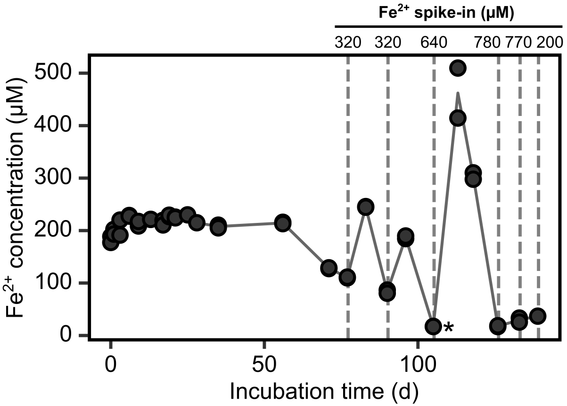
And crazily enough, we found something! But not what we had initially been looking for. After many failed incubations, one oligotrophic setup finally yielded signs of iron oxidation. This was the best-growing candidate within a set of bottles that had some signs of activity 4/
We were aiming to grow green sulfur bacteria (Chlorobia), but amplicon sequence data from the bottle suggested we found something much stranger. The dominant sequence variant in the bottle had <80% sequence identity to the nearest cultured strain 5/
What had we grown? Was it a phototroph? Could it survive in our medium alone? Or did it need the rest of the community in the bottle to live? We tried subculturing it in the same liquid medium but eventually lost the strain this way... 6/
At this point, I headed out on an already-scheduled research visit, as part of my PhD, to the PhotoMic Lab (now finished, sadly) at Tokyo Metropolitan University (Japan) to learn new cultivation skills. Took an old backup of this culture from the fridge with me just in case we could work on it 7/
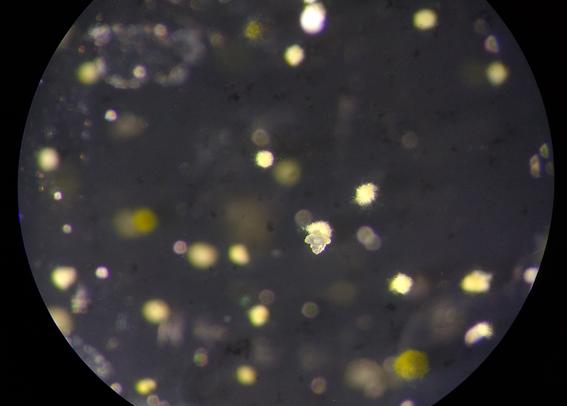
And wow! Turns out the expertise of this group in cultivation was just what was needed. Changed up the medium, switched to soft agar, and boom -- revival of filamentous & highly autofluorescent cells. It was a phototroph after all... 8/
We had actually sequenced a metagenome of the culture and gotten the data shortly before I was scheduled to head out on the trip. With the growing culture in hand, we started to examine the MAG data more earnestly... and were stunned by what we found 9/
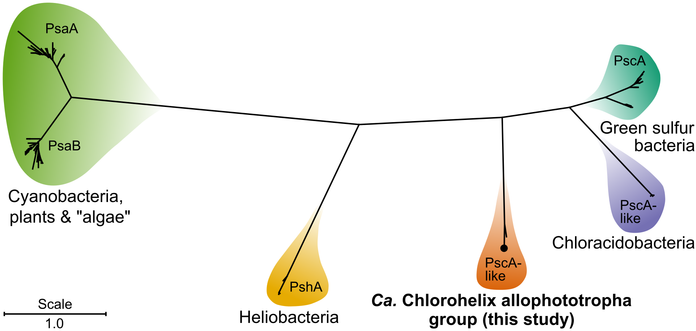
The bacterium seemed related in some ways to known phototrophs in the #Chloroflexota phylum, but the gene for its photosynthetic reaction centre -- the "heart" of photosynthesis that converts light into chemical energy -- was in a completely novel clade 10/
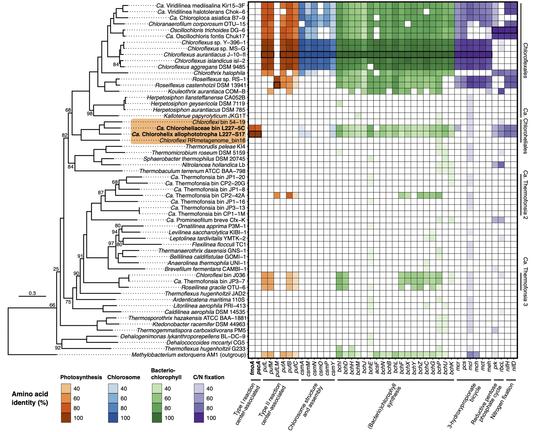
What was going on? We didn't believe these data at first but eventually backed them up with rigorous genomic and then physiological analyses that all agreed that the typical photosynthetic reaction centre used by #Chloroflexota members was absent from the bacterium. 11/
Phylogenomic approaches showed us that pretty much all other phototrophy-related genes and taxonomic marker genes pointed to a consistent phylogenetic topology, with our novel bacterium placing in a basal clade (novel order) compared to canonical #Chloroflexota phototrophs 12/
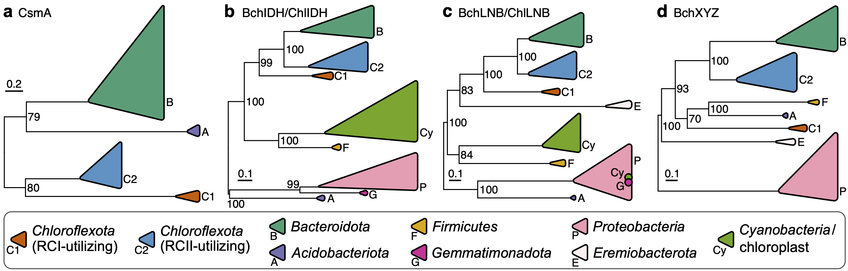
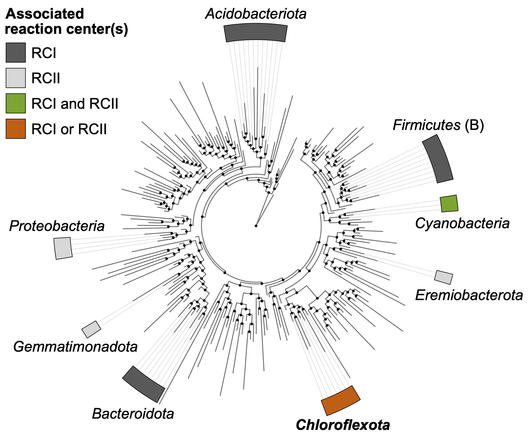
What we were seeing had never been observed before -- two groups in the same phylum with different core reaction centers for photosynthesis. Turns out these were in two fundamentally different photsynthetic reaction centres classes, too -- Type 1 vs. Type 2 reaction centres 13/
This finding has BIG implications for the evolution of photosynthesis. The phylogenomic patterns we see imply that the two newly discovered phototrophic groups in the #Chloroflexota have a common phototrophic ancestor. What reaction centre(s) did that ancestor use? 14/
And what changed to cause the two descendent groups to use diverging methods for light-energy conversion? 15/
Beyond the Chloroflexota, could this discovery help us unravel deep questions in the evolution of photosynthesis and untangle how/when different phototrophic groups evolved? Could knowledge of the surprising evolution of the Chloroflexota help us tease apart old conundrums? 16/
We are super excited for what the future holds studying this beautiful and fascinating bacterium. Check out the paper if you're interested for more! 17/

A ton of people and groups contributed to this work: Coauthors:
Josh D. Neufeld , Nicki Shaw, Sakiko Nagashima, Sherry Schiff, Jason Vekiteswaran , Manabu Fukui , Tomohiro Watanabe, Satoshi Hanada, Marcus Tank

Others: IISD-ELA, University of Waterloo, Hokkaido University, Japan Agency of Marine-Earth Science and Technology, Joint Genome Institute (DOE), NSERC, and more! /end