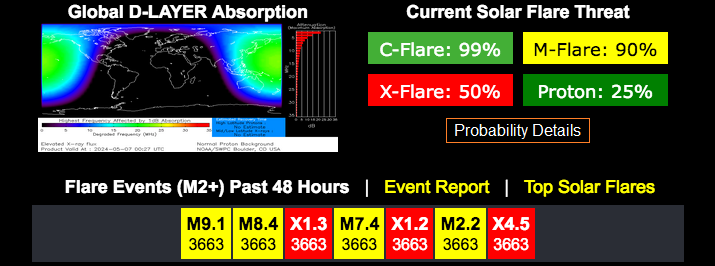
Yikes! Hold onto your hats! Chance of #XFlares 50%!!!

Current #SolarFlare Threat
(as of 5/6/2024):

C-Flare: 99%
M-Flare: 90%
X-Flare: 50%
Proton: 25%

Flare Events (M2+) Past 48 Hours (all from AR 3663):

M9.1
M8.4
X1.3
M7.4
X1.2
M2.2
X4.5
https://solarham.com/

#SolarFlares #SolarCycle25 #XClassFlare #CarringtonEffect #CME

Space Weather by SolarHam

Far-side #XClass #SolarFlare -- good thing it's not Earth-facing!

SolarHam: X2.5 / CME Update
February 16, 2024 @ 12:20 UTC

"Multiple coronal mass ejections are visible in the latest cornagraph imagery.

"For the third day in a row, an energetic eruption was observed off the farside of the Sun. This will obviously be directed away from Earth.

"The impulsive X2.5 solar flare around AR 3576 this morning resulted in a beautiful eruption of plasma off the southwest limb. Although there is currently a gap in imagery, the main stream of plasma appears to be headed away from Earth. I do not expect a noteworthy impact from this event."

Current Solar Flare Threat
C-Flare: 99%
M-Flare: 60%
X-Flare: 15%
Proton: 15%

Source:
https://www.solarham.net/

#SolarCycle25 #SolarHam #CarringtonEffect

Space Weather by SolarHam

#SolarHam update:

Solar Flux is 190
November 22, 2023 @ 21:20 UTC

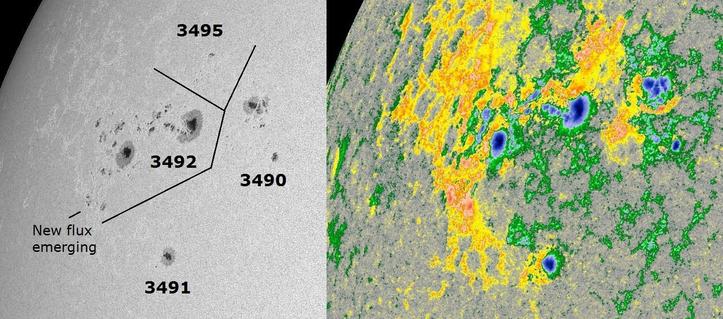
"Below is the latest look at the #sunspot party currently taking place on the Sun. #AR3490 and #AR3492 remain the main regions of focus and are listed as the most likely to produce a noteworthy #SolarFlare. What appears to be another large active region is now turning into view off the southeast limb. With all of the #sunspots currently facing #Earth, the solar flux index for Wednesday is 190. What a turnaround compared to even five days ago. The current flare threat stands at 55% for a moderate M-Flare and 10% for a strong #XFlare."

https://www.solarham.net/pictures/2023/nov22_2023_disk2.jpg

#SolarFlares #SolarCycle25 #EarthFacing #CarringtonEffect

Update: the probably for an #XClass flare is now 10%.

The sun has been extra active!

#Sunspot Cluster Update

November 22, 2023 @ 01:10 UTC

"Below is the latest look at the cluster of sunspots in the northeast quadrant of the Sun as we head into Wednesday. #AR3492 remains the most complex of these regions and has beta-gamma magnetic configuration. #AR3490 and #AR3497 were combined into one region and retains #AR3490 as its number. All three regions in close proximity to each other (3490, 3492, 3495) produced a number of low to mid level C-Flares during the past 12 hours. Moderate M-Flares will remain possible during the next 24 hours."

Current Solar Flare Threat
C-Flare: 99%
M-Flare: 55%
X-Flare: 10%
Proton: 05%

Source:
https://www.solarham.net/

#SolarFlares #SolarFlare #CarringtonEffect #SolarCycle25

Space Weather by SolarHam

Enormous '#Sunspot archipelago' 15 times wider than Earth could soon bombard us with #SolarFlares

Story by Harry Baker, November 21, 2023

"One of the largest and most densely populated sunspot regions seen in more than a decade has appeared on the sun's nearside to Earth — and has begun to unleash a barrage of solar storms that are shaking up our home star's surface in a big way. The sunspots' emergence could make it an interesting few weeks for Earth, which will soon be in the firing line of these eruptive dark patches.

"The first sunspot group, named #AR3490, rotated onto the sun's nearside on Nov. 18 over the star's northeastern shoulder. The dark patch was quickly followed by another sunspot group, #AR3491, which trailed in its wake, #Spaceweather.com reported.

"Scientists already knew that the sunspot groups were on their way because they had been tracking '#HelioseismicTremors," or ripples in the sun's surface, from the area. The sunspot region is 'so large, it is affecting the way the whole sun vibrates,' Spaceweather.com representatives wrote.

"Since emerging, the sunspot groups have split up and birthed new dark patches, including #AR3492, #AR3495, #AR3496 and #AR3497, which has created a 'solar archipelago of sunspots,' astronomy news site EarthSky reported.

"In total, the massive collection of sunspots spans around 125,000 miles (200,000 kilometers) across, which is more than 15 times wider than Earth, according to Spaceweather.com.

"The sunspots have already spat out at least 16 C-class and 3 M-class solar flares — which are the third and second strongest flare classes, respectively — in the last 4 days, according to SpaceWeatherLive.com. And experts are warning that there could be many more of these flares in the next few weeks, as well as potentially #XClass flares, the strongest type of solar flare.

"The impending flares may also birth coronal mass ejections (#CMEs), or enormous blobs of charged solar particles, that could slam into Earth and trigger strong geomagnetic storms, which could cause radio blackouts and spark vibrant aurora displays.

"Astronomers have also spotted several large loops of plasma, known as #SolarProminences, growing above some of the sunspots in the group. The largest loops tower more than 40,000 miles (64,000 km) above the surface, according to EarthSky, and could snap off and fling into space at any moment, temporarily leaving behind enormous 'canyons of fire' in the sun's surface.

"At least three sunspot groups have also emerged on the sun's southern hemisphere in the last few days.

"The sunspots' emergence is the latest sign that the sun is fast approaching the explosive peak in its roughly 11-year solar cycle, known as the solar maximum, which scientists now predict will begin next year.

"During solar maximum, sunspots become much more frequent and increase in size as the sun's magnetic fields get tangled up, allowing the dark patches to grow more easily.

"The latest dark patches make up 'probably the biggest sunspot region I've seen so far from [the current] solar cycle,' Chris Wicklund, a meteorologist and aurora photographer, wrote on X (formerly known as Twitter). 'The next 14 days could be very interesting,' he added."

https://www.msn.com/en-us/news/world/enormous-sunspot-archipelago-15-times-wider-than-earth-could-soon-bombard-us-with-solar-flares/ar-AA1kjz2n?rc=1&ocid=winp1taskbar&cvid=6329c7174fa44e45824bf6cb16f6b180&ei=5

#CarringtonEffect #SolarFlare #SolarCycle25 #LightsOut

MSN

Ancient #SolarStorm smashed Earth at wrong part of the sun's cycle — and scientists are concerned

The 9,200-year-old storm left researchers with a stark conclusion: We are not ready for the next one.

By Brandon Specktor
published January 28, 2022

"An extremely powerful solar storm pummeled our planet 9,200 years ago, leaving permanent scars on the #ice buried deep below #Greenland and #Antarctica.

"A new study of those ancient ice samples has found that this previously unknown storm is one of the strongest outbursts of solar weather ever detected and would have crippled modern communications systems if it had hit Earth today.

"But perhaps most surprising, the massive storm appears to have hit during a #SolarMinimum, the point during the sun's 11-year cycle when solar outbursts are typically much less common, according to the study, published Jan. 11 in the journal Nature Communications. Because of this unexpected discovery, the study researchers are concerned that devastating solar storms could hit when we least expect them — and that Earth might not be prepared when the next big one arrives.

"Solar storms occur when magnetic field lines on the sun's corona (the outermost part of the sun's atmosphere) become tangled up and then violently snap back into place. This sudden magnetic reconnection can release huge gouts of plasma and magnetic field known as coronal mass ejections (CMEs), which surf across space on the sun's ever-gusting #SolarWind.

"If a powerful #CME passes over Earth, it can compress the planet's #MagneticShield, causing what's known as a #GeomagneticStorm.

"Mild geomagnetic storms can damage #satellites and interrupt radio transmissions; severe storms, like the 'Halloween storms' of 2003, can cause widespread #PowerOutages across the world and permanently damage #ElectricalInfrastructure, such as power transformers. Some researchers fear that a sufficiently large solar storm could also ravage the world's undersea internet cables, resulting in an '#InternetApocalypse' that leaves huge chunks of the world population disconnected for months.

"CME outbursts typically peak every 11 years or so, when the sun enters the part of its natural activity cycle known as the solar maximum — the time when magnetic activity in the corona is in high gear.

"Today, satellites can monitor solar outbursts directly. But finding evidence of ancient storms requires some atomic detective work. The authors of the new study looked for evidence of special particles known as #CosmogenicRadionuclides — essentially, radioactive isotopes (versions of elements) created when charged solar particles collide with elements in Earth's atmosphere.

"These radioactive particles can appear in natural records, like tree rings and ice cores. In the study, the authors looked at the latter, analyzing several cores drilled in Antarctica and Greenland. Cores from both locations showed a remarkable spike in the radionuclides beryllium-10 and chlorine-36 around 9,200 years ago, indicating that a powerful solar storm swept across Earth at that time.

"Further analysis of the cores showed that the storm was particularly powerful — perhaps on a par with the most powerful solar storm ever detected, which occurred during a solar maximum between the years 775 B.C. and 774 B.C.

"The newly discovered storm's occurrence during a solar minimum, when magnetic activity on the sun should be low, left the study authors puzzled and alarmed.

"'This [storm] further pushes the magnitude of a potential worst-case scenario for [solar storm] events,' the researchers wrote in the study.

"According to the study authors, it is now essential for researchers to detect more ancient, extreme storms in the ice-core and tree-ring records, to determine if there is some sort of pattern beyond the sun's 11-year cycle that dictates when the most extreme storms will occur."

https://www.livescience.com/ancient-solar-storm-solar-minimum

#SolarFlares #SolarCycle25 #CarringtonEffect #LightsOut #KesslerSyndrome

Ancient solar storm smashed Earth at the wrong part of the sun's cycle — and scientists are concerned

The 9,200-year-old storm left researchers with a stark conclusion: We are not ready for the next one.

Live Science

This is the same area that shot out a huge #CME the other day. It was not Earth-facing, but still affected us. However, the sunspot will be facing us THIS WEEKEND! Hold onto your hats!

"BIG FARSIDE SUNSPOT: There's a spot on the farside of the sun so large it is affecting the way the whole sun vibrates. Helioseismic echoes pinpoint the active region in the sun's southern hemisphere not far behind the sun's southeastern limb. It should rotate into view this weekend."

Source: Spaceweather.com

https://spaceweather.com/images2023/26jul23/helioseismic.jpg

#Solar #solarcycle25 #SolarFlares #Spaceweather #CarringtonEffect

#SolarMaximum could hit us harder and sooner than we thought. How dangerous will the sun's chaotic peak be?

The sun is quickly approaching a major peak in solar activity. Experts warn it could potentially begin by the end of 2023, years before initial predictions suggested.

By Harry Baker, June 23, 2023

"Originally, scientists predicted that the current solar cycle would peak in 2025. But a bumper crop of sunspots, #SolarStorms and rare solar phenomena suggest solar maximum could arrive by the end of this year at the earliest — and several experts told Live Science we are poorly prepared. "

• The sun is becoming more active and may reach peak activity sooner than expected.

• Solar maximum was predicted to happen in 2025, but #sunspot activity has changed that.

• An unusual burst of sunspots this year suggests solar maximum could hit by the end of 2023.

#SolarFlares #SolarFlare #SolarCycle24 #CarringtonEvent #CarringtonEffect #LightsOut

Read more:
https://www.livescience.com/space/the-sun/solar-maximum-could-hit-us-harder-and-sooner-than-we-thought-how-dangerous-will-the-suns-chaotic-peak-be

Solar maximum could hit us harder and sooner than we thought. How dangerous will the sun's chaotic peak be?

The sun is quickly approaching a major peak in solar activity. Experts warn it could potentially begin by the end of 2023, years before initial predictions suggested.

Live Science

Latest #SolarHam news:
Flaring Continues

May 19, 2023 @ 03:30 UTC

"At least nine M-Flares during the past 24 hours, all of which were centered around newly assigned AR 3311. As of this update, the largest event was an M5.3 flare at 00:48 UTC (May 19). So far, none of the flares appear to have generated a coronal mass ejection (CME). An increased chance for an isolated X-Flare is now present."

#SolarFlares #SolarCycle25 #SolarFlare #CarringtonEffect #LightsOut #SpaceWeather #NoNukes #NoNewNukes #RethinkNotRestart

https://www.solarham.net/

Space Weather by SolarHam