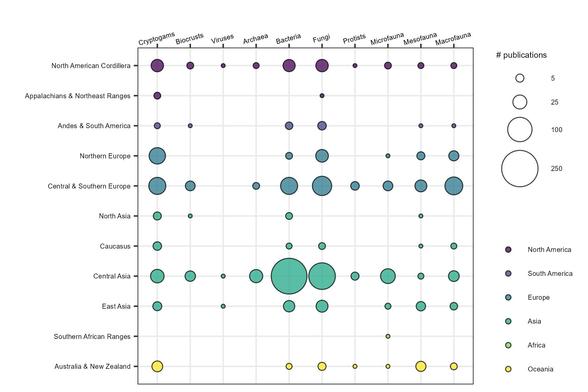
(3/4) 🌍 We found that most publications came from Central Europe (mainly the #EuropeanAlps) and Central Asia (#TibetanPlateau).

The research focus on each global mountain region differed: a research hub on alpine soil fauna is found in Central Europe, for #biocrusts also in Northern Europe, and for microbiota in Central Asia.

Most other mountain regions are still underrepresented, and more research should be conducted there to fill crucial knowledge gaps. 🏔️

National Audubon Society Embrace of Ranching.
"If Audubon were serious about preserving bird habitat, it would invest its resources in garnering support for the Voluntary Grazing Permit Retirement Act, which is one means of reducing livestock degradation of public lands and thus bird habitat" --Wuerthner.
https://www.thewildlifenews.com/2024/11/26/national-audubon-society-emcrace-of-ranching/ #Biocrusts, #Birds,.
National Audubon Society Emcrace of Ranching

Cattle grazing is the most significant adverse impact upon natural landscapes in the West. Photo George Wuerthner The National Audubon Society has a program called “Conservation Ranching,&#82…

The Wildlife News

The Dirt on #Biocrusts: Why Scientists Are Working to Save Earth’s Living Skin
https://eos.org/articles/the-dirt-on-biocrusts-why-scientists-are-working-to-save-earths-living-skin

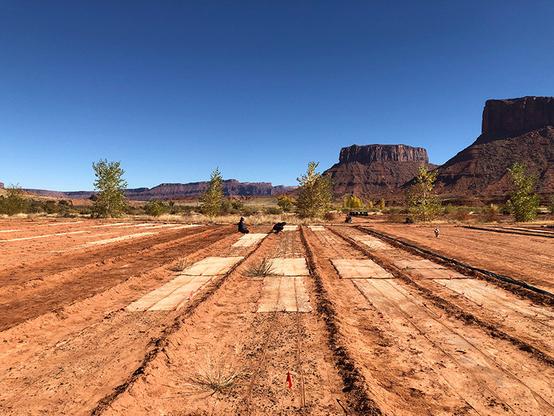
"Under the dry, piercing heat of the #Utah sun, Sasha Reed is growing plots of #plants—and #bacteria, #lichen and #fungi, too. But Reed is no farmer, and at first glance, her fields look to be mostly dirt. She’s an ecologist, and what she is growing is cryptobiotic #soil... These crusts are vital across Earth’s dryland ecosystems"

The Dirt on Biocrusts: Why Scientists Are Working to Save Earth’s Living Skin

Think twice before stepping on that crunchy top layer of soil. It may be a vital ecosystem—one that you can help protect.

Eos

Scientists discover how #soil #microbes survive in desert environments
https://phys.org/news/2024-04-scientists-soil-microbes-survive-harsh.html

Survival and rapid resuscitation permit limited productivity in desert microbial communities: Stefanie Imminger et al. https://www.nature.com/articles/s41467-024-46920-6

"Desert #bacteria endure long periods in dormancy, but are reactivated in rainfall... They uncovered a kind of all-in reactivation strategy in #biocrusts. The bacteria make the most of rainfall—within this narrow window, almost all diversity become active."

Scientists discover how soil microbes survive in harsh desert environments

Prolonged droughts followed by sudden bursts of rainfall—how do desert soil bacteria manage to survive such harsh conditions? This long-debated question has now been answered by an ERC project led by microbiologist Dagmar Woebken from the Centre for Microbiology and Environmental Systems Science (CeMESS) at the University of Vienna.

Phys.org
Scientists discover how soil microbes survive in harsh desert environments

Prolonged droughts followed by sudden bursts of rainfall—how do desert soil bacteria manage to survive such harsh conditions? This long-debated question has now been answered by an ERC project led by microbiologist Dagmar Woebken from the Centre for Microbiology and Environmental Systems Science (CeMESS) at the University of Vienna.

Phys.org

#Microbe-stuffed #SoilCrusts menaced by #ClimateChange https://phys.org/news/2023-08-microbe-stuffed-soil-crusts-menaced-climate.html

BONCAT-FACS-Seq reveals the active fraction of a #biocrust community undergoing a wet-up event https://www.frontiersin.org/articles/10.3389/fmicb.2023.1176751/full

"Using a novel method to detect #microbial activity in biological #soil crusts, or #biocrusts, after they are wetted, research team uncovered clues that will lead to a better understanding of the role #microbes play in forming a living skin over many semi-#arid ecosystems around the world."

Microbe-stuffed soil crusts menaced by climate change

Using a novel method to detect microbial activity in biological soil crusts, or biocrusts, after they are wetted, a Penn State–led research team in a new study uncovered clues that will lead to a better understanding of the role microbes play in forming a living skin over many semi-arid ecosystems around the world. The tiny organisms—and the microbiomes they create—are threatened by climate change.

Phys.org
Two #postdoc positions available at University of Jyväskylä, Finland. Arctic field work, soil microbes, winter microbiology, DNA & RNA lab work, genomics of carbon fixation, stable isotope probing, #biocrusts . https://rekry.saima.fi/certiahome/open_job_view.html?did=5600&jc=12&id=000014402&lang=fi&_ga=2.26813758.2003210687.1674911913-1598988274.1662538210
Avoin työpaikka

x·posting from twitter

PD Dr. Kenneth Dumack, on twitter @KDumack
Sampling #biocrusts and #soil in #Antarctica looks eerie when everything around you is tinted grey. Look at the lovely ground though. As you can see, Antarctica is full of #life - in this case life is exclusively #microbial though :) #lichens #fungi #cyanobacteria #protists

https://twitter.com/KDumack/status/1616339494117982209?s=20&t=B7EzXw7FjxptBXn2idq9Iw

PD Dr. Kenneth Dumack on Twitter

“Sampling #biocrusts and #soil in #Antarctica looks eerie when everything around you is tinted grey. Look at the lovely ground though. As you can see, Antarctica is full of #life - in this case life is exclusively #microbial though :) #lichens #fungi #cyanobacteria #protists”

Twitter

An observational study of #biocrusts from the sandy soils in the Jornada Range, Las Cruces, New Mexico shows a visible patchiness. Microscopic and 16S analysis of the crust showed that the patches were dominated by either Microcoleus vaginatus or Parifilum sp. Segregation extends to the associated microbiomes. Experiments on agar showed that these 2 #cyanobacteria segregated from each other via active motility.

https://doi.org/10.1038/s43705-022-00199-0

@oneabstractaday