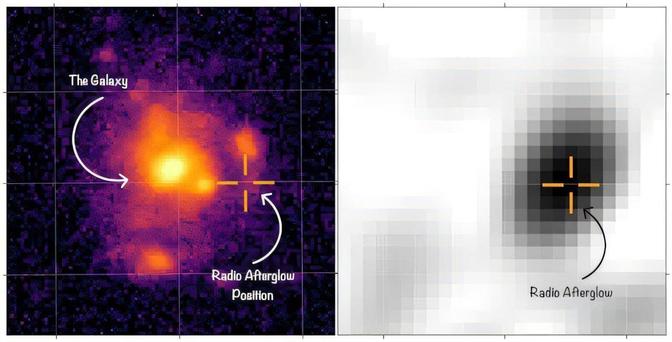
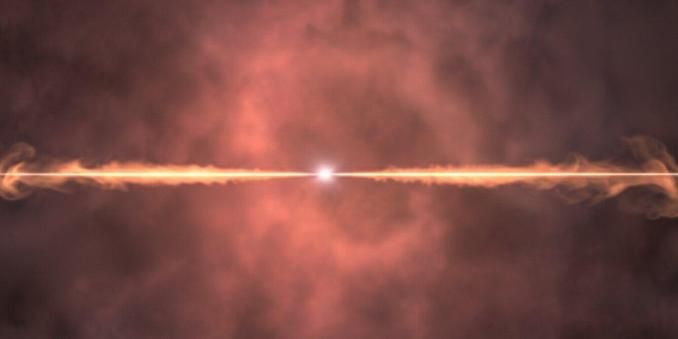
Un'esplosione cosmica con la forza di un miliardo di soli è passata inosservata, finché non ne abbiamo colto l'eco

#ASKAP @astronomia

Alcune delle esplosioni più estreme dell’universo non lasciano quasi alcuna traccia visibile. L’esplosione iniziale non viene osservata, ma le nostre osservazioni possono catturare l’eco di lunga durata che essa lascia quando l’onda d’urto si propaga nell’ambiente circostante.

https://umbertogaetani.substack.com/p/unesplosione-cosmica-con-la-forza
Would @[email protected] let @[email protected] date his daughter?? #nfltodayplus is not afraid to ask the tough questions 😂 #AskAP
Ask @[email protected] ANYTHING. He may respond to your inquiry on #nfltodayplus coming up! #askap
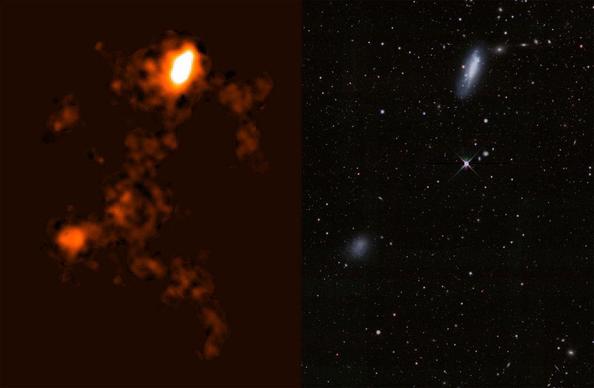
185.000 lichtjaar lange brug van neutraal waterstofgas verbindt twee dwergsterrenstelsels
In het kader van de Widefield ASKAP L-band Legacy All-sky Survey (WALLABY) heeft een internationaal team van astronomen het dwergsterrenstelselpaar
#askap #DDO137 #dwergsterrenstelsel #NGC4532 #sterrenstelsel #WALLABY
https://www.kuuke.nl/185-000-lichtjaar-lange-brug-van-neutraal-waterstofgas-verbindt-twee-dwergsterrenstelsels/
On vient d'apprendre que le signal radio spatial le plus intense capté en 2024 venait… d’un satellite zombie

Découvrez pourquoi le signal radio d’un satellite désactivé suscite aujourd’hui des inquiétudes chez les astrophysiciens.

Science et vie

#arxiv:
"
A nanosecond-duration radio pulse originating from the defunct Relay 2 satellite
"
".. detection of a burst of emission over a 695.5 MHz-1031.5 MHz bandwidth by the Australian Square Kilometre Array Pathfinder, ASKAP .."

https://arxiv.org/abs/2506.11462

13.6.2025

#ASKAP #ESD #Kommunikationssatellit #plasma #Raumfahrt #Relay2 #Satelliten #SpaceFlight #Radioastronomie #Radioteleskop #Weltraummüll #Weltraumschrott

A nanosecond-duration radio pulse originating from the defunct Relay 2 satellite

We report the detection of a burst of emission over a 695.5 MHz-1031.5 MHz bandwidth by the Australian Square Kilometre Array Pathfinder, ASKAP. The burst was localised through analysis of near-field time delays to the long-decommissioned Relay 2 satellite, and exhibited a dispersion measure of $2.26 \cdot 10^{-5}$ pc cm$^{-3}$ -- 69.7 TECU, consistent with expectations for a single pass through the ionosphere. After coherent dedispersion, the burst was determined to be less than 30 ns in width, with an average flux density of at least 300 kJy. We consider an electrostatic discharge (ESD) or plasma discharge following a micrometeoroid impact to be plausible explanations for the burst. ESDs have previously been observed with the Arecibo radio telescope, but on 1000 times longer timescales. Our observation opens new possibilities for the remote sensing of ESD, which poses a serious threat to spacecraft, and reveals a new source of false events for observations of astrophysical transients.

arXiv.org
🚀🔭 Big news, folks! Apparently, the universe has been busy gossiping about "giant radio galaxies" while our grand technological overlords at #ASKAP are too busy blocking requests to explain what that even means. 💫📡 Guess the galaxies will have to wait in line behind our 400 Bad Requests. 🙄
https://phys.org/news/2025-04-fifteen-giant-radio-galaxies-askap.html #giantRadioGalaxies #techNews #spaceGossip #400BadRequests #HackerNews #ngated
Fifteen new giant radio galaxies discovered with ASKAP

Using the Australian Square Kilometer Array Pathfinder (ASKAP), astronomers have discovered 15 new giant radio galaxies with physical sizes exceeding 3 million light years. The finding was reported in a research paper published April 9 on the arXiv preprint server.

Phys.org
Fifteen new giant radio galaxies discovered with ASKAP

Using the Australian Square Kilometer Array Pathfinder (ASKAP), astronomers have discovered 15 new giant radio galaxies with physical sizes exceeding 3 million light years. The finding was reported in a research paper published April 9 on the arXiv preprint server.

Phys.org

Your on a Good Thing [TM] when the first trial you run yields "too much" [1] good data :)

SKA -side effects 101

**Cosmic Fast Bursts**

January 28, 2025

The first trial of an Australian-developed technology has detected mysterious objects by sifting through signals from space like sand on a beach.

“That’s the equivalent of sifting through a whole beach of sand to look for a single five-cent coin every minute,”

“We’re also detecting long-period transients, which remain mysterious objects within our galaxy. Both fast radio bursts and these transients were first discovered in Australia, so it is great that we’re continuing the path of discovery with this impressive technology,” Dr Wang said.

https://www.icrar.org/craco/

[1] more than expected
#Astronomy #CosmicFastBurst #CSIRO #ICRAR #ASKAP

Australian innovation ‘sifts’ space for mysteries - ICRAR

The first trial of an Australian-developed technology has detected mysterious objects by sifting through signals from space like sand on a beach. Astronomers and engineers at CSIRO, Australia’s national science agency, developed the specialised system, CRACO, for their ASKAP radio telescope to rapidly detect mysterious fast radio bursts and other space phenomena. The new technology […]

ICRAR
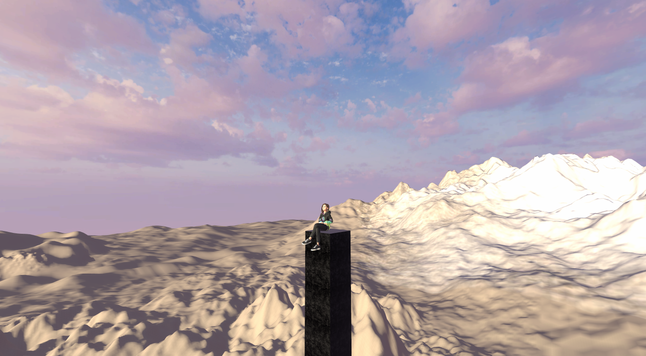
Hi everyone 👋 Planning to get a bit more active on here, looking forward to meeting you and chatting about #astronomy, #VR, #ASKAP, #TFOM, #automation, #scicomm, #remotecollab and more! 🙌 Here's a pic of me contemplating the future of #humanity atop a carbon pillar representing conference travel ✈️