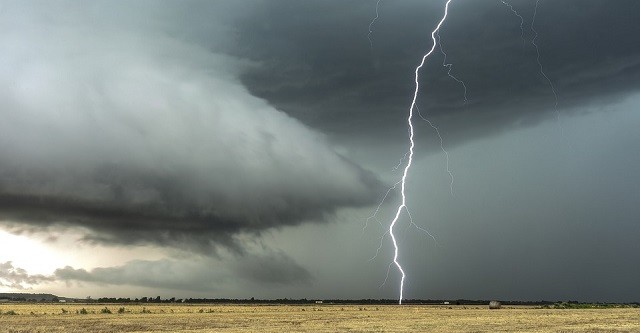
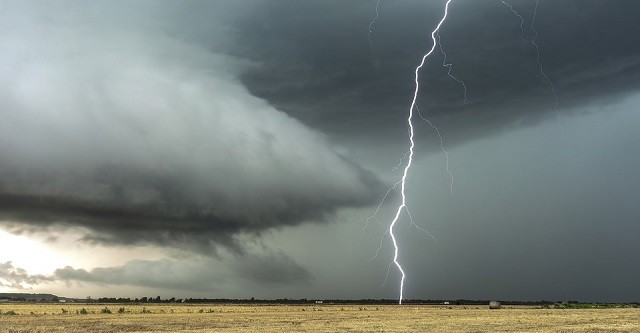
#Météo de ce dimanche 31 août 2025 en Deux-Sèvres : temps pluvieux et orageux. 🌬️ Rafales < 40 km/h 🌡️ 16°/20°. Bonne fête aux #Aristide.
⚠️🟡 Vigilance jaune crues et pluie inondation
https://nrt79.link/sjre4b
Prévisions de La Météo de Max avec l’app Prévi+
https://nrt79.link/previplus-meteo-deux-sevres
One Day Moral principles will guide policy and a lot of people will be happier, healthier and not suffering under sanctions or torture regimes.

Nicaragua and the USA


,> The highest per capita debt in the region is Nicaragua’s, currently $6.4 billion and clearly unpayable. The human costs of the IMF programs designed to ensure that lenders are compensated many times over are incalculable. About $1.5 billion is from the Somoza years, hence clearly “odious debt,” of no standing. Another $3 billion is from the post-1990 period when the US regained control over Nicaragua; also odious debt. The remainder is the direct responsibility of the United States, which was conducting brutal economic warfare and a murderous terrorist war against Nicaragua, for which it was condemned by the World Court, which ordered the US to pay reparations, variously estimated in the range of $17 billion. Accordingly, the highly conservative principle of adhering to international law, as determined by the highest international judicial body, would suffice to eliminate Nicaragua’s debt, with a good deal left over. Were elementary moral principles even to be imaginable in elite Western culture, similar conclusions would at once be drawn far more broadly throughout Europe and the US, even without World Court judgments. But that day remains very distant.  [Patricia Adams, Odious Debts (Earthscan, 1991); Lissakers, Banks, Borrowers. Witness for Peace, A Bankrupt Future: The Human Cost of Nicaragua’s Debt (WFP, 2000); Envio (Managua, Nicaragua: UCA), 18.220, Nov. 1999.]
  
   - Noam Chomsky in Rogue States Jubilee 2000


Haiti and France (and the USA...)


.> ... The French king agreed to recognise Haiti’s independence only if the new republic paid France an indemnity of 150 million francs and reduced its import and export taxes by half. The ‘debt’ that Haiti recognised was incurred by the slaves when they deprived the French owners not only of land and equipment but of their human ‘property’.
.> The impact of the debt repayments – which continued until after World War Two – was devastating. In the words of the Haitian anthropologist Jean Price-Mars, ‘the incompetence and frivolity of its leaders’ had ‘turned a country whose revenues and outflows had been balanced up to then into a nation burdened with debt and trapped in financial obligations that could never be satisfied.’ ‘Imposing an indemnity on the victorious slaves was equivalent to making them pay with money that which they had already paid with their blood,’ the abolitionist Victor Schoelcher argued.
...
.> Why such animus towards Haiti’s leader? Taking up the question of the historic French debt, Aristide declared that France ‘extorted this money from Haiti by force and ... should give it back to us so that we can build primary schools, primary healthcare, water systems and roads.’ He did the maths, adding in interest and adjusting for inflation, to calculate that France owes Haiti $21,685,135,571.48 and counting. This figure was scoffed at by some of the French, who saw the whole affair as a farce mounted by their disgruntled former subjects; others, it’s increasingly clear, were insulted or angered when the point was pressed in diplomatic and legal circles.
.> Still, Aristide kept up the pressure. The figure of $21 billion was repeated again and again. The number 21 appeared all over the place in Haiti, along with the word ‘restitution’... [ Paul Farmer in "Who removed Aristide? Paul Farmer reports from Haiti" ]


- https://www.lrb.co.uk/the-paper/v26/n08/paul-farmer/who-removed-aristide

#NoamChomsky #NicaraguanDebt #Jubliee2000 #DropTheDebt #DebtRestitution #HaitiDebt #PaulFarmer #Aristide #JeanBertrandAristide #WorldCourt #WorldCourtJudgments
Paul Farmer · Who removed Aristide?

London Review of Books
Paul Farmer on Haiti, Aristide, US intervention (2004):

Why such animus towards Haiti’s leader? Taking up the question of the historic French debt, Aristide declared that France ‘extorted this money from Haiti by force and ... should give it back to us so that we can build primary schools, primary healthcare, water systems and roads.’ He did the maths, adding in interest and adjusting for inflation, to calculate that France owes Haiti $21,685,135,571.48 and counting. This figure was scoffed at by some of the French, who saw the whole affair as a farce mounted by their disgruntled former subjects; others, it’s increasingly clear, were insulted or angered when the point was pressed in diplomatic and legal circles.

Still, Aristide kept up the pressure. The figure of $21 billion was repeated again and again. The number 21 appeared all over the place in Haiti, along with the word ‘restitution’. On 1 January this year, during the bicentennial celebrations, Aristide announced he would replace a 21-gun salute with a list of the 21 things that had been done in spite of the embargo and that would be done when restitution was made. The crowd went wild. The French press by and large dismissed his comments as silly, despite the legal merits of his case. Many Haitians saw Aristide as a modern Toussaint l’Ouverture, a comparison that Aristide did not discourage. ‘Toussaint was undone by foreign powers,’ Madison Smartt Bell wrote in Harper’s in January, ‘and Aristide also had suffered plenty of vexation from outside interference.’

-  https://www.lrb.co.uk/the-paper/v26/n08/paul-farmer/who-removed-aristide
#PaulFarmer #Haiti #Aristide #USAIntervention #DropTheDebt #RaiseReparations #HaitiAndFrance
#^Paul Farmer · Who removed Aristide?


On the night of 28 February, the Haitian president, Jean-Bertrand Aristide, was forced from power. He claimed he’d been kidnapped and didn’t know where he was being taken until, at the end of a 20-hour flight, he was told that he and his wife would be landing ‘in a French military base in the middle of Africa’. He found himself in the...
Paul Farmer · Who removed Aristide?

London Review of Books
Haiti's Curse: Black or White? French and Gringo?
On the first day of his year[2004], freedom in this world turned 200. But no one noticed, or almost no one. A few days later, the country where this birth occurred, Haiti, found itself in the media spotlight, not for the anniversary of universal freedom but for the ouster of President Aristide.
Haiti was the first country to abolish slavery. However, the most widely read encyclopedias and almost all educational textbooks attribute this honorable deed to England. It is true that one fine day the empire that had been the champion in the slave trade changed its mind about it. But abolition in Britain took place in 1807, three years after the Haitian revolution, and it was so unconvincing that in 1832 Britain had to ban slavery again.
There is nothing new about this slight of Haiti. For two centuries it has suffered scorn and punishment. Thomas Jefferson, a slave owner and champion of liberty at the same time, warned that Haiti had created a bad example and argued it was necessary to "confine the plague to the island." His country heeded him. It was sixty years before the U.S. granted diplomatic recognition to this freest of nations. Meanwhile in Brazil disorder and violence came to be called "Haitianism." Slave owners there were saved from this fury until 1888 when Brazil abolished slavery-the last country in the world to do so.
...
To reinstate slavery in Haiti, France sent more than fifty shiploads of soldiers. The country's blacks rose up and defeated France and won national independence and freedom for the slaves. In 1804, they inherited a land that had been razed to grow sugarcane and a land consumed by the conflagrations of a fierce civil war. And they inherited "the French debt." France made Haiti pay dearly for the humiliation it inflicted on Napoleon Bonaparte. The newly born nation had to commit to pay a gigantic indemnification for the damage it had caused in winning its freedom. This expiation of the sin of freedom would cost Haiti 150 million gold francs.
The new country was born with a rope wrapped tightly around its neck: the equivalent of $21.7 billion in today's dollars, or forty-four times Haiti's current yearly budget.
In exchange for this fortune, France officially recognized the new nation. No other countries did so. Haiti was born condemned to solitude.
Not even Simon Bolivar recognized Haiti, though he owed it everything. In 1816, it was Haiti that furnished Bolivar with boats, arms, and soldiers when he showed up on the island defeated and asking for shelter and help.
Haiti gave him everything with only one condition: that he free the slaves-an idea that had not occurred to him until then. The great man triumphed in his war of independence and showed his gratitude by sending a sword as a gift to Port-au-Prince. Of recognition he made no mention.
In 1915, the Marines landed in Haiti. They stayed nineteen years. The first thing they did was occupy the customs house and . duty collection facilities. The occupying army suspended the salary of the Haitian president until he agreed to sign off on the liquidation of the Bank of the Nation, which became a branch of City Bank of New York. The president and other blacks were barred entry into the private hotels, restaurants, and clubs of the foreign occupying power. The occupiers didn't dare reestablish slavery, but they did impose forced labor for the building of public works. And they killed a lot of people. It wasn't easy to quell the fires of resistance.
...
Aristide, the rebel priest, became president in 1991. He lasted a few months before the U.S. government helped to oust him, brought him to the United States, subjected him to Washington's treatment, and then sent him back a few years later, in the arms of Marines, to resume his post. Then once again, in 2004, the U.S. helped to remove him from power, and yet again there was killing. And yet again the Marines came back, as they always seem to, like the flu.
But the international experts are far more destructive than invading troops. Placed under strict orders from the World Bank and the International Monetary Fund, Haiti obeyed every instruction, without cheating. The government paid what it was told to even if it meant there would be neither bread nor salt. Its credit was frozen despite the fact that the state had been dismantled and the subsidies and tariffs that had protected national production had been eliminated. Rice farmers, once the majority, soon became beggars or boat people. Many have ended in the depths of the Caribbean, and more are following them to the bottom, only these shipwreck victims aren't Cuban so their plight never makes the papers.
Today Haiti imports its rice from the United States, where international experts, who are rather distracted people, forgot to prohibit tariffs and subsidies to protect national production.
On the border between Haiti and the Dominican Republic, there is a large sign that reads: Road to Ruin.
Down that road, everyone is a sculptor. Haitians have the habit of collecting tin cans and scrap metal that they cut and shape and hammer with old-world mastery, creating marvels that are sold in the street markets.
Haiti is a country that has been thrown away, as an eternal punishment of its dignity. There it lies, like scrap metal. It awaits the hands of its people.


#^The White Curse [Haiti] by Eduardo Galeano
tiksi@net

Eyes of the Heart (2000)


by Jean-Bertrand Aristide


In 1982 international agencies assured Haiti's peasants their pigs were sick and had to be killed (so that the illness would not spread to countries to the North). Promises were made that better pigs would replace the sick pigs. With an efficiency not since seen among development projects, all of the Creole pigs were killed over period of a thirteen months.
Two years later the new, better pigs came from lowa. They were so much better that they required clean drinking water (unavailable to 80% of the Haitian population), imported feed (costing $90 a year when the per capita income was about $130), and special roofed pigpens. Haitian peasants quickly dubbed them "prince a quatre pieds," (four-footed princes). Adding insult to injury, the meat did not taste as good. Needless to say, the repopulation program was a complete failure. One observer of the process estimated that in monetary terms Haitian peasants lost $600 million dollars. There was a 30% drop in enrollment in rural schools, there was a dramatic decline in the protein consumption in rural Haiti, a devastating decapitalization of the peasant economy and an incalculable negative impact on Haiti's soil and agricultural productivity. The Haitian peasantry has not recovered to this day.
Most of rural Haiti is still isolated from global markets, so for many peasants the extermination of the Creole pigs was their first experience of globalization. The experience looms large in the collective memory. Today, when the peasants are told that "economic reform" and privatization will benefit them they are understandably wary. The state-owned enterprises are sick, we are told, and they must be privatized. The peasants shake their heads and remember the Creole pigs.
The 1997 sale of the state-owned flour mill confirmed their skepticism. The mill sold for a mere $9 million, while estimates place potential yearly profits at $20-30 million a year. The mill was bought by a group of investors linked to one of Haiti's largest banks. One outcome seems certain; this sale will further concentrate wealth-in a country where 1% of the population already holds 45% of the wealth of the country.
...
I see [for the children of Haiti a future] country with 85% literacy, rather than 85% illiteracy. Cooperatives flourish in villages and in the informal sectors of the cities. Water is flowing through the fields of the countryside-where food enough for all of Haiti's people is growing. Creole pigs are seen more and more in the countryside, the descendants of those few that the peasants hid away and saved from extermination. Seedlings are beginning to take root on the mountainsides. The seedlings have a chance at survival because the people are no longer in misery, but are already on the road to poverty with dignity. There are primary schools and health clinics in every municipality of Haiti. The schoolbooks are not just half-price-they are free, in accordance with Article 32.1 of our constitution which promises a free education to every Haitian child.

- #^Eyes of the Heart by Jean-Bertrand Aristide
#Aristide #CreolePigs #IowaPigs #WorldBankIMF #ForeignAid #JeanBertrandAristide #EyesOfTheHeart
Eyes of the Heart by Jean-Bertrand Aristide

> Haiti is, of course, an extremely impoverished country, with awful conditions. Aristide was nevertheless beginning to get places. He was able to reduce corruption extensively, and to trim a highly bloated state bureaucracy. He won a lot of international praise for this, even from the international lending institutions, which were offering him loans and preferential terms because they liked what he was doing.

https://chomsky.info/secrets05/
#NoamChomsky #ChomskyOnHaiti #Haiti #Aristide

Haiti, by Noam Chomsky (Excerpted from Secrets, Lies, and Democracy)

The Noam Chomsky Website.

#Météo du samedi 31 août 2024 à #Niort : orageux le matin, nuageux avec de belles éclaircies et quelques averses ensuite. Min. 17°. Max. 27°. Bonne fête aux #Aristide.
⚠🟡 Les Deux-Sèvres en vigilance jaune aux orages.
https://bit.ly/2MFBJhy
VIGILANCE METEO DEUX-SÈVRES (79) par Météo-France

Consultez la carte de Vigilance de Météo-France sur les DEUX-SEVRES (79) : Information sur les risques météorologiques de la journée en cours.

Météo France

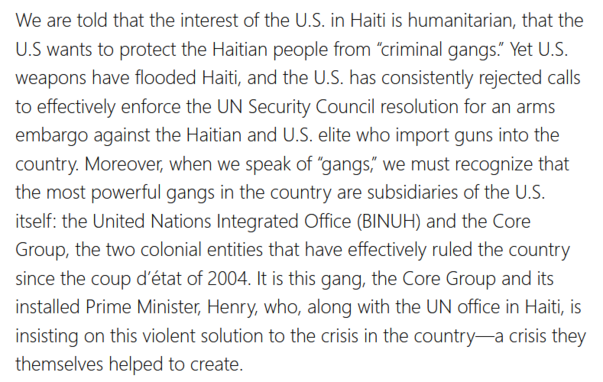
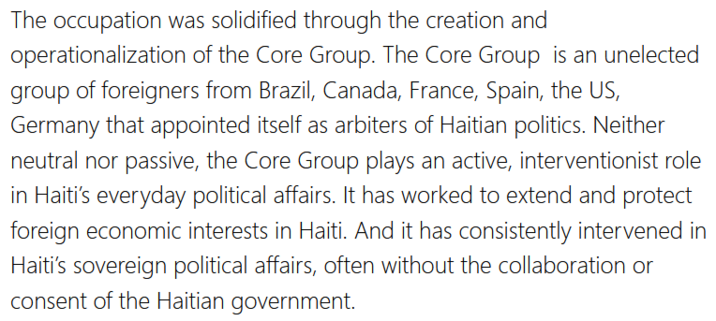
While western corporate msm spread headlines and reports on #gangs in #Haiti it is western empire that is the real gang carrying out an #occupation in Haiti to prevent African sovereignty.

Palestine gave us clarity about the nazis in Ukraine, we need this clarity when it comes to Haiti. ☝🏽 🇭🇹 🔥 🕊️

"Why is CARICOM Betraying Haiti on Behalf of the U.S.?"

By: Jemima Pierre

https://www.stabroeknews.com/2024/02/26/features/in-the-diaspora/why-is-caricom-betraying-haiti-on-behalf-of-the-u-s/

#HandsOffHaiti #CARICOM #Aristide #France #Canada #CoreGroup #UnitedNations #Germany #Brazil

Why is CARICOM Betraying Haiti on Behalf of the U.S.? - Stabroek News

by Jemima Pierre Jemima Pierre, Ph.D., is a Haitian-born Professor at the Social Justice Institute at the University of British Columbia and Research

Stabroek News
¿Qué está pasando en Haití?
La capital haitiana está sumida en el pánico. Pandillas enmascaradas deambulan por las sombras de secciones de la ciudad que alguna vez fueron vibrantes y ahora están abandonadas y en ruinas. Es inquietante ver los bordes desgastados de la ciudad.
https://afrofeminas.com/2024/03/11/que-esta-pasando-en-haiti/
#Actualidad #Historia #afrodescendientes #Afrofminas #Aristide #colonialismo #dispora #GuyPhilippe #Hait #JimmyBarbecueCherizier #pandillas
¿Qué está pasando en Haití?

La capital haitiana está sumida en el pánico. Pandillas enmascaradas deambulan por las sombras de secciones de la ciudad que alguna vez fueron vibrantes y ahora están abandonadas y en ruinas. Es inquietante ver los bordes desgastados de la ciudad.

Afroféminas

https://www.reuters.com/world/africa/un-urges-states-haitis-region-join-kenya-security-force-2023-07-31/

Guterres is due to submit a report to the U.N. Security Council by mid-August outlining the full range of U.N. support options "including support for a non-U.N. multinational force, or a possible peacekeeping operation."

#GreenNewDealForHealth #SocialSafetyNet #sdg15 #Aristide

UN urges states in Haiti's region to join Kenya in security force

U.N. Secretary-General Antonio Guterres on Monday welcomed Kenya's readiness to lead an international force to help Haiti's police combat gang violence and encouraged other countries - particularly from Haiti's region - to join the effort.

Reuters