Earliest evidence of cereal harvesting by ancient Canarians discovered in Gran Canaria

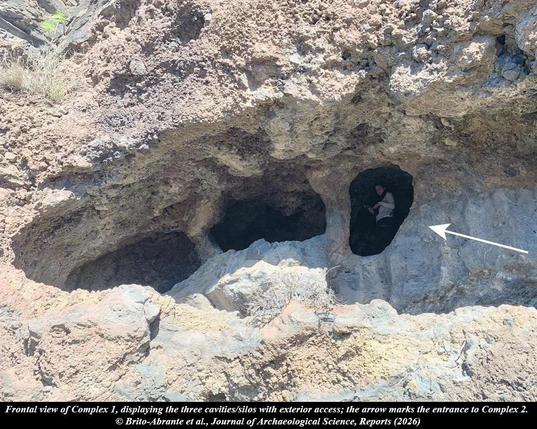
Archaeologists studying a cave complex on Gran Canaria have found the earliest direct evidence of cereal harvesting in the Canary Islands, adding new detail to what is known about farming and burial customs among the island’s Indigenous communities before the Castilian conquest...

More info: https://archaeologymag.com/2026/05/earliest-evidence-of-cereal-harvesting-in-gran-canaria/

Follow @archaeology

#archaeology #archeology #archaeologynews #archaeobotany #GranCanaria

Soil temp, not just rainfall, may have driven the shifting geography of millet farming in Neolithic East Asia. A 3°C mid-Holocene cooling compressed cultivation zones and pushed farming southward. #Neolithic #Archaeobotany #Paleoanthropology https://www.anthropology.net/p/the-ground-went-cold-soil-temperature
The Ground Went Cold: Soil Temperature and the Shifting Geography of Millet Farming in Neolithic East Asia

A new climate proxy record from the Chinese Loess Plateau suggests the early spread of millet agriculture was shaped less by rainfall than by what was happening a few centimeters underground.

Anthropology.net
New archaeological finds from Neolithic Georgia have finally delivered physical evidence to match decades of genetic inference: bread wheat and its wild ancestor were both present ~8,000 years ago in the South Caucasus. #Archaeobotany #WheatDomestication #Neolithic https://www.anthropology.net/p/where-bread-wheat-began
Where Bread Wheat Began

New archaeological finds from two Neolithic villages in Georgia place the world's most important grain at its likely birthplace — and the evidence was hiding in the stem.

Anthropology.net
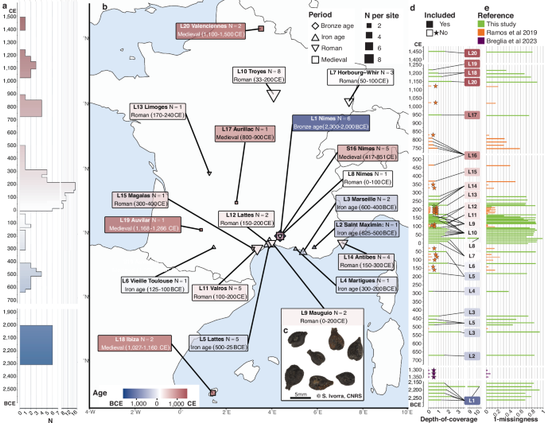
On this week's #MetagenomicsMonday: #aDNA study 🧬traces the roots of French #wine! 🍇 Roman trade, clonal propagation, and even a medieval grape identical to modern #PinotNoir emerge from 4,000 years of #viticulture.
https://www.nature.com/articles/s41467-026-70166-z
#SPAAM #archaeogenomics #archaeobotany #domestication #agriculture
Ancient DNA reveals 4000 years of grapevine diversity, viticulture and clonal propagation in France - Nature Communications

Here, the authors present aDNA from 49 grape pips spanning the Bronze Age to Medieval period in France and surrounding areas. They find evidence of long-distance exchange of domestic varieties through vegetative clones and one Medieval sample that is nearly identical to modern Pinot Noir.

Nature

The history of olive cultivation in the southern Levant

Abstract The olive tree (Olea europaea L. subsp. europaea var. europaea) is one of the most important crops across the Mediterranean, particul…
#dining #cooking #diet #food #mediterranean #MediterraneanDiet #MediterraneanFood #MediterraneanOliveOil #OliveOil #Archaeobotany #Cropwildrelatives #Landraces #Mediterranean #Olive #Olives #palynology
https://www.diningandcooking.com/2552371/the-history-of-olive-cultivation-in-the-southern-levant/

The history of olive cultivation in the southern Levant

Abstract The olive tree (Olea europaea L. subsp. europaea var. europaea) is one of the most important crops across the Mediterranean, particularly the southern Levant. Its regional economic impor…
#dining #cooking #diet #food #MediterraneanOliveOil #OliveOil #Archaeobotany #Cropwildrelatives #Landraces #Mediterranean #Olive #Olives #palynology
https://www.diningandcooking.com/2552371/the-history-of-olive-cultivation-in-the-southern-levant/

Archaeobotany, frequently used interchangeably with paleoethnobotany, is the multidisciplinary scientific study of past human-plant interactions through the recovery, identification, and analysis of plant remains from archaeological contexts.
#Archaeobotany #paleoethnobotany #Botany #Archeology #sflorg
https://www.sflorg.com/2026/02/cat02222601.html
Archaeobotany: In-Depth Description

While archaeobotany is a specialized subset of archaeology, it is further divided into distinct branches based on the size and type of the botanical

Early farmers accidentally bred “warrior” wheat — plants shaped over millennia to fight neighbors for light and space. Then modern breeding had to undo all of it. A wild loop in crop evolution. #HumanEvolution #Archaeobotany #CropScience https://www.anthropology.net/p/how-early-farmers-accidentally-bred
How Early Farmers Accidentally Bred Wheat to Fight

Ancient cultivation created warrior plants. Modern breeding had to undo the damage.

Anthropology.net