 Stan Carey
 Hacker News
Affixes: The Building Blocks of English — https://www.affixes.org/index.html
#HackerNews #Affixes #English #Language #Linguistics #WordBuilding #LanguageLearning
#HackerNews #Affixes #English #Language #Linguistics #WordBuilding #LanguageLearning
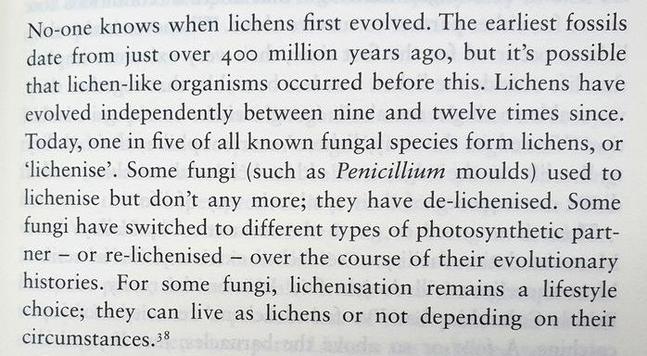
Lichen morphology (no, the other kind) in Sheldrake's "Entangled Life"
#lichen #lichenisation #evolution #LichenSubscribe #biology #MerlinSheldrake #nature #fungi #mycology #affixes #morphology
Readers who get a kick out of unfashionable affixes may also enjoy this post on obsolete be- words, such as:
BEBUTTER: to cover with butter (1611)
BEDINNER: to give a dinner to (1837)
BEMISSIONARY: to pester with missionaries (1884)
BEMONSTER: to make a monster of (1692)
BEPAW: to befoul as with paws (1684)
BETHWACK: to thwack soundly (1598)
BEWIZARD: to influence by a wizard (1862)
https://stancarey.wordpress.com/2017/09/25/bewondered-by-obsolete-be-words/
#words #language #OED #RareWords #linguistics #grammar #etymology #affixes
"In this study, we improved the #methodology by teasing out two distinct measures: #fusion (how many #affixes #verbs and #nouns have) and informativity (how many distinctions are made)."
Yeesh. Regardless of the merits of the study, this is extremely poor framing, especially a #science #journalism article, as it's really just asking if #fusional #languages specifically are correlated with environment.
#linguistics #grammar #linguisticcomplexity #morphology
https://phys.org/news/2023-08-evolution-complex-grammars-grammatical-complexity.html

Languages around the world differ greatly in how many grammatical distinctions they make. This variation is observable even between closely related languages. The speakers of Swedish, Danish, and Norwegian, for example, use the same word hunden, meaning "the dog," to communicate that the dog is in the house or that someone found the dog or gave food to the dog. In Icelandic, on the other hand, three different word forms would be used in these situations, corresponding to the nominative, accusative, and dative case respectively: hundurinn, hundinn, and hundinum.
Children’s awareness of irregular verbs
I’ve been enjoying Steven Pinker’s Words and Rules: The Ingredients of Language (1999). More technical and focused than his popular bestseller The Language Instinct, it is effectively a monograph on linguistic irregularity, examining in particular how we inflect verbs for past tense and plurality, and what the exceptions can tell us about the structure of language and our minds.
In chapter 7, ‘Kids Say the Darnedest Things’, Pinker points out that children sometimes know that the mistakes they make are mistakes. He cites Dan Slobin and Tom Bever, psycholinguists who inserted their children’s speech errors into their own speech and recorded the results:
TOM: Where’s Mommy?
CHILD: Mommy goed to the store.
TOM: Mommy goed to the store?
CHILD: NO! (annoyed) Daddy, I say it that way, not you.
CHILD: You readed some of it too . . . she readed all the rest.
DAN: She read the whole thing to you, huh?
CHILD: Nu-uh, you read some.
DAN: Oh, that’s right, yeah, I readed the beginning of it.
CHILD: Readed? (annoyed surprise) Read! (pronounced rĕd)
DAN: Oh yeah, read.
CHILD: Will you stop that, Papa?
Pinker infers from this, and from the evidence of more controlled studies, that children know irregular forms better than we might suppose; as they progressively master these forms, their errors are ‘slip-ups in which they cannot slot an irregular form into a sentence in real time’. Adults make similar slips, though nowhere near as often.
The main points of Words and Rules are set out in a short lecture (PDF) of the same name, while the London Review of Books has a critical review by Charles Yang.
#affixation #affixes #books #children #grammar #language #languageAcquisition #linguistics #morphology #plurals #psycholinguistics #psychology #speech #speechErrors #StevenPinker #tense


 Kara Finance
 Joshua McNeill
 Sentence first