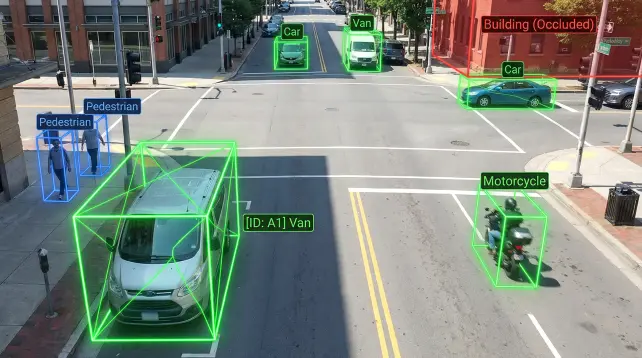
Top data annotation companies play a key role in building accurate and scalable AI and ML systems. By delivering high-quality labeled data across images, text, video, and LiDAR, they improve model performance, reduce bias, and support faster deployment across industries.

Explore more: https://www.techwebspace.com/top-data-annotation-companies-for-ai-and-ml-projects-in-2026/

#dataannotation #AItrainingdata #MLdatalabeling #AIsolutions

What Is Object Detection? A Simple Guide to How AI Sees Objects

Ever wondered how AI recognizes people, cars, or faces in images? This easy guide breaks down object detection, how it works, and where it’s used in daily life. Learn why image annotation services are essential for training reliable AI models.

Know More: https://www.hitechdigital.com/blog/object-detection-guide

#ObjectDetection #AITrainingData #ImageAnnotationServices

How to Get AI and ML Data Annotation Services for Your Project

Machine learning needs quality ai and ml data annotation services. Learn how to get labeled datasets via in-house teams or outsourcing.

Know More: https://peerlist.io/jagadishthakar/articles/how-to-get-annotated-data-for-machine-learning

#MachineLearningData #MLDatasets #DataLabeling #AITrainingData #MLAnnotation #DataAnnotationServices #AIandMLDataAnnotation

Real vs. Synthetic Data: Pros and Cons for Model Training

Balancing real vs synthetic data is key for effective AI training. Real data brings authentic patterns, while synthetic data supports scalability and privacy.
Combining both helps teams manage cost, quality, and ethical considerations responsibly.

Explore more: https://www.habiledata.com/blog/real-vs-synthetic-data/

#realvssyntheticdata #syntheticdata #realdata #Aitrainingdata

Wikipedia signs major AI firms to new priority data access deals

Wikimedia Enterprise signs Microsoft, Meta, Amazon, Perplexity, and Mistral to API access deals.

Ars Technica

Polygon and polyline annotations are key image labeling techniques in AI.

Polygons define closed boundaries for area-based objects and segmentation, while polylines map open paths like lanes or cables. The right choice impacts accuracy, cost, and model performance.

Learn more: https://www.habiledata.com/blog/polygon-vs-polyline-annotation/

#ImageAnnotation #Computervision #AITrainingData

Top 7 Applications of Generative AI for Synthetic Datasets

Generative AI creates synthetic data when real datasets are scarce, sensitive, or expensive. It supports AI training, data augmentation, rare-scenario simulation, and safe testing. Industries like healthcare, finance, retail, and autonomous systems use it to improve accuracy, protect privacy, and speed up innovation.

Explore more: https://www.techsling.com/top-7-applications-of-generative-ai-for-synthetic-datasets/

#SyntheticData #GenerativeAI #MachineLearning #AITrainingData

(3/3)
Nikhil Kandpal et al.: The Common Pile v0.1: An 8TB Dataset of Public Domain and Openly Licensed Text, June 2025
https://doi.org/10.48550/arXiv.2506.05209

Stefan Baack et al.: Towards Best Practices for Open Datasets for LLM Training, Jan 2025
https://doi.org/10.48550/arXiv.2501.08365

Please extend this reading list!

#AITrainingData #Commons #OpenAccess #PublicDomain

@paulk @sclaeyssens @sophiesposts @europeana @stabi_berlin

The Common Pile v0.1: An 8TB Dataset of Public Domain and Openly Licensed Text

Large language models (LLMs) are typically trained on enormous quantities of unlicensed text, a practice that has led to scrutiny due to possible intellectual property infringement and ethical concerns. Training LLMs on openly licensed text presents a first step towards addressing these issues, but prior data collection efforts have yielded datasets too small or low-quality to produce performant LLMs. To address this gap, we collect, curate, and release the Common Pile v0.1, an eight terabyte collection of openly licensed text designed for LLM pretraining. The Common Pile comprises content from 30 sources that span diverse domains including research papers, code, books, encyclopedias, educational materials, audio transcripts, and more. Crucially, we validate our efforts by training two 7 billion parameter LLMs on text from the Common Pile: Comma v0.1-1T and Comma v0.1-2T, trained on 1 and 2 trillion tokens respectively. Both models attain competitive performance to LLMs trained on unlicensed text with similar computational budgets, such as Llama 1 and 2 7B. In addition to releasing the Common Pile v0.1 itself, we also release the code used in its creation as well as the training mixture and checkpoints for the Comma v0.1 models.

arXiv.org

@paulk @europeana @sclaeyssens @sophiesposts

The paper written by @paulk is amongst the most recent developments, which I have not yet intellectually metabolised, as is the case with Thomas Padilla et al's Public Interest Corpus Principles and Goals

https://www.authorsalliance.org/2025/12/03/releasing-the-public-interest-corpus-principles-and-goals/

#openAccess #PublicDomain #AITrainingData

Releasing The Public Interest Corpus Principles and Goals

Today, we are pleased to release The Public Interest Corpus Principles and Goals. This release builds on the recap of our final planning workshop and anticipates release of our final deliverable la…

Authors Alliance