The “Grandkid in Trouble” Trap
2,377 words, 13 minutes read time.
The Anatomy of a High-Stakes Psychological Mugging
The modern “Grandparent Scam” is not a misunderstanding, nor is it a simple case of an elderly person getting confused by a computer screen. It is a calculated, high-stakes psychological mugging designed to strip a target of their logic, their agency, and their life savings in a matter of hours. When we look at the mechanics of the “Grandkid in Trouble” trap, we aren’t looking at bored kids in a basement; we are looking at sophisticated, multinational criminal enterprises that treat human emotion as just another attack vector. These predators understand that the bond between a grandfather and a grandchild is one of the strongest biological imperatives in existence. They don’t hack your bank account first; they hack your nervous system. By the time the victim realizes they are in a fight, the money is already halfway across the globe, laundered through a series of digital wallets and shell accounts that would make a Wall Street firm blush.
We need to stop talking about these incidents as if they are “tricks” played on the gullible. That narrative is dangerous because it breeds a false sense of security in those who think they are too smart to be caught. The reality is that these scammers use a refined methodology involving artificial urgency, sleep deprivation, and extreme emotional distress to force the brain into a “fight or flight” state. In this state, the prefrontal cortex—the part of the brain responsible for logical reasoning and skeptical inquiry—essentially shuts down. Looking at the data from the FBI’s Internet Crime Complaint Center, it becomes clear that this is a professional industry. These groups operate out of call centers with scripts that have been A/B tested for maximum conversion rates. They know exactly which buttons to press to ensure that a man who has spent forty years being a rational provider suddenly finds himself at a CVS buying five thousand dollars in gift cards or heading to a Bitcoin ATM in a panicked daze.
The Biological Exploit: Why Evolution Makes You Vulnerable to the Trap
To understand why this trap is so effective, you have to understand the biological exploit at its core. Humans are hardwired to protect their offspring and their offspring’s offspring. This isn’t a character flaw; it’s an evolutionary necessity. Scammers exploit this by initiating what psychologists call an “Amygdala Hijack.” The call usually comes at an inconvenient time—late at night or early in the morning when defenses are low. The voice on the other end is frantic, sobbing, or hushed, claiming to be a grandchild who has been arrested, involved in a horrific car accident, or trapped in a foreign country. By presenting a life-altering crisis that requires immediate action, the scammer forces the victim to bypass the “verify” stage of communication and jump straight into “rescue” mode. This is tactical social engineering that relies on the fact that most men will do anything to protect their family from harm, a trait these parasites use as a handle to drag their victims toward financial ruin.
Furthermore, the scammer creates a vacuum of information that they control entirely. They will often tell the victim that there is a “gag order” on the case or that the grandchild is “too embarrassed” for their parents to find out. This is a deliberate move to isolate the target from their support network. In the world of cybersecurity, we talk about “Man-in-the-Middle” attacks where a hacker sits between two communicating parties to steal data. This is the social equivalent. By cutting off the victim’s ability to call the grandchild’s parents or check social media, the scammer becomes the sole source of “truth” in a high-stress environment. Consequently, the victim feels a heavy burden of secret responsibility, which only increases the emotional pressure to comply with the scammer’s demands. The “no bullshit” reality is that your own empathy is being weaponized against you, turned into a tool that the attacker uses to pick the lock on your bank account while you think you’re saving a life.
Deepfakes and the Death of “Trust but Verify”
The game changed the moment generative artificial intelligence became accessible to the average criminal. In the past, a scammer had to rely on a muffled voice and a sob story to convince a grandfather that the stranger on the line was his flesh and blood. Today, that barrier to entry has vanished. Using advanced AI-driven vocal cloning technology, a predator only needs a few seconds of high-quality audio—scraped from a TikTok video, a YouTube clip, or a public Facebook post—to create a near-perfect digital replica of a grandchild’s voice. This is no longer a “close enough” imitation; it captures the specific cadence, the regional accent, and the emotional inflections that make a voice unique. When you hear that familiar tone screaming that they are in a jail cell in a foreign country, your brain doesn’t look for digital artifacts or “robotic” glitches. It reacts to the sound of family in pain. This technological leap has effectively murdered the old “Trust but Verify” mantra because the primary method we use to verify identity—the human voice—has been compromised at the source.
Furthermore, the proliferation of deepfake audio means that the traditional “secret questions” families used to rely on are becoming obsolete. If a scammer has done their reconnaissance, they already know the name of the family dog, the street you grew up on, and where you went for the last Christmas vacation, all thanks to the trail of digital breadcrumbs left on social media. We are entering an era where biological authentication is a liability rather than a security feature. Analyzing the current threat landscape, it is clear that we have to move toward a “Zero Trust” model within our own family communications. This means accepting the hard reality that a phone call, regardless of how much it sounds like a loved one, must be treated as a potentially hostile transmission until it is verified through an out-of-band communication channel. It sounds paranoid, and it feels cold, but in a world where your grandson’s voice can be synthesized for forty dollars by a script-kiddie in another hemisphere, paranoia is just another word for readiness.
The Logistics of the Loot: How Your Money Vanishes in Seconds
Once the psychological hook is set and the vocal clone has done its job, the scammer pivots to the most critical phase of the operation: the extraction of capital. These organizations do not want wire transfers that can be clawed back or checks that can be canceled; they want “finality of payment.” This is why they historically pushed for gift cards from big-box retailers. It was a low-tech but highly effective way to launder money, as the numbers could be sold on secondary markets within minutes of the victim reading them over the phone. However, as retailers and law enforcement have clamped down on gift card fraud, the syndicates have evolved their logistics. Now, we see a massive surge in the use of Bitcoin ATMs and cryptocurrency exchanges. By directing a panicked grandfather to a physical kiosk, the scammer ensures the funds are converted into a digital asset that moves through the blockchain at light speed, hitting a series of “tumblers” or “mixers” that make the trail nearly impossible for local law enforcement to follow.
The most aggressive evolution in this logistical chain, however, is the return to physical interaction through “courier” or “bail bondsman” ruses. In these scenarios, the scammer claims that a courier is coming directly to the victim’s house to collect the cash for bail or legal fees. This is a bold, high-risk tactic, but it works because it adds a layer of “official” legitimacy to the nightmare. The victim sees a person in a professional-looking polo or a nondescript vehicle and believes they are part of the legal system. In reality, that courier is often a low-level “money mule” recruited through “work-from-home” ads, someone who may not even realize they are part of a criminal syndicate until the handcuffs click. This shift to physical collection is a direct response to the digital friction created by banks and fraud departments. The scammers are literally coming to your front door because they know that once that cash leaves your hand, the chance of recovery is effectively zero. They are betting on your desire to be the “fixer” for your family to override the red flags of a stranger standing on your porch asking for a paper bag full of hundreds.
Case Study: The $2.3 Billion Financial Carnage
The numbers don’t lie, and they paint a grim picture of a specialized economy built on the backs of the vulnerable. According to the FBI’s IC3 reports, elder fraud has skyrocketed, with total losses now exceeding $3.4 billion annually, of which “emergency” and “grandparent” scams represent a massive, multi-hundred-million-dollar chunk. When we look at the $2.3 billion in overall losses reported by seniors in previous cycles, we have to realize that these are only the reported figures. The real number is likely much higher because this specific crime carries a heavy tax of shame. Men who have spent their entire lives as the “provider” or the “smart one” in the family often refuse to report the crime because they cannot bear the perceived emasculation of being outsmarted by a voice on the phone. This silence is exactly what the criminal syndicates rely on to keep their operations in the shadows. They aren’t just stealing your retirement; they are stealing your dignity, and they use that psychological weight to ensure you never go to the cops.
Analyzing the systemic targeting of the aging population reveals that this isn’t random. These groups purchase “lead lists” from data brokers that specifically filter for age, homeownership status, and estimated net worth. They know who has a 401(k) sitting in a liquid state and who is likely to have the “rescue” instinct dialed up to ten. The fallout from these attacks goes far beyond the bank balance. We see cases where victims lose their homes, their ability to pay for medical care, and their trust in their own judgment. The psychological aftermath is a form of domestic trauma; the victim often experiences a decline in physical health shortly after the financial hit. It is a predatory cycle where the initial emotional exploit leads to financial ruin, which then leads to a total collapse of the victim’s sense of security. In this “no bullshit” assessment, we have to stop viewing this as a white-collar crime and start viewing it as a violent assault on the family unit that just happens to use a telephone instead of a lead pipe.
Hardening the Perimeter: Practical Defense for the Family Unit
If you want to protect your family, you have to stop playing by the old rules. The “Perimeter” is no longer just your front door or your firewall; it’s every mobile device in your house. The first step in a hard-target defense is establishing a Family Communications Protocol. This means sitting down with your grandkids and your children to establish a “Challenge-Response” system—a non-digital safe word or a specific question that can’t be answered by looking at a Facebook profile. It needs to be something obscure, like the name of a character in a book you read together or a fake memory you both agree to use as a tripwire. If the person on the other end of the line can’t provide the response, you hang up immediately. No discussion, no “let me just check,” no second chances. You have to be willing to be the “asshole” who hangs up on a sobbing voice to protect the family’s future.
Furthermore, you need to manage the digital footprint that provides the ammunition for these attacks. Scammers can’t clone a voice they can’t hear. Encouraging your family to move their social media profiles to “Private” and being extremely selective about who can see video or audio content is basic digital hygiene that most people ignore until it’s too late. You also need to implement a technical “Kill Switch” for unsolicited communication. This includes using robust call-filtering apps and setting phones to “Silence Unknown Callers” so that the scammers can’t even get through the initial gate. Most importantly, you must establish an out-of-band verification process. If you get a call from a “grandchild” in jail, your immediate move—after hanging up—is to call that grandchild’s parent or the grandchild directly on their known, saved number. If the “authority” on the phone tells you not to call anyone, that is your 100% confirmation that you are talking to a predator. In the high-stakes world of social engineering, the only way to win is to refuse to play the game on the attacker’s terms.
Call to Action
If this breakdown helped you think a little clearer about the threats out there, don’t just click away. Subscribe for more no-nonsense security insights, drop a comment with your thoughts or questions, or reach out if there’s a topic you want me to tackle next. Stay sharp out there.
SUPPORTSUBSCRIBECONTACT ME D. Bryan King
Sources
Disclaimer:
The views and opinions expressed in this post are solely those of the author. The information provided is based on personal research, experience, and understanding of the subject matter at the time of writing. Readers should consult relevant experts or authorities for specific guidance related to their unique situations.
#AIDeepfakeScams #AIRiskManagement #amygdalaHijack #artificialUrgency #bailBondsmanRuse #BitcoinATMScams #callFiltering #childSafety #cognitiveSecurity #courierScams #crimeLogistics #cyberVigilance #cybercrimeSyndicates #digitalFootprints #digitalHygiene #elderFraudPrevention #elderJustice #emergencyRuse #emotionalWeaponization #familyDefensePlan #familyEmergencyScam #familySafeWords #familyUnitHardening #financialExploitationOfSeniors #financialFinality #forensicSocialEngineering #fraudRecovery #fraudShame #giftCardFraud #grandchildImpersonation #GrandparentScam #highStakesFraud #IC3ElderFraudData #IC3Report2023 #identityTheft #moneyMuleNetworks #outOfBandVerification #phishingAttacks #predatorReconnaissance #predatorTactics #privateSocialMedia #psychologicalMugging #redFlagIdentification #reportingElderAbuse #safeWordProtocol #scammerScripts #seniorCitizenSafety #seniorFinancialProtection #seniorSecurityProtocols #socialEngineeringTactics #socialMediaScraping #techEnabledFraud #threatLandscape #victimology #vocalCadenceCloning #voiceCloningFraud #voiceSynthesisTheft #wireTransferFraud #zeroTrustCommunication AI Governance and Risk Management


 Bob Carver

 Bryan King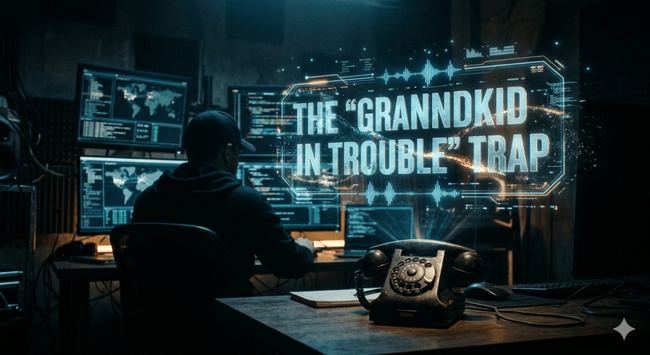
 Analyst207
 Tycoon World


 Zate 🦘🇦🇺